Map of Scotland showing where the Sligo arms are recorded
The Sligo arms were recorded in Lanark, c. 1829.
Lanarkshire ran along the upper Clyde, farming country with coal beneath it. Its landed families were long-established, and long establishment is what brought them into the register.
This is where the arms were entered in the register. Families often moved to other parts of the country, so the same name can turn up in more than one region.
The body that granted and recorded arms in Scotland in this period.
George IV of the United Kingdom
Sovereign of the period
George IV of the United Kingdom
1820–1830
Reigning in Scotland when the Sligo arms are first recorded.
How Arms Worked in Scotland
Scottish heraldry is unique because it treats a coat of arms as a piece of personal property protected by law. Only one person can own a specific design at any given time. When a family grows, the head keeps the original shield while other relatives must apply for their own distinct version with slight changes to prove their specific identity.
Granting authority
The Court of the Lord Lyon acts as the official body that regulates and controls all heraldic matters throughout Scotland.
How they got arms
Individuals obtain a legal right to their arms through a formal petition process that confirms their identity and family connection.
Where arms were recorded
All valid coats of arms are officially entered into the Public Register of All Arms and Bearings starting from 1672.
The family's standing
Recorded among the armigerous families of Lanark.
Origin & History of the Sligo Family in Scotland
The family name Sligo is primarily associated with the town of Sligo in Ireland, but its presence in Scotland suggests a history of migration and movement across the Irish Sea. By 1829, records confirm that members of the Sligo family were established in the Lanark region of Scotland. During the nineteenth century, Lanark was a hub of industrial growth and agricultural activity, drawing many families from across the British Isles to seek new opportunities in the textile mills and surrounding farmlands. It is likely that the early Sligo family members in Lanark were part of this broader movement of people who relocated for work. Over time, the family name became integrated into the local community, reflecting the common patterns of internal migration that shaped the population of the Scottish Lowlands during the Industrial Revolution.
Related Branches & Arms
Root word
Sligeach
A place characterized by an abundance of shells or shelly river.
This name
SligoDerived from a Scottish habitational name referring to a place of shells.
also spelled
Slygo
Slygoe
Slygowe
Related arms
Houldsworthsame arms
Coultrecorded with Sligo, same area
Documented Sources
Sir Bernard Burke, The General Armory of England, Scotland, Ireland and Wales, London: Harrison & Sons, 1884
National Records of Scotland, OPR Births and Baptisms, Lanark, 1829
National Records of Scotland, Census Returns for Lanarkshire, 1841
Digital archive packCoat of arms PNG, gold border print PDF, vector SVG and the certificate of authenticity. Sent to your email in minutes.


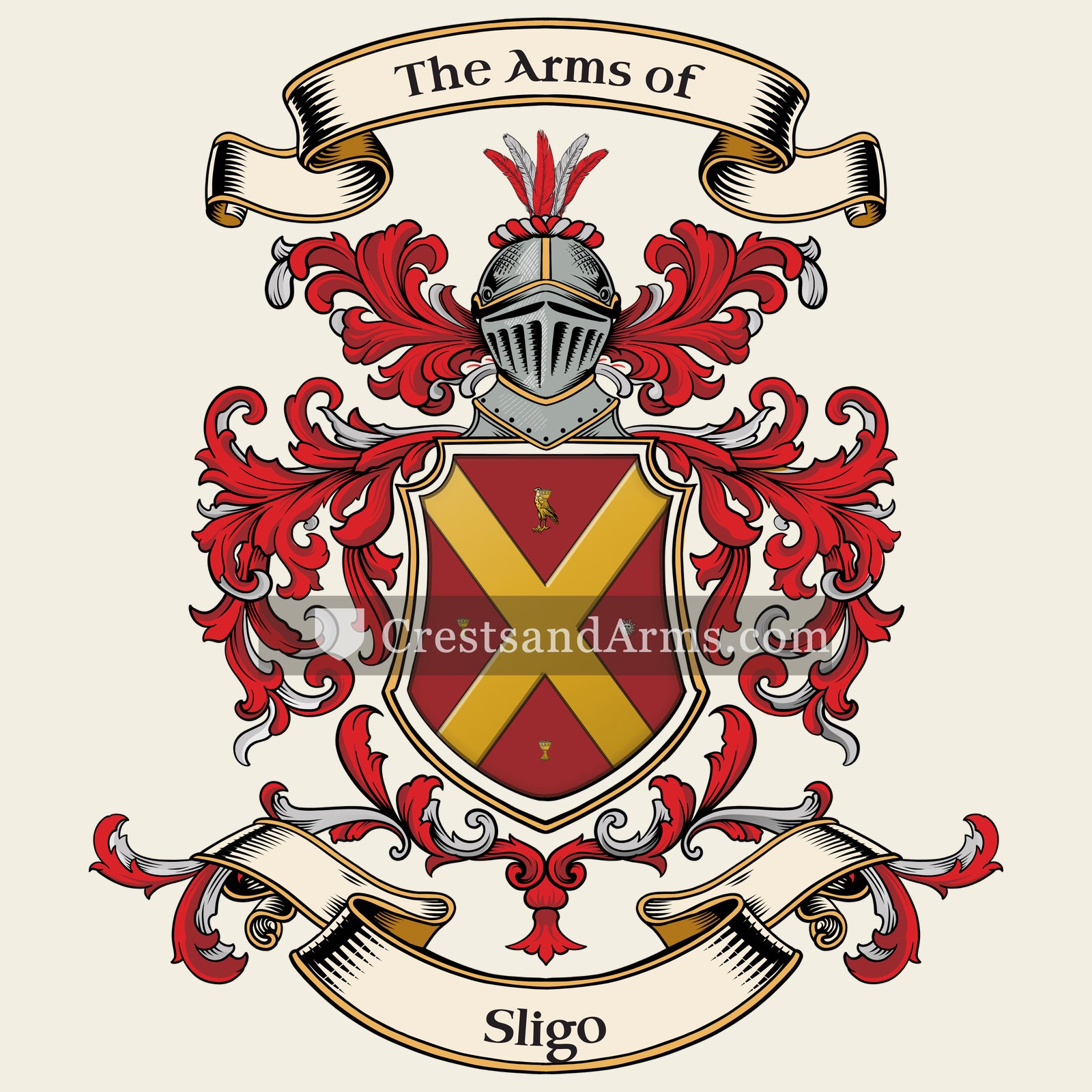
 saltireResolution, and St Andrew's cross
 falconOne eager and quick in pursuit
 cupFaith, office, and a trust discharged
 sunGlory, splendour and the source of life
 saltireResolution, and St Andrew's cross
 falconOne eager and quick in pursuit
 cupFaith, office, and a trust discharged
 sunGlory, splendour and the source of life