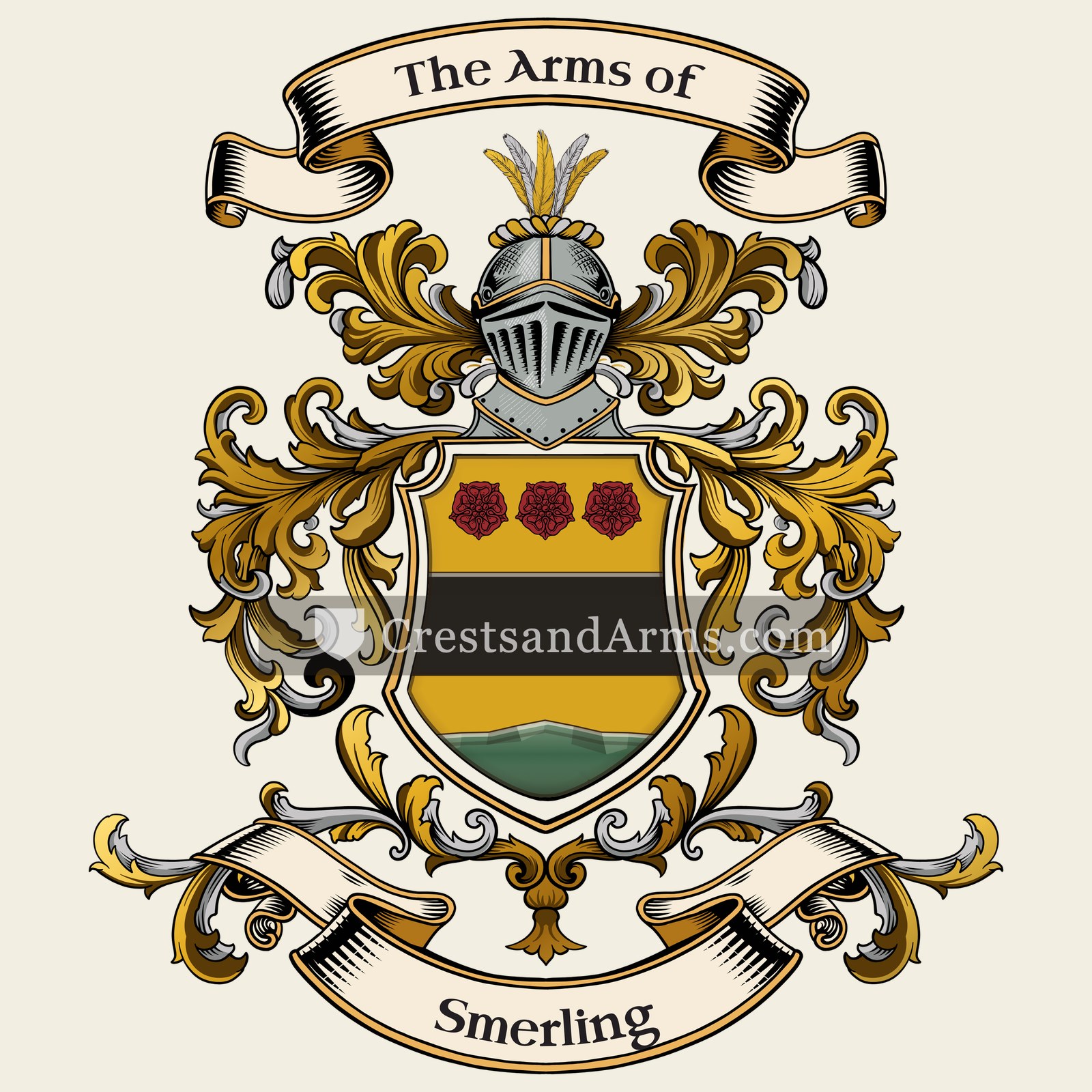
A record of documented arms, meaning and origin, researched for the Smerling family of Austria.
Reg. 2272 · Austrian, T–V
Coat of Arms & Family Crest Details
Symbols on this shield
fessThe military belt, and readiness to serve
mountThe ground held, and steadfastness upon it
cross symbolChristian faith and service
chevronProtection, and faithful service completed
roseThe seventh son, and beauty with grace
Colours
Gold (Or)Means: Generosity
Black (Sable)Means: Constancy
Green (Vert)Means: Hope
Red (Gules)Means: Military strength
Historical info
Source
J. B. Rietstap, Armorial Général, Gouda: G. B. van Goor Zonen, 1884–87
Blazon (the actual original written record)
“D'or à la fasce de sa., acc. en chef de trois roses rangées de gu. et en p. d'un tertre de trois coupeaux de sin., le coupeau du milieu sommé d'une croix latine pattée de gu., soutenue de deux poutres de gu. en forme de chevron, celles-ci soutenues des deux autres coupeaux. Deux cq. cour. C.: 1° la croix avec ses soutiens, entre un vol de sa.; 1. d'et de gu.; 2° un senestrochère arm., posé sur le coude, tenant une tête de Turc ensanglantée, percée d'une épée en pal; le tout entre deux prob. de sa.; 1. d'or et de sa.”
Austriac. 1793
Digital archive packCoat of arms PNG, gold border print PDF, vector SVG and the certificate of authenticity. Sent to your email in minutes.
Map of Austria showing where the Smerling arms are recorded
The Smerling arms were recorded in Austria, c. 1793.
Arms such as these were typically recorded in Tyrol.
Tyrol was mountain country in western Austria, where the valleys were held by families who had been there a very long time. Old tenure counted for more than money, and old families carried arms.
This is where the arms were entered in the register. Families often moved to other parts of the country, so the same name can turn up in more than one region.
Region
Tyrol
First recorded
1793
Granting Authority for the Smerling Arms
Imperial and Royal chancery
Sodacan · CC BY-SA 3.0
The body that granted and recorded arms in Austria in this period.
Francis II, Holy Roman Emperor
Sovereign of the period
Francis II, Holy Roman Emperor
1792–1806
Reigning in Austria when the Smerling arms are first recorded.
How Arms Worked in Austria
Austrian coats of arms were often linked directly to noble titles granted by the Emperor. These symbols belonged to the entire family line rather than just one individual. When a family grew, new branches kept the original design without needing to change it. This system allowed all members of a noble house to share the same identity across many generations.
Granting authority
The Imperial and Royal chancery managed all heraldic matters and controlled the official granting of arms throughout the Austrian lands.
How they got arms
Families typically received their arms through a formal imperial decree that often accompanied the elevation of a person to noble status.
Where arms were recorded
Official records of these grants were kept in the Imperial Register of Nobility which began its formal documentation process in 1453.
The family's standing
Recorded among the armigerous families of Austria.
Origin & History of the Smerling Family in Austria
The surname Smerling is rooted in the alpine regions of Central Europe, with documented evidence placing the family in the Tyrol area as early as 1793. The name likely originated as a descriptive term, potentially derived from Middle High German words related to physical characteristics or specific trade roles within the local mountain communities. During the late 18th century, the Tyrol region was a complex landscape of agricultural villages and trade routes connecting the Italian peninsula to the German states. Families like the Smerlings were often deeply integrated into the local parish systems, which served as the primary record keepers for births, marriages, and deaths. As the family moved through these mountainous territories, they adapted to the shifting political boundaries of the Holy Roman Empire and the subsequent Napoleonic era. Their presence in 1793 suggests they were part of a stable, established population that relied on traditional crafts or land cultivation to survive in the rugged terrain of the Eastern Alps.
Related Branches & Arms
Root word
Schmerl
A Middle High German term for lard or grease.
This name
SmerlingLikely an occupational name for a butcher or a dealer in fats and oils.
also spelled
Schmerlin
Shmerling
Documented Sources
J. B. Rietstap, Armorial Général, Gouda: G. B. van Goor Zonen, 1884–87
Heintze, Albert. Die deutschen Familiennamen: geschichtlich, geographisch, sprachlich. 1903
Bahlow, Hans. Deutsches Namenlexikon: Familien- und Vornamen nach Ursprung und Sinn erklärt. 1967
Tiroler Landesarchiv, Tiroler Heirats- und Geburtenmatriken
Digital archive packCoat of arms PNG, gold border print PDF, vector SVG and the certificate of authenticity. Sent to your email in minutes.


 fessThe military belt, and readiness to serve
 mountThe ground held, and steadfastness upon it
 cross symbolChristian faith and service
 chevronProtection, and faithful service completed
 roseThe seventh son, and beauty with grace
 fessThe military belt, and readiness to serve
 mountThe ground held, and steadfastness upon it
 cross symbolChristian faith and service
 chevronProtection, and faithful service completed
 roseThe seventh son, and beauty with grace