Map of Belgium showing where the Smida arms are recorded
The Smida arms were recorded in Flandre, c. 1663.
Flandre grew rich on cloth, and its towns were among the busiest in Europe. Merchant families bought land with their profits and took arms to go with it, so trade put as many names in the registers here as land did.
This is where the arms were entered in the register. Families often moved to other parts of the country, so the same name can turn up in more than one region.
The body that granted and recorded arms in Belgium in this period.
Philip IV of Spain
Sovereign of the period
Philip IV of Spain
1621–1665
Reigning in Belgium when the Smida arms are first recorded.
How Arms Worked in Belgium
In Belgium, a coat of arms is considered personal property that is passed down through the male line to legitimate descendants. Families often use the same shield design across generations to show their shared heritage. If a branch of the family wants to change the design, they must apply for an official update to their specific version of the arms.
Granting authority
The Conseil héraldique is the official body that regulates and approves all coats of arms in Belgium.
How they got arms
Families obtain their coats of arms through formal royal grants or by confirming their historical right to use existing designs.
Where arms were recorded
All approved coats of arms are officially recorded in the public registers of the Conseil héraldique since 1844.
The family's standing
Recorded among the armigerous families of Flandre.
Origin & History of the Smida Family in Belgium
The history of the Smida family in Belgium begins in the seventeenth century, with documented records placing family members in the Flanders region as early as 1663. During this period, the Low Countries were a bustling center of trade and agriculture, and families like the Smidas were often deeply connected to the local rural economy. The name itself likely evolved from regional dialects and naming customs common to the Flemish-speaking areas of the time. As the family established their roots in the countryside, they lived through a transformative era marked by shifting borders and the influence of both Spanish and French rule. By remaining in Flanders, the early Smida ancestors contributed to the cultural and social fabric of the region, navigating the challenges of agricultural life and the changing political landscape of the seventeenth century. Their presence in these historical records provides a clear window into the lives of ordinary families who helped shape the identity of the Flemish provinces.
Meaning of the Smida family crest colors & symbols
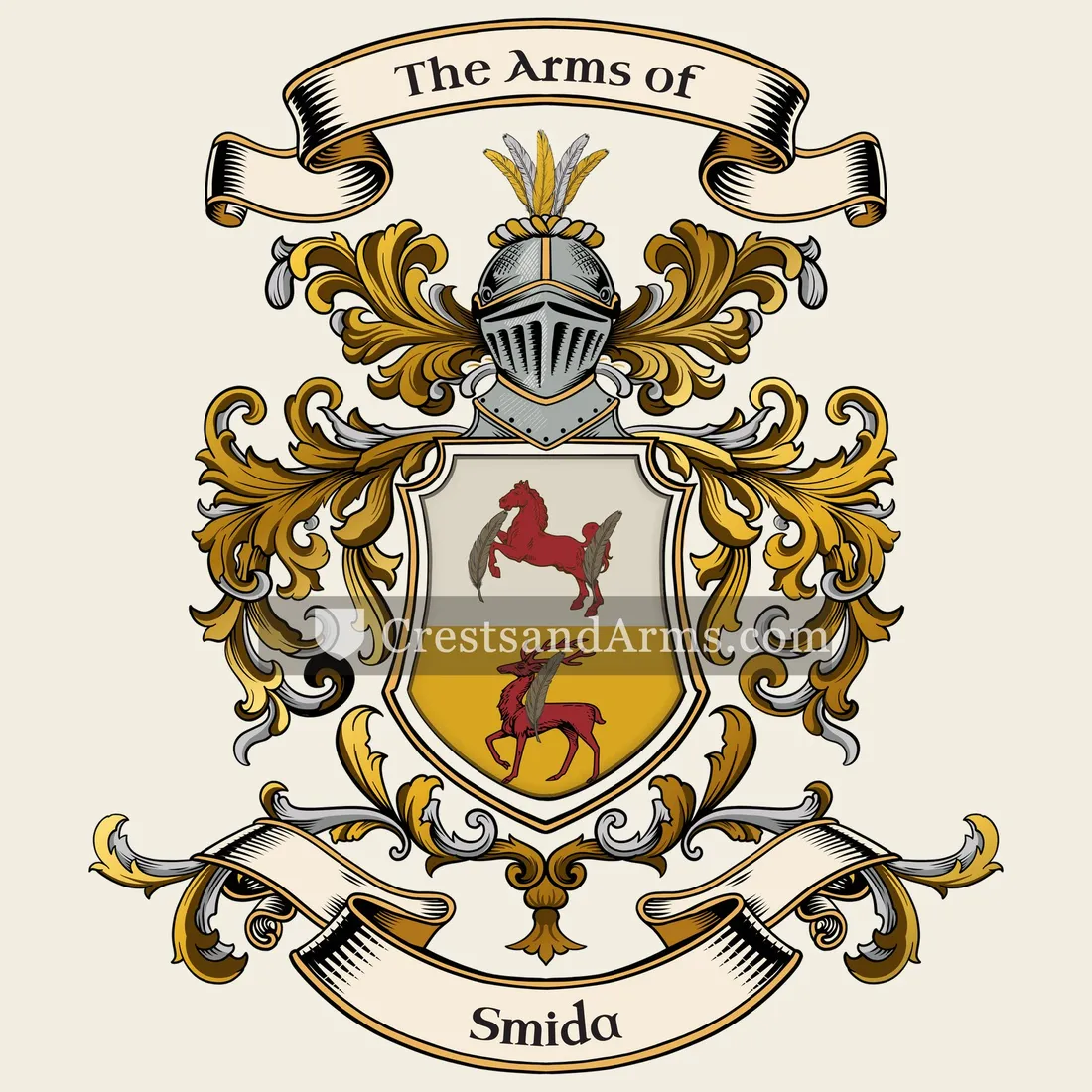
Symbols on this shield
feathersWilling obedience and serenity
horseReadiness to serve king and country
stagPeace and harmony, and one who will not fight unprovoked
Colours
Silver (Argent)Means: Peace and sincerity
Gold (Or)Means: Generosity
Red (Gules)Means: Military strength
Historical info
Source
J. B. Rietstap, Armorial Général, Gouda: G. B. van Goor Zonen, 1884–87
Blazon (the actual original written record)
“Coupé: au 1 d'arg. à un cheval galopant de gu.; au 2 parti: a. d'or à une demi-ramure de cerf de gu.; b. de gu. à un panache de trois plumes de paon au nat. Cq. cour. C.: le cheval, iss. L.: à dextre d'arg. et de gu., à sen. d'or et de gu.”
Germanyc. 1765
Digital archive packCoat of arms PNG, gold border print PDF, vector SVG and the certificate of authenticity. Sent to your email in minutes.
Map of Germany showing where the Smida arms are recorded
The Smida arms were recorded in Germany, c. 1765.
Arms such as these were typically recorded in Bavaria.
Bavaria was a country of old landed families and walled market towns. Estates passed down the same line for centuries, and both the landowners and the leading townsmen kept arms, which is why so many Bavarian names sit in the registers.
This is where the arms were entered in the register. Families often moved to other parts of the country, so the same name can turn up in more than one region.
The body that granted and recorded arms in Germany in this period.
Francis I, Holy Roman Emperor
Sovereign of the period
Francis I, Holy Roman Emperor
1745–1765
Reigning in Belgium when the Smida arms are first recorded.
How Arms Worked in Germany
In the Holy Roman Empire, coats of arms were often granted to individuals by the Emperor or his representatives. These arms were then passed down through the generations to all legitimate descendants of the original holder. Younger branches of a family usually kept the same shield design without needing to change it, as the arms belonged to the entire lineage.
Granting authority
The Holy Roman Emperor held the sole power to grant new coats of arms throughout his vast imperial territories.
How they got arms
Families typically obtained their coats of arms through a formal imperial grant or by proving their noble status to the authorities.
Where arms were recorded
These grants were officially recorded in the Imperial Chancery registers, which began keeping formal records of such honors during the Middle Ages.
The family's standing
Recorded among the armigerous families of Germany.
Origin & History of the Smida Family in Germany
The surname Smida is deeply rooted in the historical landscape of Bavaria, where records confirm the presence of the family as early as 1765. During this period, the name was closely linked to the social and economic structures of rural southern Germany, where families were often identified by their trade or their specific location within a village. In the mid-18th century, Bavaria was undergoing significant agricultural and administrative changes under the rule of the Wittelsbach dynasty, which influenced how families settled and registered their names in local church books. The Smida family likely lived as part of a tight-knit agrarian community, where they contributed to the local economy through farming or craftsmanship. Over generations, the name became a permanent marker of their identity, reflecting the traditions and regional dialects of the Bavarian people during a time of transition toward the modern era.
Smida Meaning & Related Branches
Root word
Smid
A person who works with metal or a blacksmith.
This name
SmidaA variant of the occupational surname for a smith or metalworker.
also spelled
Schmidt
Smit
Smith
Documented Sources
J. B. Rietstap, Armorial Général, Gouda: G. B. van Goor Zonen, 1884–87
State Archives in Belgium (Rijksarchief), Parochieregisters van de provincie West-Vlaanderen, 1663
De Smet, A., Geschiedenis van de Vlaamse bevolking in de 17e eeuw, 1974
Digital archive packCoat of arms PNG, gold border print PDF, vector SVG and the certificate of authenticity. Sent to your email in minutes.


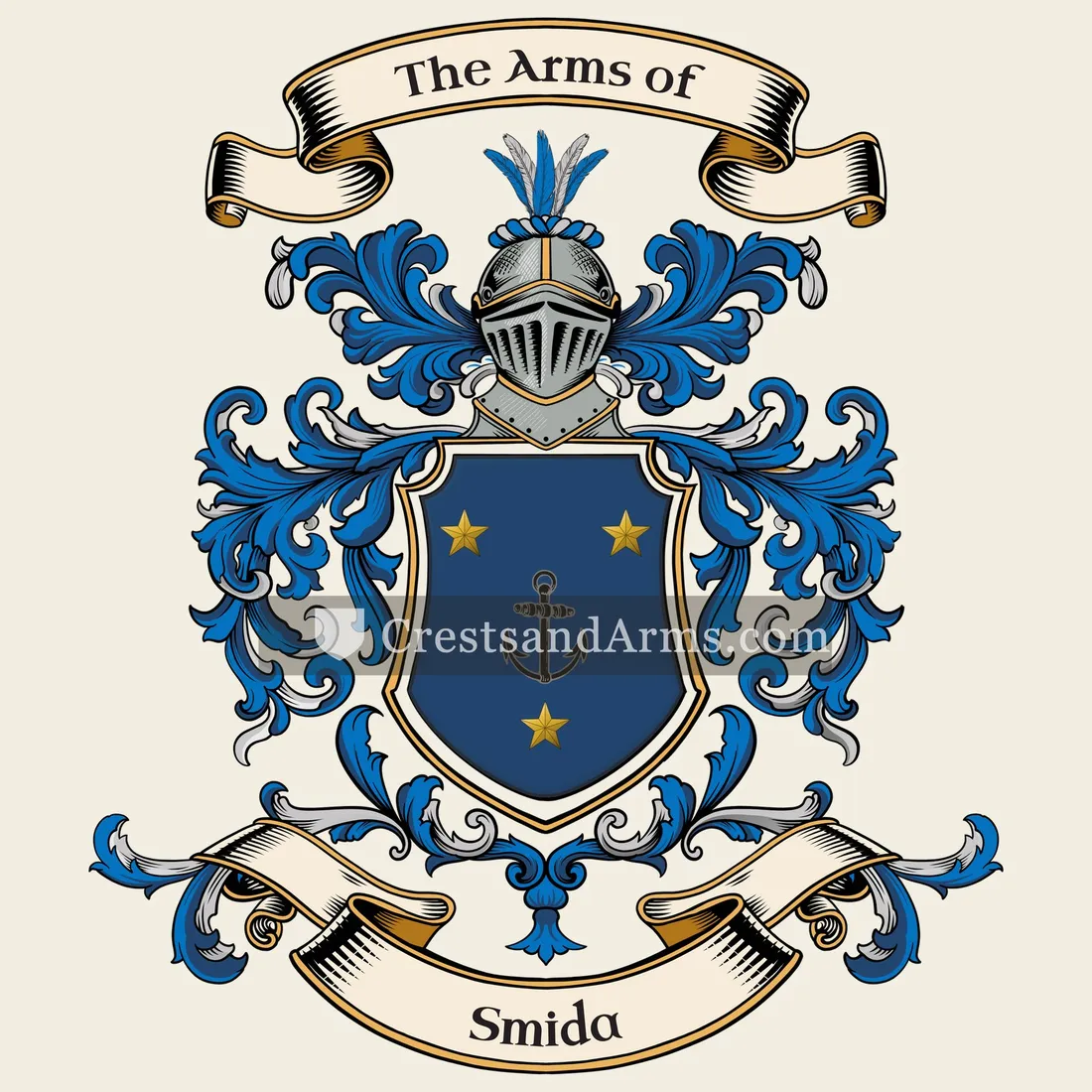
 anchorHope, and steadfastness in trouble
 mulletThe third son, and a divine quality from above
 anchorHope, and steadfastness in trouble
 mulletThe third son, and a divine quality from above


 feathersWilling obedience and serenity
 horseReadiness to serve king and country
 stagPeace and harmony, and one who will not fight unprovoked