Map of England showing where the Snelgrove arms are recorded
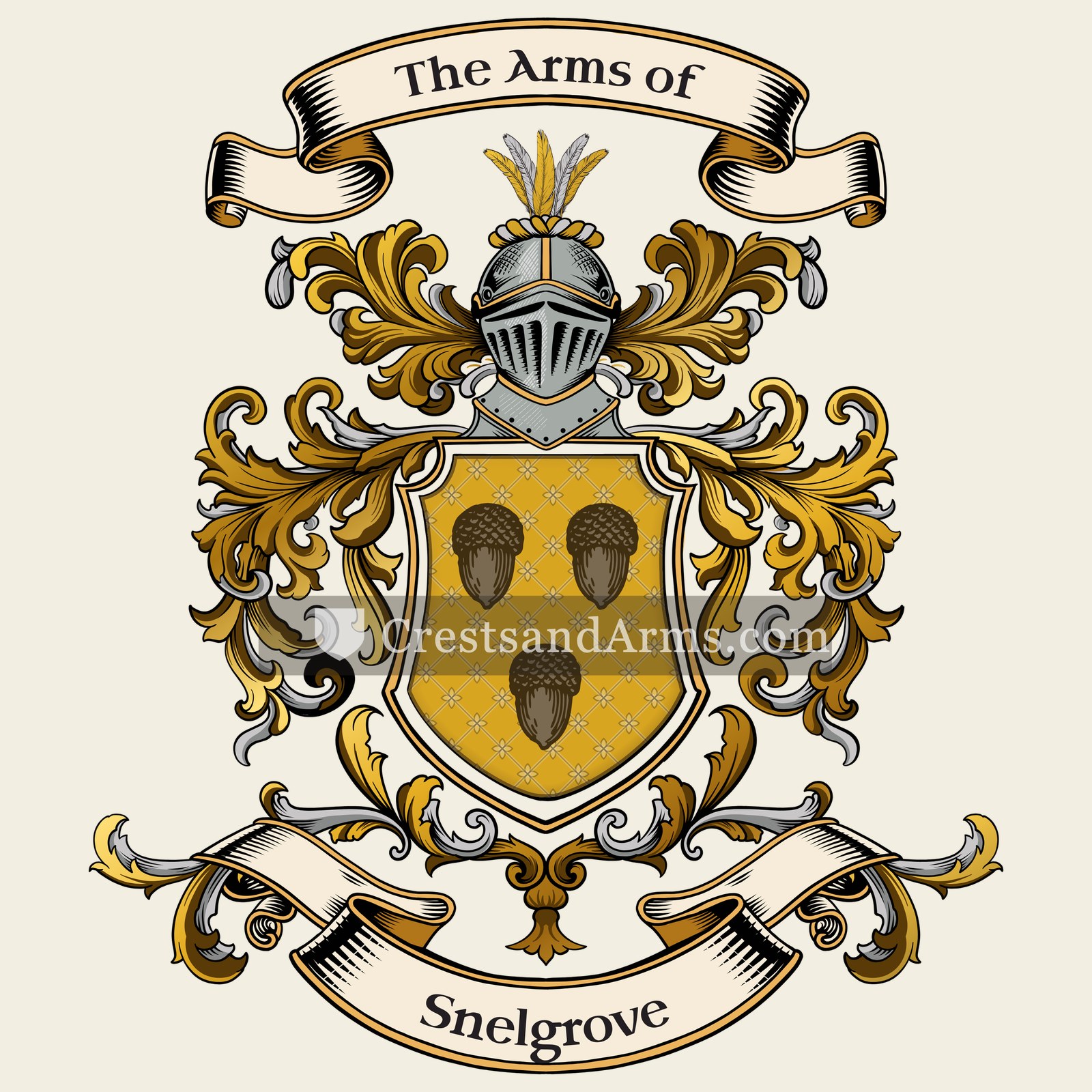
The Snelgrove arms were recorded in Wilts, c. 1685.
Wiltshire was sheep country, and wool made money steadily for hundreds of years. Families who made it bought manors on the downs, and holding a manor was the usual reason to take arms.
This is where the arms were entered in the register. Families often moved to other parts of the country, so the same name can turn up in more than one region.
The body that granted and recorded arms in England in this period.
Charles II of England
Sovereign of the period
Charles II of England
1660–1685
Reigning in England when the Snelgrove arms are first recorded.
How Arms Worked in England
English heraldry allowed arms to be shared by all legitimate descendants of the original owner. These symbols were treated as personal property that moved through the generations to all children. While the eldest son kept the original design, other family members could use the same shield without needing to change it or register their own unique versions.
Granting authority
The College of Arms in London has regulated the use of coats of arms throughout England and Wales since 1484.
How they got arms
Families typically obtained their coats of arms through a formal grant from the Crown or by proving their ancient right to them.
Where arms were recorded
All official coats of arms are recorded in the registers kept at the College of Arms, which date back to the fifteenth century.
The family's standing
Recorded among the armigerous families of Wilts.
Origin & History of the Snelgrove Family in England
The surname Snelgrove is a locative name, meaning it was originally derived from a specific place rather than a person’s trade or physical traits. The name is rooted in Old English, combining the elements "snell," which meant quick or bold, and "graf," which referred to a grove or a small wooded area. This suggests that the earliest ancestors likely lived near a prominent or swift-flowing wooded clearing. By the late 17th century, the family had established a clear presence in the county of Wiltshire, particularly around the village of Horningsham. Historical records from 1685 confirm that members of the Snelgrove family were active in this region during the reign of King James II, likely working as tenant farmers or tradespeople who were deeply integrated into the local parish life of the English countryside.
Related Branches & Arms
Root word
Snell and Graf
Old English for quick or agile and a grove or wood.
This name
SnelgroveRefers to someone who lived near a small or quick-growing wooded area.
also spelled
Snelgrave
Documented Sources
Sir Bernard Burke, The General Armory of England, Scotland, Ireland and Wales, London: Harrison & Sons, 1884
Reaney, P.H. and Wilson, R.M., A Dictionary of English Surnames, 1991
Wiltshire and Swindon History Centre, Parish Register Transcripts for Horningsham, 1685
Digital archive packCoat of arms PNG, gold border print PDF, vector SVG and the certificate of authenticity. Sent to your email in minutes.


 oakGreat age, strength and steadfastness
 oakGreat age, strength and steadfastness