Map of France showing where the Soberano arms are recorded
The Soberano arms were recorded in Languedoc, c. 1663.
Languedoc stretched across the south of France, a country of small towns, vineyards and old local families. Its gentry were numerous rather than grand, and a great many of them held arms even where their estates were modest.
This is where the arms were entered in the register. Families often moved to other parts of the country, so the same name can turn up in more than one region.
The body that granted and recorded arms in France in this period.
Louis XIV of France
Sovereign of the period
Louis XIV of France
1643–1715
Reigning in France when the Soberano arms are first recorded.
How Arms Worked in France
In France, a coat of arms was a mark of honor that passed down through the male line to all legitimate descendants. Families often used the same shield without changes to show their shared heritage. If a branch wanted to stand out, they could add a small mark to their shield to show their specific place in the family tree.
Granting authority
The Juge d'armes de France acted as the official authority that regulated and verified coats of arms across the country.
How they got arms
Families typically inherited their arms from ancestors, though they could also receive them through royal grants or by proving their noble status.
Where arms were recorded
Coats of arms were officially recorded in the Armorial Général de France, which began its main collection in the year 1696.
The family's standing
Recorded among the armigerous families of Languedoc.
Origin & History of the Soberano Family in France
The family name Soberano traces its roots to the historical region of Languedoc in southern France, where records confirm the presence of family members as early as 1663. The name itself is derived from terms meaning sovereign or supreme, which suggests that the earliest ancestors may have held positions of local authority or served within the administrative structures of the French monarchy. During the seventeenth century, Languedoc was a vibrant area defined by its unique blend of Occitan culture and its strategic importance to the kingdom. Families living in this region often integrated into the local agricultural or merchant classes, contributing to the economic stability of their towns. By establishing themselves in this part of France, the early Soberano family became part of a long tradition of regional history that spanned generations of social and political change.
Soberano Meaning & Related Branches
Root word
superanus
Latin term meaning situated above or superior.
This name
SoberanoA title denoting a sovereign, ruler, or someone of high status and authority.
also spelled
Soubeiran
Soobayran
Documented Sources
J. B. Rietstap, Armorial Général, Gouda: G. B. van Goor Zonen, 1884–87
Archives départementales de l'Hérault, Série E (Registres paroissiaux et d'état civil)
Le Roy Ladurie, Emmanuel, Les Paysans de Languedoc, 1966
Wolff, Philippe, Histoire du Languedoc, 1967
Digital archive packCoat of arms PNG, gold border print PDF, vector SVG and the certificate of authenticity. Sent to your email in minutes.


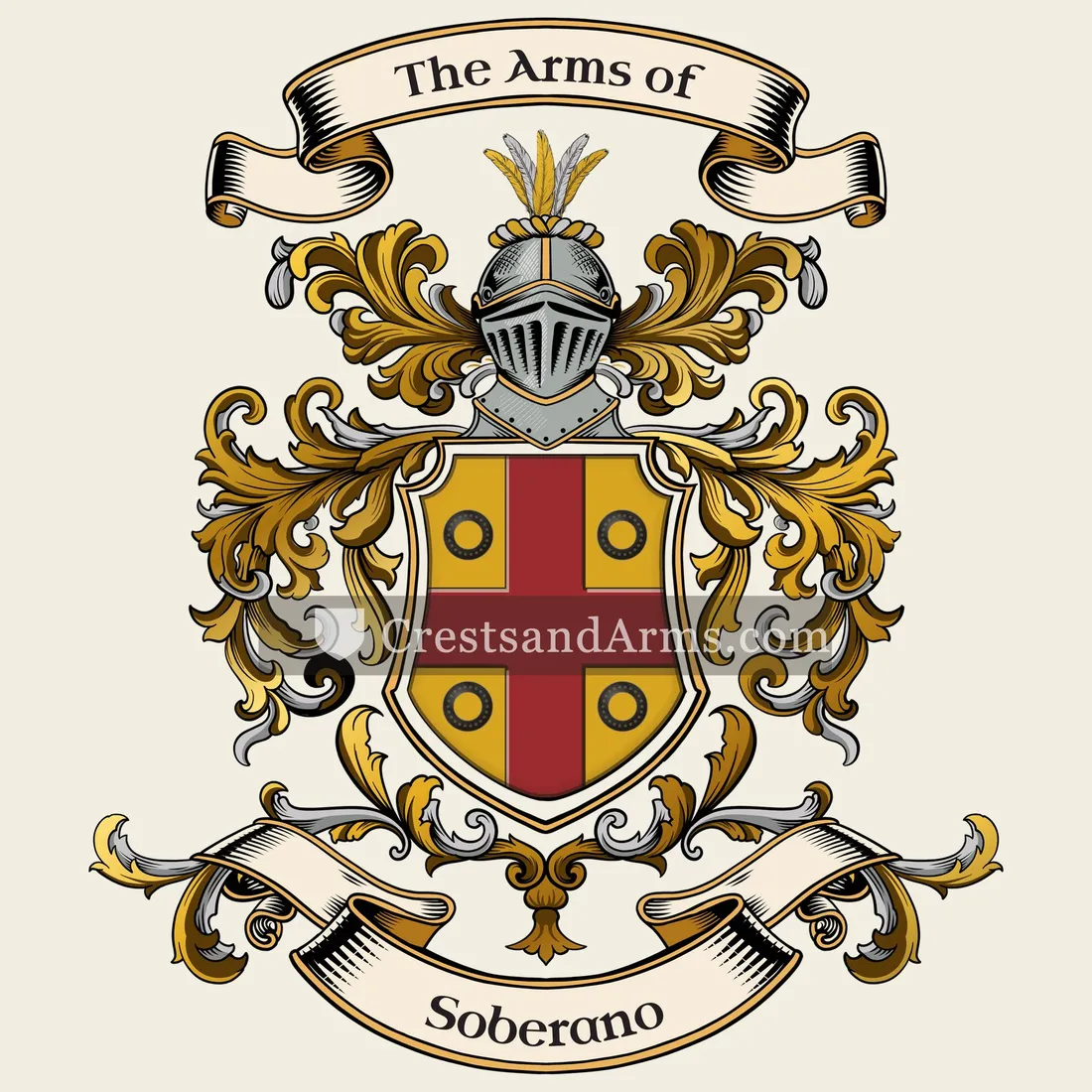
 cross symbolChristian faith and service
 ringFidelity, and a promise kept
 cross symbolChristian faith and service
 ringFidelity, and a promise kept