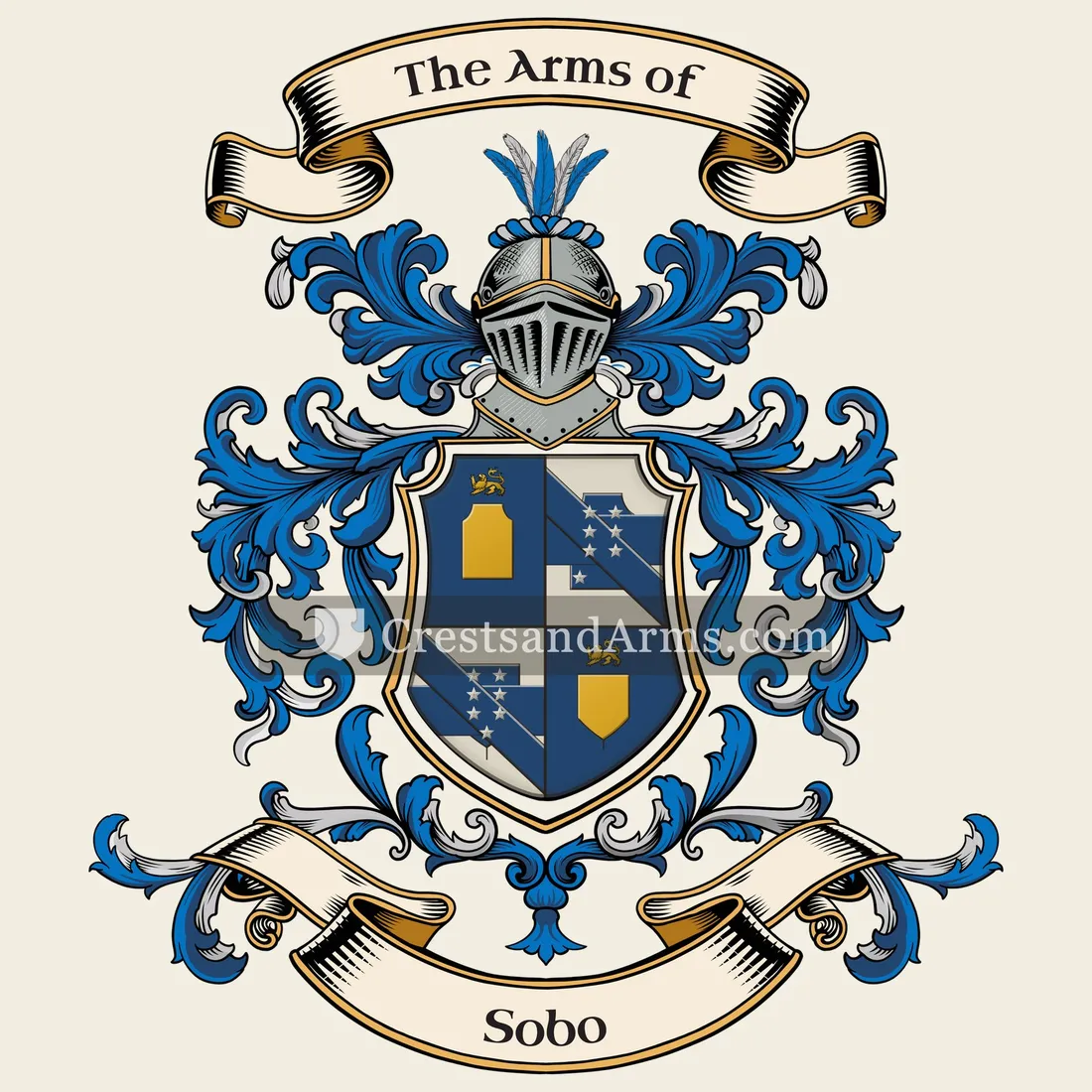
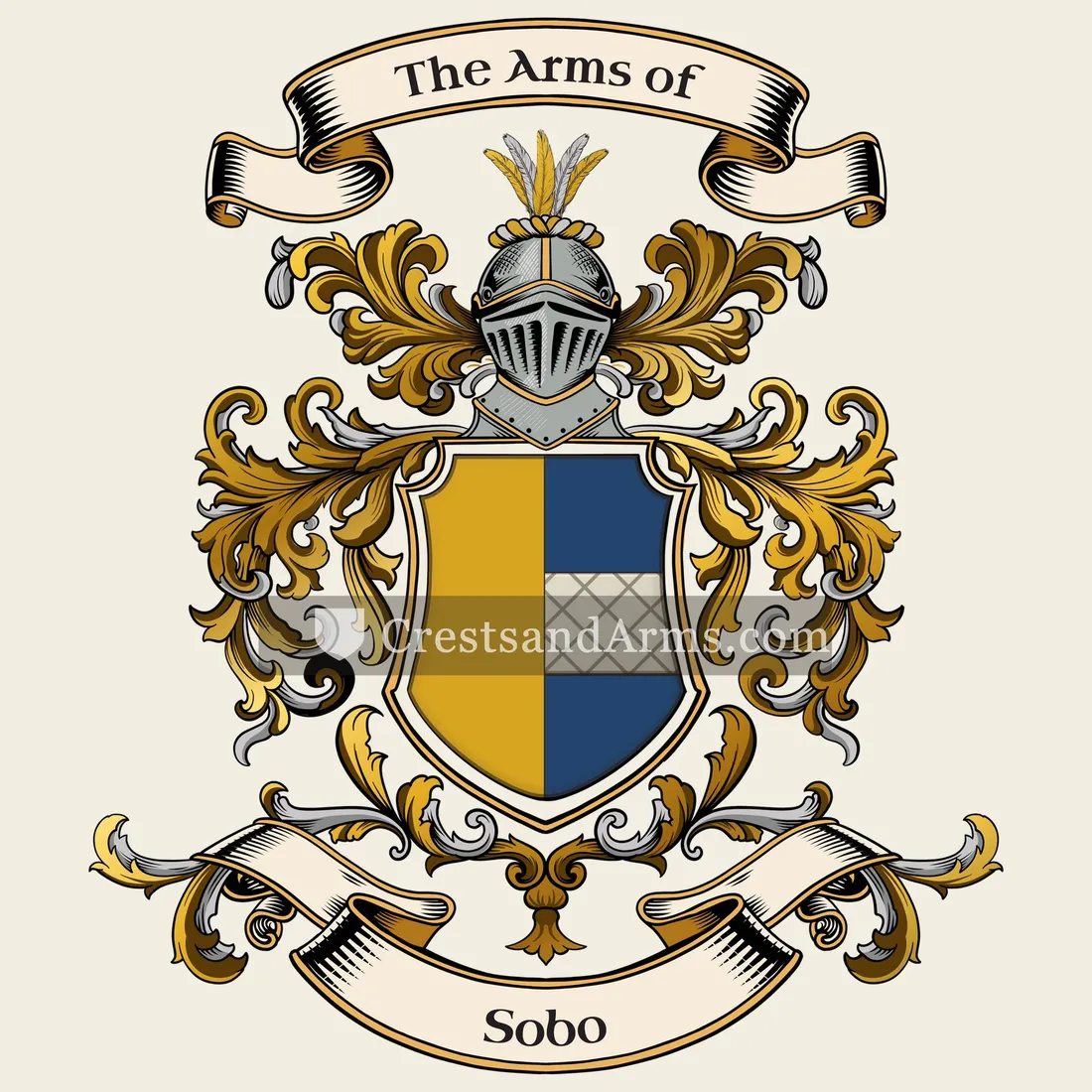
A record of documented arms, meaning and origin, researched for the Sobo family lines. Documented in 2 countries.
Reg. 7534 · Swedish, T–V
Meaning of the Sobo family crest colors & symbols
Symbols on this shield
bendDefence, and the scarf of a commander
fessThe military belt, and readiness to serve
lionCourage, strength and royalty
mulletThe third son, and a divine quality from above
Colours
Blue (Azure)Means: Loyalty and truth
Silver (Argent)Means: Peace and sincerity
Gold (Or)Means: Generosity
Historical info
Source
J. B. Rietstap, Armorial Général, Gouda: G. B. van Goor Zonen, 1884–87
Blazon (the actual original written record)
“Éc.: aux 1 et 4 d'azur au lion d'or; aux 2 et 3 d'arg. à trois bandes d'azur, ch. de sept étoiles du champ, 2, 3 et 2. Sur le tout parti: a. d'or plein; b. d'azur à la fasce d'arg. Deux cq. cour. C.: 1° deux bras, arm. d'arg., les mains de carn. tenant une brosse d'arg.; 2° le lion, iss.”
Swedenc. 1687
Digital archive packCoat of arms PNG, gold border print PDF, vector SVG and the certificate of authenticity. Sent to your email in minutes.
Map of Sweden showing where the Sobo arms are recorded
The Sobo arms were recorded in Sweden, c. 1687.
Arms such as these were typically recorded in Stockholm.
Stockholm held the Swedish court and the House of Nobility, where every noble family's arms were entered and kept. Families ennobled for service registered there, which is why so many are recorded around the city.
This is where the arms were entered in the register. Families often moved to other parts of the country, so the same name can turn up in more than one region.
The body that granted and recorded arms in Sweden in this period.
Charles XI of Sweden
Sovereign of the period
Charles XI of Sweden
1660–1697
Reigning in Sweden when the Sobo arms are first recorded.
How Arms Worked in Sweden
In Sweden, a coat of arms belonged to a noble family as a whole rather than just one individual. These arms were passed down through the generations to all legitimate descendants. Younger branches of the family used the same shield without needing to change it. This system ensured that the entire lineage shared the same identity and status under the law.
Granting authority
The Riddarhuset, or House of Nobility, regulated all noble coats of arms in Sweden under royal authority.
How they got arms
Families received their coats of arms through royal grants of nobility which were then officially registered with the House.
Where arms were recorded
Coats of arms were officially recorded in the Swedish House of Nobility register starting in the year 1626.
The family's standing
Recorded among the armigerous families of Sweden.
Origin & History of the Sobo Family in Sweden
The history of the Sobo name in Sweden begins with a documented presence in Stockholm as early as 1687. During the late 17th century, Stockholm was a rapidly growing capital city that attracted skilled workers, merchants, and soldiers from across the Baltic region. The name likely emerged during this period of urban expansion, reflecting the movement of individuals seeking new opportunities within the Swedish Empire. Families like the Sobos often integrated into the city’s social fabric by participating in the local trade guilds or serving in administrative roles. Because the name appears in official records during this era, it suggests that the family was established enough to be recognized by the authorities of the time. Over the following generations, the family name became a permanent part of the Swedish landscape as descendants moved from the bustling capital into other provinces.
Meaning of the Sobo family crest colors & symbols
Symbols on this shield
fessThe military belt, and readiness to serve
Colours
Gold (Or)Means: Generosity
Blue (Azure)Means: Loyalty and truth
Silver (Argent)Means: Peace and sincerity
Historical info
Source
J. B. Rietstap, Armorial Général, Gouda: G. B. van Goor Zonen, 1884–87
Blazon (the actual original written record)
“Parti: au 1 d'or plein; au 2 d'azur à la fasce d'arg. Cq. cour. C.: deux bras arm., les mains de carn. tenant une brosse d'or par le manche, ledit manche en haut.”
HolsteinHolstein, c. 1625
Digital archive packCoat of arms PNG, gold border print PDF, vector SVG and the certificate of authenticity. Sent to your email in minutes.
Map of Germany showing where the Sobo arms are recorded
The Sobo arms were recorded in Holstein, c. 1625.
Holstein was farming country between the North Sea and the Baltic, held in large estates. The same families kept the same land for generations, and generations of holding is what fills a register.
This is where the arms were entered in the register. Families often moved to other parts of the country, so the same name can turn up in more than one region.
The body that granted and recorded arms in Germany in this period.
Ferdinand II, Holy Roman Emperor
Sovereign of the period
Ferdinand II, Holy Roman Emperor
1619–1637
Reigning in Sweden when the Sobo arms are first recorded.
How Arms Worked in Germany
In the Holy Roman Empire, coats of arms were often granted to individuals by the Emperor or his representatives. These arms were then passed down through the generations to all legitimate descendants of the original holder. Younger branches of a family usually kept the same shield design without needing to change it, as the arms belonged to the entire lineage.
Granting authority
The Holy Roman Emperor held the sole power to grant new coats of arms throughout his vast imperial territories.
How they got arms
Families typically obtained their coats of arms through a formal imperial grant or by proving their noble status to the authorities.
Where arms were recorded
These grants were officially recorded in the Imperial Chancery registers, which began keeping formal records of such honors during the Middle Ages.
The family's standing
Recorded among the armigerous families of Holstein.
Origin & History of the Sobo Family in Germany
The family name Sobo traces its early roots to the northern region of Holstein, where members of the family were established by the year 1625. During this period, Holstein was a landscape defined by its proximity to the North Sea and the Baltic, serving as a vital crossroads for trade and cultural exchange between German and Scandinavian populations. Families in this region often lived in rural farming communities or small market towns, where their daily lives were shaped by the shifting political alliances of the Holy Roman Empire. The name likely developed as a localized identifier within these tight-knit communities, reflecting the linguistic patterns of the Low German dialects spoken in the area at the time. By the early seventeenth century, the Sobo family was part of a stable population that navigated the challenges of the Thirty Years' War, which deeply impacted the social and economic structure of northern Germany. Their presence in the historical record during this era highlights a long-standing connection to the land and the regional identity of the Holstein territory.
Sobo Meaning & Related Branches
Root word
Söbo
Derived from the Old Swedish words for south and dwelling or farm.
This name
SoboRefers to a person originating from a southern farm or settlement location.
also spelled
Sop
Sope
Documented Sources
J. B. Rietstap, Armorial Général, Gouda: G. B. van Goor Zonen, 1884–87
Stockholm City Archives (Stockholms stadsarkiv), Mantalslängder för Stockholms stad 1687
National Archives of Sweden (Riksarkivet), Biographica: Sobo
Digital archive packCoat of arms PNG, gold border print PDF, vector SVG and the certificate of authenticity. Sent to your email in minutes.


 bendDefence, and the scarf of a commander
 fessThe military belt, and readiness to serve
 lionCourage, strength and royalty
 mulletThe third son, and a divine quality from above
 bendDefence, and the scarf of a commander
 fessThe military belt, and readiness to serve
 lionCourage, strength and royalty
 mulletThe third son, and a divine quality from above