Map of Germany showing where the Solero arms are recorded
The Solero arms were recorded in Swabia, c. 1765.
Swabia was broken into a great many small territories in southern Germany, and each had its own landowners and its own leading townsmen. That fragmentation produced an unusual number of families with arms.
This is where the arms were entered in the register. Families often moved to other parts of the country, so the same name can turn up in more than one region.
The body that granted and recorded arms in Germany in this period.
Francis I, Holy Roman Emperor
Sovereign of the period
Francis I, Holy Roman Emperor
1745–1765
Reigning in Germany when the Solero arms are first recorded.
How Arms Worked in Germany
In the Holy Roman Empire, coats of arms were often granted to individuals by the Emperor or his representatives. These arms were then passed down through the generations to all legitimate descendants of the original holder. Younger branches of a family usually kept the same shield design without needing to change it, as the arms belonged to the entire lineage.
Granting authority
The Holy Roman Emperor held the sole power to grant new coats of arms throughout his vast imperial territories.
How they got arms
Families typically obtained their coats of arms through a formal imperial grant or by proving their noble status to the authorities.
Where arms were recorded
These grants were officially recorded in the Imperial Chancery registers, which began keeping formal records of such honors during the Middle Ages.
The family's standing
Recorded among the armigerous families of Swabia.
Origin & History of the Solero Family in Germany
The family name Solero carries a deep history rooted in the southwestern region of Germany known as Swabia. By the year 1765, records confirm that members of the family were well-established within this area, which was characterized by a mix of independent city-states and rural farming communities. During this period, the name likely evolved alongside the local Swabian dialect, which was distinct from the standardized German used in the north. Families in this region often lived in close-knit agricultural villages, and their daily lives were shaped by the seasonal rhythms of the fertile Neckar and Danube river valleys. As the eighteenth century progressed, the Solero family would have navigated the complex social changes of the Holy Roman Empire, contributing to the local economy through trade or craftsmanship. This early presence in Swabia suggests that the family was part of a stable, hardworking population that helped define the cultural identity of southwestern Germany long before the unification of the country.
Coat of Arms & Family Crest Details
Symbols on this shield
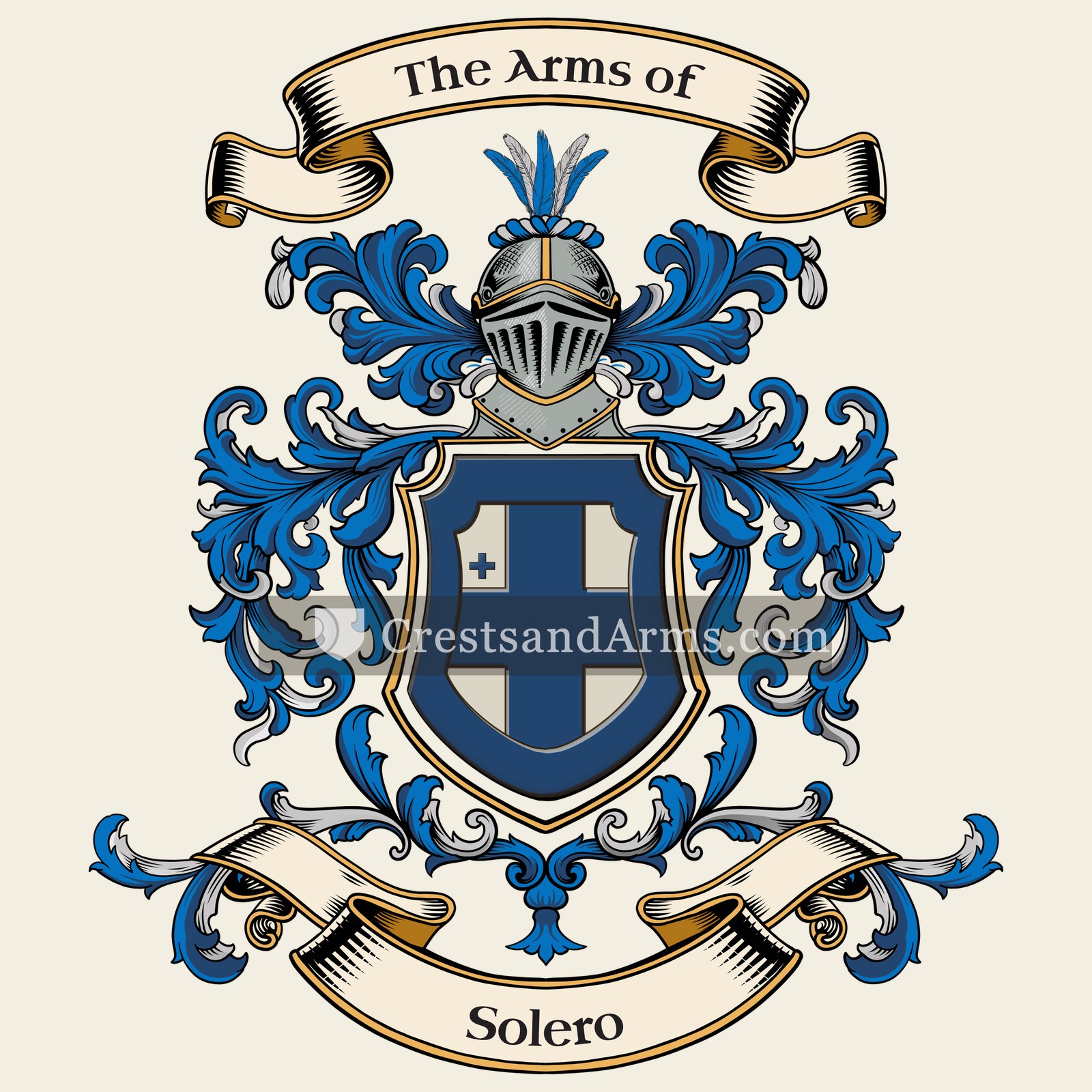
cross symbolChristian faith and service
Colours
Silver (Argent)Means: Peace and sincerity
Blue (Azure)Means: Loyalty and truth
Historical info
Source
J. B. Rietstap, Armorial Général, Gouda: G. B. van Goor Zonen, 1884–87
Blazon (the actual original written record)
“D'arg. à une croix de Calatrava d'azur, vidée du champ; à la bord. denché du sec.”
CastileCastile, c. 1722
Digital archive packCoat of arms PNG, gold border print PDF, vector SVG and the certificate of authenticity. Sent to your email in minutes.
Map of Spain showing where the Solero arms are recorded
The Solero arms were recorded in Castile, c. 1722.
Castile was the heart of Spain and the source of most of its noble families. Land won in the long wars against the Moors was granted out to fighting men, and a man granted land was granted arms along with it.
This is where the arms were entered in the register. Families often moved to other parts of the country, so the same name can turn up in more than one region.
The body that granted and recorded arms in Spain in this period.
Philip V of Spain
Sovereign of the period
Philip V of Spain
1714–1724
Reigning in Germany when the Solero arms are first recorded.
How Arms Worked in Spain
In Spain, a coat of arms was considered a form of property that belonged to the entire family line. These arms were passed down from a father to all his children equally. Younger branches of the family usually kept the original design without needing to add any special marks to distinguish their specific line.
Granting authority
The Cronista Rey de Armas was the official body that regulated and granted coats of arms throughout Spain.
How they got arms
Families often obtained their arms through royal grants or by proving their noble status to the official heraldic authority.
Where arms were recorded
Coats of arms were officially recorded in the registers of the Cronista Rey de Armas starting in 1496.
The family's standing
Recorded among the armigerous families of Castile.
Origin & History of the Solero Family in Spain
The surname Solero finds its historical roots in the rugged landscape of the Castile region, where members of the family were documented as early as 1722. During this period, the name was closely tied to the social and agricultural structures of the Spanish interior. Families living in Castile often took names that reflected their connection to the land or their specific local identity within the kingdom. As the family established itself in this central plateau, they became part of the local administration and community life that defined the Spanish countryside in the eighteenth century. While the name is not as widespread as some others, its presence in early Castilian records suggests a family that was integrated into the local economy and the evolving social hierarchy of the time. This foundation in Castile allowed the family to maintain a distinct identity that persisted through generations as they expanded across the Iberian Peninsula.
Related Branches & Arms
Root word
solarium
A place exposed to the sun or a sun terrace.
This name
SoleroDerived from a topographic location associated with a sunny or elevated place.
also spelled
Soller
Solar
Documented Sources
J. B. Rietstap, Armorial Général, Gouda: G. B. van Goor Zonen, 1884–87
Bader, Karl S., Der deutsche Südwesten in seiner territorialstaatlichen Entwicklung, 1950
Schmid, Josef, Bevölkerungsgeschichte von Schwaben, 1968
Landesarchiv Baden-Württemberg, Bestand H 101: Kirchenbücher und Standesregister
Digital archive packCoat of arms PNG, gold border print PDF, vector SVG and the certificate of authenticity. Sent to your email in minutes.




 cross symbolChristian faith and service