Map of Belgium showing where the Solomons arms are recorded
The Solomons arms were recorded in Flandre, c. 1663.
Flandre grew rich on cloth, and its towns were among the busiest in Europe. Merchant families bought land with their profits and took arms to go with it, so trade put as many names in the registers here as land did.
This is where the arms were entered in the register. Families often moved to other parts of the country, so the same name can turn up in more than one region.
The body that granted and recorded arms in Belgium in this period.
Philip IV of Spain
Sovereign of the period
Philip IV of Spain
1621–1665
Reigning in Belgium when the Solomons arms are first recorded.
How Arms Worked in Belgium
In Belgium, a coat of arms is considered personal property that is passed down through the male line to legitimate descendants. Families often use the same shield design across generations to show their shared heritage. If a branch of the family wants to change the design, they must apply for an official update to their specific version of the arms.
Granting authority
The Conseil héraldique is the official body that regulates and approves all coats of arms in Belgium.
How they got arms
Families obtain their coats of arms through formal royal grants or by confirming their historical right to use existing designs.
Where arms were recorded
All approved coats of arms are officially recorded in the public registers of the Conseil héraldique since 1844.
The family's standing
Recorded among the armigerous families of Flandre.
Origin & History of the Solomons Family in Belgium
The history of the Solomons family in Belgium begins in the seventeenth century, with records confirming their presence in the Flanders region by 1663. During this era, the Low Countries served as a vital crossroads for trade and cultural exchange, attracting families who were often involved in merchant activities or skilled craftsmanship. The name itself is a patronymic, derived from the biblical name Solomon, which suggests a lineage rooted in deep cultural and religious traditions that were common among Jewish communities in Western Europe at the time. As these families settled into Flemish cities, they navigated a complex social landscape defined by shifting political borders and the rise of mercantilism. By establishing themselves in Flanders during the mid-1600s, the early members of the Solomons family became part of the long-standing tradition of urban migration that helped shape the economic identity of the region. Their survival and integration into the local community reflect the broader experiences of families who maintained their distinct identity while contributing to the development of early modern Belgian society.
Coat of Arms & Family Crest Details
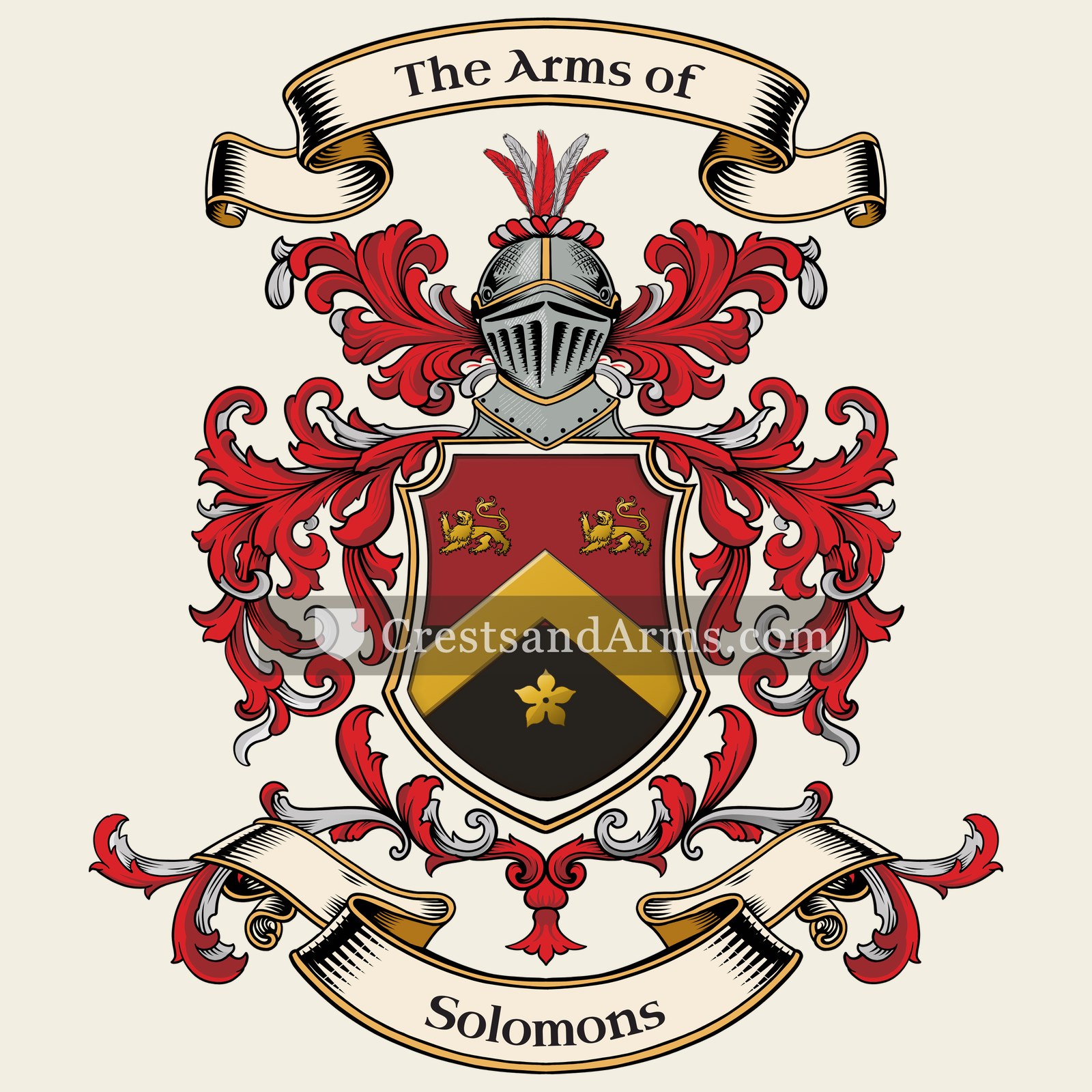
Symbols on this shield
chevronProtection, and faithful service completed
vairProtection, and the winter fur
ermineDignity and rank
lionCourage, strength and royalty
cinquefoilHope and joy
Colours
Red (Gules)Means: Military strength
Black (Sable)Means: Constancy
Gold (Or)Means: Generosity
Historical info
Source
J. B. Rietstap, Armorial Général, Gouda: G. B. van Goor Zonen, 1884–87
Blazon (the actual original written record)
“de gu. sur sa., au chev. de vair, br. sur la division; ledit chev. acc. en chef de deux lions d'or, tenant chacun entre ses pattes un bes. ch. d'une mouch. d'herm. de sa., et en p. d'une quintefeuille d'or semée de mouch. d'herm. de sa. C.: un lion de l'écu, iss. d'un rang de six palissades d'or, posées sur un terre de sin. D.: DEO ADJUVANTE.”
BritainLondres, c. 1869
Digital archive packCoat of arms PNG, gold border print PDF, vector SVG and the certificate of authenticity. Sent to your email in minutes.
Map of Britain showing where the Solomons arms are recorded
The Solomons arms were recorded in Londres, c. 1869.
Arms such as these were typically recorded in Kent.
Kent sits between London and the short crossing to Europe, and the trade passing through made it wealthy. Merchant families bought land with that money, and it was landowners who took coats of arms.
This is where the arms were entered in the register. Families often moved to other parts of the country, so the same name can turn up in more than one region.
The body that granted and recorded arms in Britain in this period.
Victoria
Sovereign of the period
Victoria
1837–1901
Reigning in Belgium when the Solomons arms are first recorded.
How Arms Worked in Britain
English heraldry allowed arms to be shared by all legitimate descendants of the original owner. These symbols were treated as personal property that moved through the generations to all children. While the eldest son kept the original design, other family members could use the same shield without needing to change it or register their own unique versions.
Granting authority
The College of Arms in London has regulated the use of coats of arms throughout England and Wales since 1484.
How they got arms
Families typically obtained their coats of arms through a formal grant from the Crown or by proving their ancient right to them.
Where arms were recorded
All official coats of arms are recorded in the registers kept at the College of Arms, which date back to the fifteenth century.
The family's standing
Recorded among the armigerous families of Britain.
Origin & History of the Solomons Family in Britain
The surname Solomons is a patronymic name, meaning it was originally derived from the given name Solomon, which carries deep historical roots in various cultures. In Britain, the name gained prominence among Jewish families who settled in the country over several centuries. By the mid-19th century, the family had established a notable presence in the county of Kent. During this period, the region was undergoing significant social and economic changes, and families like the Solomons were often involved in the growing trade and mercantile sectors of Victorian England. As they integrated into local communities, they contributed to the diverse cultural fabric of the British landscape. The presence of the family in Kent by 1869 reflects a broader pattern of migration and settlement that saw many families move into regional hubs to pursue new opportunities and build stable lives for future generations.
Related Branches & Arms
Root word
Shalom
A Hebrew term meaning peace or completeness.
This name
SolomonsA patronymic surname derived from Solomon, signifying son of the peaceful one.
also spelled
Salomonz
Solomons
Salamon
Solomon
Documented Sources
J. B. Rietstap, Armorial Général, Gouda: G. B. van Goor Zonen, 1884–87
State Archives in Belgium (Rijksarchief), Parochieregisters van de provincie West-Vlaanderen (Parish Registers of the Province of West Flanders)
City Archives of Bruges (Stadsarchief Brugge), Registers van de Burgerlijke Stand en Bevolking (Civil Registry and Population Registers)
Israel, Jonathan I., The Dutch Republic: Its Rise, Greatness, and Fall 1477-1806 (1995)
Pirenne, Henri, Histoire de Belgique (1900)
Digital archive packCoat of arms PNG, gold border print PDF, vector SVG and the certificate of authenticity. Sent to your email in minutes.


 swanGrace, light and the poet's art
 swanGrace, light and the poet's art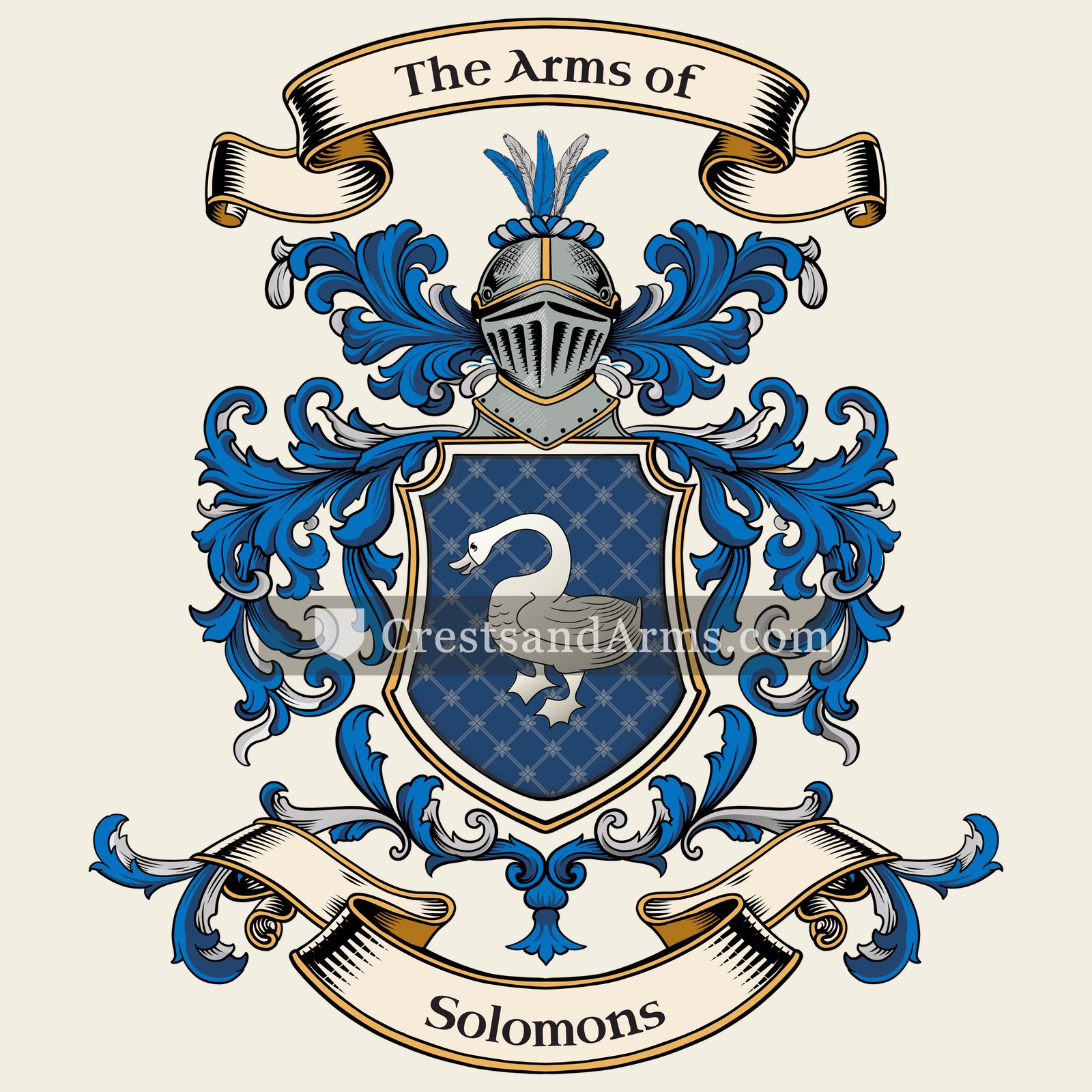


 chevronProtection, and faithful service completed
 ermineDignity and rank
 lionCourage, strength and royalty
 cinquefoilHope and joy