A record of documented arms, meaning and origin, researched for the Sonnenberg family lines. Documented in 3 countries.
Reg. 1622 · German, T–V
Meaning of the Sonnenberg family crest colors & symbols
Symbols on this shield
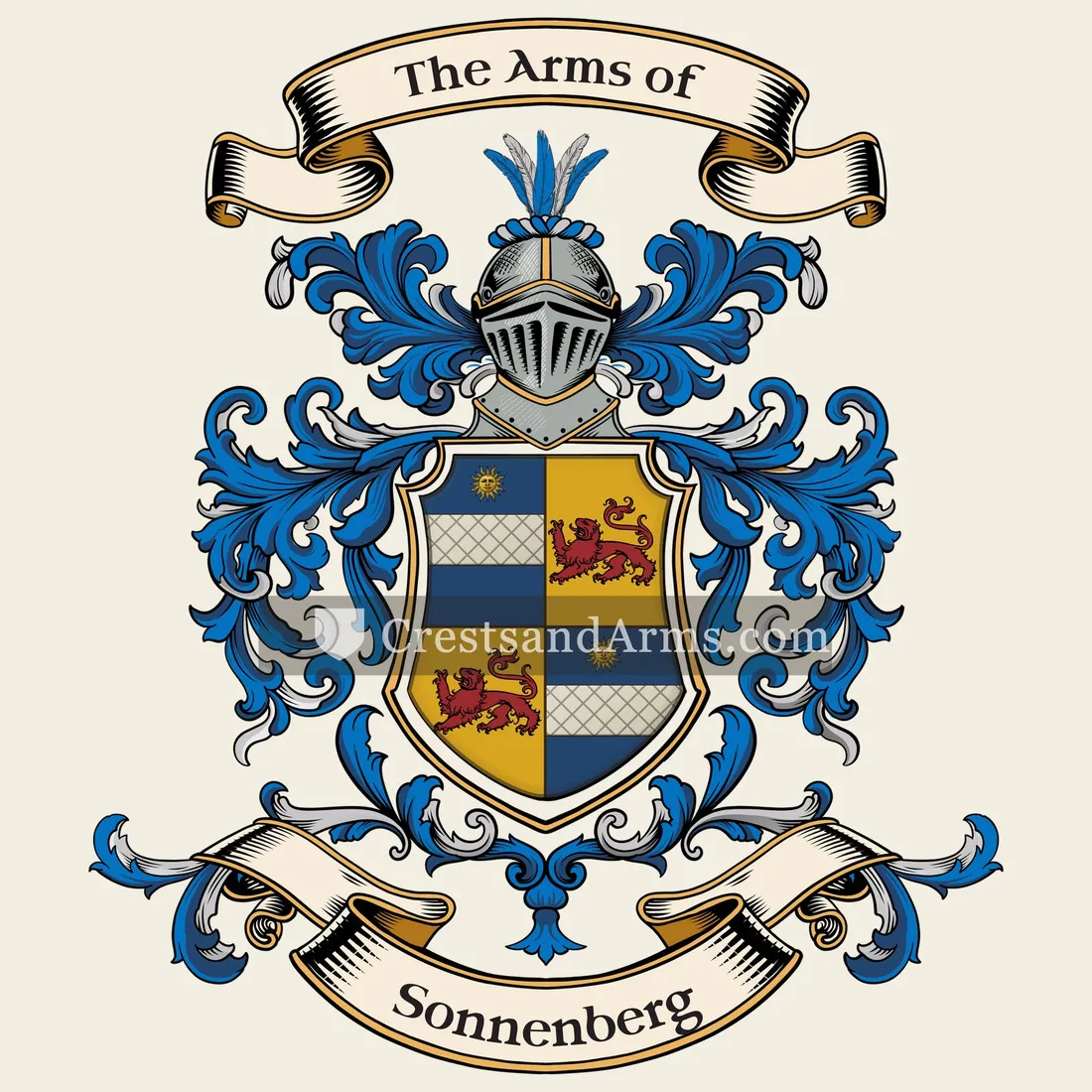
fessThe military belt, and readiness to serve
sunGlory, splendour and the source of life
lionCourage, strength and royalty
Colours
Blue (Azure)Means: Loyalty and truth
Gold (Or)Means: Generosity
Silver (Argent)Means: Peace and sincerity
Red (Gules)Means: Military strength
Historical info
Source
J. B. Rietstap, Armorial Général, Gouda: G. B. van Goor Zonen, 1884–87
Blazon (the actual original written record)
“Ec.: aux 1 et 4 d'azur à la fasce d'arg., acc. en chef d'un soleil d'or; aux 2 et 3 d'or au lion de gu. Cq. cour. C.: un soleil d'or, entre un vol de sa. L.: à dextre d'or et d'azur, à sen. d'or et de gu.”
GermanyAnhalt, c. 1764
Digital archive packCoat of arms PNG, gold border print PDF, vector SVG and the certificate of authenticity. Sent to your email in minutes.
Map of Germany showing where the Sonnenberg arms are recorded
The Sonnenberg arms were recorded in Anhalt, c. 1764.
This is where the arms were entered in the register. Families often moved to other parts of the country, so the same name can turn up in more than one region.
The body that granted and recorded arms in Germany in this period.
Francis I, Holy Roman Emperor
Sovereign of the period
Francis I, Holy Roman Emperor
1745–1765
Reigning in Germany when the Sonnenberg arms are first recorded.
How Arms Worked in Germany
In the Holy Roman Empire, coats of arms were often granted to individuals by the Emperor or his representatives. These arms were then passed down through the generations to all legitimate descendants of the original holder. Younger branches of a family usually kept the same shield design without needing to change it, as the arms belonged to the entire lineage.
Granting authority
The Holy Roman Emperor held the sole power to grant new coats of arms throughout his vast imperial territories.
How they got arms
Families typically obtained their coats of arms through a formal imperial grant or by proving their noble status to the authorities.
Where arms were recorded
These grants were officially recorded in the Imperial Chancery registers, which began keeping formal records of such honors during the Middle Ages.
The family's standing
Recorded among the armigerous families of Germany.
Origin & History of the Sonnenberg Family in Germany
The surname Sonnenberg is a topographical name, which means it was originally chosen to describe the landscape where a family lived. In German, the name translates to "sun mountain" or "sun hill," likely referring to a family that resided on a south-facing slope that received the most sunlight. By the mid-18th century, records confirm that members of the Sonnenberg family were established in the region of Anhalt. During this period, Anhalt was a collection of small principalities where families were often deeply tied to the local agricultural economy and the land they occupied. Because surnames were becoming more fixed in official record-keeping during the 1700s, the presence of the family in Anhalt by 1764 suggests they were well-integrated into the local community and subject to the administrative census and church registration practices of the time. This transition from descriptive nicknames to permanent family names reflects the growing need for the German state to track its citizens for tax and military purposes.
Meaning of the Sonnenberg family crest colors & symbols
Symbols on this shield
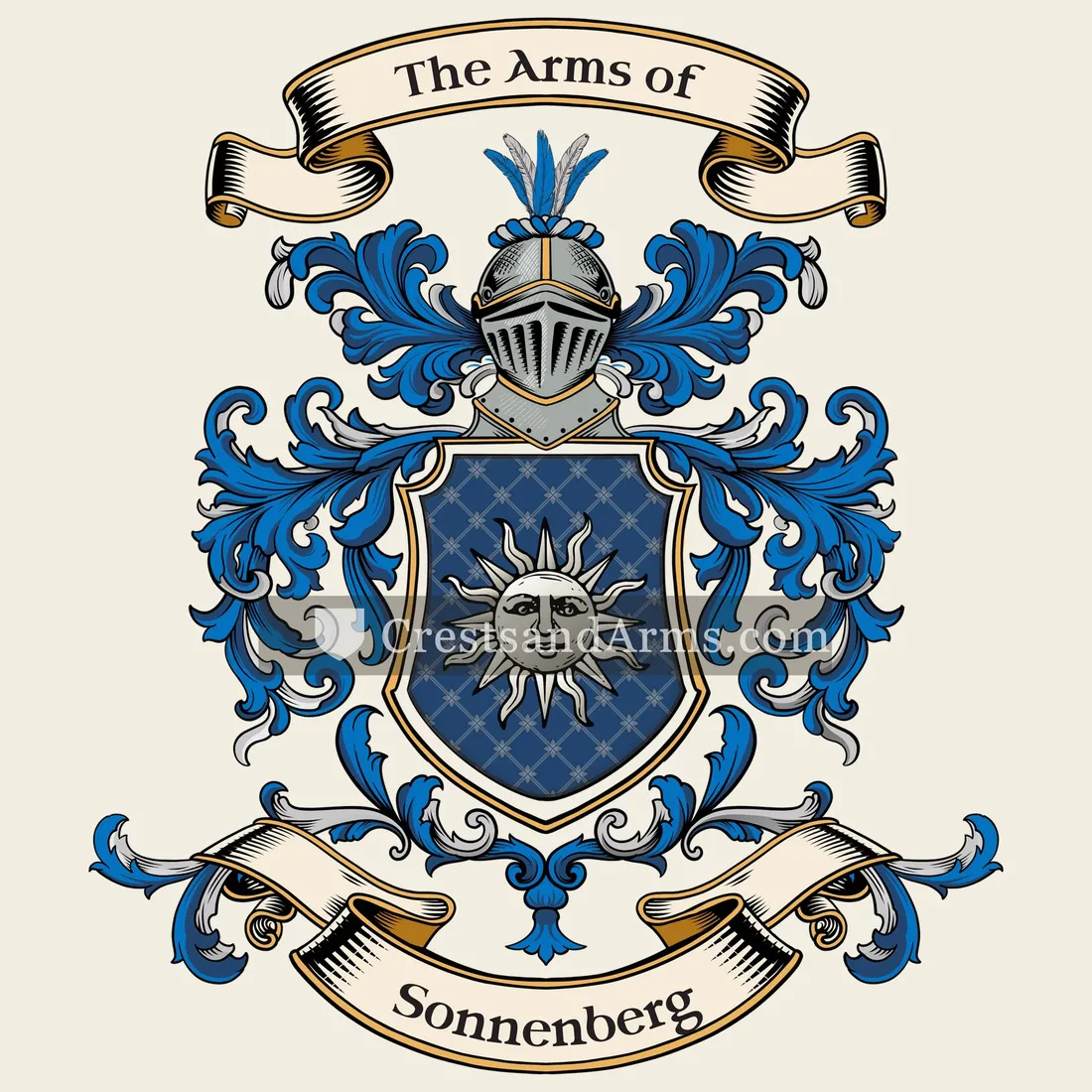
sunGlory, splendour and the source of life
Colours
Blue (Azure)Means: Loyalty and truth
Silver (Argent)Means: Peace and sincerity
Historical info
Source
J. B. Rietstap, Armorial Général, Gouda: G. B. van Goor Zonen, 1884–87
Blazon (the actual original written record)
“D'azur à un soleil d'arg.; ou, d'azur à un soleil d'or; ou, d'arg. à un soleil de gu.,—tous les soleils à figure humaine.”
Austriac. 1772
Digital archive packCoat of arms PNG, gold border print PDF, vector SVG and the certificate of authenticity. Sent to your email in minutes.
Map of Austria showing where the Sonnenberg arms are recorded
The Sonnenberg arms were recorded in Austria, c. 1772.
Arms such as these were typically recorded in Tyrol.
Tyrol was mountain country in western Austria, where the valleys were held by families who had been there a very long time. Old tenure counted for more than money, and old families carried arms.
This is where the arms were entered in the register. Families often moved to other parts of the country, so the same name can turn up in more than one region.
Region
Tyrol
First recorded
1772
Granting Authority for the Sonnenberg Arms
Imperial and Royal chancery
Sodacan · CC BY-SA 3.0
The body that granted and recorded arms in Austria in this period.
Joseph II, Holy Roman Emperor
Sovereign of the period
Joseph II, Holy Roman Emperor
1765–1790
Reigning in Germany when the Sonnenberg arms are first recorded.
How Arms Worked in Austria
Austrian coats of arms were often linked directly to noble titles granted by the Emperor. These symbols belonged to the entire family line rather than just one individual. When a family grew, new branches kept the original design without needing to change it. This system allowed all members of a noble house to share the same identity across many generations.
Granting authority
The Imperial and Royal chancery managed all heraldic matters and controlled the official granting of arms throughout the Austrian lands.
How they got arms
Families typically received their arms through a formal imperial decree that often accompanied the elevation of a person to noble status.
Where arms were recorded
Official records of these grants were kept in the Imperial Register of Nobility which began its formal documentation process in 1453.
The family's standing
Recorded among the armigerous families of Austria.
Origin & History of the Sonnenberg Family in Austria
The name Sonnenberg, which translates literally to "sun mountain," emerged as a descriptive topographical surname in the German-speaking regions of Central Europe. By the late eighteenth century, the family had established a documented presence in the rugged landscape of Tyrol, a region defined by the dramatic peaks of the Alps. In 1772, members of the family were living within this mountainous territory, likely working as farmers, craftsmen, or local officials who identified their home by the sun-drenched slopes of the surrounding terrain. Because Tyrol served as a vital crossroads for trade and travel between the Italian peninsula and the German lands, families like the Sonnenbergs were often deeply connected to the shifting social and economic life of the Austrian Empire. Their history reflects the broader movement of people who settled in high-altitude valleys, where the name served as a permanent link to the specific geography of their ancestral home.
Meaning of the Sonnenberg family crest colors & symbols
Symbols on this shield
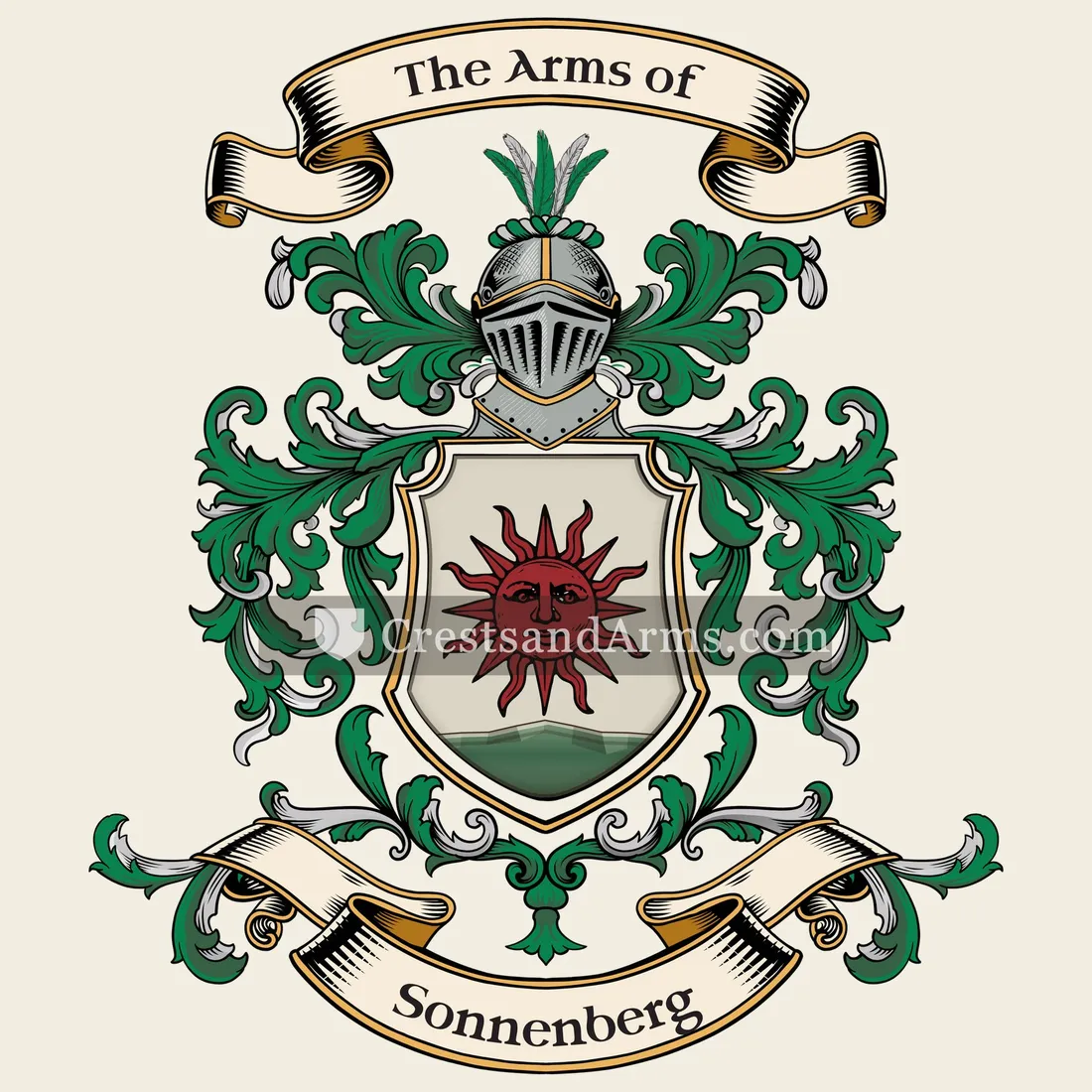
mountThe ground held, and steadfastness upon it
sunGlory, splendour and the source of life
Colours
Silver (Argent)Means: Peace and sincerity
Green (Vert)Means: Hope
Red (Gules)Means: Military strength
Historical info
Source
J. B. Rietstap, Armorial Général, Gouda: G. B. van Goor Zonen, 1884–87
Blazon (the actual original written record)
“D'arg. à un soleil de gu., soutenu d'un tertre de trois coupeaux de sin. Cq. cour. C.: les meubles de l'écu.”
Switzerlandc. 1745
Digital archive packCoat of arms PNG, gold border print PDF, vector SVG and the certificate of authenticity. Sent to your email in minutes.
Map of Switzerland showing where the Sonnenberg arms are recorded
The Sonnenberg arms were recorded in Switzerland, c. 1745.
Arms such as these were typically recorded in Bern.
Bern was the largest of the Swiss cantons and ran itself, with its own council and its own courts. Its governing families held office for generations, and office of that kind carried a shield with it.
This is where the arms were entered in the register. Families often moved to other parts of the country, so the same name can turn up in more than one region.
The body that granted and recorded arms in Switzerland in this period.
How Arms Worked in Switzerland
In Switzerland, coats of arms were not restricted to the nobility and were often adopted by common citizens and families. These symbols were passed down through generations to show family identity. When branches of a family grew, they often changed small details of the design to distinguish their own line from the original group.
Granting authority
Cantonal and civic authorities managed the use of coats of arms within their specific regions and local jurisdictions.
How they got arms
Families typically assumed their own coats of arms based on local custom rather than receiving them from a central monarch.
Where arms were recorded
Arms were recorded in various cantonal and civic registers starting from the fourteenth century throughout the Swiss region.
The family's standing
Recorded among the armigerous families of Switzerland.
Origin & History of the Sonnenberg Family in Switzerland
The family name Sonnenberg finds its roots in the German-speaking regions of Switzerland, where it functioned as a topographic surname. In the medieval and early modern periods, such names were often given to families who lived near a specific landmark, in this case, a sunny mountain or a hill facing the sun. By the mid-eighteenth century, the family was firmly established in the canton of Bern. Records confirm that members of the Sonnenberg family were active citizens in this region by 1745. During this era, Bern was a powerful city-state, and families living there were often involved in the local trades, agriculture, or the complex administrative systems of the Swiss Confederacy. The name reflects a deep connection to the alpine landscape, suggesting that the earliest ancestors likely settled in the sunny slopes of the Bernese Oberland before moving into the city itself to pursue new opportunities.
Sonnenberg Meaning & Related Branches
Root word
Sonne and Berg
Sun and mountain or hill
This name
SonnenbergA topographic name for someone living on a sunny mountain or hill.
also spelled
Soneberg
Sonenberg
Documented Sources
J. B. Rietstap, Armorial Général, Gouda: G. B. van Goor Zonen, 1884–87
Bahlow, Hans, Deutsches Namenlexikon: Familien- und Vornamen nach Ursprung und Sinn erklärt, 1967
Gottschald, Max, Deutsche Namenkunde: Unsere Familiennamen, 1971
Landesarchiv Sachsen-Anhalt, Kirchenbücher der evangelischen Landeskirche Anhalts, 1764
Digital archive packCoat of arms PNG, gold border print PDF, vector SVG and the certificate of authenticity. Sent to your email in minutes.


 fessThe military belt, and readiness to serve
 sunGlory, splendour and the source of life
 lionCourage, strength and royalty
 fessThe military belt, and readiness to serve
 sunGlory, splendour and the source of life
 lionCourage, strength and royalty




 mountThe ground held, and steadfastness upon it