A record of documented arms, meaning and origin, researched for the Sossi family lines. Documented in 2 countries.
Reg. 7364 · Polish, T–V
Coat of Arms & Family Crest Details
Symbols on this shield
arrowReadiness for battle, and affliction endured
crescentHonour by the sovereign, and the second son
mulletThe third son, and a divine quality from above
Colours
Blue (Azure)Means: Loyalty and truth
Silver (Argent)Means: Peace and sincerity
Gold (Or)Means: Generosity
Historical info
Source
J. B. Rietstap, Armorial Général, Gouda: G. B. van Goor Zonen, 1884–87
Blazon (the actual original written record)
“D'azur à une flèche d'arg., soutenue d'un croiss. d'or et accostée de deux étoiles du même. Cq. cour. C.: une queue de paon, au nat., percée d'une flèche d'or, en fasce, la pointe à sen.”
Polandc. 1772
Digital archive packCoat of arms PNG, gold border print PDF, vector SVG and the certificate of authenticity. Sent to your email in minutes.
Map of Poland showing where the Sossi arms are recorded
The Sossi arms were recorded in Poland, c. 1772.
Arms such as these were typically recorded in Mazovia.
Mazovia held Warsaw, the Polish court and the assemblies where the szlachta met. Poland's nobles were unusually numerous and every one of them bore arms, and Warsaw is where those arms were argued over and recorded.
This is where the arms were entered in the register. Families often moved to other parts of the country, so the same name can turn up in more than one region.
Region
Mazovia
First recorded
1772
Granting Authority for the Sossi Arms
Ennoblement by the Sejm
Author: Olek Remesz · CC BY-SA 3.0
The body that granted and recorded arms in Poland in this period.
Stanisław August Poniatowski
Sovereign of the period
Stanisław August Poniatowski
1764–1795
Reigning in Poland when the Sossi arms are first recorded.
How Arms Worked in Poland
Polish noble families shared a single coat of arms across many different surnames, creating large clans rather than individual designs. These symbols were held collectively by all members of the clan regardless of their specific family name. When a new family joined the nobility, they were adopted into an existing clan and began using that group's established shield.
Granting authority
The Sejm, which was the Polish parliament, held the power to grant noble status and the right to bear arms.
How they got arms
Families typically received their coat of arms through a formal act of ennoblement granted by the Sejm for distinguished service.
Where arms were recorded
These grants were officially recorded in the Crown Metrica, which served as the central archive for state documents starting in the sixteenth century.
The family's standing
Recorded among the armigerous families of Poland.
Origin & History of the Sossi Family in Poland
The history of the Sossi family in Poland is deeply rooted in the historical region of Mazovia, where records confirm their presence by 1772. During this period, Mazovia was a central hub of Polish social and agricultural life, characterized by a mix of noble estates and growing village communities. The name likely entered the region through migration patterns common in Central Europe, where families moved across borders to find new land or trade opportunities. As the family settled into the Mazovian landscape, they became part of the local fabric, participating in the daily life of the region during a time of significant political transition for the Polish-Lithuanian Commonwealth. By establishing themselves in this area, the Sossi family contributed to the long-standing demographic history of the province, maintaining their identity through generations of local growth and community development.
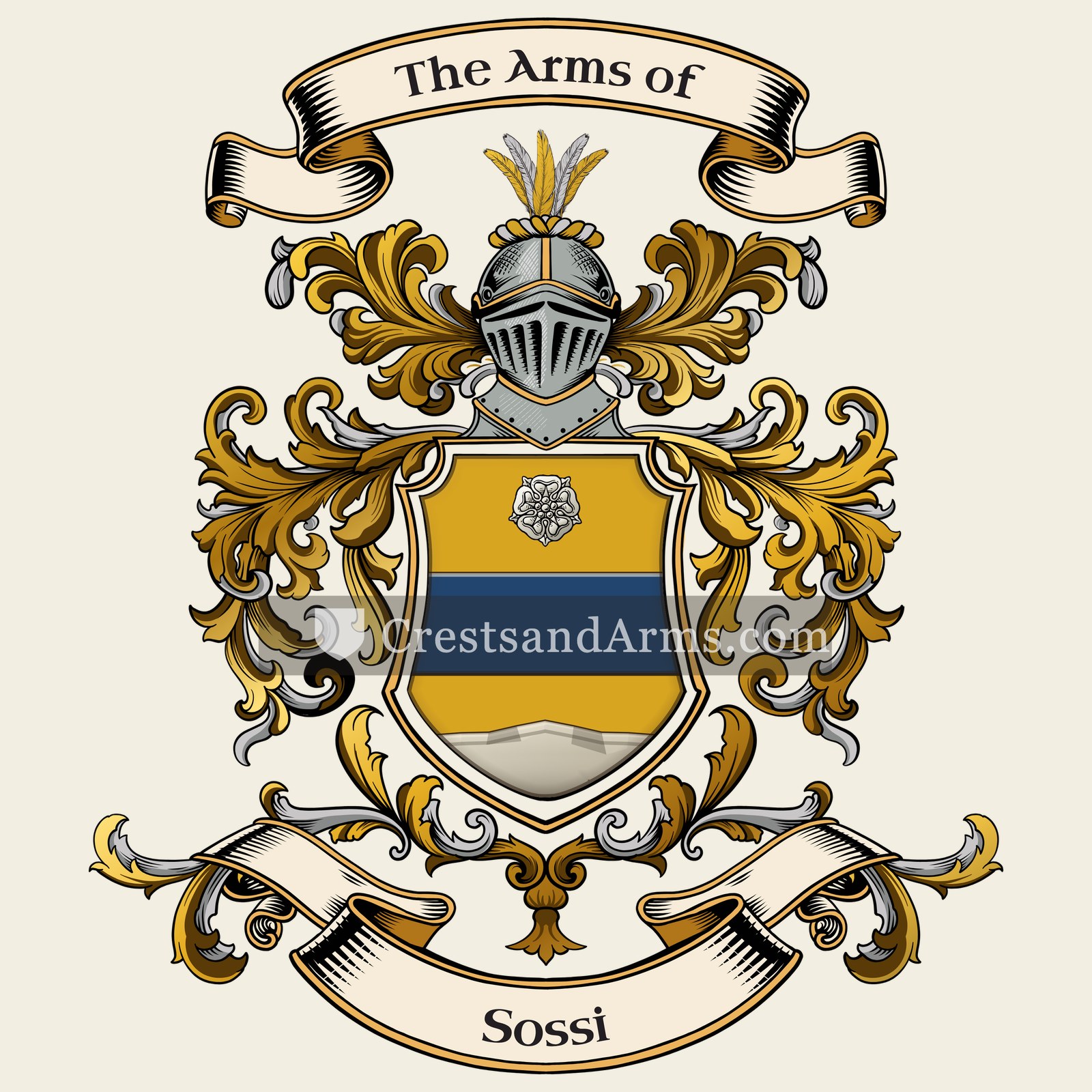
Coat of Arms & Family Crest Details
Symbols on this shield
fessThe military belt, and readiness to serve
mountThe ground held, and steadfastness upon it
roseThe seventh son, and beauty with grace
Colours
Gold (Or)Means: Generosity
Blue (Azure)Means: Loyalty and truth
Silver (Argent)Means: Peace and sincerity
Historical info
Source
J. B. Rietstap, Armorial Général, Gouda: G. B. van Goor Zonen, 1884–87
Blazon (the actual original written record)
“D'or à la fasce d'azur, acc. en chef d'une rose d'arg. et en p. d'un mont de trois coupeaux du même, mouv. de la p.”
ItalyBologne, c. 1775
Digital archive packCoat of arms PNG, gold border print PDF, vector SVG and the certificate of authenticity. Sent to your email in minutes.
Map of Italy showing where the Sossi arms are recorded
The Sossi arms were recorded in Bologne, c. 1775.
This is where the arms were entered in the register. Families often moved to other parts of the country, so the same name can turn up in more than one region.
The body that granted and recorded arms in Italy in this period.
Alvise Giovanni Mocenigo
Sovereign of the period
Alvise Giovanni Mocenigo
1763–1778
Reigning in Poland when the Sossi arms are first recorded.
How Arms Worked in Italy
In the Italian states, coats of arms were often used by noble families to show their status and history. These symbols were passed down through the generations to all legitimate male descendants. Younger branches of a family usually kept the original design but sometimes added small changes to distinguish their specific line from the main branch.
Granting authority
Various local rulers and city governments controlled the use of coats of arms across the different Italian states.
How they got arms
Families often assumed their own arms or received them as official grants from local lords, popes, or city councils.
Where arms were recorded
Arms were recorded in local city archives or private family books rather than in one single national register.
The family's standing
Recorded among the armigerous families of Italy.
Origin & History of the Sossi Family in Italy
The family name Sossi traces its roots deep into the heart of the Italian peninsula, with significant historical documentation placing the family firmly in the city of Bologna by the year 1775. During this period, Bologna was a prominent center of learning and trade within the Papal States, and families like the Sossi were often integrated into the local urban fabric as skilled artisans, merchants, or landowners. The name itself likely evolved from regional naming conventions common in Northern Italy, where surnames were frequently derived from personal nicknames or shortened versions of traditional given names. By the late 18th century, the Sossi family was well-established enough to appear in local parish registers and municipal tax records, which served as the primary way for the government to track citizens in an era of shifting political power. These early records suggest a family that was deeply connected to the social and economic life of the Emilia-Romagna region, living through the transition from the old aristocratic order to the social changes brought on by the late Enlightenment and the subsequent Napoleonic era.
Related Branches & Arms
Root word
Sos
A diminutive form of the name Zofia or Sosna meaning pine tree.
This name
SossiA patronymic or habitational surname derived from the name Sos, often associated with pine forests.
also spelled
Sassy
Documented Sources
J. B. Rietstap, Armorial Général, Gouda: G. B. van Goor Zonen, 1884–87
Archiwum Główne Akt Dawnych (AGAD), Księgi metrykalne parafii rzymskokatolickich z terenu Mazowsza
Borkiewicz, Adam, Dzieje Mazowsza w XVIII wieku, 1958
Gieysztor, Aleksander, Historia Mazowsza, 1994
Digital archive packCoat of arms PNG, gold border print PDF, vector SVG and the certificate of authenticity. Sent to your email in minutes.


 arrowReadiness for battle, and affliction endured
 crescentHonour by the sovereign, and the second son
 mulletThe third son, and a divine quality from above
 arrowReadiness for battle, and affliction endured
 crescentHonour by the sovereign, and the second son
 mulletThe third son, and a divine quality from above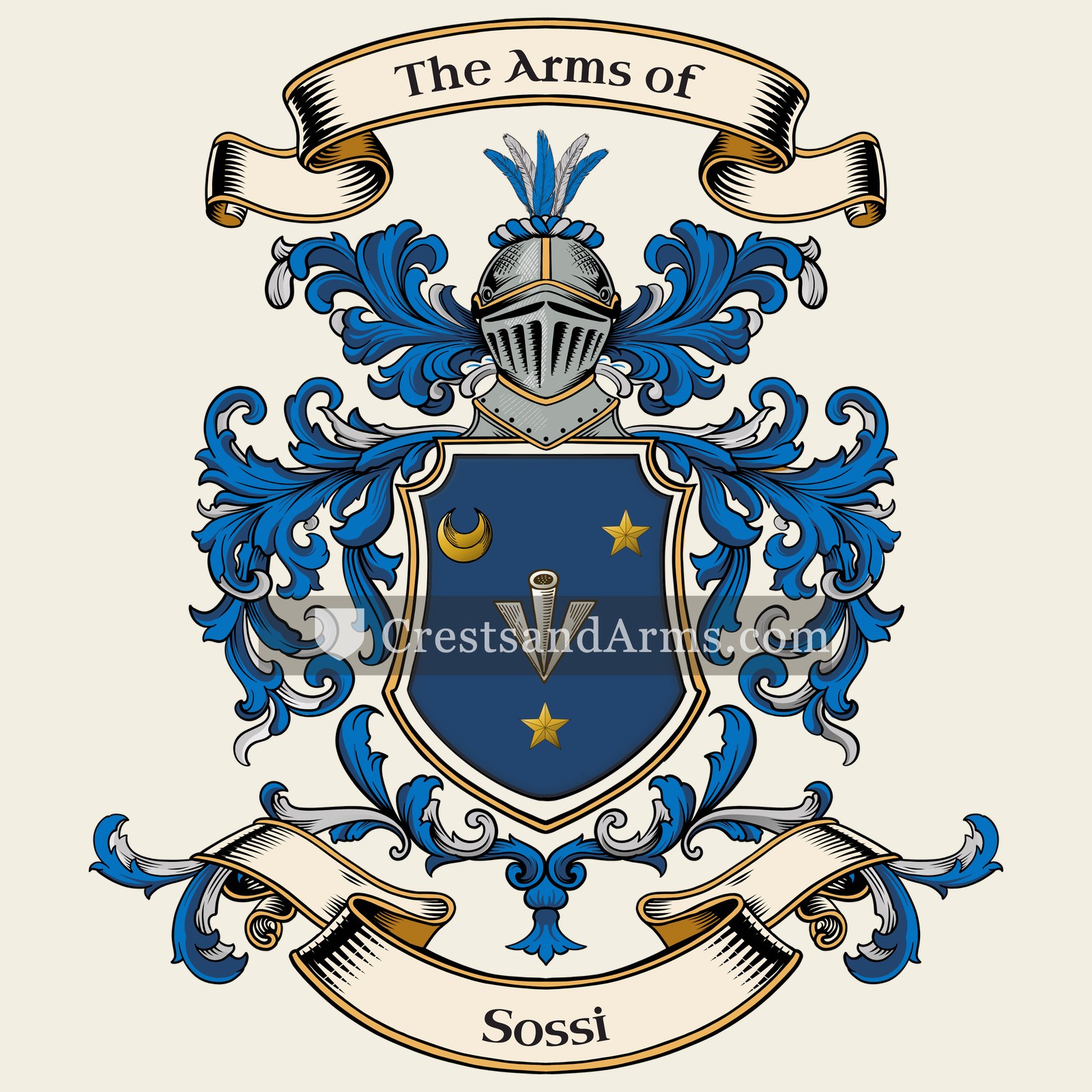


 fessThe military belt, and readiness to serve
 mountThe ground held, and steadfastness upon it
 roseThe seventh son, and beauty with grace