Map of Spain showing where the Sow arms are recorded
The Sow arms were recorded in Catalonia, c. 1722.
Catalonia lived by sea trade, and its merchant houses were as powerful as its landowners. Both sorts of family took arms, and Barcelona kept records of the houses entitled to bear them.
This is where the arms were entered in the register. Families often moved to other parts of the country, so the same name can turn up in more than one region.
The body that granted and recorded arms in Spain in this period.
Philip V of Spain
Sovereign of the period
Philip V of Spain
1714–1724
Reigning in Spain when the Sow arms are first recorded.
How Arms Worked in Spain
In Spain, a coat of arms was considered a form of property that belonged to the entire family line. These arms were passed down from a father to all his children equally. Younger branches of the family usually kept the original design without needing to add any special marks to distinguish their specific line.
Granting authority
The Cronista Rey de Armas was the official body that regulated and granted coats of arms throughout Spain.
How they got arms
Families often obtained their arms through royal grants or by proving their noble status to the official heraldic authority.
Where arms were recorded
Coats of arms were officially recorded in the registers of the Cronista Rey de Armas starting in 1496.
The family's standing
Recorded among the armigerous families of Catalonia.
Origin & History of the Sow Family in Spain
The family name Sow, while often associated with various linguistic roots across the globe, has a documented presence in the Catalonia region of Spain dating back to at least 1722. During the eighteenth century, families in this area were deeply integrated into the local agricultural and mercantile landscape, often living in small rural communities where surnames were tied to specific landholdings or local occupations. As the family established itself in the Catalan social structure, they likely participated in the vibrant trade networks that connected the Mediterranean coast to the rest of Europe. Over time, the name persisted through generations as the family adapted to the shifting political and economic climates of northeastern Spain. By maintaining their presence in the region, the early members of the Sow family contributed to the long-standing cultural tapestry of Catalonia.
Related Branches & Arms
Root word
Sus
Latin term referring to a pig or swine.
This name
SowAn occupational surname for a swineherd or someone who raised pigs.
Documented Sources
J. B. Rietstap, Armorial Général, Gouda: G. B. van Goor Zonen, 1884–87
Arxiu de la Corona d'Aragó, Catàleg de protocols notarials de Barcelona, 1722
Arxiu Històric de Protocols de Barcelona, Lligalls de testaments i inventaris, 1722
Vinyeta, Ramon, Història de la Catalunya rural, 1985
Digital archive packCoat of arms PNG, gold border print PDF, vector SVG and the certificate of authenticity. Sent to your email in minutes.


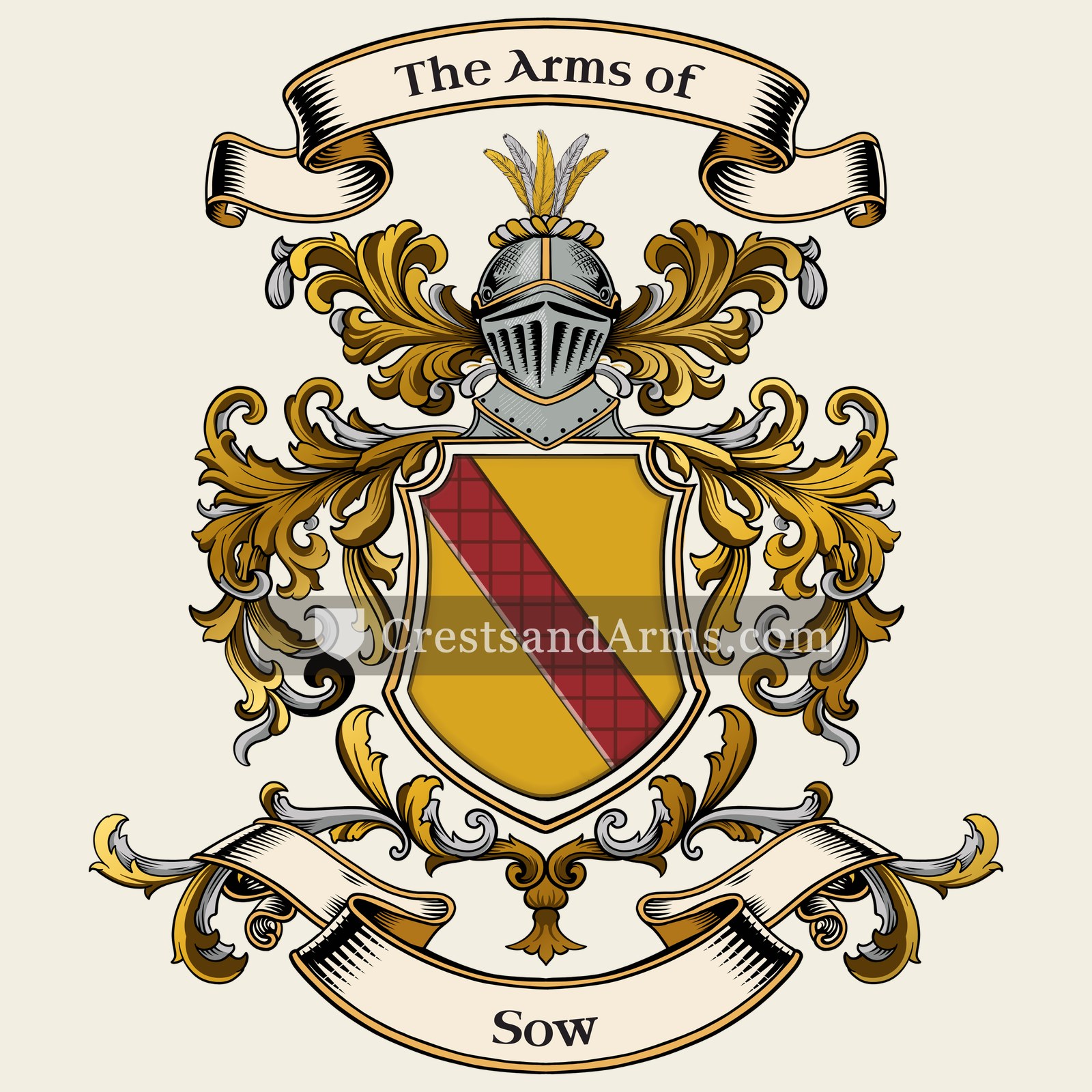
 bendDefence, and the scarf of a commander
 bendDefence, and the scarf of a commander