A record of documented arms, meaning and origin, researched for the Spaan family lines. Documented in 2 countries.
Reg. 3130 · Danish, T–V
Coat of Arms & Family Crest Details
Symbols on this shield
anchorHope, and steadfastness in trouble
horseReadiness to serve king and country
Colours
Green (Vert)Means: Hope
Blue (Azure)Means: Loyalty and truth
Gold (Or)Means: Generosity
Silver (Argent)Means: Peace and sincerity
Historical info
Source
J. B. Rietstap, Armorial Général, Gouda: G. B. van Goor Zonen, 1884–87
Blazon (the actual original written record)
“Ec.: aux 1 et 4 de sin. à une ancre d'or, posée en barre; aux 2 et 3 d'azur à un cheval cont. d'arg., la tête retournée vers dextre, pass. dans une mer d'arg. Sur le tout d'or à un arc bandé de sa., posé en barre, encoché d'une flèche du même, posée en bande. Cq. cour. C.: un bras, arm. au nat., la main de carn. tenant en guidon de gu. à la croix d'arg., la hampe du guidon posée en barre.”
Denmarkc. 1683
Digital archive packCoat of arms PNG, gold border print PDF, vector SVG and the certificate of authenticity. Sent to your email in minutes.
Map of Denmark showing where the Spaan arms are recorded
The Spaan arms were recorded in Denmark, c. 1683.
Arms such as these were typically recorded in Sjaælland.
Zealand held the Danish court, the crown's offices and Copenhagen itself. Families who served the king kept estates within reach of it, and royal service was the ordinary route to a coat of arms.
This is where the arms were entered in the register. Families often moved to other parts of the country, so the same name can turn up in more than one region.
The body that granted and recorded arms in Denmark in this period.
Christian V of Denmark
Sovereign of the period
Christian V of Denmark
1670–1699
Reigning in Denmark when the Spaan arms are first recorded.
How Arms Worked in Denmark
Danish heraldry during this period was closely tied to noble status and royal favor rather than being open to all citizens. Arms were typically granted by the monarch to individuals, and these symbols were then shared by all members of the noble house. If a family line died out, the right to use those specific arms ended with them.
Granting authority
The Danish royal chancery held the power to issue and regulate official coats of arms for the kingdom.
How they got arms
Families usually received their arms through a formal royal grant that confirmed their noble status and rights.
Where arms were recorded
These grants were officially recorded in the Danish Royal Chancery records starting in the sixteenth century.
The family's standing
Recorded among the armigerous families of Denmark.
Origin & History of the Spaan Family in Denmark
The history of the Spaan family in Denmark is deeply rooted in the rural landscape of Sjælland, where records confirm their presence as early as 1683. During this period, the name was often associated with families living in the agricultural heartlands, where they likely worked as farmers or skilled laborers. The name itself is thought to be linked to the Old Danish word for a wood chip or a splinter, which suggests that the earliest ancestors may have been woodworkers or carpenters who earned their living by shaping timber. As the family established themselves in the region, they became part of the local parish communities that formed the backbone of Danish society. By remaining in these specific districts for generations, the Spaan family helped shape the local history of Sjælland through their steady contributions to village life and the regional economy.
Coat of Arms & Family Crest Details
Symbols on this shield
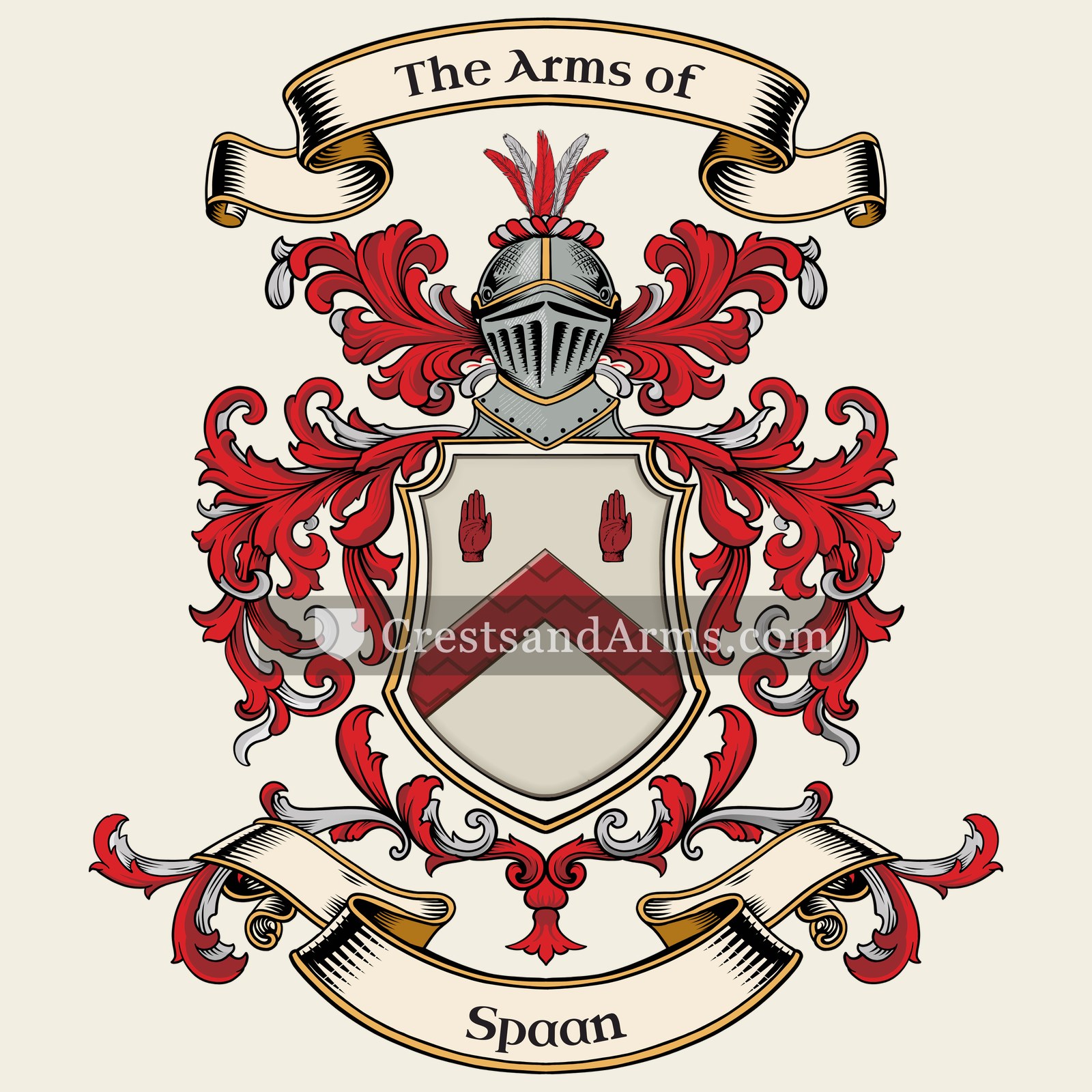
chevronProtection, and faithful service completed
handFaith, sincerity and justice
Colours
Silver (Argent)Means: Peace and sincerity
Red (Gules)Means: Military strength
Historical info
Source
Sir Bernard Burke, The General Armory of England, Scotland, Ireland and Wales, London: Harrison & Sons, 1884
Blazon (the actual original written record)
“Ar. three chev. gu. in chief two dexter hands couped of the last”
Englandc. 1620
Digital archive packCoat of arms PNG, gold border print PDF, vector SVG and the certificate of authenticity. Sent to your email in minutes.
Map of England showing where the Spaan arms are recorded
The Spaan arms were recorded in England, c. 1620.
Arms such as these were typically recorded in York.
Yorkshire is the largest of the English counties, and it held more gentry families than any other. Land there was split among a great many households rather than a few, so a great many of them carried arms.
This is where the arms were entered in the register. Families often moved to other parts of the country, so the same name can turn up in more than one region.
The body that granted and recorded arms in England in this period.
James VI and I
Sovereign of the period
James VI and I
1603–1625
Reigning in Denmark when the Spaan arms are first recorded.
How Arms Worked in England
English heraldry allowed arms to be shared by all legitimate descendants of the original owner. These symbols were treated as personal property that moved through the generations to all children. While the eldest son kept the original design, other family members could use the same shield without needing to change it or register their own unique versions.
Granting authority
The College of Arms in London has regulated the use of coats of arms throughout England and Wales since 1484.
How they got arms
Families typically obtained their coats of arms through a formal grant from the Crown or by proving their ancient right to them.
Where arms were recorded
All official coats of arms are recorded in the registers kept at the College of Arms, which date back to the fifteenth century.
The family's standing
Recorded among the armigerous families of England.
Origin & History of the Spaan Family in England
The history of the Spaan family in England is rooted in the vibrant social landscape of the seventeenth century, with documented evidence placing members of the family in the city of York by 1620. During this period, York served as a significant northern hub for trade and craftsmanship, attracting individuals from across the North Sea who brought unique skills and linguistic traditions to the region. The name itself is thought to be of Low German or Dutch origin, likely functioning as an occupational descriptor for someone who worked with wood or as a spinner of yarn. As these early settlers integrated into the local community, they navigated the complexities of English parish life and urban commerce. Their presence in York suggests that the family was part of a larger movement of continental migrants who sought new opportunities in England, eventually weaving their own distinct history into the fabric of the city’s long-standing mercantile culture.
Related Branches & Arms
Root word
Span
A Middle Low German term referring to a chip or splinter.
This name
SpaanAn occupational name for a woodworker or someone who produced wood shavings.
also spelled
Spann
Spane
Spayne
Documented Sources
J. B. Rietstap, Armorial Général, Gouda: G. B. van Goor Zonen, 1884–87
Rigsarkivet (Danish National Archives), Danske Kancellis skuffearkiver
Rigsarkivet (Danish National Archives), Kirkebøger (Parish Registers) for Sjælland
Jørgensen, Bent, Dansk Stednavneleksikon, 1981
Nielsen, O., Olddanske Personnavne, 1883
Digital archive packCoat of arms PNG, gold border print PDF, vector SVG and the certificate of authenticity. Sent to your email in minutes.


 anchorHope, and steadfastness in trouble
 horseReadiness to serve king and country
 anchorHope, and steadfastness in trouble
 horseReadiness to serve king and country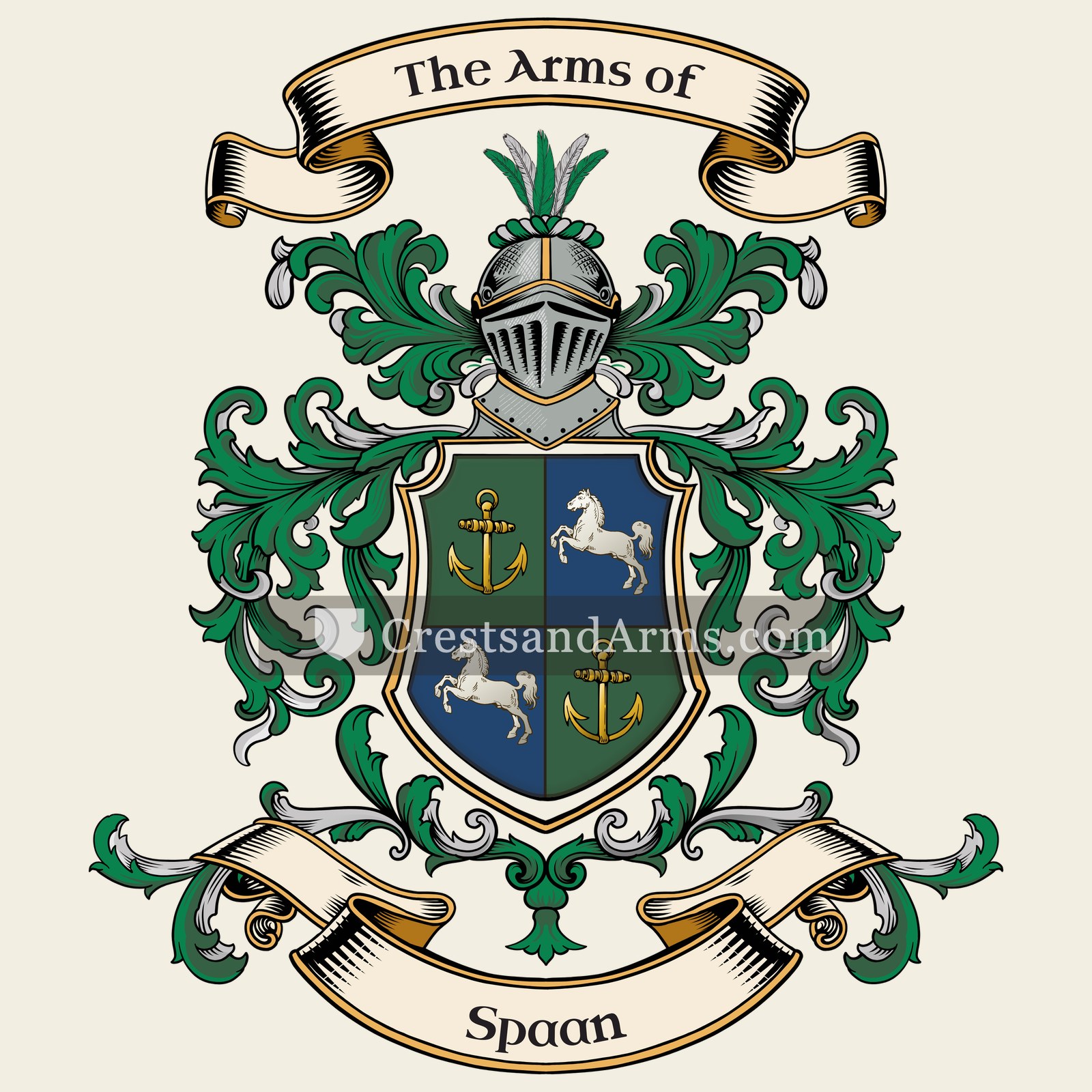


 chevronProtection, and faithful service completed
 handFaith, sincerity and justice