A record of documented arms, meaning and origin, researched for the Spada family lines. Documented in 2 countries.
Reg. 4240 · French, T–V
Coat of Arms & Family Crest Details
Symbols on this shield
fessThe military belt, and readiness to serve
chiefAuthority, wisdom and dominion
bendDefence, and the scarf of a commander
lionCourage, strength and royalty
trefoilPerpetuity, and the Trinity
ringFidelity, and a promise kept
Colours
Silver (Argent)Means: Peace and sincerity
Red (Gules)Means: Military strength
Blue (Azure)Means: Loyalty and truth
Gold (Or)Means: Generosity
Black (Sable)Means: Constancy
Historical info
Source
J. B. Rietstap, Armorial Général, Gouda: G. B. van Goor Zonen, 1884–87
Blazon (the actual original written record)
“Fascé d'arg. et de sa. de quatre pièces, chaque fasce d'arg. ch. d'un lion léopardé de gu.; au chef d'azur, ch. d'une bande de gu., surch. de trois trèfles d'or, mouvants de sa ligne inférieure, et acc. de deux annelets d'or.”
LorraineLorraine, c. 1663
Digital archive packCoat of arms PNG, gold border print PDF, vector SVG and the certificate of authenticity. Sent to your email in minutes.
Map of France showing where the Spada arms are recorded
The Spada arms were recorded in Lorraine, c. 1663.
Lorraine sat on the border between France and the German lands, and border country bred soldiers. Families here held small estates and served in arms, and a fighting man was exactly the sort who carried a shield of his own.
This is where the arms were entered in the register. Families often moved to other parts of the country, so the same name can turn up in more than one region.
The body that granted and recorded arms in France in this period.
Louis XIV of France
Sovereign of the period
Louis XIV of France
1643–1715
Reigning in France when the Spada arms are first recorded.
How Arms Worked in France
In France, a coat of arms was a mark of honor that passed down through the male line to all legitimate descendants. Families often used the same shield without changes to show their shared heritage. If a branch wanted to stand out, they could add a small mark to their shield to show their specific place in the family tree.
Granting authority
The Juge d'armes de France acted as the official authority that regulated and verified coats of arms across the country.
How they got arms
Families typically inherited their arms from ancestors, though they could also receive them through royal grants or by proving their noble status.
Where arms were recorded
Coats of arms were officially recorded in the Armorial Général de France, which began its main collection in the year 1696.
The family's standing
Recorded among the armigerous families of Lorraine.
Origin & History of the Spada Family in France
The family name Spada traces its roots to the border regions of Europe, where it became established in the province of Lorraine by at least 1663. During this period, Lorraine served as a cultural crossroads between the French kingdom and the Holy Roman Empire, making it a place of constant movement and change. The name itself is derived from the Italian word for sword, which suggests that the earliest ancestors may have been professional soldiers or individuals associated with the military class. As these families settled into the French-speaking territories, they integrated into the local social structures while maintaining their distinct identity. Life in seventeenth-century Lorraine was often difficult due to regional conflicts, yet the presence of the family in official records from that time indicates they were settled members of the community who participated in local trade or administration. By establishing themselves in this specific region, the family became part of the complex history of a territory that would eventually be fully incorporated into France.
Coat of Arms & Family Crest Details
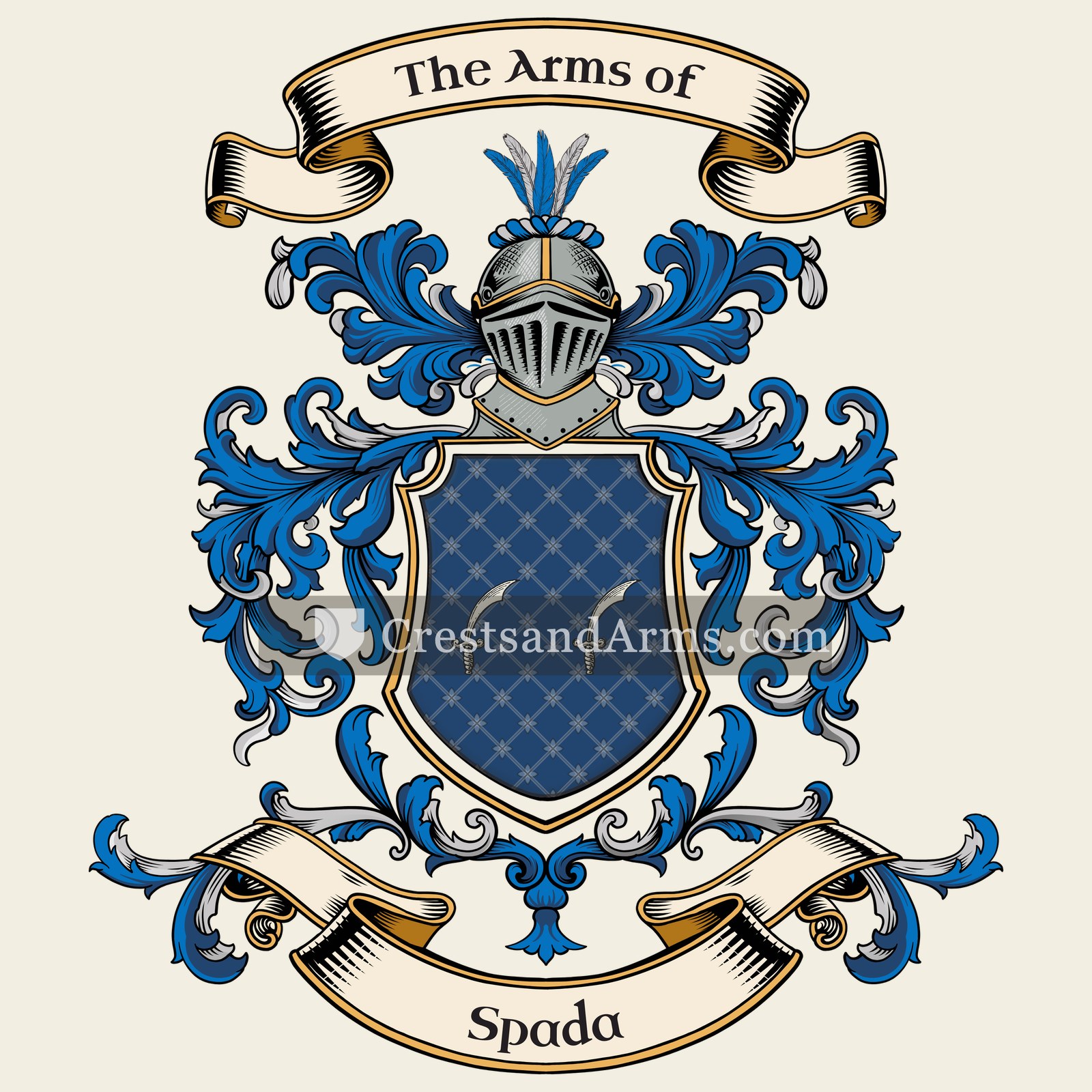
Symbols on this shield
saltireResolution, and St Andrew's cross
swordJustice, and military honour
Colours
Blue (Azure)Means: Loyalty and truth
Silver (Argent)Means: Peace and sincerity
Historical info
Source
J. B. Rietstap, Armorial Général, Gouda: G. B. van Goor Zonen, 1884–87
Blazon (the actual original written record)
“D'azur à deux épées d'arg., passées en saut.”
ItalyLucques, c. 1775
Digital archive packCoat of arms PNG, gold border print PDF, vector SVG and the certificate of authenticity. Sent to your email in minutes.
Map of Italy showing where the Spada arms are recorded
The Spada arms were recorded in Lucques, c. 1775.
This is where the arms were entered in the register. Families often moved to other parts of the country, so the same name can turn up in more than one region.
The body that granted and recorded arms in Italy in this period.
Alvise Giovanni Mocenigo
Sovereign of the period
Alvise Giovanni Mocenigo
1763–1778
Reigning in France when the Spada arms are first recorded.
How Arms Worked in Italy
In the Italian states, coats of arms were often used by noble families to show their status and history. These symbols were passed down through the generations to all legitimate male descendants. Younger branches of a family usually kept the original design but sometimes added small changes to distinguish their specific line from the main branch.
Granting authority
Various local rulers and city governments controlled the use of coats of arms across the different Italian states.
How they got arms
Families often assumed their own arms or received them as official grants from local lords, popes, or city councils.
Where arms were recorded
Arms were recorded in local city archives or private family books rather than in one single national register.
The family's standing
Recorded among the armigerous families of Italy.
Origin & History of the Spada Family in Italy
The surname Spada carries a rich history rooted in the Italian peninsula, where it emerged as a name often associated with military service or craftsmanship. The word itself translates to sword, suggesting that early ancestors may have been skilled blacksmiths or soldiers who earned the name through their trade or prowess on the battlefield. By the late eighteenth century, the family established a notable presence in the city of Lucca. Records confirm that members of the Spada family were living and working in this Tuscan hub by 1775. During this period, Lucca was a center of trade and culture, and families like the Spadas often integrated into the local economy as merchants or civic contributors. This transition from a name linked to physical tools to a settled urban family reflects the broader social shifts occurring in Italy before the turn of the nineteenth century.
Related Branches & Arms
Root word
spatha
A broad, two-edged Roman sword.
This name
SpadaAn occupational name for a swordsman or a maker of swords.
also spelled
Spadda
Spade
Documented Sources
J. B. Rietstap, Armorial Général, Gouda: G. B. van Goor Zonen, 1884–87
Archives départementales de Meurthe-et-Moselle, Série B: Cours et juridictions
Cabourdin, Guy, Terres et hommes en Lorraine 1550-1635, 1977
Lepage, Henri, Les archives de Nancy, ou documents inédits relatifs à l'histoire de cette ville, 1865
Digital archive packCoat of arms PNG, gold border print PDF, vector SVG and the certificate of authenticity. Sent to your email in minutes.


 fessThe military belt, and readiness to serve
 chiefAuthority, wisdom and dominion
 bendDefence, and the scarf of a commander
 lionCourage, strength and royalty
 trefoilPerpetuity, and the Trinity
 ringFidelity, and a promise kept
 fessThe military belt, and readiness to serve
 chiefAuthority, wisdom and dominion
 bendDefence, and the scarf of a commander
 lionCourage, strength and royalty
 trefoilPerpetuity, and the Trinity
 ringFidelity, and a promise kept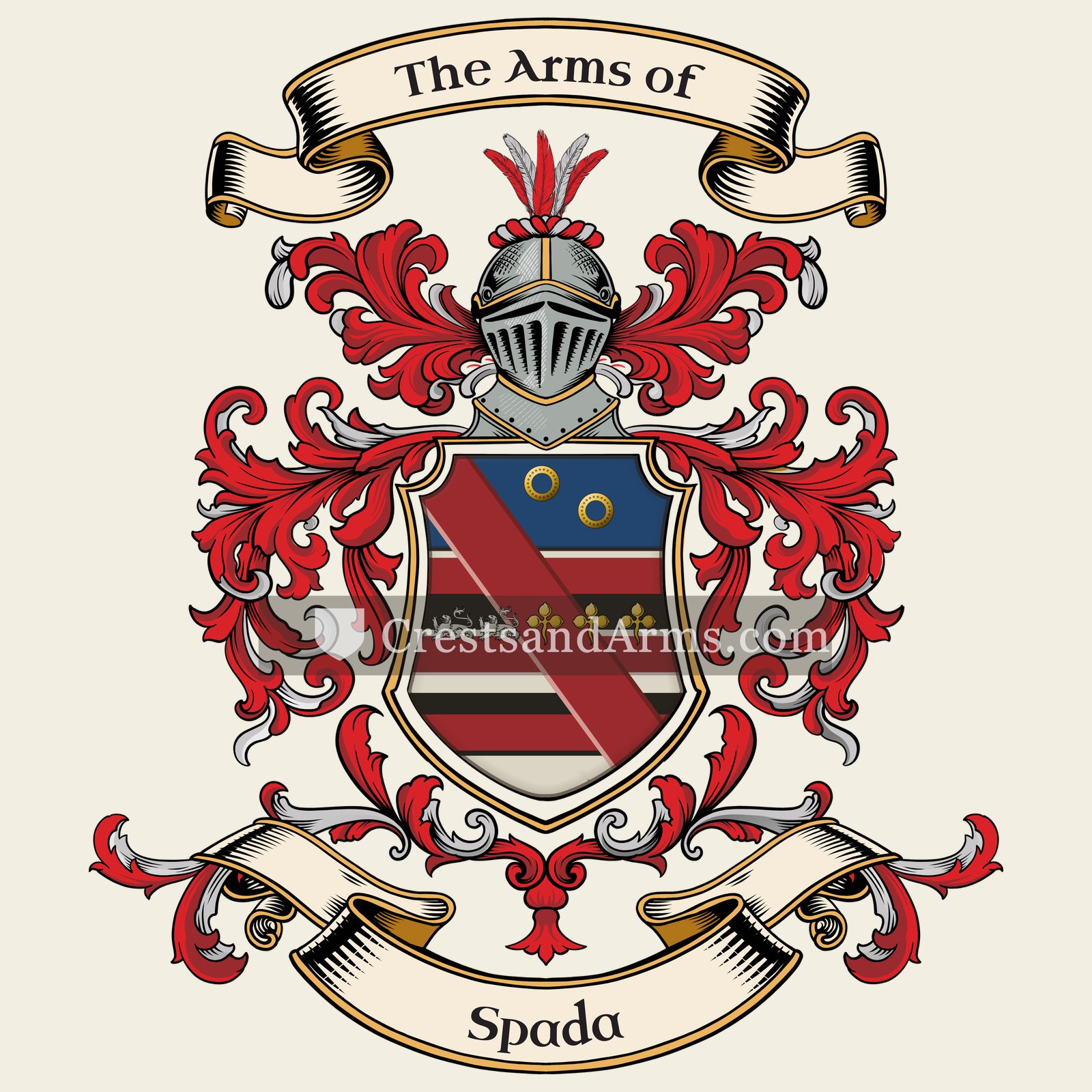


 saltireResolution, and St Andrew's cross
 swordJustice, and military honour