A record of documented arms, meaning and origin, researched for the Spano family lines. Documented in 2 countries.
Reg. 9966 · Danish, T–V
Meaning of the Spano family crest colors & symbols
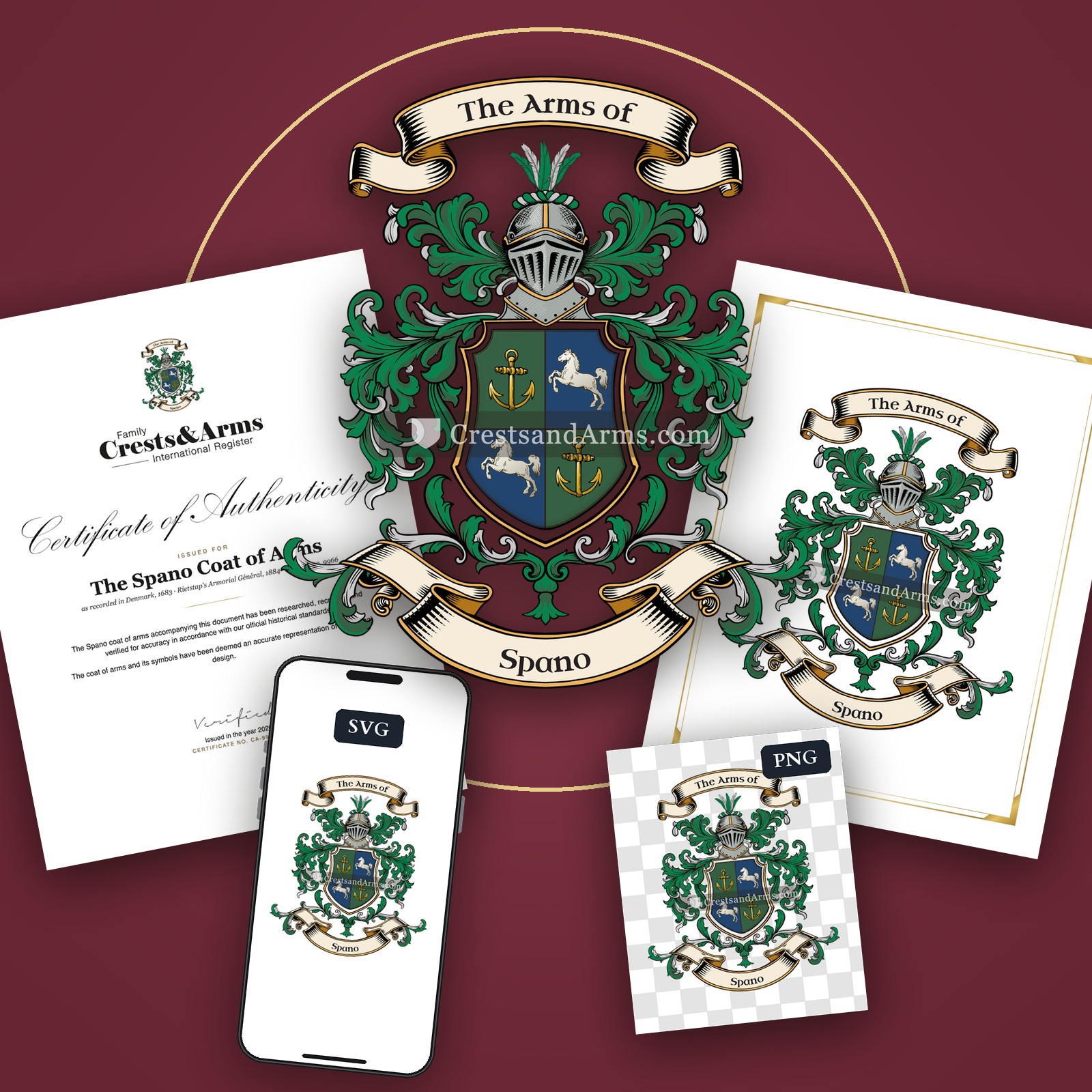
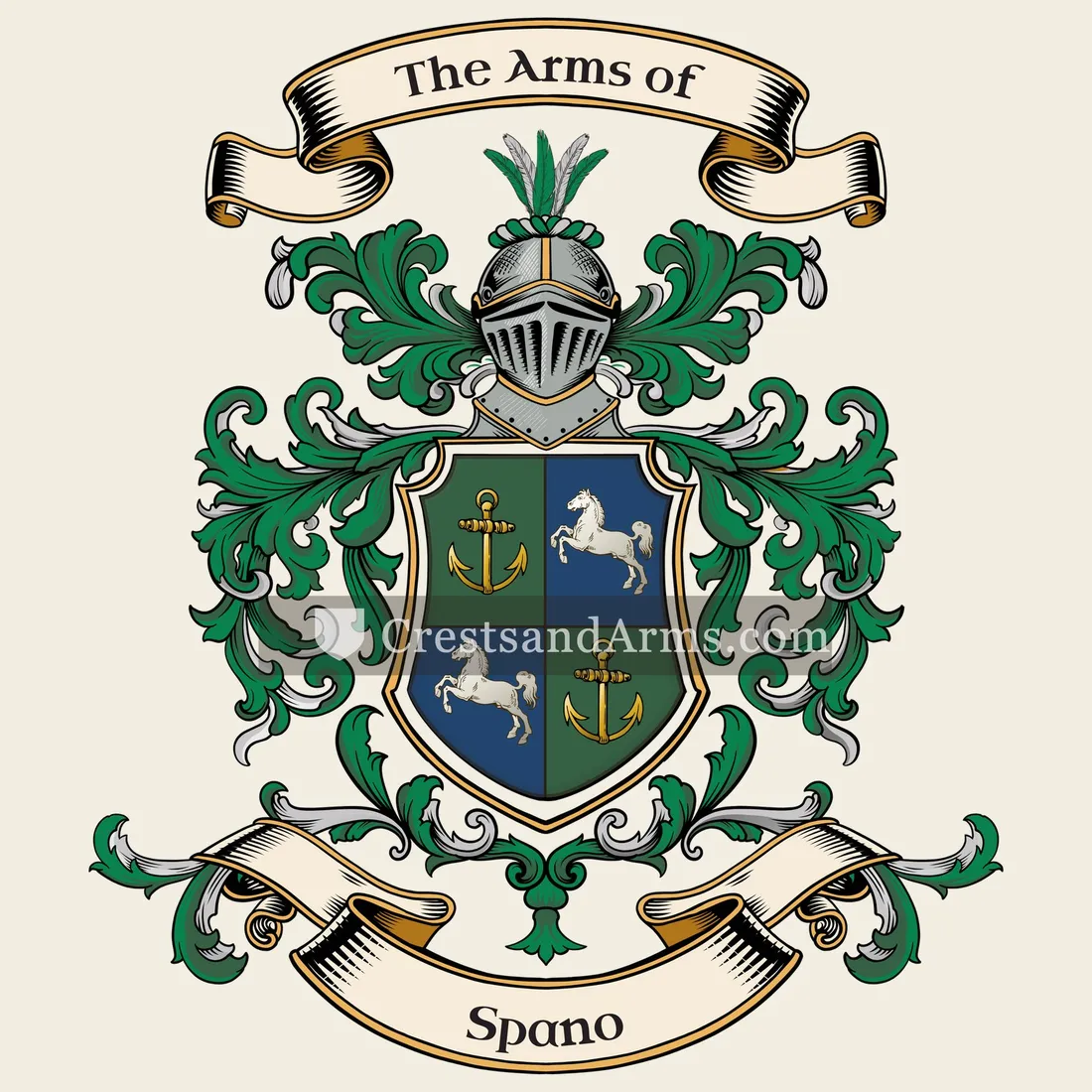
Symbols on this shield
anchorHope, and steadfastness in trouble
horseReadiness to serve king and country
Colours
Green (Vert)Means: Hope
Blue (Azure)Means: Loyalty and truth
Gold (Or)Means: Generosity
Silver (Argent)Means: Peace and sincerity
Historical info
Source
J. B. Rietstap, Armorial Général, Gouda: G. B. van Goor Zonen, 1884–87
Blazon (the actual original written record)
“Ec.: aux 1 et 4 de sin. à une ancre d'or, posée en barre; aux 2 et 3 d'azur à un cheval cont. d'arg., la tête retournée vers dextre, pass. dans une mer d'arg. Sur le tout d'or à un arc bandé de sa., posé en barre, encoché d'une flèche du même, posée en bande. Cq. cour. C.: un bras, arm. au nat., la main de carn. tenant en guidon de gu. à la croix d'arg., la hampe du guidon posée en barre.”
Denmarkc. 1683
Digital archive packCoat of arms PNG, gold border print PDF, vector SVG and the certificate of authenticity. Sent to your email in minutes.
Map of Denmark showing where the Spano arms are recorded
The Spano arms were recorded in Denmark, c. 1683.
Arms such as these were typically recorded in Sjaælland.
Zealand held the Danish court, the crown's offices and Copenhagen itself. Families who served the king kept estates within reach of it, and royal service was the ordinary route to a coat of arms.
This is where the arms were entered in the register. Families often moved to other parts of the country, so the same name can turn up in more than one region.
The body that granted and recorded arms in Denmark in this period.
Christian V of Denmark
Sovereign of the period
Christian V of Denmark
1670–1699
Reigning in Denmark when the Spano arms are first recorded.
How Arms Worked in Denmark
Danish heraldry during this period was closely tied to noble status and royal favor rather than being open to all citizens. Arms were typically granted by the monarch to individuals, and these symbols were then shared by all members of the noble house. If a family line died out, the right to use those specific arms ended with them.
Granting authority
The Danish royal chancery held the power to issue and regulate official coats of arms for the kingdom.
How they got arms
Families usually received their arms through a formal royal grant that confirmed their noble status and rights.
Where arms were recorded
These grants were officially recorded in the Danish Royal Chancery records starting in the sixteenth century.
The family's standing
Recorded among the armigerous families of Denmark.
Origin & History of the Spano Family in Denmark
The Spano family name in Denmark carries a unique history that traces back to the late seventeenth century. Records confirm that members of the family were established on the island of Sjælland by 1683. During this period, Denmark was undergoing significant social changes as the monarchy consolidated power and formalized record-keeping through church registers. The presence of the family in Sjælland suggests they were part of the local community during a time when surnames were becoming more permanent fixtures of identity. While the name itself has roots that often point toward Mediterranean origins, its early appearance in Danish records highlights the movement of people across Europe during the early modern era. These early ancestors likely integrated into the agrarian or artisan classes of the region, contributing to the local workforce and social fabric of the Danish countryside during the reign of King Christian V.
Meaning of the Spano family crest colors & symbols
Symbols on this shield
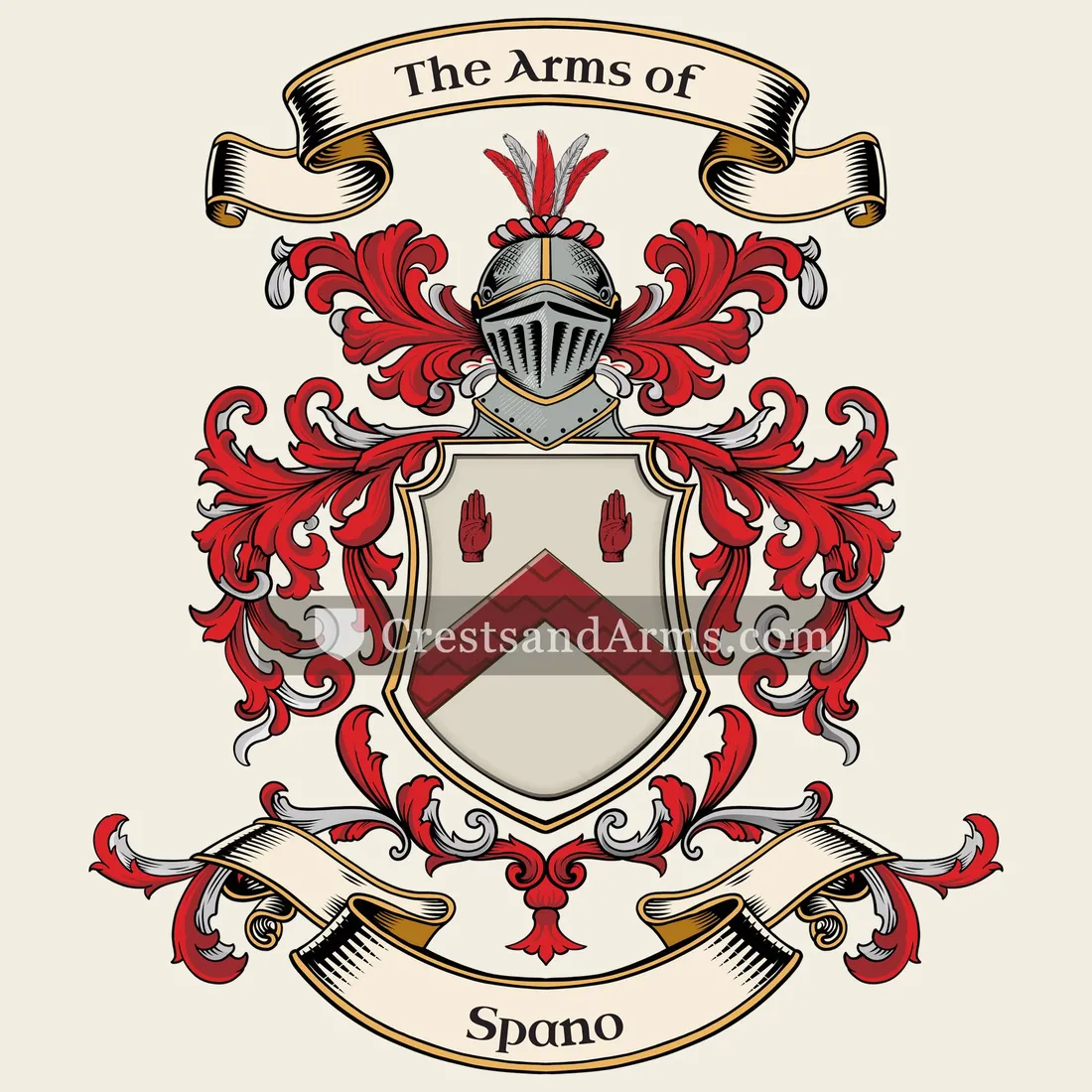
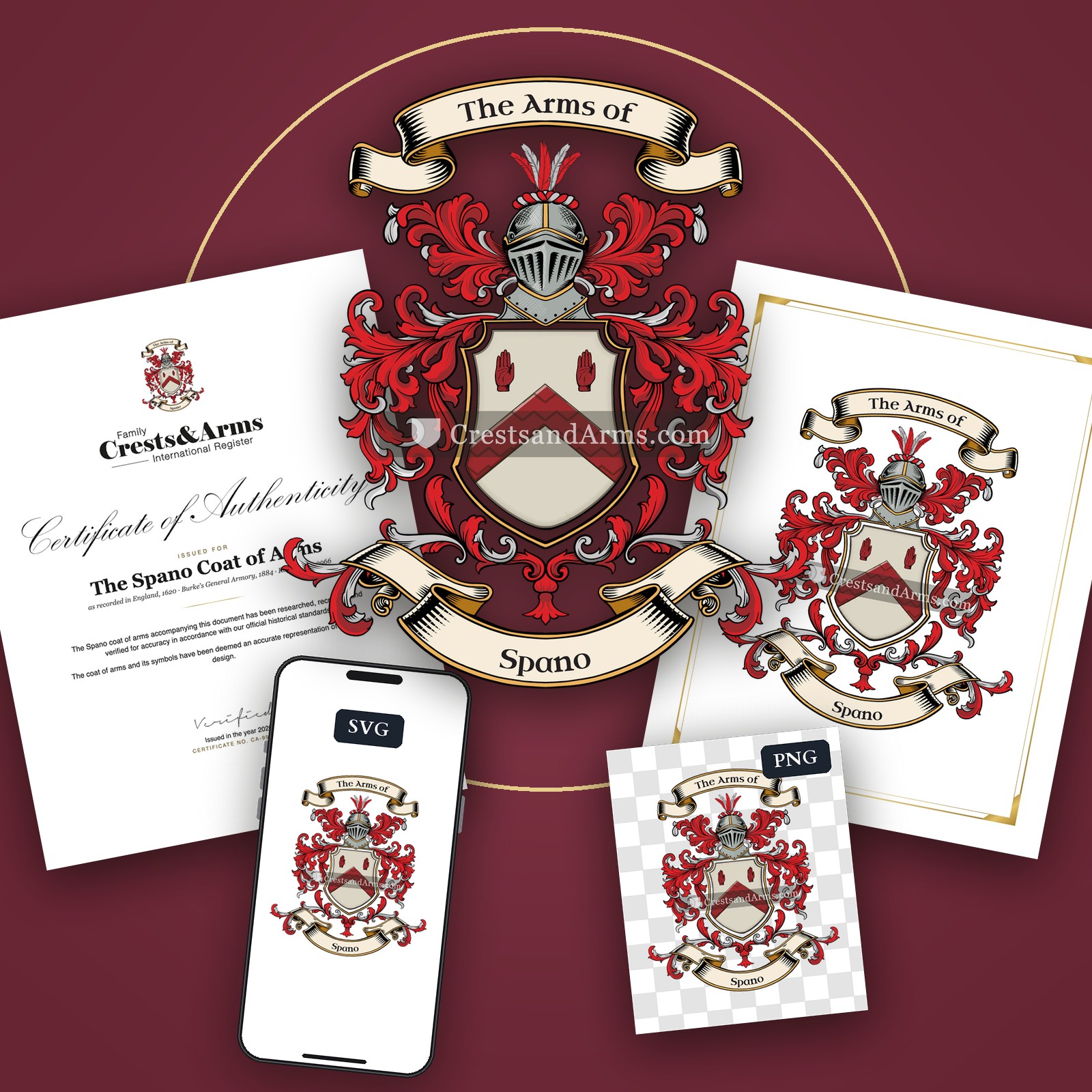
chevronProtection, and faithful service completed
handFaith, sincerity and justice
Colours
Silver (Argent)Means: Peace and sincerity
Red (Gules)Means: Military strength
Historical info
Source
Sir Bernard Burke, The General Armory of England, Scotland, Ireland and Wales, London: Harrison & Sons, 1884
Blazon (the actual original written record)
“Ar. three chev. gu. in chief two dexter hands couped of the last”
Englandc. 1620
Digital archive packCoat of arms PNG, gold border print PDF, vector SVG and the certificate of authenticity. Sent to your email in minutes.
Map of England showing where the Spano arms are recorded
The Spano arms were recorded in England, c. 1620.
Arms such as these were typically recorded in York.
Yorkshire is the largest of the English counties, and it held more gentry families than any other. Land there was split among a great many households rather than a few, so a great many of them carried arms.
This is where the arms were entered in the register. Families often moved to other parts of the country, so the same name can turn up in more than one region.
The body that granted and recorded arms in England in this period.
James VI and I
Sovereign of the period
James VI and I
1603–1625
Reigning in Denmark when the Spano arms are first recorded.
How Arms Worked in England
English heraldry allowed arms to be shared by all legitimate descendants of the original owner. These symbols were treated as personal property that moved through the generations to all children. While the eldest son kept the original design, other family members could use the same shield without needing to change it or register their own unique versions.
Granting authority
The College of Arms in London has regulated the use of coats of arms throughout England and Wales since 1484.
How they got arms
Families typically obtained their coats of arms through a formal grant from the Crown or by proving their ancient right to them.
Where arms were recorded
All official coats of arms are recorded in the registers kept at the College of Arms, which date back to the fifteenth century.
The family's standing
Recorded among the armigerous families of England.
Origin & History of the Spano Family in England
The history of the Spano family in England begins with the arrival of early members in the city of York around 1620. During this period, York was a bustling northern hub where tradespeople and immigrants often settled to find work in the textile and mercantile industries. The name itself is of Mediterranean origin, and its presence in a northern English city suggests that these early ancestors were likely part of the small but significant waves of continental Europeans who traveled to England for religious or economic reasons. By establishing themselves in York, the family became part of the local social fabric during a time of great transition in English history. They lived through the era of the early Stuarts, adapting to the customs and language of their new home while maintaining the unique identity tied to their ancestral name. Over the following decades, these early settlers integrated into the community, contributing to the diverse population that defined the city of York during the seventeenth century.
Spano Meaning & Related Branches
Root word
Spanus
Latin term referring to a person of Hispanic or Spanish origin.
This name
SpanoA surname historically used to identify individuals who migrated from Spain to other European regions.
also spelled
Spann
Spane
Spayne
Documented Sources
J. B. Rietstap, Armorial Général, Gouda: G. B. van Goor Zonen, 1884–87
Rigsarkivet (The Danish National Archives), Kirkebøger for Sjællands Stift (Parish Registers for the Diocese of Sjælland), 1683
Trap, J.P., Statistisk-topographisk Beskrivelse af Kongeriget Danmark, 1856
Digital archive packCoat of arms PNG, gold border print PDF, vector SVG and the certificate of authenticity. Sent to your email in minutes.


 anchorHope, and steadfastness in trouble
 horseReadiness to serve king and country
 anchorHope, and steadfastness in trouble
 horseReadiness to serve king and country


 chevronProtection, and faithful service completed
 handFaith, sincerity and justice