A record of documented arms, meaning and origin, researched for the Speller family lines. Documented in 3 countries.
Reg. 5197 · Austrian, T–V
Coat of Arms & Family Crest Details
Symbols on this shield
chequyConstancy, and the counting-board
bearStrength, cunning and protection of kin
Colours
Gold (Or)Means: Generosity
Red (Gules)Means: Military strength
Black (Sable)Means: Constancy
Historical info
Source
J. B. Rietstap, Armorial Général, Gouda: G. B. van Goor Zonen, 1884–87
Blazon (the actual original written record)
“Ec.: aux 1 et 4 d'or à un ours ramp. de sa.; aux 2 et 3 échiq. de gu. et d'arg. Cq. cour. C.: un ours iss. de sa., tenant ses pattes un échiquier de gu. et d'arg.”
Austriac. 1772
Digital archive packCoat of arms PNG, gold border print PDF, vector SVG and the certificate of authenticity. Sent to your email in minutes.
Map of Austria showing where the Speller arms are recorded
The Speller arms were recorded in Austria, c. 1772.
Arms such as these were typically recorded in Tyrol.
Tyrol was mountain country in western Austria, where the valleys were held by families who had been there a very long time. Old tenure counted for more than money, and old families carried arms.
This is where the arms were entered in the register. Families often moved to other parts of the country, so the same name can turn up in more than one region.
Region
Tyrol
First recorded
1772
Granting Authority for the Speller Arms
Imperial and Royal chancery
Sodacan · CC BY-SA 3.0
The body that granted and recorded arms in Austria in this period.
Joseph II, Holy Roman Emperor
Sovereign of the period
Joseph II, Holy Roman Emperor
1765–1790
Reigning in Austria when the Speller arms are first recorded.
How Arms Worked in Austria
Austrian coats of arms were often linked directly to noble titles granted by the Emperor. These symbols belonged to the entire family line rather than just one individual. When a family grew, new branches kept the original design without needing to change it. This system allowed all members of a noble house to share the same identity across many generations.
Granting authority
The Imperial and Royal chancery managed all heraldic matters and controlled the official granting of arms throughout the Austrian lands.
How they got arms
Families typically received their arms through a formal imperial decree that often accompanied the elevation of a person to noble status.
Where arms were recorded
Official records of these grants were kept in the Imperial Register of Nobility which began its formal documentation process in 1453.
The family's standing
Recorded among the armigerous families of Austria.
Origin & History of the Speller Family in Austria
The family name Speller has deep roots in the alpine region of Tyrol, where records confirm members of the family were established by 1772. During this period, the name was closely tied to the rugged landscape and the traditional agricultural lifestyle of the Austrian mountains. Families in this area often derived their surnames from their specific trade or their location within a valley. In the case of the Spellers, the name likely emerged from a local dialect term describing a person who worked with wood or served as a village official. As the family settled in Tyrol, they became part of the tightly knit mountain communities that relied on communal farming and seasonal trade routes crossing the Alps. These early ancestors lived through a time of significant transition in the Habsburg Empire, as the region moved toward more centralized administration and record-keeping. By maintaining their presence in these high-altitude settlements, the Speller family contributed to the long-standing cultural identity of the Tyrolean people.
Coat of Arms & Family Crest Details
Symbols on this shield
mountThe ground held, and steadfastness upon it
lozengeHonour and nobility, and the arms of a woman
Colours
Blue (Azure)Means: Loyalty and truth
Green (Vert)Means: Hope
Gold (Or)Means: Generosity
Historical info
Source
J. B. Rietstap, Armorial Général, Gouda: G. B. van Goor Zonen, 1884–87
Blazon (the actual original written record)
“D'azur à trois fuseaux accostés d'or, posés en éventail sur un tertre de trois coupeaux de sin. C.: les fuseaux. L., d'or et d'azur.”
Switzerlandc. 1745
Digital archive packCoat of arms PNG, gold border print PDF, vector SVG and the certificate of authenticity. Sent to your email in minutes.
Map of Switzerland showing where the Speller arms are recorded
The Speller arms were recorded in Switzerland, c. 1745.
Arms such as these were typically recorded in Bern.
Bern was the largest of the Swiss cantons and ran itself, with its own council and its own courts. Its governing families held office for generations, and office of that kind carried a shield with it.
This is where the arms were entered in the register. Families often moved to other parts of the country, so the same name can turn up in more than one region.
The body that granted and recorded arms in Switzerland in this period.
How Arms Worked in Switzerland
In Switzerland, coats of arms were not restricted to the nobility and were often adopted by common citizens and families. These symbols were passed down through generations to show family identity. When branches of a family grew, they often changed small details of the design to distinguish their own line from the original group.
Granting authority
Cantonal and civic authorities managed the use of coats of arms within their specific regions and local jurisdictions.
How they got arms
Families typically assumed their own coats of arms based on local custom rather than receiving them from a central monarch.
Where arms were recorded
Arms were recorded in various cantonal and civic registers starting from the fourteenth century throughout the Swiss region.
The family's standing
Recorded among the armigerous families of Switzerland.
Origin & History of the Speller Family in Switzerland
The family name Speller has deep roots in the Swiss canton of Bern, where records confirm members of the family were established by 1745. During this period, Bern was a powerful city-state governed by a strict social hierarchy, and families like the Spellers were often integrated into the local craft or agricultural guilds that defined daily life. The name itself likely originated as an occupational descriptor, as the term often related to individuals who were skilled in reading, writing, or acting as a scribe in an era when literacy was not yet universal. Living in the heart of the Swiss Confederation, these early family members would have navigated a landscape shaped by the transition from feudal traditions to the burgeoning influence of the Enlightenment. Their presence in official municipal registers suggests they were recognized citizens who contributed to the stability and administrative functions of the Bernese region during the mid-eighteenth century.
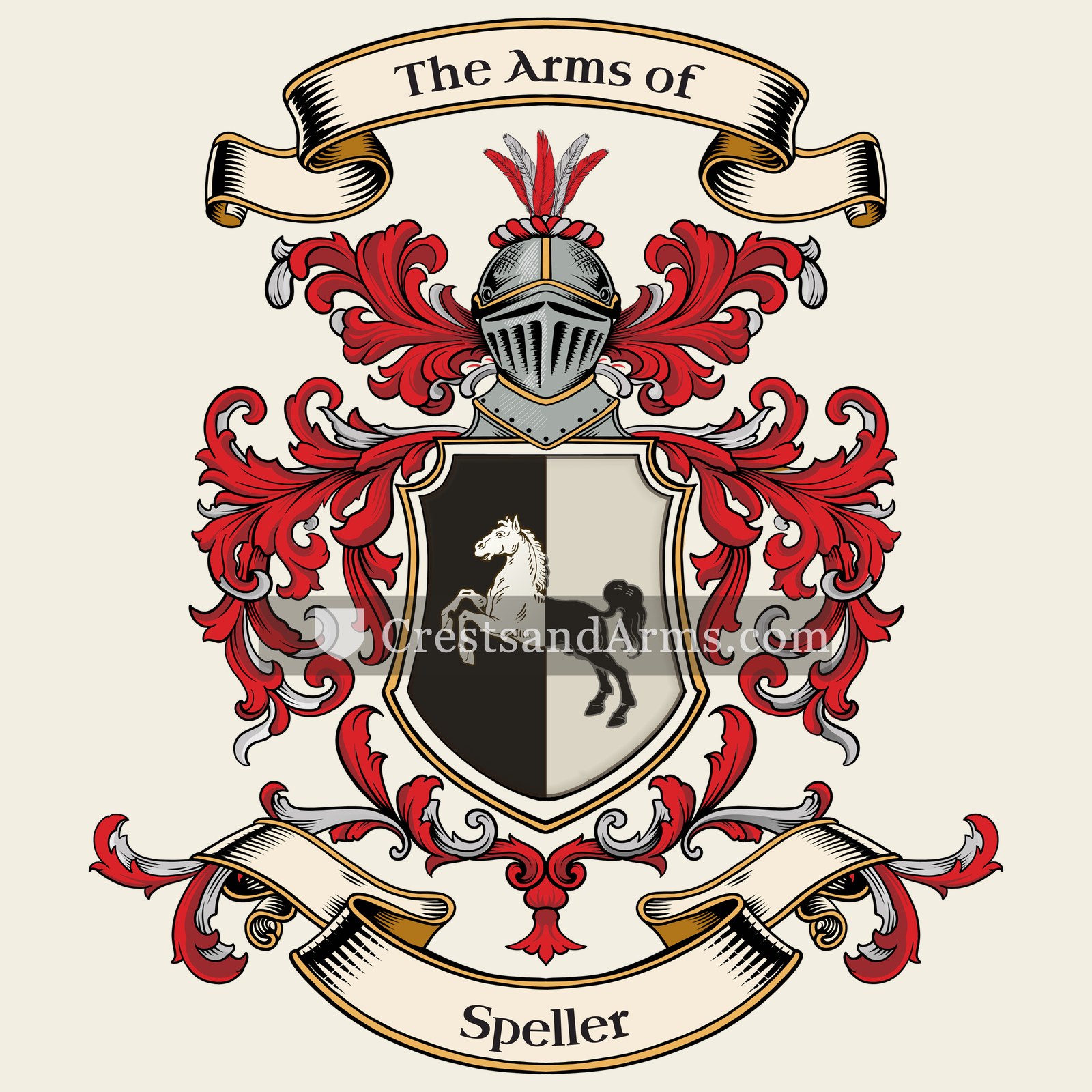
Coat of Arms & Family Crest Details
Symbols on this shield
horseReadiness to serve king and country
Colours
Black (Sable)Means: Constancy
Silver (Argent)Means: Peace and sincerity
Historical info
Source
Sir Bernard Burke, The General Armory of England, Scotland, Ireland and Wales, London: Harrison & Sons, 1884
Blazon (the actual original written record)
“Per pale sa. and ar. a horse courant counterchanged”
CornwallBodmin · Cornwall, c. 1620
Digital archive packCoat of arms PNG, gold border print PDF, vector SVG and the certificate of authenticity. Sent to your email in minutes.
Map of England showing where the Speller arms are recorded
The Speller arms were recorded in Cornwall, c. 1620.
Cornwall was a county apart, with its own language and its own tight-knit gentry. Tin and the sea made money there, and families who made it bought land, which is what brought arms with it.
This is where the arms were entered in the register. Families often moved to other parts of the country, so the same name can turn up in more than one region.
The body that granted and recorded arms in England in this period.
James VI and I
Sovereign of the period
James VI and I
1603–1625
Reigning in Austria when the Speller arms are first recorded.
How Arms Worked in England
English heraldry allowed arms to be shared by all legitimate descendants of the original owner. These symbols were treated as personal property that moved through the generations to all children. While the eldest son kept the original design, other family members could use the same shield without needing to change it or register their own unique versions.
Granting authority
The College of Arms in London has regulated the use of coats of arms throughout England and Wales since 1484.
How they got arms
Families typically obtained their coats of arms through a formal grant from the Crown or by proving their ancient right to them.
Where arms were recorded
All official coats of arms are recorded in the registers kept at the College of Arms, which date back to the fifteenth century.
The family's standing
Recorded among the armigerous families of Cornwall.
Origin & History of the Speller Family in England
The surname Speller is an occupational name that traces its roots back to the Middle Ages in England. It originates from the Middle English word "speller," which referred to someone who recited stories, performed plays, or acted as a public speaker. By the early 17th century, the family had established a notable presence in the rugged landscape of Cornwall. Records from 1620 confirm that members of the Speller family were living in this southwestern region, likely working in trades connected to the local mining or maritime industries. As the name moved through English history, it transitioned from a descriptor of a person’s professional role into a permanent family identifier passed down through generations. This evolution reflects the broader social changes in England, where surnames became essential for tracking families as populations grew and moved across the countryside.
Related Branches & Arms
Root word
Spellen
Middle High German term for playing, joking, or performing a narrative.
This name
SpellerAn occupational surname for a storyteller, minstrel, or someone who performed plays.
also spelled
Spiler
Spilar
Spillar
Documented Sources
J. B. Rietstap, Armorial Général, Gouda: G. B. van Goor Zonen, 1884–87
Kranzmayer, Eberhard. Ortsnamenbuch von Kärnten. 1956
Schweizer, Friedrich. Tiroler Familiennamen. 1982
Tiroler Landesarchiv, Tiroler Steuerkataster
Tiroler Landesarchiv, Pfarrmatriken der Diözese Innsbruck
Digital archive packCoat of arms PNG, gold border print PDF, vector SVG and the certificate of authenticity. Sent to your email in minutes.


 chequyConstancy, and the counting-board
 bearStrength, cunning and protection of kin
 chequyConstancy, and the counting-board
 bearStrength, cunning and protection of kin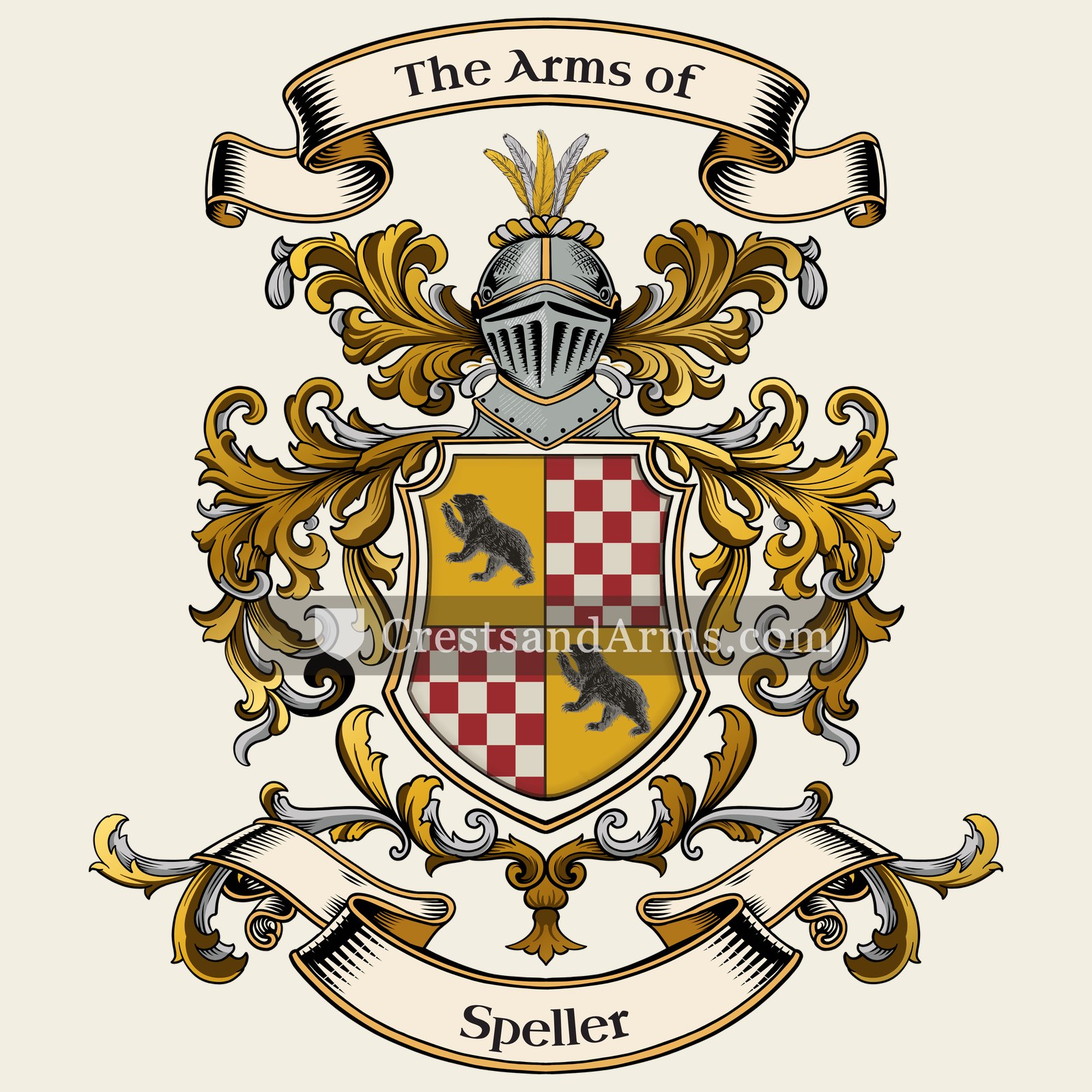


 mountThe ground held, and steadfastness upon it
 lozengeHonour and nobility, and the arms of a woman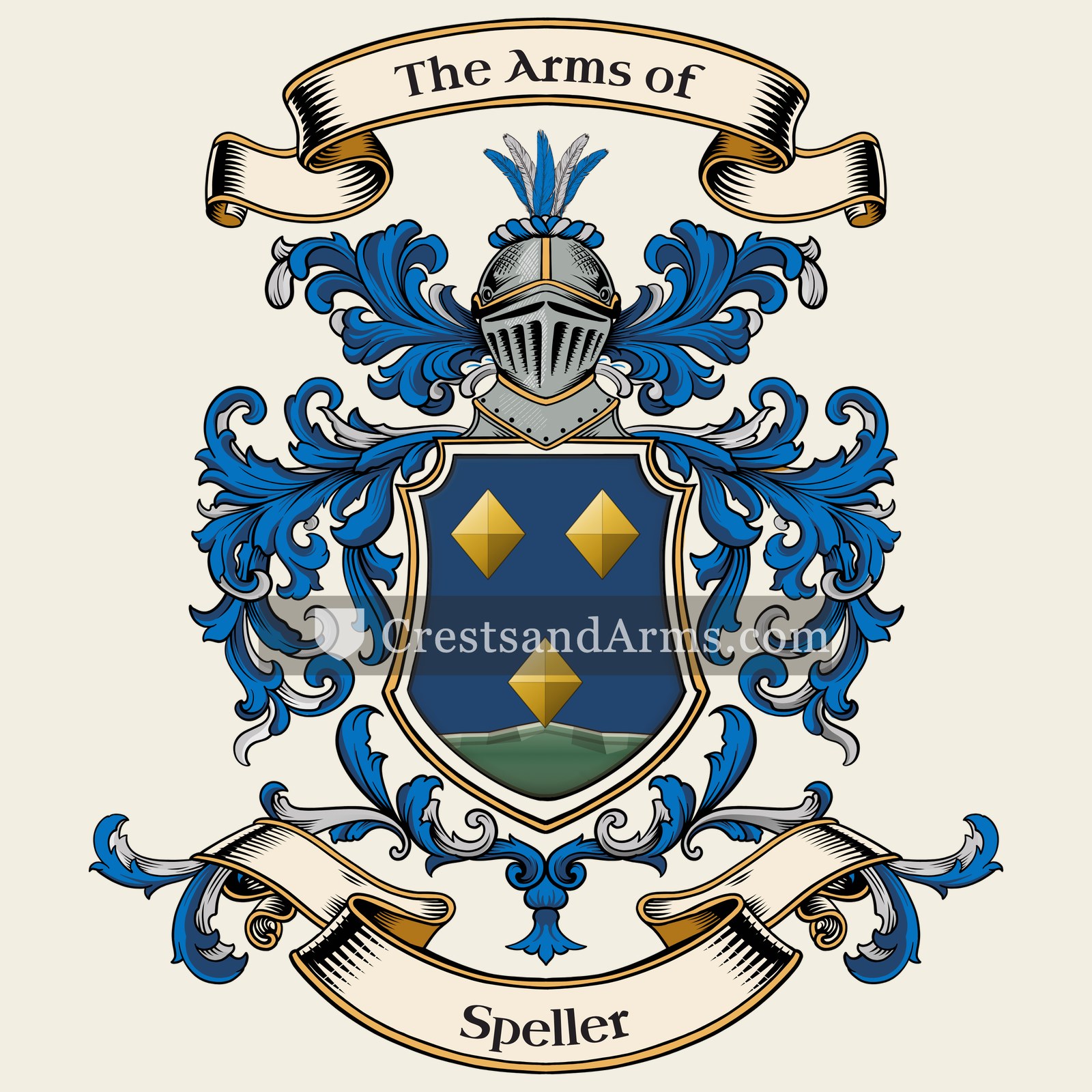

 horseReadiness to serve king and country