Map of Belgium showing where the Spiering arms are recorded
The Spiering arms were recorded in Belgium, c. 1737.
Arms such as these were typically recorded in Brabant.
Brabant lay at the heart of the Low Countries, where the trade routes met. Its towns were wealthy and its landowners many, and both kinds of family kept arms, which is why the region is so heavily represented.
This is where the arms were entered in the register. Families often moved to other parts of the country, so the same name can turn up in more than one region.
The body that granted and recorded arms in Belgium in this period.
Charles VI, Holy Roman Emperor
Sovereign of the period
Charles VI, Holy Roman Emperor
1711–1740
Reigning in Belgium when the Spiering arms are first recorded.
How Arms Worked in Belgium
In Belgium, a coat of arms is considered personal property that is passed down through the male line to legitimate descendants. Families often use the same shield design across generations to show their shared heritage. If a branch of the family wants to change the design, they must apply for an official update to their specific version of the arms.
Granting authority
The Conseil héraldique is the official body that regulates and approves all coats of arms in Belgium.
How they got arms
Families obtain their coats of arms through formal royal grants or by confirming their historical right to use existing designs.
Where arms were recorded
All approved coats of arms are officially recorded in the public registers of the Conseil héraldique since 1844.
The family's standing
Recorded among the armigerous families of Belgium.
Origin & History of the Spiering Family in Belgium
The family name Spiering has deep roots in the region of Brabant, where historical records confirm the presence of family members as early as 1737. During the eighteenth century, Brabant was a central hub of activity within the Austrian Netherlands, characterized by a mix of agricultural traditions and growing urban commerce. The name itself is thought to be linked to the Middle Dutch word spiering, which refers to a small, silvery fish known as the smelt. In many cases, surnames derived from fish or nature were given to people who worked as fishermen, fishmongers, or those who lived near bodies of water where these fish were common. As the family established itself in this region, they likely participated in the local economy and social structures of the time, contributing to the development of the communities that defined the landscape of modern-day Belgium.
Coat of Arms & Family Crest Details
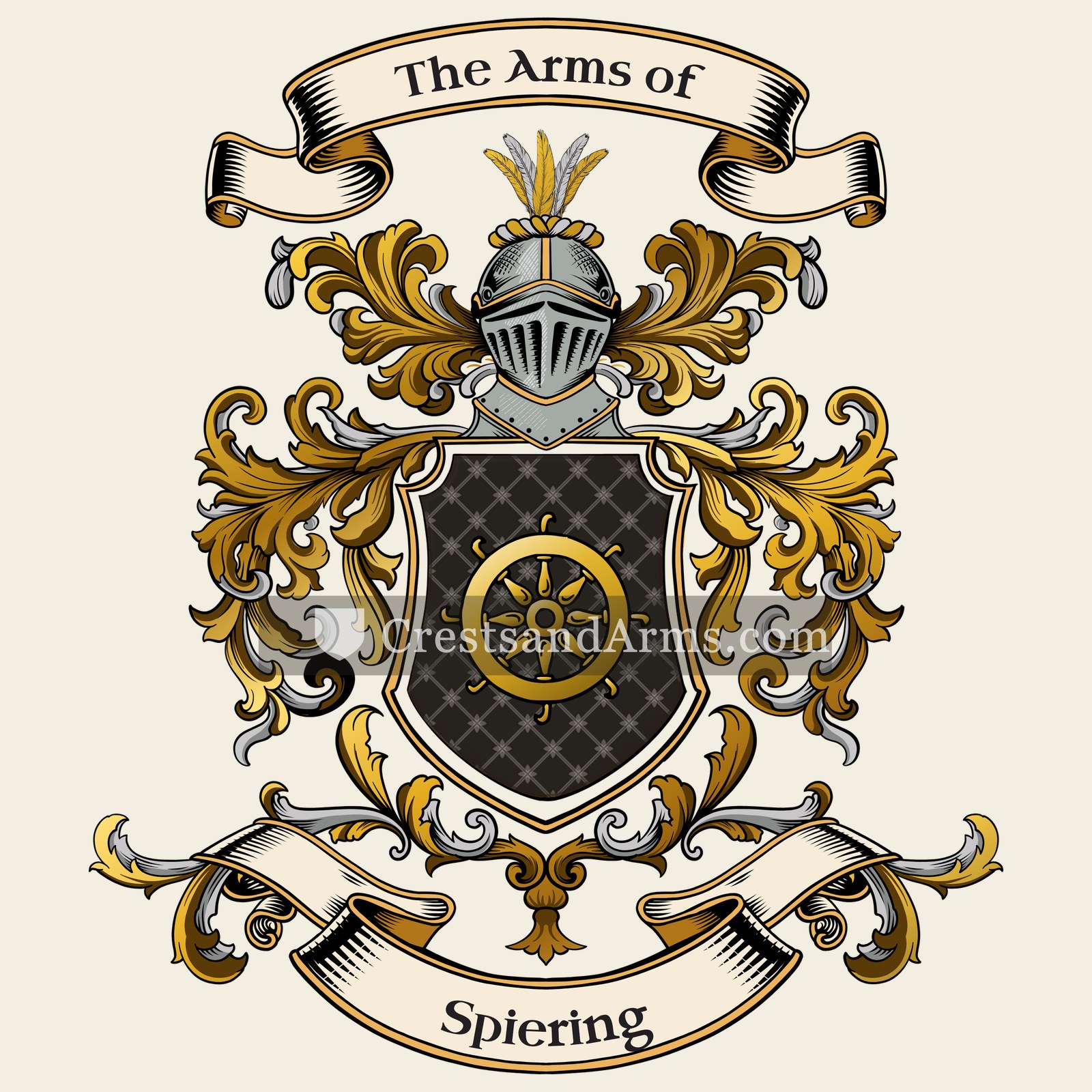
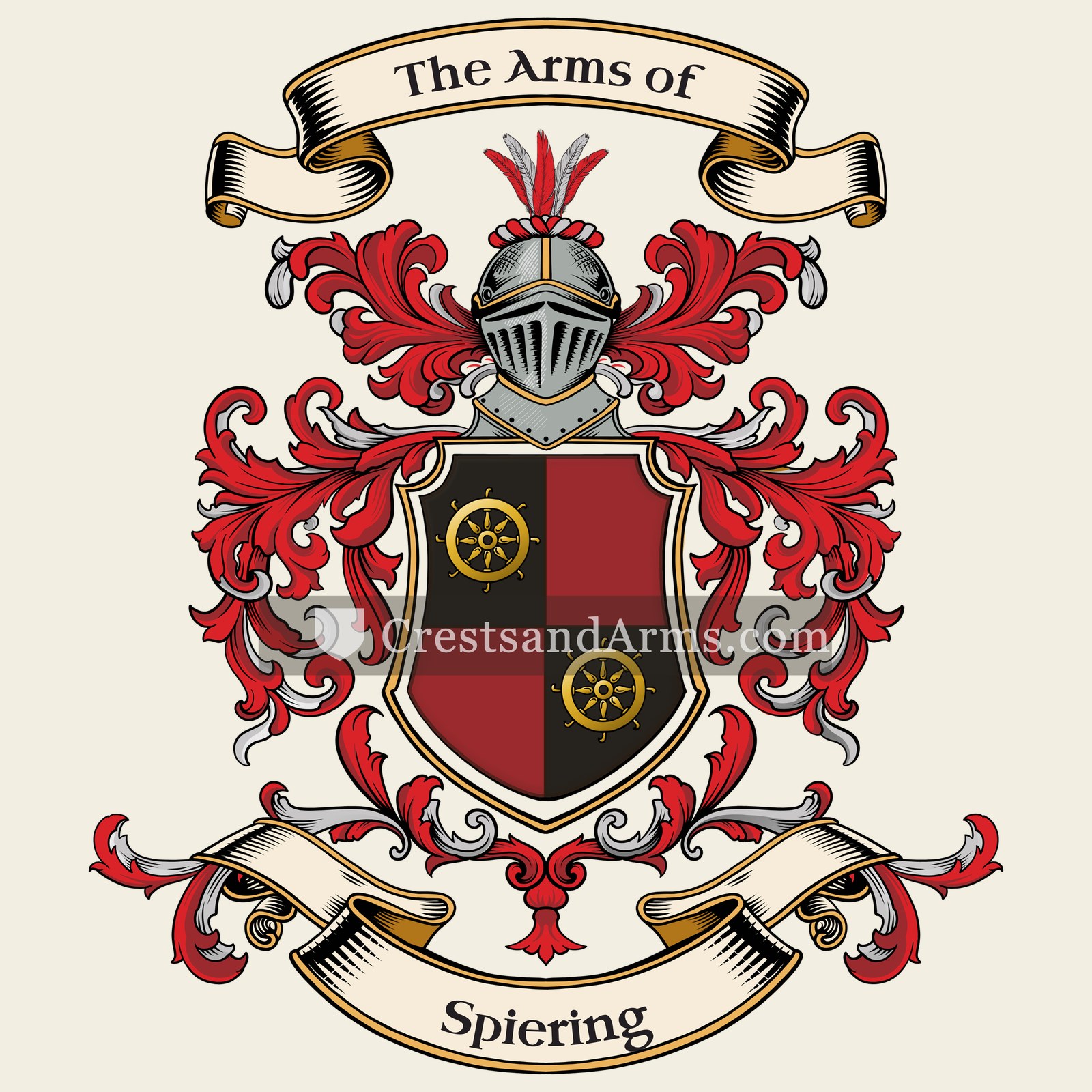
Symbols on this shield
wheelFortune's turning, and the carter's trade
Colours
Black (Sable)Means: Constancy
Red (Gules)Means: Military strength
Gold (Or)Means: Generosity
Historical info
Source
J. B. Rietstap, Armorial Général, Gouda: G. B. van Goor Zonen, 1884–87
Blazon (the actual original written record)
“Ec.: aux 1 et 4 de sa. à une roue d'or; aux 2 et 3 de gu. à trois éperlans nageants d'arg., l'un sur l'autre.”
Netherlandsc. 1815
Digital archive packCoat of arms PNG, gold border print PDF, vector SVG and the certificate of authenticity. Sent to your email in minutes.
Map of Netherlands showing where the Spiering arms are recorded
The Spiering arms were recorded in Netherlands, c. 1815.
Arms such as these were typically recorded in Friesland.
Friesland was low, wet country on the northern coast of the Netherlands, farmed by families who had held the same land for centuries. Free landholders were unusually common there, and a free landholder could carry arms.
This is where the arms were entered in the register. Families often moved to other parts of the country, so the same name can turn up in more than one region.
Region
Friesland
First recorded
1815
Granting Authority for the Spiering Arms
Hoge Raad van Adel
Photograph made by me · CC BY-SA 3.0
The body that granted and recorded arms in Netherlands in this period.
William I of the Netherlands
Sovereign of the period
William I of the Netherlands
1815–1840
Reigning in Belgium when the Spiering arms are first recorded.
How Arms Worked in Netherlands
In the Netherlands, coats of arms were often used by noble families and those who held specific public offices. These arms were passed down through the generations to legitimate descendants. Younger branches of a family usually kept the original design without needing to add special marks. This system ensured that the family identity remained clear and consistent over many years.
Granting authority
The Hoge Raad van Adel is the official body that regulates and manages noble titles and coats of arms in the Netherlands.
How they got arms
Families typically obtained their coats of arms through official royal grants or by proving their long-standing historical use of the symbols.
Where arms were recorded
Coats of arms are officially recorded in the registers held by the Hoge Raad van Adel, which began its work in 1814.
The family's standing
Recorded among the armigerous families of Netherlands.
Origin & History of the Spiering Family in Netherlands
The family name Spiering has deep roots in the northern regions of the Netherlands, particularly within the province of Friesland. By the early 19th century, records confirm that members of the family were well-established in this area, living through a time of significant political change as the Netherlands transitioned into a unified kingdom. The name itself is thought to be derived from the Middle Dutch word "spierinc," which refers to a small, silvery fish known as a smelt. In medieval times, surnames were often taken from a person’s occupation, a physical trait, or a nickname, suggesting that the first people to carry this name may have been involved in the local fishing industry or were perhaps noted for their slender build. As the family grew, they became part of the social fabric of the Frisian countryside, contributing to the agricultural and maritime traditions that defined the region during the 1800s.
Coat of Arms & Family Crest Details
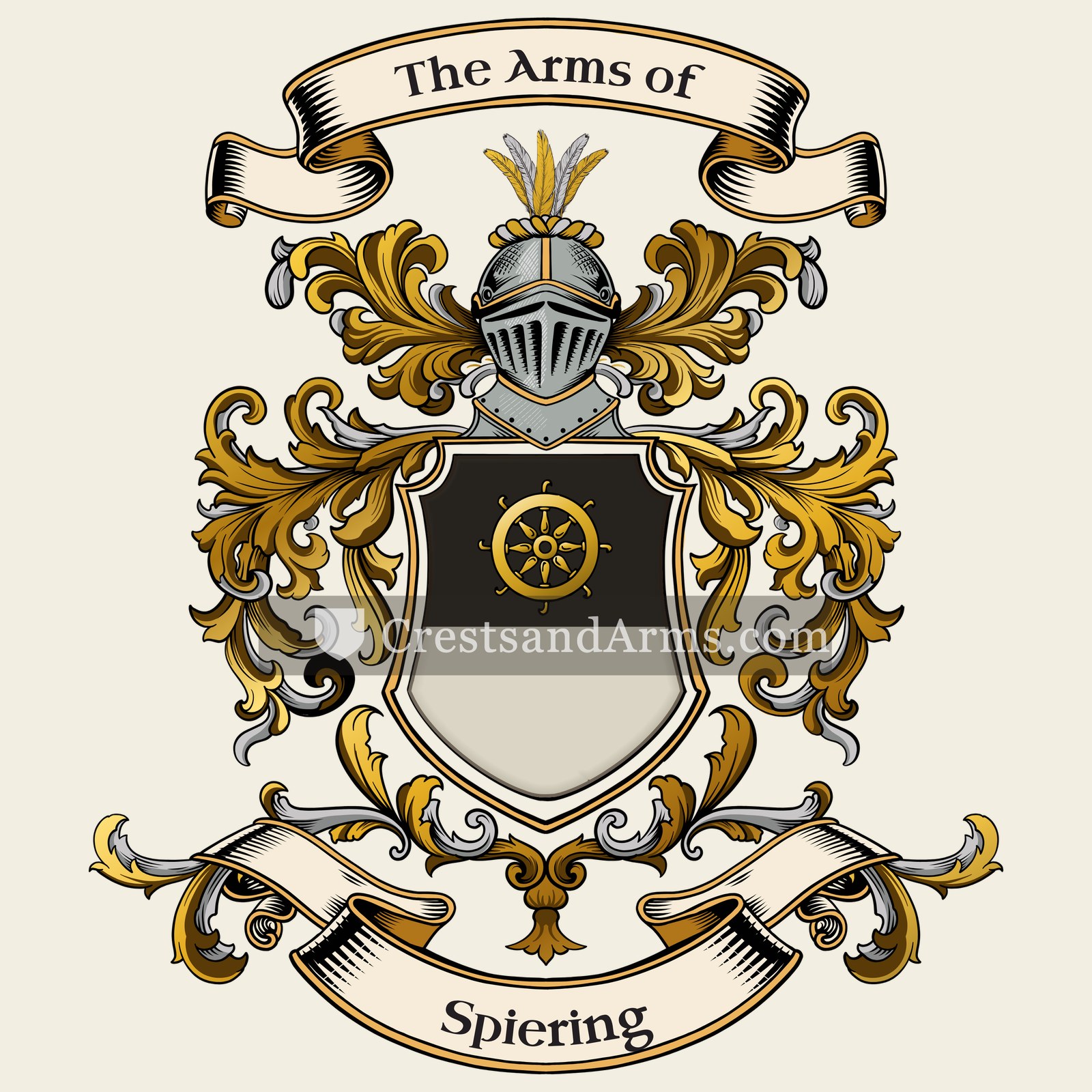
Symbols on this shield
wheelFortune's turning, and the carter's trade
Colours
Black (Sable)Means: Constancy
Silver (Argent)Means: Peace and sincerity
Gold (Or)Means: Generosity
Historical info
Source
J. B. Rietstap, Armorial Général, Gouda: G. B. van Goor Zonen, 1884–87
Blazon (the actual original written record)
“Coupé: au 1 de sa. à une roue d'or; au 2 d'arg. à trois ruches de gu., cerclées chacune de trois pièces de sa. Cq. cour. C.: la roue, entre un vol de sa. L.: à dextre d'or et de sa., à sen. d'arg. et de sa.”
BavariaBade · Bavaria, c. 1623
Digital archive packCoat of arms PNG, gold border print PDF, vector SVG and the certificate of authenticity. Sent to your email in minutes.
Map of Germany showing where the Spiering arms are recorded
The Spiering arms were recorded in Bavaria, c. 1623.
Bavaria was a country of old landed families and walled market towns. Estates passed down the same line for centuries, and both the landowners and the leading townsmen kept arms, which is why so many Bavarian names sit in the registers.
This is where the arms were entered in the register. Families often moved to other parts of the country, so the same name can turn up in more than one region.
The body that granted and recorded arms in Germany in this period.
Ferdinand II, Holy Roman Emperor
Sovereign of the period
Ferdinand II, Holy Roman Emperor
1619–1637
Reigning in Belgium when the Spiering arms are first recorded.
How Arms Worked in Germany
In the Holy Roman Empire, coats of arms were often granted to individuals by the Emperor or his representatives. These arms were then passed down through the generations to all legitimate descendants of the original holder. Younger branches of a family usually kept the same shield design without needing to change it, as the arms belonged to the entire lineage.
Granting authority
The Holy Roman Emperor held the sole power to grant new coats of arms throughout his vast imperial territories.
How they got arms
Families typically obtained their coats of arms through a formal imperial grant or by proving their noble status to the authorities.
Where arms were recorded
These grants were officially recorded in the Imperial Chancery registers, which began keeping formal records of such honors during the Middle Ages.
The family's standing
Recorded among the armigerous families of Bavaria.
Origin & History of the Spiering Family in Germany
The family name Spiering traces its roots back to the Germanic regions, with significant historical evidence placing the family in Bavaria by the year 1623. The name itself is thought to be derived from the Middle High German word *spier*, which was often used to describe a tall or slender person. During the early seventeenth century, Bavaria was a region defined by the turmoil of the Thirty Years' War, which forced many families to move or document their presence more carefully for local authorities. Members of the Spiering family during this era were likely involved in the agricultural or artisan trades that supported the local Bavarian economy. As the family established their roots in southern Germany, they became part of the social fabric of the region, navigating the complex religious and political shifts that shaped the Holy Roman Empire. By maintaining their presence in these communities, the early generations of the Spiering family helped preserve their name as a recognized part of the local population for centuries to come.
Related Branches & Arms
Root word
spier
A Middle Dutch term referring to a spear or a pointed object.
This name
SpieringLikely an occupational name for a spearman or a nickname for a tall, thin person.
also spelled
Speering
Documented Sources
J. B. Rietstap, Armorial Général, Gouda: G. B. van Goor Zonen, 1884–87
State Archives in Belgium (Rijksarchief in België), Parochieregisters (Dopen, Huwelijken, Begrafenissen)
State Archives in Belgium (Rijksarchief in België), Registers van de Burgerlijke Stand
Debrabandere, Frans, Woordenboek van de familienamen in België en Noord-Frankrijk, 1993
Leys, O., De familienamen in de Zuidelijke Nederlanden, 1974
Digital archive packCoat of arms PNG, gold border print PDF, vector SVG and the certificate of authenticity. Sent to your email in minutes.


 wheelFortune's turning, and the carter's trade
 wheelFortune's turning, and the carter's trade