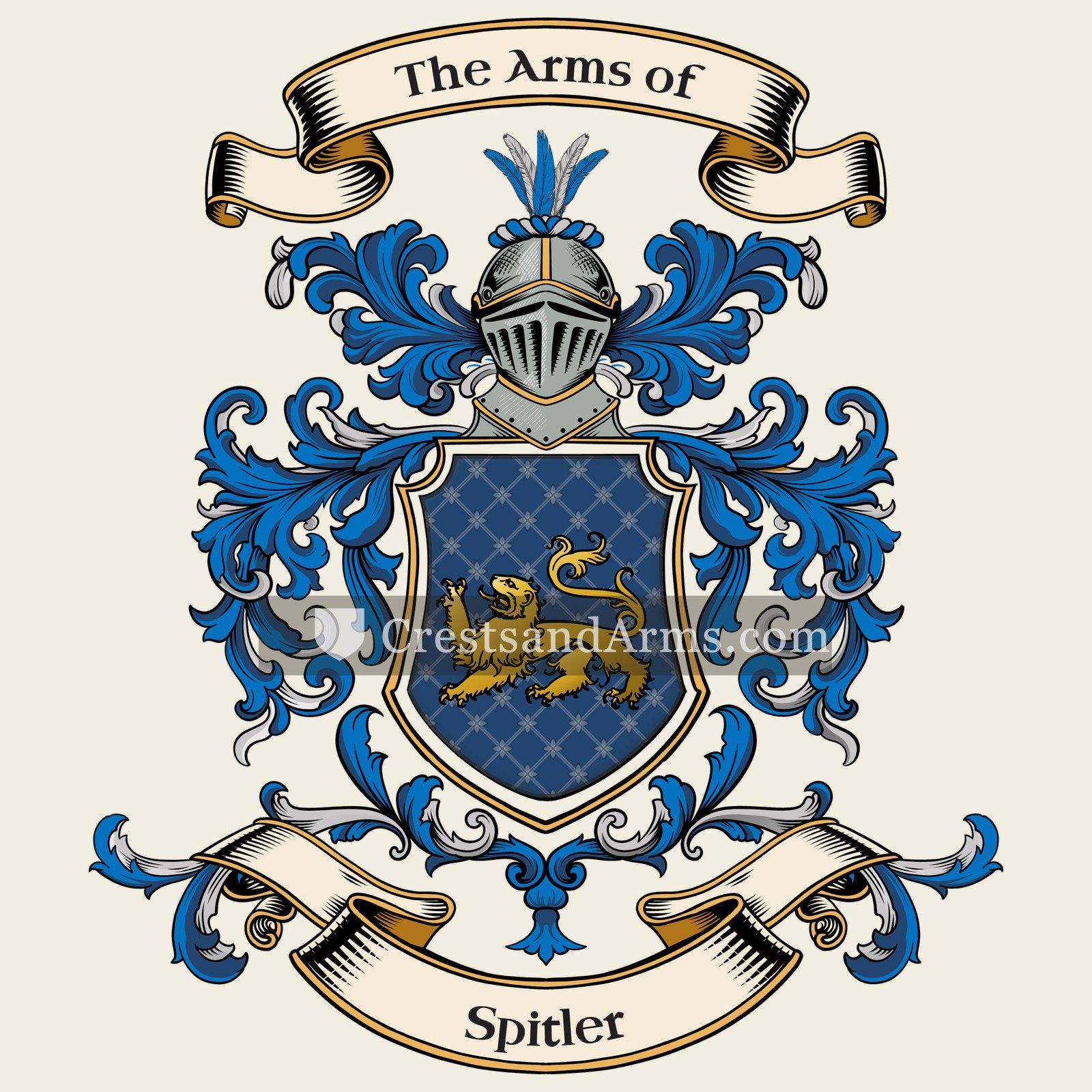
A record of documented arms, meaning and origin, researched for the Spitler family of Switzerland.
Reg. 6640 · Swiss, T–V
Coat of Arms & Family Crest Details
Symbols on this shield
lionCourage, strength and royalty
Colours
Blue (Azure)Means: Loyalty and truth
Gold (Or)Means: Generosity
Historical info
Source
J. B. Rietstap, Armorial Général, Gouda: G. B. van Goor Zonen, 1884–87
Blazon (the actual original written record)
“D'azur au lion d'or, arm. et lamp. de gu., tenant de sa patte dextre une épée d'arg., garnie d'or, et de sa sen. une balance au nat., les plateaux d'or. Cq. cour. C.: neuf pl. d'aut., disposées sur trois rangs, chacun de trois pièces, alternant d'azur et d'or. L. d'or et d'azur. — (Anoblissement d'une autre branche, 2 juin 1809.)”
WurttembergBâle · Wurttemberg, c. 1806
Digital archive packCoat of arms PNG, gold border print PDF, vector SVG and the certificate of authenticity. Sent to your email in minutes.
Map of Switzerland showing where the Spitler arms are recorded
The Spitler arms were recorded in Wurttemberg, c. 1806.
Wurttemberg was southern German country of small estates and well-off market towns. Both landowners and leading townsmen kept arms there, so the region carries far more names than its size suggests.
This is where the arms were entered in the register. Families often moved to other parts of the country, so the same name can turn up in more than one region.
The body that granted and recorded arms in Switzerland in this period.
How Arms Worked in Switzerland
In Switzerland, coats of arms were not restricted to the nobility and were often adopted by common citizens and families. These symbols were passed down through generations to show family identity. When branches of a family grew, they often changed small details of the design to distinguish their own line from the original group.
Granting authority
Cantonal and civic authorities managed the use of coats of arms within their specific regions and local jurisdictions.
How they got arms
Families typically assumed their own coats of arms based on local custom rather than receiving them from a central monarch.
Where arms were recorded
Arms were recorded in various cantonal and civic registers starting from the fourteenth century throughout the Swiss region.
The family's standing
Recorded among the armigerous families of Wurttemberg.
Origin & History of the Spitler Family in Switzerland
The family name Spitler finds its roots in the German-speaking regions of Europe, specifically within the historic territory of Württemberg. The name is occupational in nature, likely derived from the Middle High German word "spital," which referred to a hospital or a charitable house for travelers and the poor. During the Middle Ages, individuals who managed or worked in these institutions often adopted the name to identify their profession or their place of residence. By the time the region was reorganized into the Kingdom of Württemberg in 1806, the Spitler family had already established deep roots in the local community. These early ancestors were typically hardworking people who lived as farmers or skilled tradesmen in the rural villages of southwestern Germany. Their lives were defined by the local customs and the changing political landscape of the Holy Roman Empire, which eventually gave way to the modern German state.
Related Branches & Arms
Root word
spital
A hospital, hospice, or charitable institution for the poor and sick.
This name
SpitlerAn occupational surname for someone who worked at or lived near a hospital.
also spelled
Spitler
Documented Sources
J. B. Rietstap, Armorial Général, Gouda: G. B. van Goor Zonen, 1884–87
Bahlow, Hans. Deutsches Namenlexikon. 1967
Heintze, Albert. Die deutschen Familiennamen. 1903
Digital archive packCoat of arms PNG, gold border print PDF, vector SVG and the certificate of authenticity. Sent to your email in minutes.


 lionCourage, strength and royalty
 lionCourage, strength and royalty