A record of documented arms, meaning and origin, researched for the Spohn family lines. Documented in 2 countries.
Reg. 9924 · German, T–V
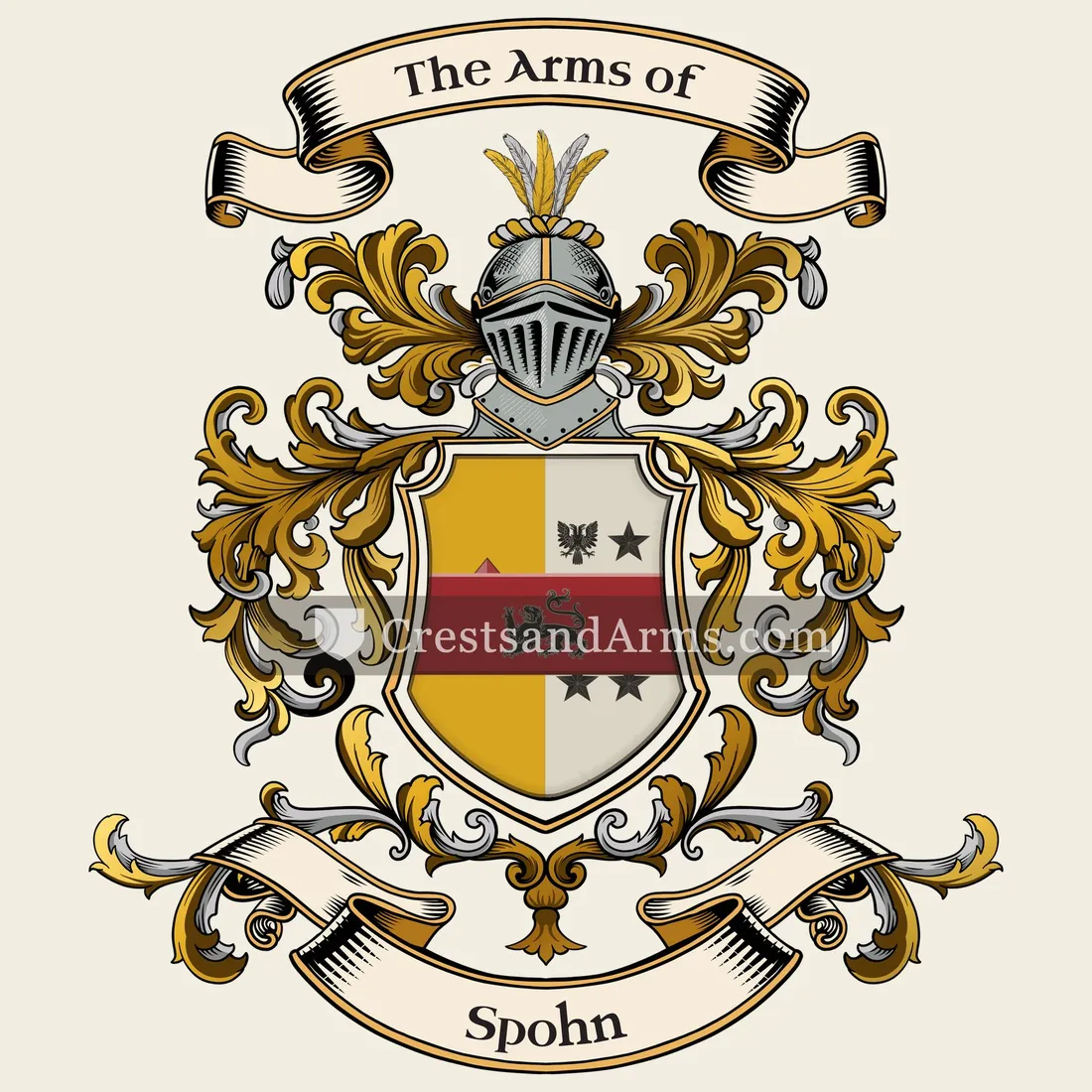
Meaning of the Spohn family crest colors & symbols
Symbols on this shield
fessThe military belt, and readiness to serve
lionCourage, strength and royalty
lozengeHonour and nobility, and the arms of a woman
eagleNobility, strength and a keen mind
mulletThe third son, and a divine quality from above
Colours
Gold (Or)Means: Generosity
Silver (Argent)Means: Peace and sincerity
Red (Gules)Means: Military strength
Black (Sable)Means: Constancy
Historical info
Source
J. B. Rietstap, Armorial Général, Gouda: G. B. van Goor Zonen, 1884–87
Blazon (the actual original written record)
“Parti: au 1 d'or semé de losanges de gu.; au lion cont. de sa., br. sur le tout; au 2 coupé d'arg. sur azur, à la fasce de gu., br. sur le coupé; l'arg. ch. d'une aigle ép. de sa., bq. et m. d'or, l'azur ch. de trois étoiles (8) d'arg., 2 et 1. Deux cq. cour. C.: 1° une tête et col de lion cont. de sa.; 1. d'or et de sa.; 2° un chapeau pyramidal d'azur, ch. de trois bandes d'arg., sommé d'une étoile du même, chaque rai orné d'une plume de paon d'azur; 1. d'arg. et d'azur. T.: à dextre un sauvage, orné d'une massue; à sen. un lion reg. d'or.”
BavariaBavaria, c. 1712
Digital archive packCoat of arms PNG, gold border print PDF, vector SVG and the certificate of authenticity. Sent to your email in minutes.
Map of Germany showing where the Spohn arms are recorded
The Spohn arms were recorded in Bavaria, c. 1712.
Bavaria was a country of old landed families and walled market towns. Estates passed down the same line for centuries, and both the landowners and the leading townsmen kept arms, which is why so many Bavarian names sit in the registers.
This is where the arms were entered in the register. Families often moved to other parts of the country, so the same name can turn up in more than one region.
The body that granted and recorded arms in Germany in this period.
Charles VI, Holy Roman Emperor
Sovereign of the period
Charles VI, Holy Roman Emperor
1711–1740
Reigning in Germany when the Spohn arms are first recorded.
How Arms Worked in Germany
In the Holy Roman Empire, coats of arms were often granted to individuals by the Emperor or his representatives. These arms were then passed down through the generations to all legitimate descendants of the original holder. Younger branches of a family usually kept the same shield design without needing to change it, as the arms belonged to the entire lineage.
Granting authority
The Holy Roman Emperor held the sole power to grant new coats of arms throughout his vast imperial territories.
How they got arms
Families typically obtained their coats of arms through a formal imperial grant or by proving their noble status to the authorities.
Where arms were recorded
These grants were officially recorded in the Imperial Chancery registers, which began keeping formal records of such honors during the Middle Ages.
The family's standing
Recorded among the armigerous families of Bavaria.
Origin & History of the Spohn Family in Germany
The surname Spohn finds its roots in the German-speaking regions of Central Europe, where it functioned as a descriptive name for the people who lived there. Etymologists often link the name to the Middle High German word *spōn*, which referred to a wood chip or a splinter. In the context of early medieval naming conventions, this likely identified an ancestor who worked as a woodcutter or a carpenter. By the time the family was documented in Bavaria in 1712, the name had become firmly established within the local social fabric. During this period, families like the Spohns were typically tied to the land through agricultural labor or specialized craftsmanship. As the family grew, they became part of the steady movement of people across the Bavarian landscape, participating in the local church and village life that defined the German experience in the early eighteenth century.
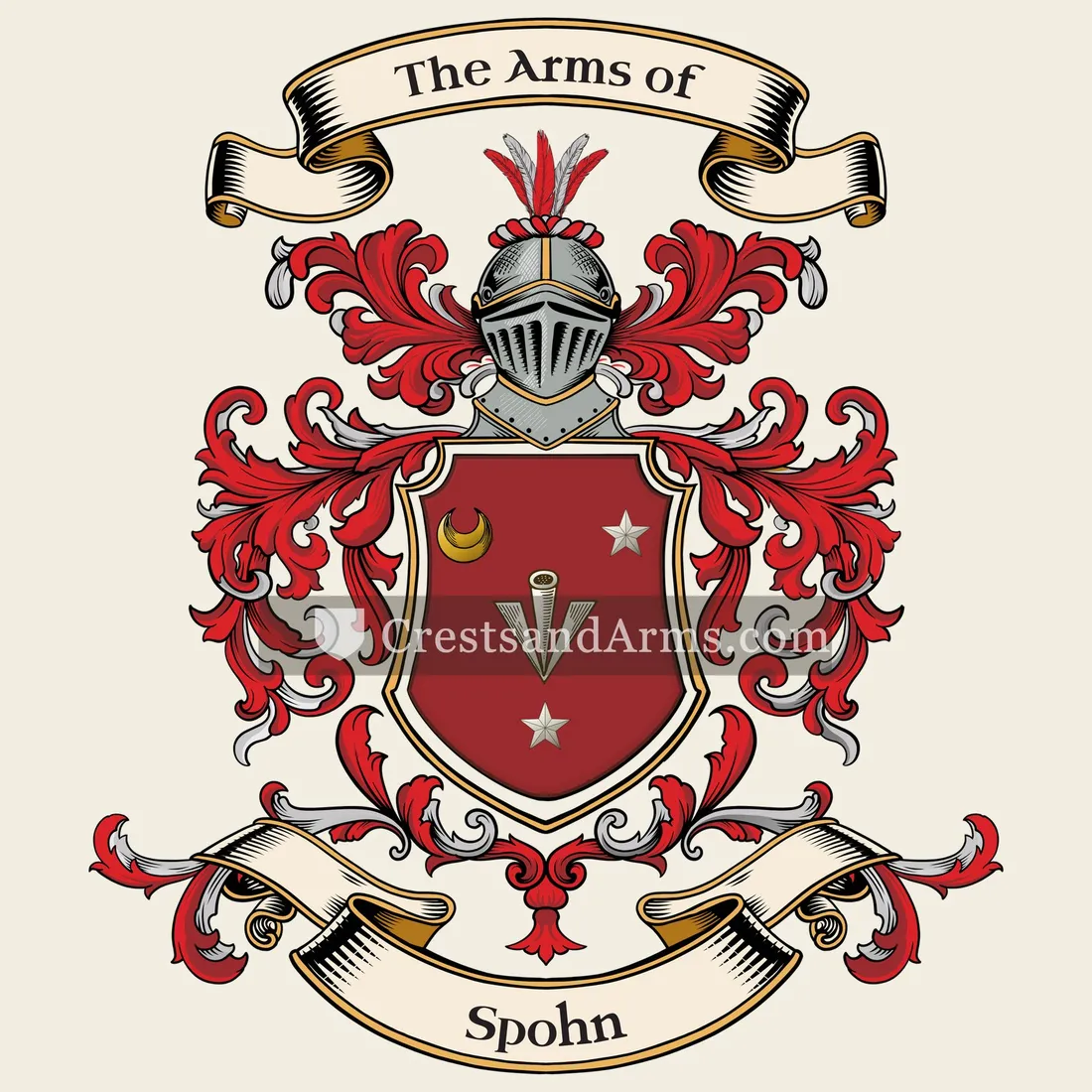
Meaning of the Spohn family crest colors & symbols
Symbols on this shield
arrowReadiness for battle, and affliction endured
crescentHonour by the sovereign, and the second son
mulletThe third son, and a divine quality from above
Colours
Red (Gules)Means: Military strength
Silver (Argent)Means: Peace and sincerity
Gold (Or)Means: Generosity
Historical info
Source
J. B. Rietstap, Armorial Général, Gouda: G. B. van Goor Zonen, 1884–87
Blazon (the actual original written record)
“De gu. à une flèche d'arg., accostée de deux étoiles (5) du même; et un croiss. d'or vers le bas, br. sur le bois de la flèche.”
SwitzerlandGenève, c. 1745
Digital archive packCoat of arms PNG, gold border print PDF, vector SVG and the certificate of authenticity. Sent to your email in minutes.
Map of Switzerland showing where the Spohn arms are recorded
The Spohn arms were recorded in Genève, c. 1745.
This is where the arms were entered in the register. Families often moved to other parts of the country, so the same name can turn up in more than one region.
The body that granted and recorded arms in Switzerland in this period.
How Arms Worked in Switzerland
In Switzerland, coats of arms were not restricted to the nobility and were often adopted by common citizens and families. These symbols were passed down through generations to show family identity. When branches of a family grew, they often changed small details of the design to distinguish their own line from the original group.
Granting authority
Cantonal and civic authorities managed the use of coats of arms within their specific regions and local jurisdictions.
How they got arms
Families typically assumed their own coats of arms based on local custom rather than receiving them from a central monarch.
Where arms were recorded
Arms were recorded in various cantonal and civic registers starting from the fourteenth century throughout the Swiss region.
The family's standing
Recorded among the armigerous families of Switzerland.
Origin & History of the Spohn Family in Switzerland
The family name Spohn has deep roots in the German-speaking regions of Europe, but its presence in Switzerland reveals a history of movement and integration. By the mid-eighteenth century, members of the Spohn family were established in Geneva. At that time, Geneva was a growing center for trade and intellectual exchange, attracting families from across the continent. The name itself is thought to derive from Middle High German terms related to a spoon or a wooden tool, which suggests that the earliest ancestors may have been skilled woodworkers or craftsmen. As these individuals settled in the Swiss landscape, they often integrated into the local economy and social structures of their new home. Their presence in Geneva by 1745 indicates that the family was part of the broader migration patterns that defined the Swiss cantons during the Enlightenment era. Through these early records, we can see how a family name traveled across borders and adapted to the unique cultural environment of Switzerland.
Spohn Meaning & Related Branches
Root word
Spān
Old High German word referring to a chip, splinter, or shaving.
This name
SpohnAn occupational name for a woodworker, carpenter, or someone who produced wood shavings.
Documented Sources
J. B. Rietstap, Armorial Général, Gouda: G. B. van Goor Zonen, 1884–87
Bahlow, Hans. Deutsches Namenlexikon: Familien- und Vornamen nach Ursprung und Sinn erklärt. 1967
Heintze, Albert. Die deutschen Familiennamen, geschichtlich, geographisch, sprachlich. 1903


 fessThe military belt, and readiness to serve
 lionCourage, strength and royalty
 lozengeHonour and nobility, and the arms of a woman
 eagleNobility, strength and a keen mind
 mulletThe third son, and a divine quality from above
 fessThe military belt, and readiness to serve
 lionCourage, strength and royalty
 lozengeHonour and nobility, and the arms of a woman
 eagleNobility, strength and a keen mind
 mulletThe third son, and a divine quality from above


 arrowReadiness for battle, and affliction endured
 crescentHonour by the sovereign, and the second son