Map of Germany showing where the Sprenkel arms are recorded
The Sprenkel arms were recorded in Mecklenburg, c. 1765.
Mecklenburg was farming country in the north of Germany, held by a small number of families who kept their estates for generations. Owning land was what entitled a family to arms, so a great many Mecklenburg names ended up in the registers.
This is where the arms were entered in the register. Families often moved to other parts of the country, so the same name can turn up in more than one region.
The body that granted and recorded arms in Germany in this period.
Francis I, Holy Roman Emperor
Sovereign of the period
Francis I, Holy Roman Emperor
1745–1765
Reigning in Germany when the Sprenkel arms are first recorded.
How Arms Worked in Germany
In the Holy Roman Empire, coats of arms were often granted to individuals by the Emperor or his representatives. These arms were then passed down through the generations to all legitimate descendants of the original holder. Younger branches of a family usually kept the same shield design without needing to change it, as the arms belonged to the entire lineage.
Granting authority
The Holy Roman Emperor held the sole power to grant new coats of arms throughout his vast imperial territories.
How they got arms
Families typically obtained their coats of arms through a formal imperial grant or by proving their noble status to the authorities.
Where arms were recorded
These grants were officially recorded in the Imperial Chancery registers, which began keeping formal records of such honors during the Middle Ages.
The family's standing
Recorded among the armigerous families of Mecklenburg.
Origin & History of the Sprenkel Family in Germany
The surname Sprenkel finds its historical roots in the northern regions of Germany, particularly within the territory of Mecklenburg. By the mid-eighteenth century, records confirm that families bearing this name were well-established in the local landscape by 1765. The name itself is thought to be derived from Middle Low German linguistic roots, likely describing a person with a speckled or mottled physical appearance or perhaps someone who lived near a distinctively marked landmark. During this era, families in Mecklenburg were often tied to the land through agricultural labor or skilled trades, living in small village communities that had remained relatively stable for generations. As these families grew, the name became a permanent marker of their identity within the parish registers and local administrative documents of the region.
Related Branches & Arms
Root word
Sprink
A Middle High German term referring to a spring or fountain.
This name
SprenkelA topographic name for someone who lived near a small spring or a bubbling water source.
Documented Sources
J. B. Rietstap, Armorial Général, Gouda: G. B. van Goor Zonen, 1884–87


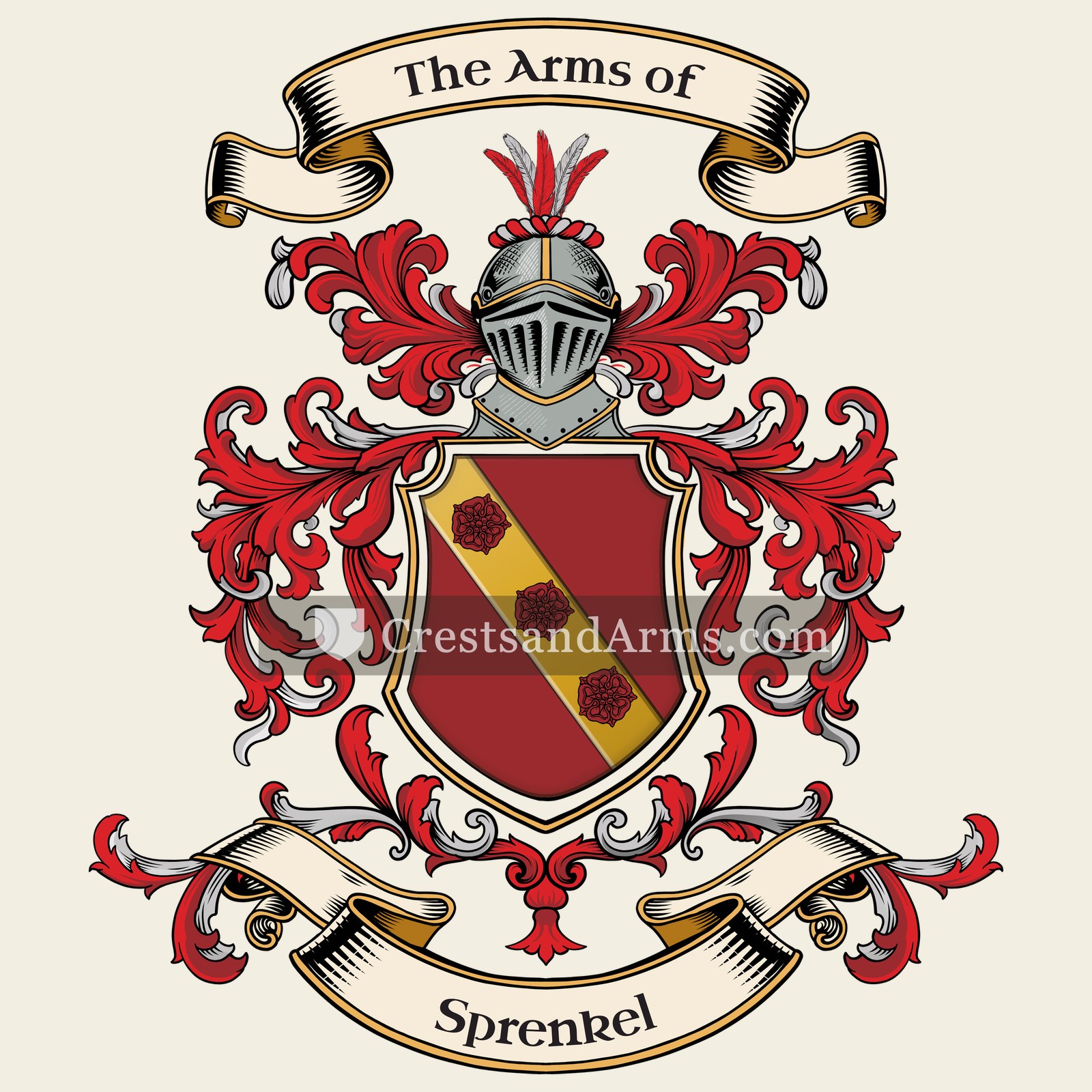
 bendDefence, and the scarf of a commander
 roseThe seventh son, and beauty with grace
 bendDefence, and the scarf of a commander
 roseThe seventh son, and beauty with grace