Map of England showing where the Squires arms are recorded
The Squires arms were recorded in Worcester, c. 1569.
Worcestershire was orchard and farming country with a scattering of old manors. Its gentry were middling rather than great, but a manor was a manor, and holding one was what brought arms.
This is where the arms were entered in the register. Families often moved to other parts of the country, so the same name can turn up in more than one region.
The body that granted and recorded arms in England in this period.
Elizabeth I of England
Sovereign of the period
Elizabeth I of England
1558–1603
Reigning in England when the Squires arms are first recorded.
How Arms Worked in England
English heraldry allowed arms to be shared by all legitimate descendants of the original owner. These symbols were treated as personal property that moved through the generations to all children. While the eldest son kept the original design, other family members could use the same shield without needing to change it or register their own unique versions.
Granting authority
The College of Arms in London has regulated the use of coats of arms throughout England and Wales since 1484.
How they got arms
Families typically obtained their coats of arms through a formal grant from the Crown or by proving their ancient right to them.
Where arms were recorded
All official coats of arms are recorded in the registers kept at the College of Arms, which date back to the fifteenth century.
The family's standing
Recorded among the armigerous families of Worcester.
Origin & History of the Squires Family in England
The surname Squires originates from the medieval English word "esquire," which served as a title for a young man serving as an apprentice to a knight. During the Middle Ages, these individuals were essential members of the social hierarchy who assisted in military duties and managed household affairs. By the time the name became a formal hereditary surname, it often identified families who held a specific rank or performed administrative roles for local landowners. Records confirm that the family was well-established in the city of Worcester by 1569, a period when the city was a thriving center for trade and cloth production. As the family settled into this urban environment, they transitioned from their traditional roles in the feudal system to become integrated members of the local community. This shift reflects the broader social changes in England during the sixteenth century as the influence of the old knightly class began to evolve into a more modern society of merchants and tradespeople.
Meaning of the Squires family crest colors & symbols
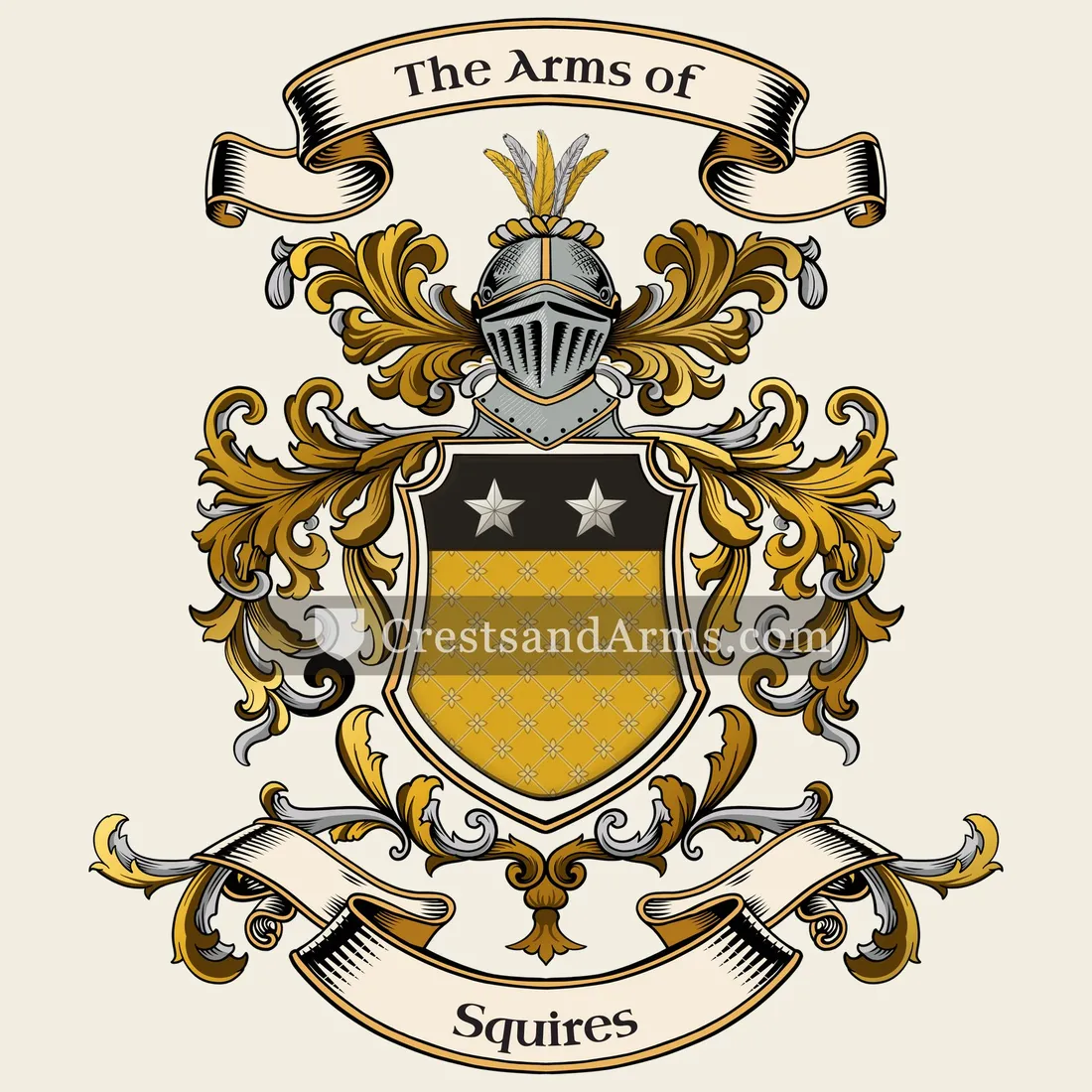
Symbols on this shield
chiefAuthority, wisdom and dominion
mulletThe third son, and a divine quality from above
Colours
Gold (Or)Means: Generosity
Black (Sable)Means: Constancy
Silver (Argent)Means: Peace and sincerity
Historical info
Source
Sir Bernard Burke, The General Armory of England, Scotland, Ireland and Wales, London: Harrison & Sons, 1884
Blazon (the actual original written record)
“Or, on a chief sa. two mullets ar”
Scotlandc. 1748
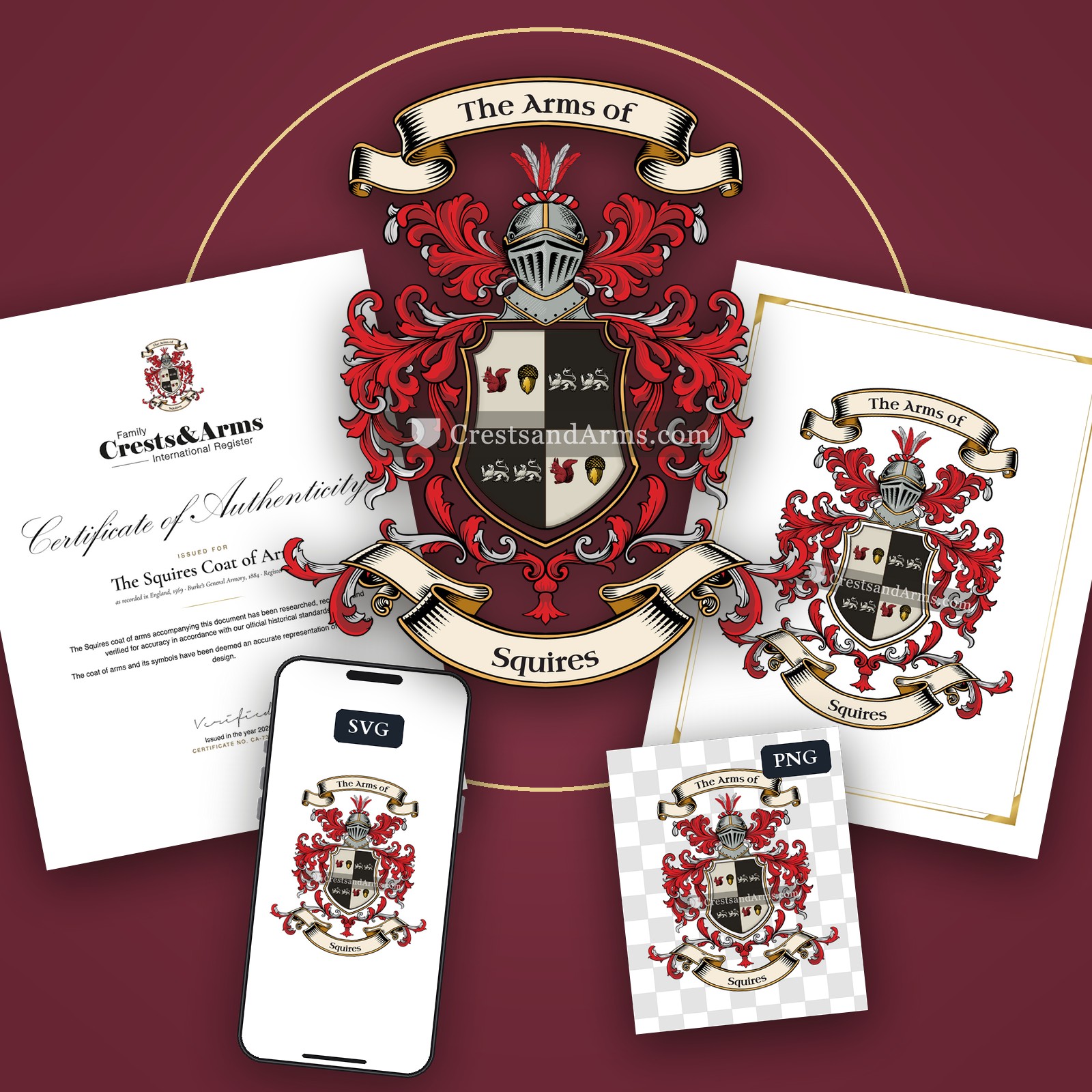
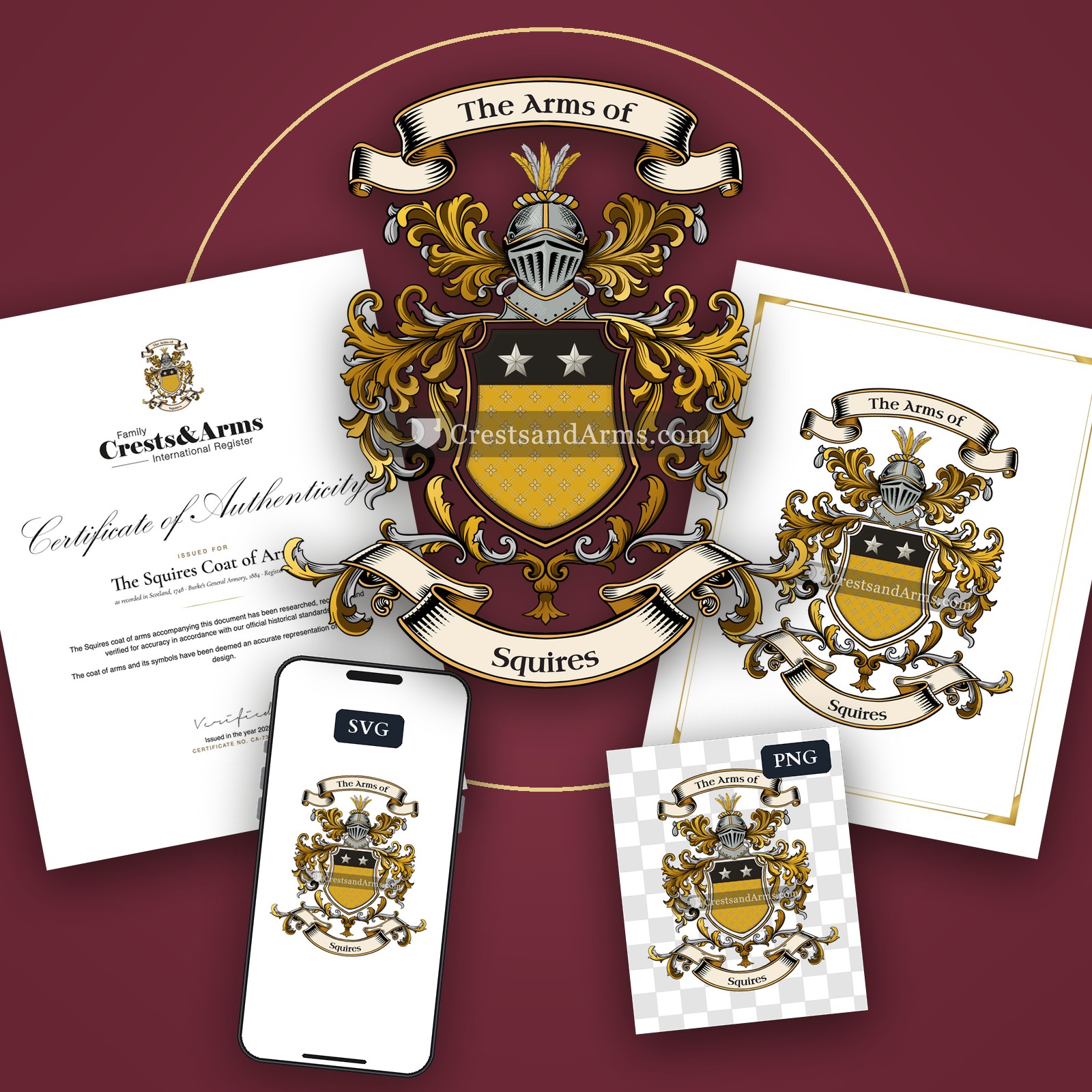
Digital archive packCoat of arms PNG, gold border print PDF, vector SVG and the certificate of authenticity. Sent to your email in minutes.
Map of Scotland showing where the Squires arms are recorded
The Squires arms were recorded in Scotland, c. 1748.
Arms such as these were typically recorded in Edinburgh.
Edinburgh was the seat of Scotland's government, its courts and its heralds. Families with business there settled nearby, and being close to where arms were recorded is exactly why so many of them appear.
This is where the arms were entered in the register. Families often moved to other parts of the country, so the same name can turn up in more than one region.
The body that granted and recorded arms in Scotland in this period.
George II of Great Britain
Sovereign of the period
George II of Great Britain
1727–1760
Reigning in England when the Squires arms are first recorded.
How Arms Worked in Scotland
Scottish heraldry is unique because it treats a coat of arms as a piece of personal property protected by law. Only one person can own a specific design at any given time. When a family grows, the head keeps the original shield while other relatives must apply for their own distinct version with slight changes to prove their specific identity.
Granting authority
The Court of the Lord Lyon acts as the official body that regulates and controls all heraldic matters throughout Scotland.
How they got arms
Individuals obtain a legal right to their arms through a formal petition process that confirms their identity and family connection.
Where arms were recorded
All valid coats of arms are officially entered into the Public Register of All Arms and Bearings starting from 1672.
The family's standing
Recorded among the armigerous families of Scotland.
Origin & History of the Squires Family in Scotland
The surname Squires originated as an occupational title, referring to a young man who served as an attendant or apprentice to a knight. In the context of Scottish history, the name began to appear in urban centers as social structures shifted away from feudal systems. By 1748, records confirm that members of the Squires family were well-established residents of Edinburgh. During this period, Edinburgh was a hub of the Scottish Enlightenment, and families like the Squires were often part of the growing professional and merchant classes that fueled the city's intellectual and economic expansion. As they integrated into the local community, they moved away from the traditional military roles associated with the name and instead took up trades and administrative positions that were vital to the development of Scotland’s capital city.
Squires Meaning & Related Branches
Root word
esquier
Old French term for a shield bearer or attendant to a knight.
This name
SquiresAn occupational surname for a young man serving as an apprentice to a knight.
also spelled
Squyer
Squyre
Squier
Documented Sources
Sir Bernard Burke, The General Armory of England, Scotland, Ireland and Wales, London: Harrison & Sons, 1884
Bardsley, Charles Wareing, A Dictionary of English and Welsh Surnames, 1901
Reaney, P.H. and Wilson, R.M., A Dictionary of English Surnames, 1991
Worcestershire Archive and Archaeology Service, Parish Registers of St. Swithun, Worcester, 1569
Digital archive packCoat of arms PNG, gold border print PDF, vector SVG and the certificate of authenticity. Sent to your email in minutes.


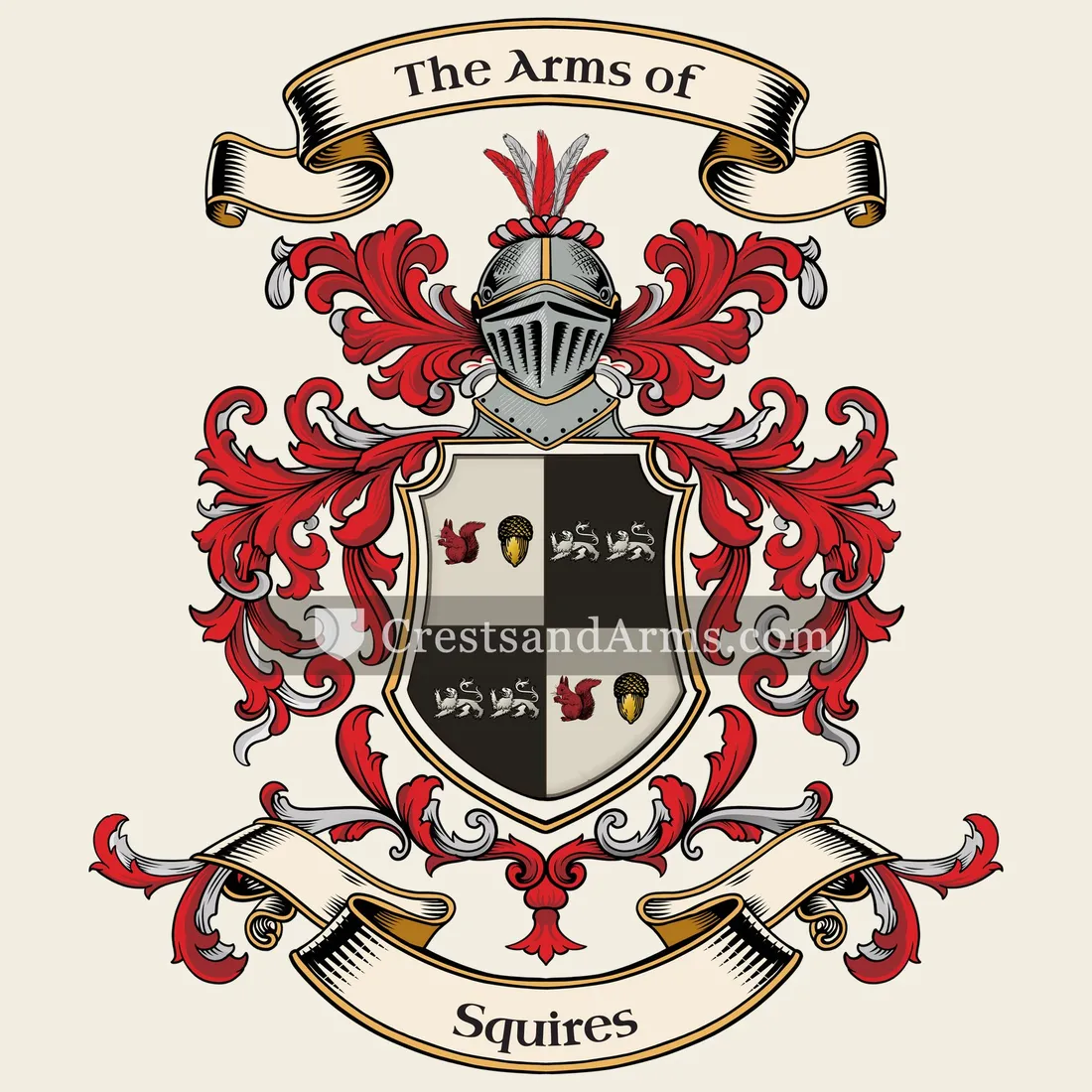
 squirrelPatience and foresight in gathering
 acornAntiquity and strength from small beginnings
 lionCourage, strength and royalty
 squirrelPatience and foresight in gathering
 acornAntiquity and strength from small beginnings
 lionCourage, strength and royalty


 chiefAuthority, wisdom and dominion
 mulletThe third son, and a divine quality from above