A record of documented arms, meaning and origin, researched for the St.-George family lines. Documented in 2 countries.
Reg. 0546 · German, T–V
Coat of Arms & Family Crest Details
Symbols on this shield
dragonA most valiant defender of treasure
lanceKnightly service and the tilt
horseReadiness to serve king and country
Colours
Blue (Azure)Means: Loyalty and truth
Red (Gules)Means: Military strength
Black (Sable)Means: Constancy
Silver (Argent)Means: Peace and sincerity
Historical info
Source
J. B. Rietstap, Armorial Général, Gouda: G. B. van Goor Zonen, 1884–87
Blazon (the actual original written record)
“D'azur à un St.-Georges d'arg., tuant de sa lance un dragon de gu., au-dessous du cheval. Cq. cour. C.: trois pl. d'aut., une d'azur entre deux d'arg. L.: d'arg. et d'azur.”
GermanyNassau, c. 1765
Digital archive packCoat of arms PNG, gold border print PDF, vector SVG and the certificate of authenticity. Sent to your email in minutes.
Map of Germany showing where the St.-George arms are recorded
The St.-George arms were recorded in Nassau, c. 1765.
This is where the arms were entered in the register. Families often moved to other parts of the country, so the same name can turn up in more than one region.
The body that granted and recorded arms in Germany in this period.
Francis I, Holy Roman Emperor
Sovereign of the period
Francis I, Holy Roman Emperor
1745–1765
Reigning in Germany when the St.-George arms are first recorded.
How Arms Worked in Germany
In the Holy Roman Empire, coats of arms were often granted to individuals by the Emperor or his representatives. These arms were then passed down through the generations to all legitimate descendants of the original holder. Younger branches of a family usually kept the same shield design without needing to change it, as the arms belonged to the entire lineage.
Granting authority
The Holy Roman Emperor held the sole power to grant new coats of arms throughout his vast imperial territories.
How they got arms
Families typically obtained their coats of arms through a formal imperial grant or by proving their noble status to the authorities.
Where arms were recorded
These grants were officially recorded in the Imperial Chancery registers, which began keeping formal records of such honors during the Middle Ages.
The family's standing
Recorded among the armigerous families of Germany.
Origin & History of the St.-George Family in Germany
The family name St. George, or Saint George, carries a history deeply rooted in the cultural and religious traditions of the German-speaking lands. While the name is often associated with the legendary figure of Saint George the Dragon Slayer, families bearing this name in Germany frequently emerged from local communities where they were identified by their devotion to this patron saint or their proximity to churches dedicated to him. By the mid-eighteenth century, historical records confirm that members of the family were firmly established in the region of Nassau. During this era, Nassau was a territory characterized by its complex political structure and its transition through various administrative reforms. Families living in this area were often involved in the local agricultural and civic life that defined the small states of the Holy Roman Empire. The presence of the St. George family in Nassau by 1765 suggests they were part of the stable, land-holding, or professional classes that helped maintain the social fabric of the region during a time of significant European change.
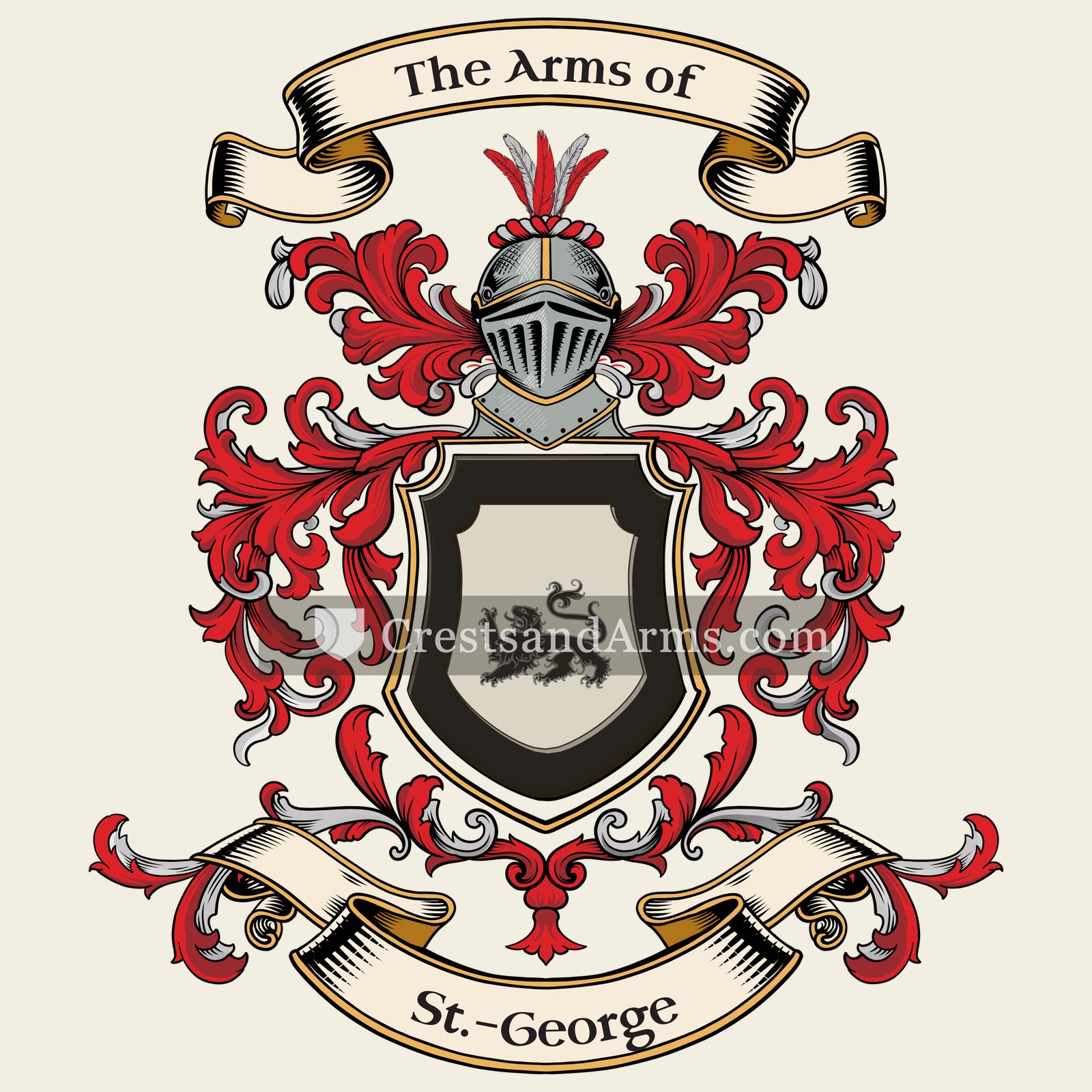
Coat of Arms & Family Crest Details
Symbols on this shield
bordureA difference between branches of one family
cross symbolChristian faith and service
fessThe military belt, and readiness to serve
chiefAuthority, wisdom and dominion
lionCourage, strength and royalty
Colours
Silver (Argent)Means: Peace and sincerity
Black (Sable)Means: Constancy
Historical info
Source
Sir Bernard Burke, The General Armory of England, Scotland, Ireland and Wales, London: Harrison & Sons, 1884
Blazon (the actual original written record)
“George. Ar. a lion ramp. sa. a border of the last; another, Gu. a cross counter-componée sa. and ar. betw. four lions ramp. or; another, Per fess vert and or, a lion ramp. counterchanged; another, Ar. a cross gu ; another, Ar. a cross pattée sa.; another, Ar. a cross flory (another, patonce) sa.; another, Ar. on a chief az. a lion pass. or”
Englandc. 1620
Digital archive packCoat of arms PNG, gold border print PDF, vector SVG and the certificate of authenticity. Sent to your email in minutes.
Map of England showing where the St.-George arms are recorded
The St.-George arms were recorded in England, c. 1620.
Arms such as these were typically recorded in York.
Yorkshire is the largest of the English counties, and it held more gentry families than any other. Land there was split among a great many households rather than a few, so a great many of them carried arms.
This is where the arms were entered in the register. Families often moved to other parts of the country, so the same name can turn up in more than one region.
The body that granted and recorded arms in England in this period.
James VI and I
Sovereign of the period
James VI and I
1603–1625
Reigning in Germany when the St.-George arms are first recorded.
How Arms Worked in England
English heraldry allowed arms to be shared by all legitimate descendants of the original owner. These symbols were treated as personal property that moved through the generations to all children. While the eldest son kept the original design, other family members could use the same shield without needing to change it or register their own unique versions.
Granting authority
The College of Arms in London has regulated the use of coats of arms throughout England and Wales since 1484.
How they got arms
Families typically obtained their coats of arms through a formal grant from the Crown or by proving their ancient right to them.
Where arms were recorded
All official coats of arms are recorded in the registers kept at the College of Arms, which date back to the fifteenth century.
The family's standing
Recorded among the armigerous families of England.
Origin & History of the St.-George Family in England
The surname St. George carries a long history that reflects the movement and social shifts of early modern England. While the name itself evokes ancient roots, historical records confirm that members of the family were firmly established in the city of York by 1620. During this period, York served as a vital northern hub for trade, law, and administration, making it a strategic location for families seeking to build influence. Families with this name often integrated into the local merchant and professional classes, navigating the complex political landscape of the seventeenth century. By settling in such a prominent urban center, the St. George family participated in the growth of England’s regional power bases, moving away from rural life to engage with the bustling commerce and civic governance that defined the era.
Related Branches & Arms
Root word
Georgios
Derived from the Greek word for a farmer or earth worker.
This name
St.-GeorgeA locative surname referring to someone who lived near a church dedicated to Saint George.
also spelled
Saint-George
Ste-George
Segeorge
Saintgeorge
Sengeorge
Documented Sources
J. B. Rietstap, Armorial Général, Gouda: G. B. van Goor Zonen, 1884–87
Hessisches Hauptstaatsarchiv, Bestand 171: Nassauische Ämter, 1765
Knetsch, Carl, Die von Nassau-Siegen in ihrer Entwicklung bis zum Ausgang des Mittelalters, 1917
Römer, Joachim, Nassauische Geschichte: Eine Einführung, 1998
Digital archive packCoat of arms PNG, gold border print PDF, vector SVG and the certificate of authenticity. Sent to your email in minutes.


 dragonA most valiant defender of treasure
 lanceKnightly service and the tilt
 horseReadiness to serve king and country
 dragonA most valiant defender of treasure
 lanceKnightly service and the tilt
 horseReadiness to serve king and country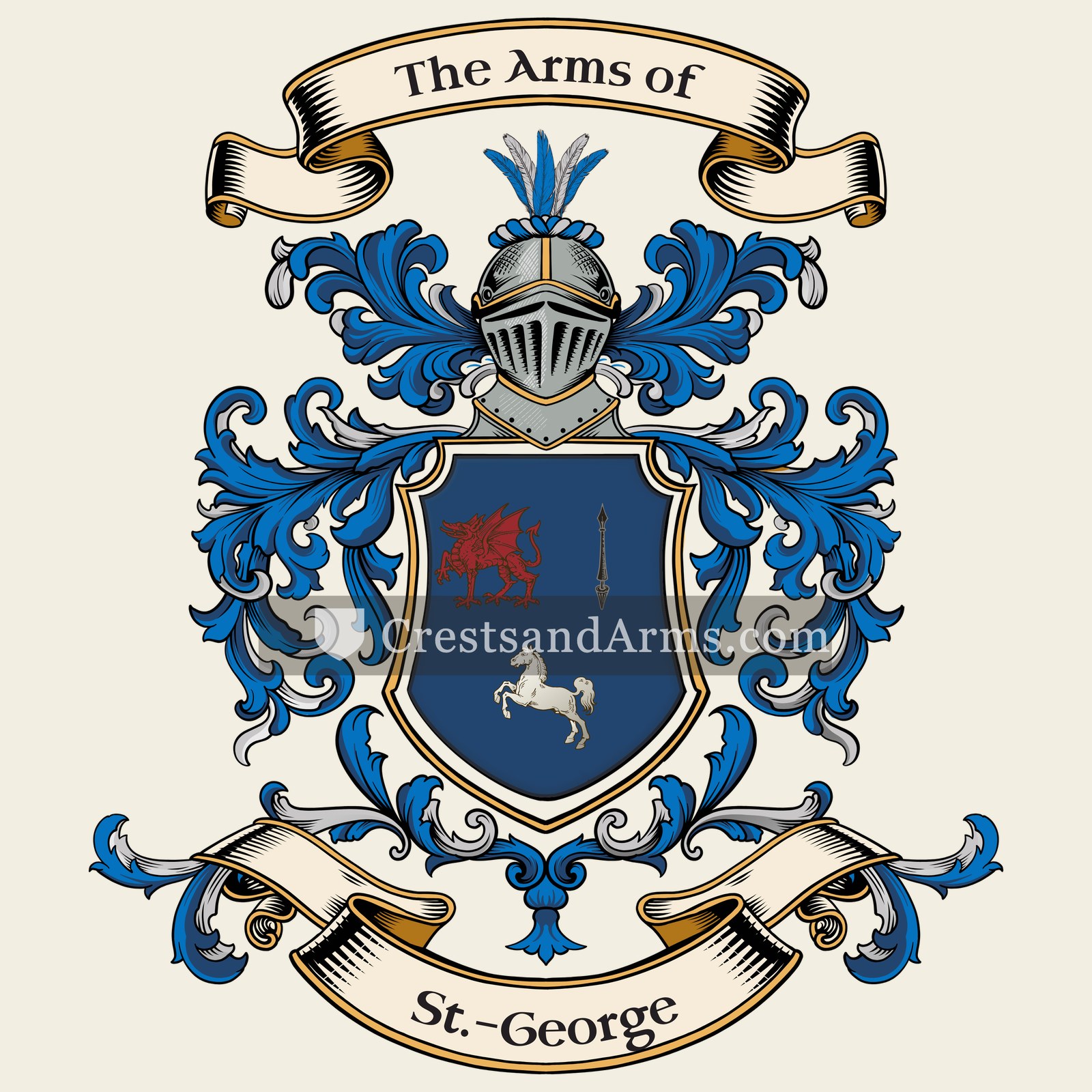


 bordureA difference between branches of one family
 cross symbolChristian faith and service
 fessThe military belt, and readiness to serve
 chiefAuthority, wisdom and dominion
 lionCourage, strength and royalty