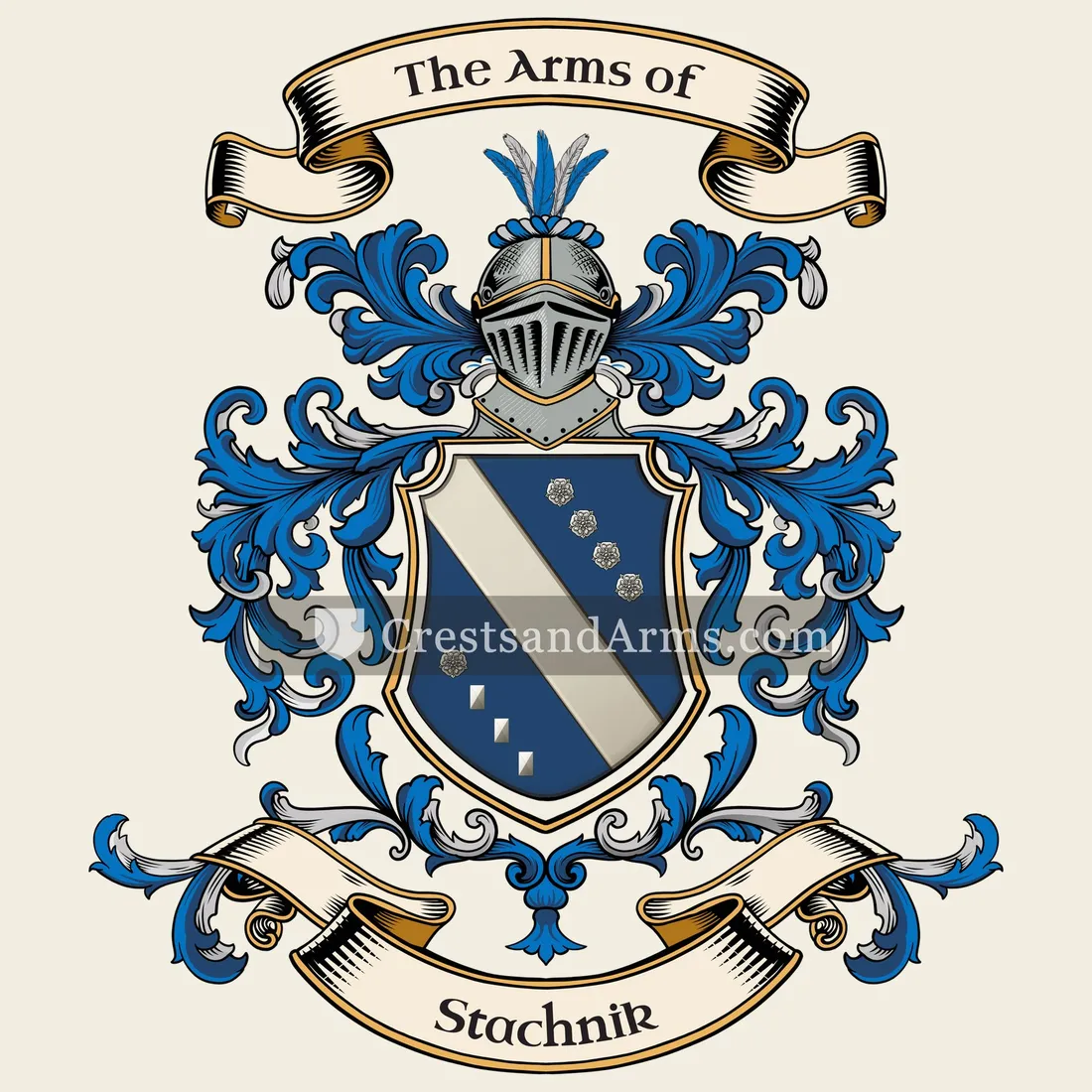
A record of documented arms, meaning and origin, researched for the Stachnik family of Italy.
Reg. 2797 · Italian, T–V
Meaning of the Stachnik family crest colors & symbols
Symbols on this shield
bendDefence, and the scarf of a commander
roseThe seventh son, and beauty with grace
billetThe sealed letter, and a message delivered
Colours
Blue (Azure)Means: Loyalty and truth
Silver (Argent)Means: Peace and sincerity
Historical info
Source
J. B. Rietstap, Armorial Général, Gouda: G. B. van Goor Zonen, 1884–87
Blazon (the actual original written record)
“D'azur à une bande, côtoyée de cinq roses d'arg., 3 en haut et 2 en bas; ladite bande de partie; la partie à dextre de gu.; la partie à sen. tranchée d'or sur azur et ch. de quatre bill. de l'un à l'autre, rangées en pal près de la ligne du parti, deux sur l'or et deux sur l'azur, posées dans le sens de la bande [V. Stecchini.]”
ItalyVicence, c. 1775
Digital archive packCoat of arms PNG, gold border print PDF, vector SVG and the certificate of authenticity. Sent to your email in minutes.
Map of Italy showing where the Stachnik arms are recorded
The Stachnik arms were recorded in Vicence, c. 1775.
This is where the arms were entered in the register. Families often moved to other parts of the country, so the same name can turn up in more than one region.
The body that granted and recorded arms in Italy in this period.
Alvise Giovanni Mocenigo
Sovereign of the period
Alvise Giovanni Mocenigo
1763–1778
Reigning in Italy when the Stachnik arms are first recorded.
How Arms Worked in Italy
In the Italian states, coats of arms were often used by noble families to show their status and history. These symbols were passed down through the generations to all legitimate male descendants. Younger branches of a family usually kept the original design but sometimes added small changes to distinguish their specific line from the main branch.
Granting authority
Various local rulers and city governments controlled the use of coats of arms across the different Italian states.
How they got arms
Families often assumed their own arms or received them as official grants from local lords, popes, or city councils.
Where arms were recorded
Arms were recorded in local city archives or private family books rather than in one single national register.
The family's standing
Recorded among the armigerous families of Italy.
Origin & History of the Stachnik Family in Italy
The surname Stachnik is a diminutive form of the name Stanisław, which was a very popular name in Slavic regions for many centuries. The suffix "nik" often indicated a person’s occupation or their status as a follower of a specific individual. By the year 1775, records confirm that members of the Stachnik family were well-established in the region of Vicence. During this era, families with this name were typically part of the rural population, often working as skilled farmers or craftsmen who contributed to the local economy of their village. Because the name is rooted in a common given name, it likely emerged independently in several different locations as a way to distinguish one family branch from another. Over time, the family became deeply integrated into the social and administrative life of the area, leaving behind a legacy tied to the development of their local community.
Stachnik Meaning & Related Branches
Root word
Stach
A diminutive form of the name Stanislaw meaning someone who achieves glory.
This name
StachnikA patronymic surname indicating descent from a person named Stach or Stanislaw.
also spelled
Stekini
Documented Sources
J. B. Rietstap, Armorial Général, Gouda: G. B. van Goor Zonen, 1884–87
Kutrzeba, Stanisław, Historia ustroju Polski w zarysie, 1905
Rymut, Kazimierz, Nazwiska Polaków: Słownik historyczno-etymologiczny, 1999
Archiwum Państwowe w Krakowie, Akta stanu cywilnego parafii rzymskokatolickiej w Vicence, 1775
Digital archive packCoat of arms PNG, gold border print PDF, vector SVG and the certificate of authenticity. Sent to your email in minutes.


 bendDefence, and the scarf of a commander
 roseThe seventh son, and beauty with grace
 billetThe sealed letter, and a message delivered
 bendDefence, and the scarf of a commander
 roseThe seventh son, and beauty with grace
 billetThe sealed letter, and a message delivered