A record of documented arms, meaning and origin, researched for the Stack family lines. Documented in 2 countries.
Reg. 4786 · German, T–V
Meaning of the Stack family crest colors & symbols
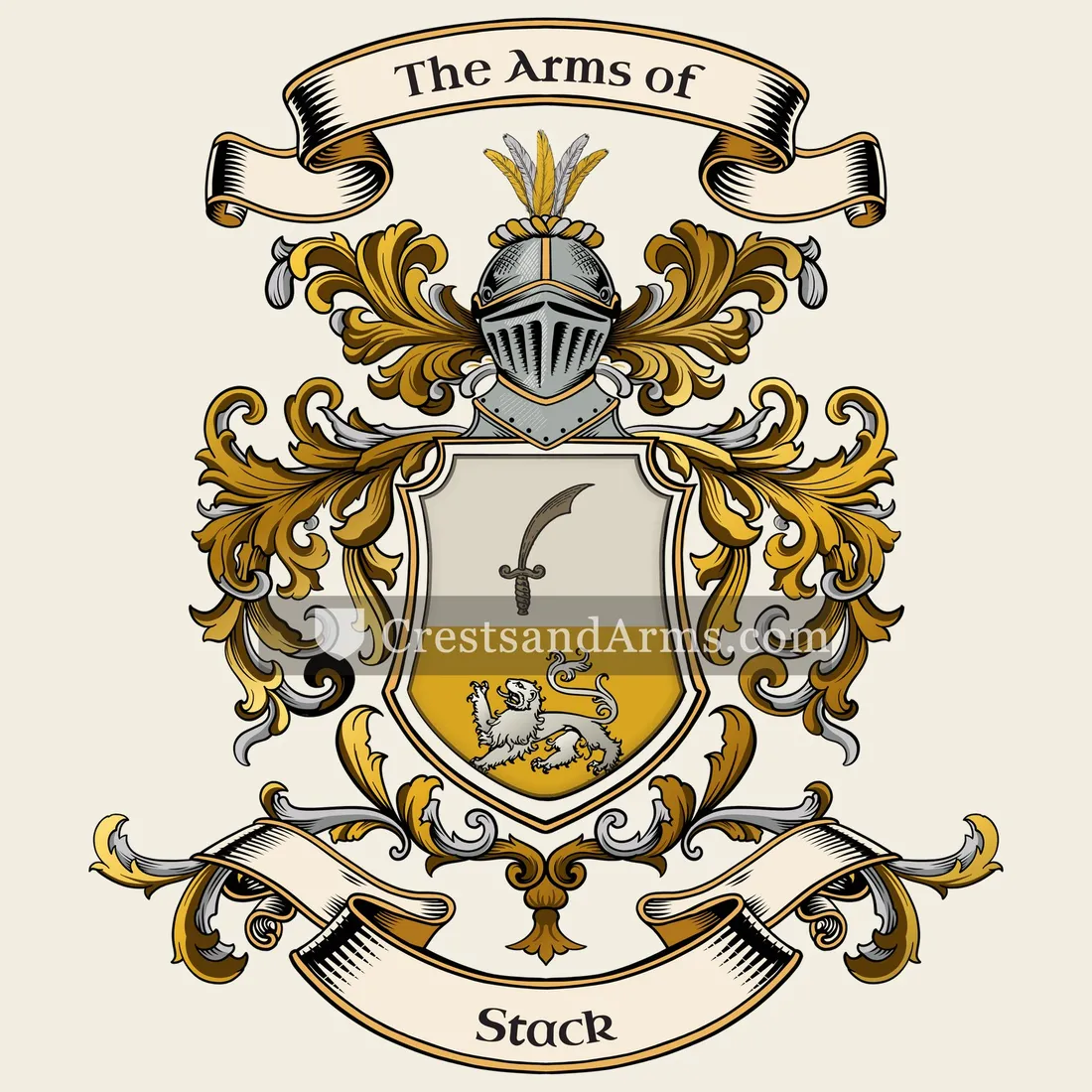
Symbols on this shield
swordJustice, and military honour
lionCourage, strength and royalty
Colours
Silver (Argent)Means: Peace and sincerity
Gold (Or)Means: Generosity
Historical info
Source
J. B. Rietstap, Armorial Général, Gouda: G. B. van Goor Zonen, 1884–87
Blazon (the actual original written record)
“Coupé: au 1 d'arg. à un sabre, posé en fasce, la garde à dextre, surm. de trois gerbes d'or, rangées en chef; au 2 d'or au lion d'arg. C.: un bras de carn. brandissant une épée.”
BavariaBavaria, c. 1765
Digital archive packCoat of arms PNG, gold border print PDF, vector SVG and the certificate of authenticity. Sent to your email in minutes.
Map of Germany showing where the Stack arms are recorded
The Stack arms were recorded in Bavaria, c. 1765.
Bavaria was a country of old landed families and walled market towns. Estates passed down the same line for centuries, and both the landowners and the leading townsmen kept arms, which is why so many Bavarian names sit in the registers.
This is where the arms were entered in the register. Families often moved to other parts of the country, so the same name can turn up in more than one region.
The body that granted and recorded arms in Germany in this period.
Francis I, Holy Roman Emperor
Sovereign of the period
Francis I, Holy Roman Emperor
1745–1765
Reigning in Germany when the Stack arms are first recorded.
How Arms Worked in Germany
In the Holy Roman Empire, coats of arms were often granted to individuals by the Emperor or his representatives. These arms were then passed down through the generations to all legitimate descendants of the original holder. Younger branches of a family usually kept the same shield design without needing to change it, as the arms belonged to the entire lineage.
Granting authority
The Holy Roman Emperor held the sole power to grant new coats of arms throughout his vast imperial territories.
How they got arms
Families typically obtained their coats of arms through a formal imperial grant or by proving their noble status to the authorities.
Where arms were recorded
These grants were officially recorded in the Imperial Chancery registers, which began keeping formal records of such honors during the Middle Ages.
The family's standing
Recorded among the armigerous families of Bavaria.
Origin & History of the Stack Family in Germany
The surname Stack originated as a topographic name in the German-speaking regions of Europe, likely describing a person who lived near a prominent stack of wood, hay, or a specific landmark. By the mid-18th century, records confirm that families bearing this name were well-established in the Bavarian region. During this era, Bavaria was a collection of territories defined by agrarian traditions and local craft guilds. Families like the Stacks were often deeply integrated into these rural village structures, where their daily lives revolved around seasonal harvests and local parish administration. Because the name was tied to the physical landscape, it suggests that the earliest ancestors were likely farmers or laborers who were identified by their proximity to these distinct outdoor features. This connection to the land remained a central part of their identity as they navigated the social and economic changes occurring in Southern Germany throughout the 1700s.
Meaning of the Stack family crest colors & symbols
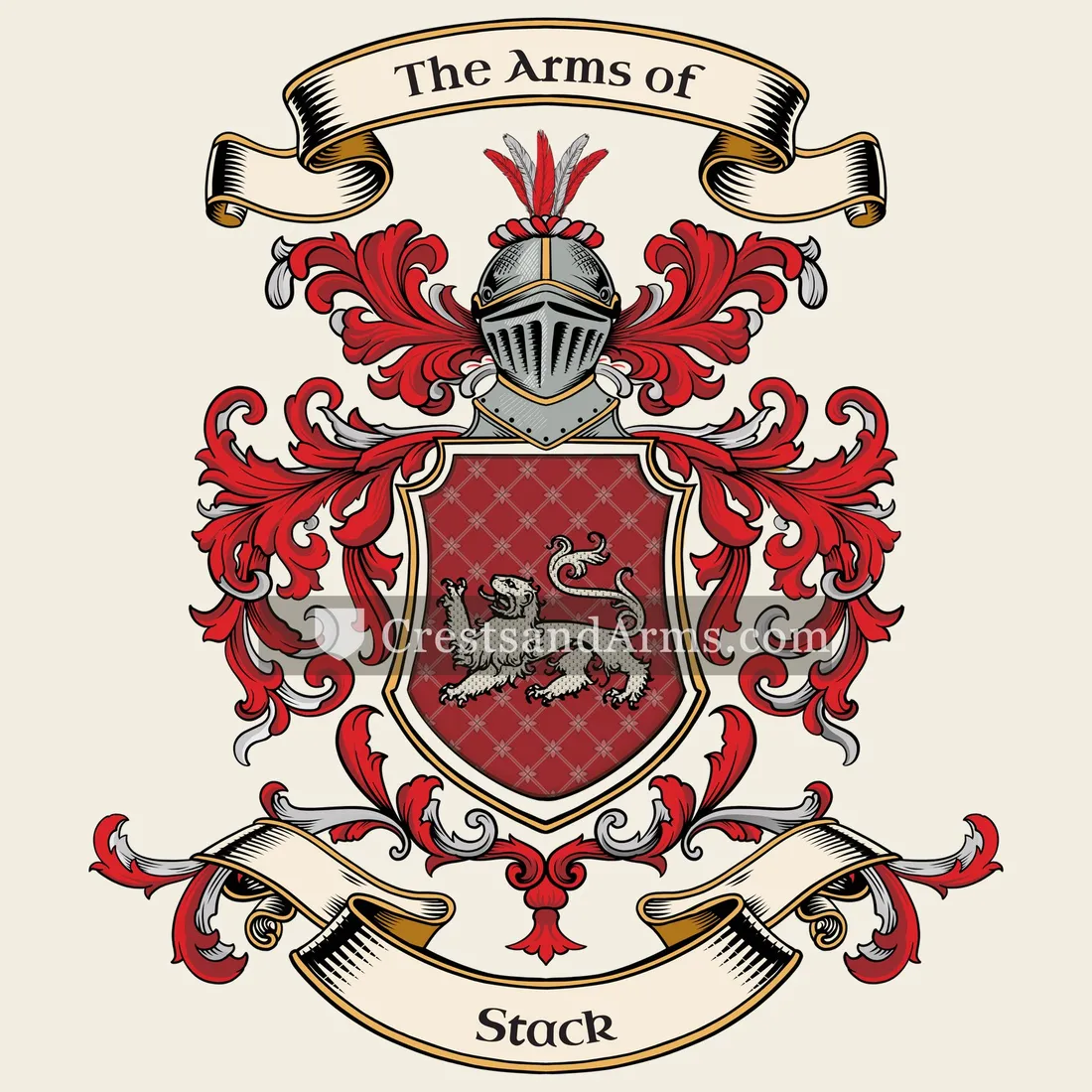
Symbols on this shield
lionCourage, strength and royalty
Colours
Red (Gules)Means: Military strength
ErmineMeans: Dignity
Historical info
Source
Sir Bernard Burke, The General Armory of England, Scotland, Ireland and Wales, London: Harrison & Sons, 1884
Blazon (the actual original written record)
“Gu. a lion ramp. erm”
KerryErrimore · Kerry, c. 1766
Digital archive packCoat of arms PNG, gold border print PDF, vector SVG and the certificate of authenticity. Sent to your email in minutes.
Map of Ireland showing where the Stack arms are recorded
The Stack arms were recorded in Kerry, c. 1766.
Kerry was mountain and coast country in the far south-west of Ireland. Its land was poor and held by a few families for a very long time, and long unbroken holding fills a register.
This is where the arms were entered in the register. Families often moved to other parts of the country, so the same name can turn up in more than one region.
The body that granted and recorded arms in Ireland in this period.
George III of Great Britain
Sovereign of the period
George III of Great Britain
1760–1801
Reigning in Germany when the Stack arms are first recorded.
How Arms Worked in Ireland
The Ulster King of Arms granted coats of arms to individuals who proved their social standing and good character. These symbols were typically inherited by all legitimate descendants of the original holder. If a family branch wanted a unique look, they could apply for a specific change to their design through the office to ensure their identity remained distinct.
Granting authority
The Ulster King of Arms acted as the official body that regulated and issued all coats of arms throughout Ireland.
How they got arms
Families obtained their arms through formal grants issued by the office after proving their eligibility and paying the required fees.
Where arms were recorded
All official grants were recorded in the registers held by the Ulster King of Arms starting from the year 1552.
The family's standing
Recorded among the armigerous families of Kerry.
Origin & History of the Stack Family in Ireland
The Stack family name has deep roots in County Kerry, where members of the clan were well established by the mid-eighteenth century. While the name is often associated with the Gaelic term *stac*, meaning a steep or conical hill, it is believed that the family originally arrived in Ireland from Normandy during the medieval period. Over the centuries, the Stacks integrated into the local culture of the southwest, becoming prominent landowners and figures within the regional community. By the time of the 1766 religious census, the family was firmly anchored in the social fabric of Kerry, holding significant influence in areas such as Ballybunion and Listowel. Their history reflects a long transition from early settlers to a distinct Irish lineage that played a quiet but steady role in the development of the local landscape.
Stack Meaning & Related Branches
Root word
Stac
Old High German term referring to a post, stake, or pillar.
This name
StackAn occupational name for someone who lived near a boundary marker or worked with stakes.
also spelled
Stacke
Stak
Stakke
Documented Sources
J. B. Rietstap, Armorial Général, Gouda: G. B. van Goor Zonen, 1884–87
Bahlow, Hans, Deutsches Namenlexikon: Familien- und Vornamen nach Ursprung und Sinn erklärt, 1967


 swordJustice, and military honour
 lionCourage, strength and royalty
 swordJustice, and military honour
 lionCourage, strength and royalty