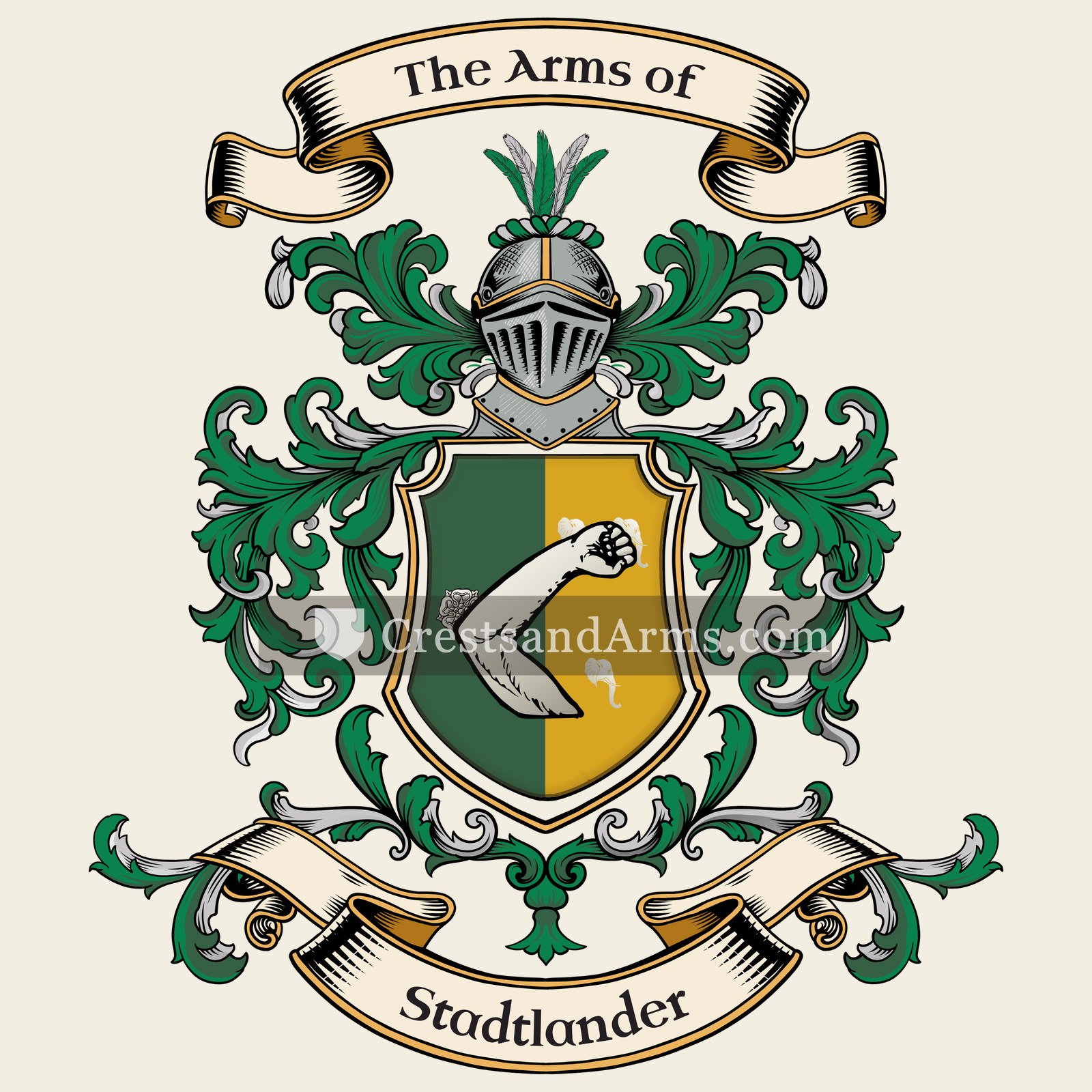
A record of documented arms, meaning and origin, researched for the Stadtlander family of Netherlands.
Reg. 1487 · Dutch, T–V
Coat of Arms & Family Crest Details
Symbols on this shield
armA person of action, industrious and laborious
roseThe seventh son, and beauty with grace
spurKnighthood, and readiness to spur on
elephantGreat strength, wit and ambition
Colours
Green (Vert)Means: Hope
Gold (Or)Means: Generosity
Silver (Argent)Means: Peace and sincerity
Historical info
Source
J. B. Rietstap, Armorial Général, Gouda: G. B. van Goor Zonen, 1884–87
Blazon (the actual original written record)
“Parti: au 1 coupé: a. de sin. à une rose d'arg. (ou molette à cinq rais d'or, percée de gu.); b. d'or à trois défenses d'éléphant d'arg., rangées en fasce, les bouts en haut; au 2 d'azur à un senestrochère de carn., iss. d'une nuée au nat., mouv. du flanc, tenant un sabre au nat.”
NetherlandsAmsterdam, c. 1815
Digital archive packCoat of arms PNG, gold border print PDF, vector SVG and the certificate of authenticity. Sent to your email in minutes.
Map of Netherlands showing where the Stadtlander arms are recorded
The Stadtlander arms were recorded in Amsterdam, c. 1815.
This is where the arms were entered in the register. Families often moved to other parts of the country, so the same name can turn up in more than one region.
Region
Amsterdam
Town
Amsterdam
First recorded
1815
Granting Authority for the Stadtlander Arms
Hoge Raad van Adel
Photograph made by me · CC BY-SA 3.0
The body that granted and recorded arms in Netherlands in this period.
William I of the Netherlands
Sovereign of the period
William I of the Netherlands
1815–1840
Reigning in Netherlands when the Stadtlander arms are first recorded.
How Arms Worked in Netherlands
In the Netherlands, coats of arms were often used by noble families and those who held specific public offices. These arms were passed down through the generations to legitimate descendants. Younger branches of a family usually kept the original design without needing to add special marks. This system ensured that the family identity remained clear and consistent over many years.
Granting authority
The Hoge Raad van Adel is the official body that regulates and manages noble titles and coats of arms in the Netherlands.
How they got arms
Families typically obtained their coats of arms through official royal grants or by proving their long-standing historical use of the symbols.
Where arms were recorded
Coats of arms are officially recorded in the registers held by the Hoge Raad van Adel, which began its work in 1814.
The family's standing
Recorded among the armigerous families of Netherlands.
Origin & History of the Stadtlander Family in Netherlands
The surname Stadtlander is a topographic name that originated in the German-speaking regions of Europe. The name is derived from the German words "Stadt," meaning city or town, and "lander," which refers to a person who lives in or comes from a specific place. This suggests that the earliest ancestors were likely residents of a town or city who were identified by their urban origin rather than a rural village. By 1815, members of the family were documented as living in Amsterdam, which was a major hub for trade and migration during the early nineteenth century. Many families moved to this bustling port city during this era to take advantage of the growing economic opportunities in the Netherlands. As these individuals settled into their new home, they carried the name forward, marking the transition of the family from their ancestral roots into the urban landscape of the Dutch capital.
Related Branches & Arms
Root word
Stad + Land
Germanic terms for city or town and land or territory.
This name
StadtlanderRefers to a person who originates from a specific city or rural territory.
also spelled
Stadlanderr
Stadlandere
Documented Sources
J. B. Rietstap, Armorial Général, Gouda: G. B. van Goor Zonen, 1884–87
Bahlow, Hans, Deutsches Namenlexikon: Familien- und Vornamen nach Ursprung und Sinn erklärt, 1967
Gottschald, Max, Deutsche Namenkunde: Unsere Familiennamen nach ihrer Entstehung und Bedeutung, 1971


 armA person of action, industrious and laborious
 roseThe seventh son, and beauty with grace
 spurKnighthood, and readiness to spur on
 elephantGreat strength, wit and ambition
 armA person of action, industrious and laborious
 roseThe seventh son, and beauty with grace
 spurKnighthood, and readiness to spur on
 elephantGreat strength, wit and ambition