Map of Austria showing where the Staggers arms are recorded
The Staggers arms were recorded in Styria, c. 1772.
Styria was mountain and forest country in southern Austria, with iron in its hills. Mining and landholding both made money, and families who held either kind of property took arms to seal their papers with.
This is where the arms were entered in the register. Families often moved to other parts of the country, so the same name can turn up in more than one region.
Region
Styria
First recorded
1772
Granting Authority for the Staggers Arms
Imperial and Royal chancery
Sodacan · CC BY-SA 3.0
The body that granted and recorded arms in Austria in this period.
Joseph II, Holy Roman Emperor
Sovereign of the period
Joseph II, Holy Roman Emperor
1765–1790
Reigning in Austria when the Staggers arms are first recorded.
How Arms Worked in Austria
Austrian coats of arms were often linked directly to noble titles granted by the Emperor. These symbols belonged to the entire family line rather than just one individual. When a family grew, new branches kept the original design without needing to change it. This system allowed all members of a noble house to share the same identity across many generations.
Granting authority
The Imperial and Royal chancery managed all heraldic matters and controlled the official granting of arms throughout the Austrian lands.
How they got arms
Families typically received their arms through a formal imperial decree that often accompanied the elevation of a person to noble status.
Where arms were recorded
Official records of these grants were kept in the Imperial Register of Nobility which began its formal documentation process in 1453.
The family's standing
Recorded among the armigerous families of Styria.
Origin & History of the Staggers Family in Austria
The family name Staggers finds its historical roots in the region of Styria, which is located in modern-day Austria. By the year 1772, records confirm that members of the family were well-established in this mountainous area. The name likely evolved as a descriptive term or a locational identifier for people living near specific geographical features or working in local trades common to the Styrian landscape. During the eighteenth century, Styria was a vital part of the Habsburg Monarchy, and families living there were often tied to the land through agriculture or regional industry. As the family grew, they became part of the local social fabric, contributing to the development of their communities before many eventually migrated to other parts of the world. This early presence in Styria serves as the foundational chapter for the family history, marking them as people who navigated the changing political and economic landscape of Central Europe during the late Enlightenment period.
Related Branches & Arms
Root word
stagg
Old Norse word for a male deer or stag.
This name
StaggersA topographic or occupational name for someone who lived near a stag or hunted them.
also spelled
Steiger
Stiger
Styger
Documented Sources
J. B. Rietstap, Armorial Général, Gouda: G. B. van Goor Zonen, 1884–87
Landesarchiv Steiermark, Ständische Aufzeichnungen und Steuerlisten
Pfeiffer, Gerhard, Die Geschichte der Steiermark, 1968
Steiermärkisches Landesarchiv, Grundbuchaufzeichnungen der Herrschaften, 1772
Digital archive packCoat of arms PNG, gold border print PDF, vector SVG and the certificate of authenticity. Sent to your email in minutes.


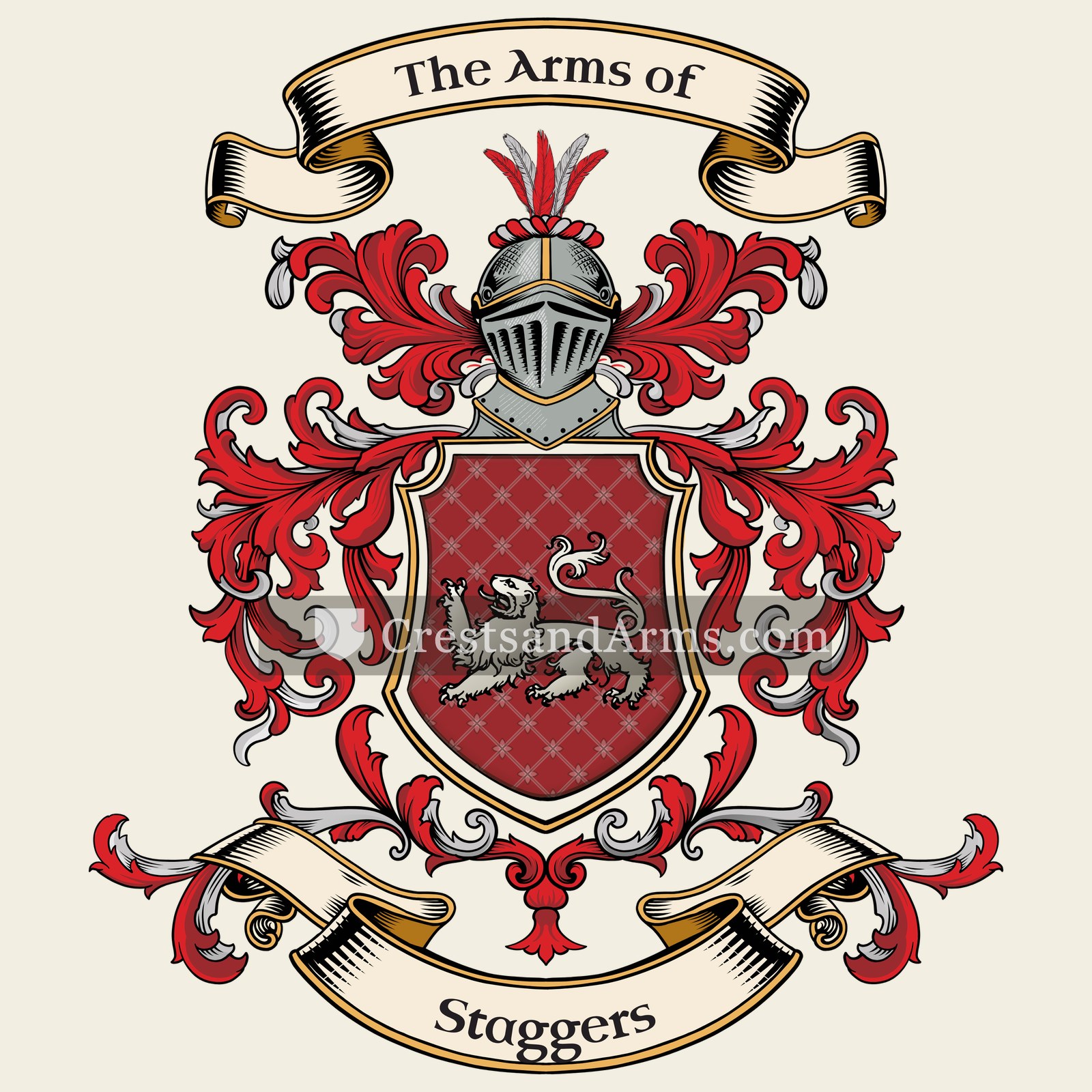
 lionCourage, strength and royalty
 lionCourage, strength and royalty