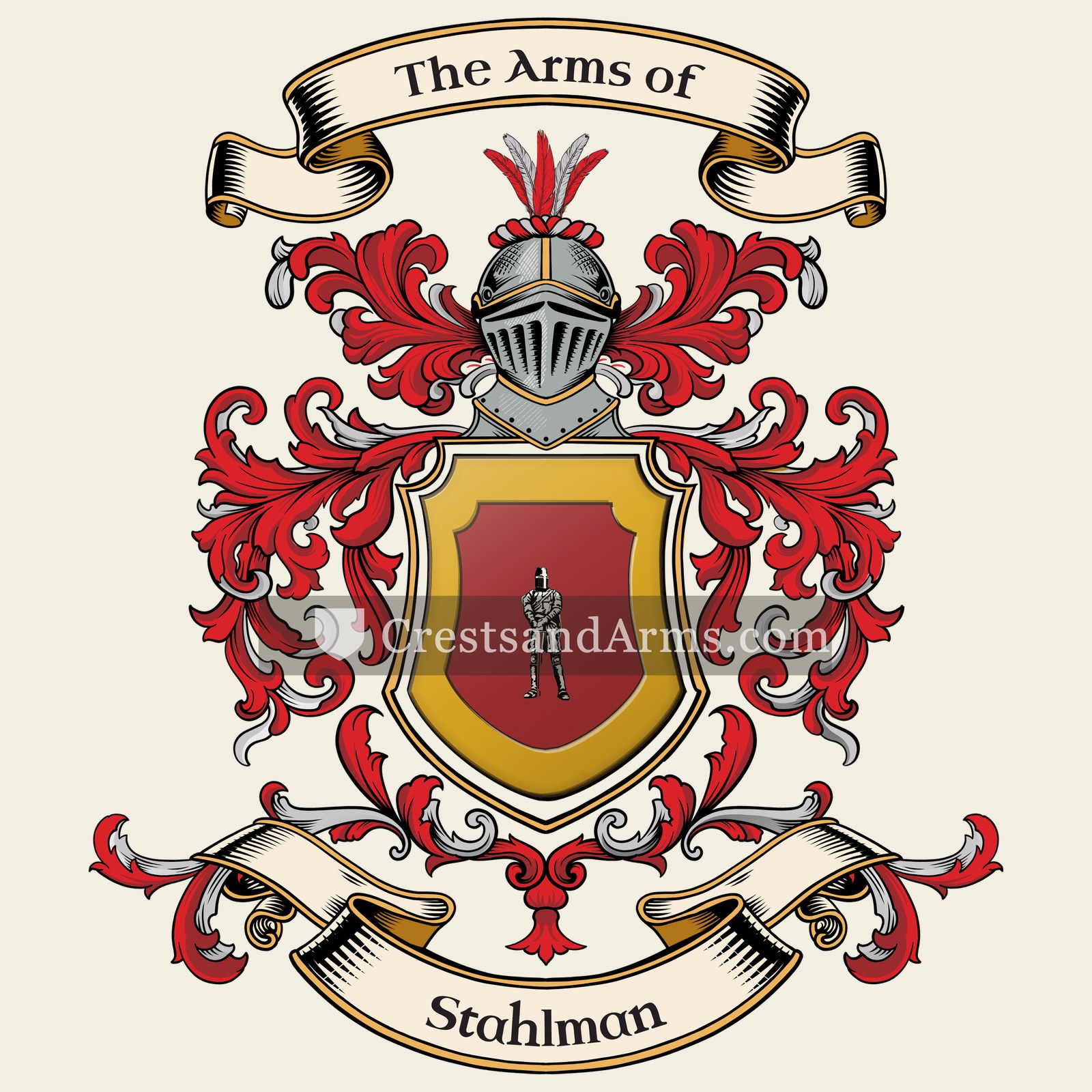
A record of documented arms, meaning and origin, researched for the Stahlman family of Sweden.
Reg. 4064 · Swedish, T–V
Coat of Arms & Family Crest Details
Symbols on this shield
knightChivalry and service in arms
Colours
Red (Gules)Means: Military strength
Gold (Or)Means: Generosity
Silver (Argent)Means: Peace and sincerity
Historical info
Source
J. B. Rietstap, Armorial Général, Gouda: G. B. van Goor Zonen, 1884–87
Blazon (the actual original written record)
“De gu. à un homme d'armes iss., arm. d'arg., la tête coiffée d'un bassinet d'arg., tenant une épée d'arg.; l'écu bordé d'or. C.: deux bras, arm. d'arg., les mains empoignant la garde d'une épée en pal.”
Swedenc. 1638
Digital archive packCoat of arms PNG, gold border print PDF, vector SVG and the certificate of authenticity. Sent to your email in minutes.
Map of Sweden showing where the Stahlman arms are recorded
The Stahlman arms were recorded in Sweden, c. 1638.
Arms such as these were typically recorded in Stockholm.
Stockholm held the Swedish court and the House of Nobility, where every noble family's arms were entered and kept. Families ennobled for service registered there, which is why so many are recorded around the city.
This is where the arms were entered in the register. Families often moved to other parts of the country, so the same name can turn up in more than one region.
The body that granted and recorded arms in Sweden in this period.
Christina of Sweden
Sovereign of the period
Christina of Sweden
1632–1654
Reigning in Sweden when the Stahlman arms are first recorded.
How Arms Worked in Sweden
In Sweden, a coat of arms belonged to a noble family as a whole rather than just one individual. These arms were passed down through the generations to all legitimate descendants. Younger branches of the family used the same shield without needing to change it. This system ensured that the entire lineage shared the same identity and status under the law.
Granting authority
The Riddarhuset, or House of Nobility, regulated all noble coats of arms in Sweden under royal authority.
How they got arms
Families received their coats of arms through royal grants of nobility which were then officially registered with the House.
Where arms were recorded
Coats of arms were officially recorded in the Swedish House of Nobility register starting in the year 1626.
The family's standing
Recorded among the armigerous families of Sweden.
Origin & History of the Stahlman Family in Sweden
The surname Stahlman originates from the German language, where it combines the words for steel and man. This name likely served as a descriptive occupational title for someone who worked as a blacksmith, a sword maker, or a metalworker. By the year 1638, records confirm that members of the Stahlman family were living in Stockholm, Sweden. During this period, Sweden was a rising power in Europe, and the city attracted many skilled craftsmen and merchants from German-speaking regions to support its growing industry and military. These early family members were likely part of a wave of migration that brought specialized technical skills to the Swedish capital. As they settled into their new home, they helped establish the name as a recognized part of the local community.
Stahlman Meaning & Related Branches
Root word
Stål
A hard, durable metal alloy made from iron and carbon.
This name
StahlmanA person who worked with or lived near steel, likely a blacksmith or metalworker.
also spelled
Stallman
Documented Sources
J. B. Rietstap, Armorial Général, Gouda: G. B. van Goor Zonen, 1884–87
Elgenstierna, Gustaf. Den introducerade svenska adelns ättartavlor. 1925
Hellquist, Elof. Svensk etymologisk ordbok. 1922
Riksarkivet (National Archives of Sweden), Stockholms stadsarkivs kyrkoarkiv
Digital archive packCoat of arms PNG, gold border print PDF, vector SVG and the certificate of authenticity. Sent to your email in minutes.


 knightChivalry and service in arms
 knightChivalry and service in arms