A record of documented arms, meaning and origin, researched for the Stanger family lines. Documented in 2 countries.
Reg. 6694 · German, T–V
Meaning of the Stanger family crest colors & symbols
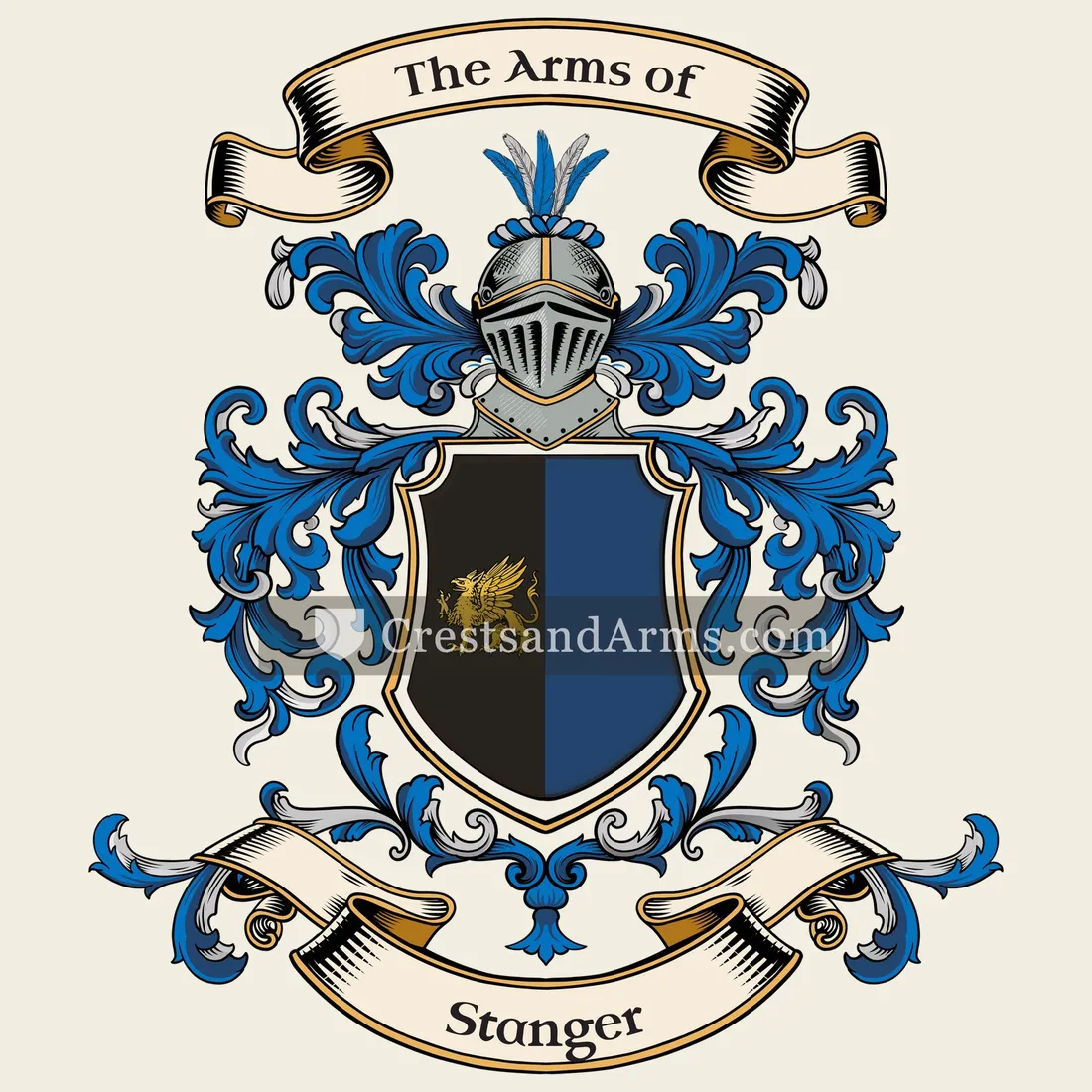
Symbols on this shield
griffinValour and vigilance, guarding great treasure
Colours
Black (Sable)Means: Constancy
Blue (Azure)Means: Loyalty and truth
Gold (Or)Means: Generosity
Historical info
Source
J. B. Rietstap, Armorial Général, Gouda: G. B. van Goor Zonen, 1884–87
Blazon (the actual original written record)
“Parti: au 1 de sa. à un griffon d'or; au 2 d'azur à deux pièces de bois d'or, passées en saut., liées au moyen d'un ruban de gu. C.: un homme barbu, iss., hab. d'un parti de sa. et d'azur, ceint d'or, coiffé d'un bonnet pointu d'azur, retr. d'or, tenant sur ses épaules l'une des pièces de bois. L.: à dextre d'or et de sa., à sen. d'or et d'azur.”
BavariaBavaria, c. 1765
Digital archive packCoat of arms PNG, gold border print PDF, vector SVG and the certificate of authenticity. Sent to your email in minutes.
Map of Germany showing where the Stanger arms are recorded
The Stanger arms were recorded in Bavaria, c. 1765.
Bavaria was a country of old landed families and walled market towns. Estates passed down the same line for centuries, and both the landowners and the leading townsmen kept arms, which is why so many Bavarian names sit in the registers.
This is where the arms were entered in the register. Families often moved to other parts of the country, so the same name can turn up in more than one region.
The body that granted and recorded arms in Germany in this period.
Francis I, Holy Roman Emperor
Sovereign of the period
Francis I, Holy Roman Emperor
1745–1765
Reigning in Germany when the Stanger arms are first recorded.
How Arms Worked in Germany
In the Holy Roman Empire, coats of arms were often granted to individuals by the Emperor or his representatives. These arms were then passed down through the generations to all legitimate descendants of the original holder. Younger branches of a family usually kept the same shield design without needing to change it, as the arms belonged to the entire lineage.
Granting authority
The Holy Roman Emperor held the sole power to grant new coats of arms throughout his vast imperial territories.
How they got arms
Families typically obtained their coats of arms through a formal imperial grant or by proving their noble status to the authorities.
Where arms were recorded
These grants were officially recorded in the Imperial Chancery registers, which began keeping formal records of such honors during the Middle Ages.
The family's standing
Recorded among the armigerous families of Bavaria.
Origin & History of the Stanger Family in Germany
The family name Stanger originates from the German language and is rooted in the occupational history of the region. The name is derived from the Middle High German word *stange*, which refers to a pole or a rod. Historically, this name was likely an occupational surname given to someone who worked as a pole-maker or a blacksmith who shaped iron rods. By the mid-18th century, records confirm that families bearing this name were well-established in the Bavarian region of Germany. In 1765, these individuals were part of a society defined by local craftsmanship and agricultural life in southern Germany. As members of the community, they contributed to the local economy through their specific trades. Over time, the name became a permanent marker of their family identity, passed down through generations as they navigated the social and economic changes of the Bavarian landscape.
Meaning of the Stanger family crest colors & symbols
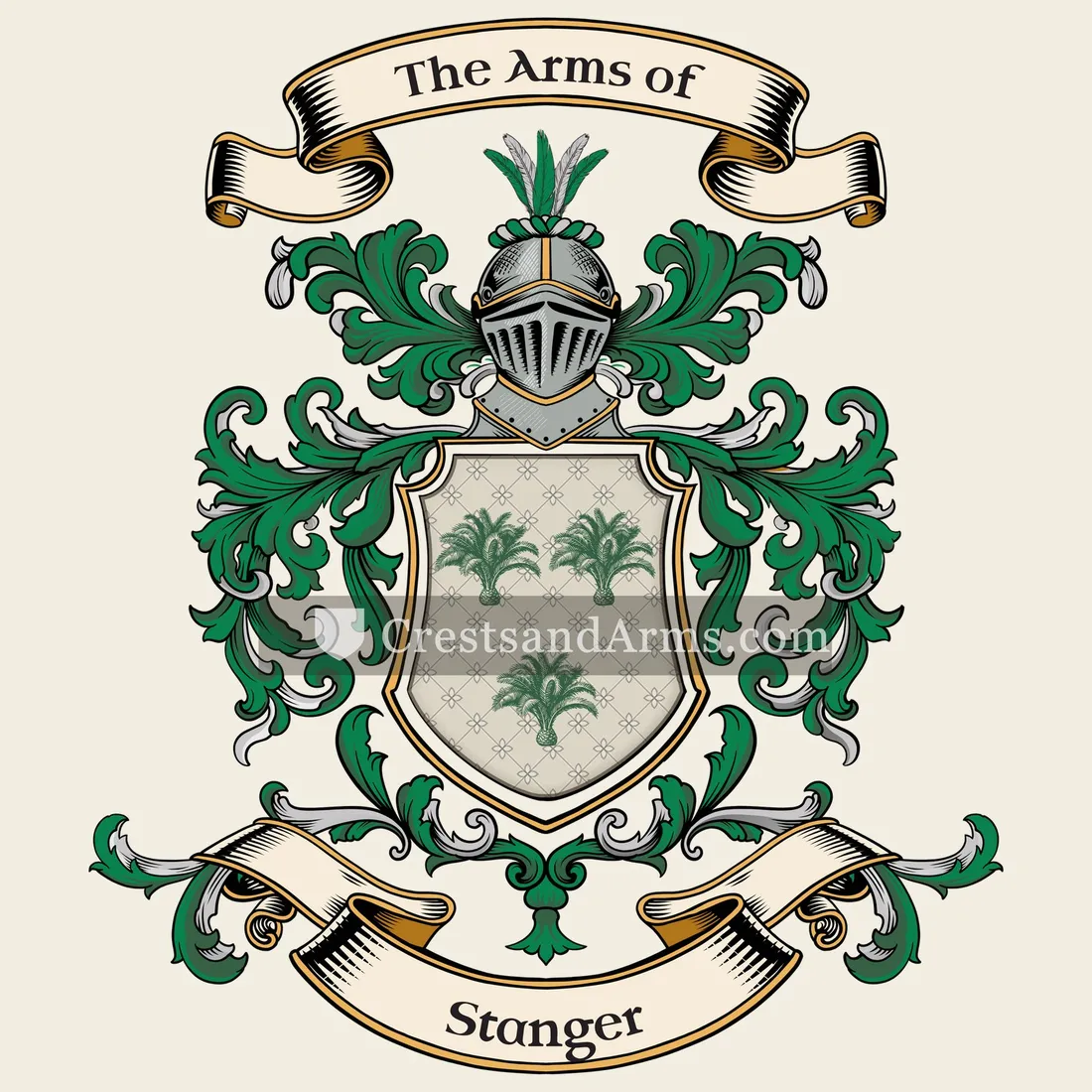
Symbols on this shield
palm treeVictory, and righteousness that flourishes
Colours
Silver (Argent)Means: Peace and sincerity
Green (Vert)Means: Hope
Historical info
Source
Sir Bernard Burke, The General Armory of England, Scotland, Ireland and Wales, London: Harrison & Sons, 1884
Blazon (the actual original written record)
“Ar. three palm branches vert”
Englandc. 1620
Digital archive packCoat of arms PNG, gold border print PDF, vector SVG and the certificate of authenticity. Sent to your email in minutes.
Map of England showing where the Stanger arms are recorded
The Stanger arms were recorded in England, c. 1620.
Arms such as these were typically recorded in York.
Yorkshire is the largest of the English counties, and it held more gentry families than any other. Land there was split among a great many households rather than a few, so a great many of them carried arms.
This is where the arms were entered in the register. Families often moved to other parts of the country, so the same name can turn up in more than one region.
The body that granted and recorded arms in England in this period.
James VI and I
Sovereign of the period
James VI and I
1603–1625
Reigning in Germany when the Stanger arms are first recorded.
How Arms Worked in England
English heraldry allowed arms to be shared by all legitimate descendants of the original owner. These symbols were treated as personal property that moved through the generations to all children. While the eldest son kept the original design, other family members could use the same shield without needing to change it or register their own unique versions.
Granting authority
The College of Arms in London has regulated the use of coats of arms throughout England and Wales since 1484.
How they got arms
Families typically obtained their coats of arms through a formal grant from the Crown or by proving their ancient right to them.
Where arms were recorded
All official coats of arms are recorded in the registers kept at the College of Arms, which date back to the fifteenth century.
The family's standing
Recorded among the armigerous families of England.
Origin & History of the Stanger Family in England
The surname Stanger is deeply rooted in the northern regions of England, particularly within the historic city of York. By the early 17th century, the family was already well-established in this area, as evidenced by records confirming their presence in York by 1620. The name itself is thought to be topographical in origin, likely derived from Old Norse or Old English terms describing someone who lived near a specific type of stone structure or a boundary marker. During this period, families like the Stangers were often tied to the local trade guilds and the growing urban economy of York. As the city served as a major hub for commerce and religion, the Stanger family would have been part of the vibrant social fabric that defined northern English life before the onset of the English Civil War. Their early history reflects the broader patterns of migration and settlement common among families in the North Riding of Yorkshire, where they remained a consistent part of the local community for generations.
Stanger Meaning & Related Branches
Root word
Stange
A pole, rod, or perch used for measuring or support.
This name
StangerAn occupational name for a maker of poles or a person who lived by a boundary marker.
also spelled
Stangar
Stangir
Stangur
Related arms
Stengervariant spelling
Documented Sources
J. B. Rietstap, Armorial Général, Gouda: G. B. van Goor Zonen, 1884–87
Bahlow, Hans. Deutsches Namenlexikon: Familien- und Vornamen nach Ursprung und Sinn erklärt. 1967
Heintze, Albert. Die deutschen Familien-Namen: geschichtlich, geographisch, sprachlich. 1903


 griffinValour and vigilance, guarding great treasure
 griffinValour and vigilance, guarding great treasure


 palm treeVictory, and righteousness that flourishes