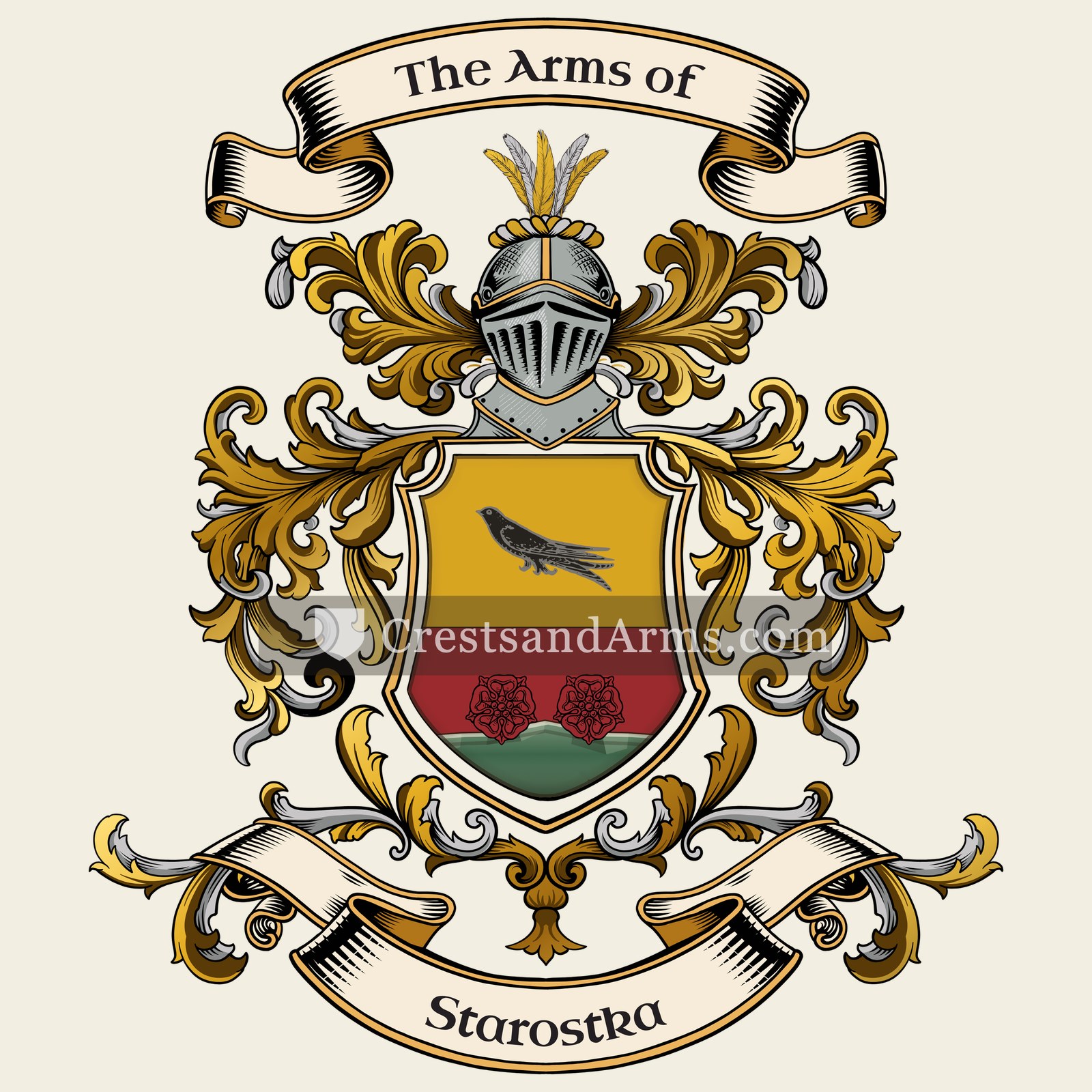
A record of documented arms, meaning and origin, researched for the Starostka family of Germany.
Reg. 0102 · German, T–V
Coat of Arms & Family Crest Details
Symbols on this shield
mountThe ground held, and steadfastness upon it
roseThe seventh son, and beauty with grace
martletA younger son, who must win his own land
Colours
Gold (Or)Means: Generosity
Red (Gules)Means: Military strength
Green (Vert)Means: Hope
Black (Sable)Means: Constancy
Historical info
Source
J. B. Rietstap, Armorial Général, Gouda: G. B. van Goor Zonen, 1884–87
Blazon (the actual original written record)
“Coupé: au 1 d'or à un étourneau de sa., posé sur une terrasse de sin.; au 2 parti de gu. et d'arg., à deux roses de l'un à l'autre, boutonnées d'azur. Brl. de gu. et d'arg. C.: un vol coupé, à dextre de gu. sur arg., à sen. d'or sur gu. L.: à dextre d'or et de gu., à sen. d'arg. et de gu.”
GermanyZittau Saxe, c. 1765
Digital archive packCoat of arms PNG, gold border print PDF, vector SVG and the certificate of authenticity. Sent to your email in minutes.
Map of Germany showing where the Starostka arms are recorded
The Starostka arms were recorded in Zittau Saxe, c. 1765.
This is where the arms were entered in the register. Families often moved to other parts of the country, so the same name can turn up in more than one region.
The body that granted and recorded arms in Germany in this period.
Francis I, Holy Roman Emperor
Sovereign of the period
Francis I, Holy Roman Emperor
1745–1765
Reigning in Germany when the Starostka arms are first recorded.
How Arms Worked in Germany
In the Holy Roman Empire, coats of arms were often granted to individuals by the Emperor or his representatives. These arms were then passed down through the generations to all legitimate descendants of the original holder. Younger branches of a family usually kept the same shield design without needing to change it, as the arms belonged to the entire lineage.
Granting authority
The Holy Roman Emperor held the sole power to grant new coats of arms throughout his vast imperial territories.
How they got arms
Families typically obtained their coats of arms through a formal imperial grant or by proving their noble status to the authorities.
Where arms were recorded
These grants were officially recorded in the Imperial Chancery registers, which began keeping formal records of such honors during the Middle Ages.
The family's standing
Recorded among the armigerous families of Germany.
Origin & History of the Starostka Family in Germany
The surname Starostka originates from the Slavic word "starosta," which historically referred to a village elder, a local magistrate, or a high-ranking administrative official. This title was common throughout Central and Eastern Europe, and it functioned as a way to identify individuals who held positions of community leadership or managed land for the nobility. By the time the family was documented in Zittau in 1765, the name had transitioned from a formal job title into a hereditary surname used to distinguish the family within the local population. Given Zittau’s location near the borders of modern-day Germany, Poland, and the Czech Republic, the presence of the Starostka name reflects the long history of migration and cultural exchange between these regions. Families bearing this name often settled in growing trade centers where their ancestors’ administrative skills or agricultural experience could be put to use in a new urban environment.
Related Branches & Arms
Root word
Starosta
A Slavic term for an elder, headman, or village official.
This name
StarostkaA diminutive or patronymic form referring to the descendant of a village elder.
Documented Sources
J. B. Rietstap, Armorial Général, Gouda: G. B. van Goor Zonen, 1884–87
Bahlow, Hans, Deutsches Namenlexikon: Familien- und Vornamen nach Ursprung und Sinn erklärt, 1967
Heintze, Albert, Die deutschen Familien-Namen: geschichtlich, geographisch, sprachlich, 1903
Sächsisches Staatsarchiv, Leipzig, Zittauer Ratsarchiv: Bürgeraufnahmen und Einwohnerverzeichnisse
Digital archive packCoat of arms PNG, gold border print PDF, vector SVG and the certificate of authenticity. Sent to your email in minutes.


 mountThe ground held, and steadfastness upon it
 roseThe seventh son, and beauty with grace
 martletA younger son, who must win his own land
 mountThe ground held, and steadfastness upon it
 roseThe seventh son, and beauty with grace
 martletA younger son, who must win his own land