A record of documented arms, meaning and origin, researched for the Start family lines. Documented in 3 countries.
Reg. 1661 · Britain, T–V
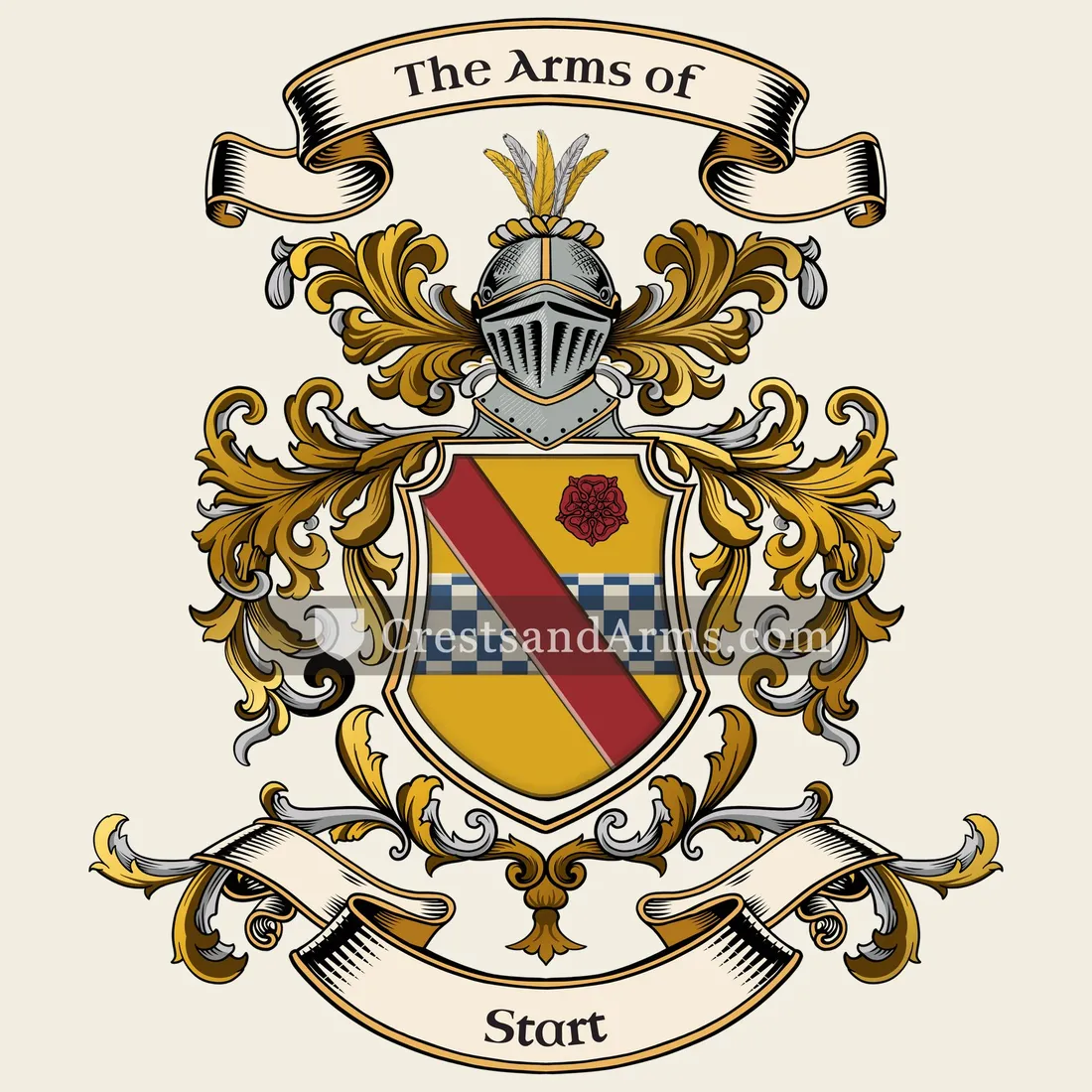
Meaning of the Start family crest colors & symbols
Symbols on this shield
fessThe military belt, and readiness to serve
chequyConstancy, and the counting-board
bendDefence, and the scarf of a commander
roseThe seventh son, and beauty with grace
Colours
Gold (Or)Means: Generosity
Blue (Azure)Means: Loyalty and truth
Red (Gules)Means: Military strength
Historical info
Source
J. B. Rietstap, Armorial Général, Gouda: G. B. van Goor Zonen, 1884–87
Blazon (the actual original written record)
“D'or à la fasce échiq. d'arg. et d'azur de trois tires, acc. au point du chef d'une rose de gu.; à la bande engr. du même, br. sur le tout. C.: une colombe, tenant en son bec un rameau d'olivier au nat. T.: à dextre un sauvage de carn., ceint et cour. de lierre, arm. d'une massue, posée sur son épaule; à sen. un lion de gu. D.: SOLA JUVAT VIRTUS.”
Britainc. 1606
Digital archive packCoat of arms PNG, gold border print PDF, vector SVG and the certificate of authenticity. Sent to your email in minutes.
Map of Britain showing where the Start arms are recorded
The Start arms were recorded in Britain, c. 1606.
Arms such as these were typically recorded in Kent.
Kent sits between London and the short crossing to Europe, and the trade passing through made it wealthy. Merchant families bought land with that money, and it was landowners who took coats of arms.
This is where the arms were entered in the register. Families often moved to other parts of the country, so the same name can turn up in more than one region.
The body that granted and recorded arms in Britain in this period.
James VI and I
Sovereign of the period
James VI and I
1603–1625
Reigning in Britain when the Start arms are first recorded.
How Arms Worked in Britain
English heraldry allowed arms to be shared by all legitimate descendants of the original owner. These symbols were treated as personal property that moved through the generations to all children. While the eldest son kept the original design, other family members could use the same shield without needing to change it or register their own unique versions.
Granting authority
The College of Arms in London has regulated the use of coats of arms throughout England and Wales since 1484.
How they got arms
Families typically obtained their coats of arms through a formal grant from the Crown or by proving their ancient right to them.
Where arms were recorded
All official coats of arms are recorded in the registers kept at the College of Arms, which date back to the fifteenth century.
The family's standing
Recorded among the armigerous families of Britain.
Origin & History of the Start Family in Britain
The surname Start has deep roots in the English county of Kent, where records confirm the family was established by at least 1606. During this period, the name likely functioned as a topographic descriptor, identifying individuals who lived near a prominent landmark or a specific stretch of land known as a "start." In Old English, this term often referred to a tail, a point of land, or a projecting piece of terrain. Because Kent was a major hub for agriculture and trade, families like the Starts were often deeply connected to the local landscape and the rhythms of rural life. Over the centuries, the name remained concentrated in the southeastern corner of England, reflecting the stable and localized nature of many families living in the region during the seventeenth century.
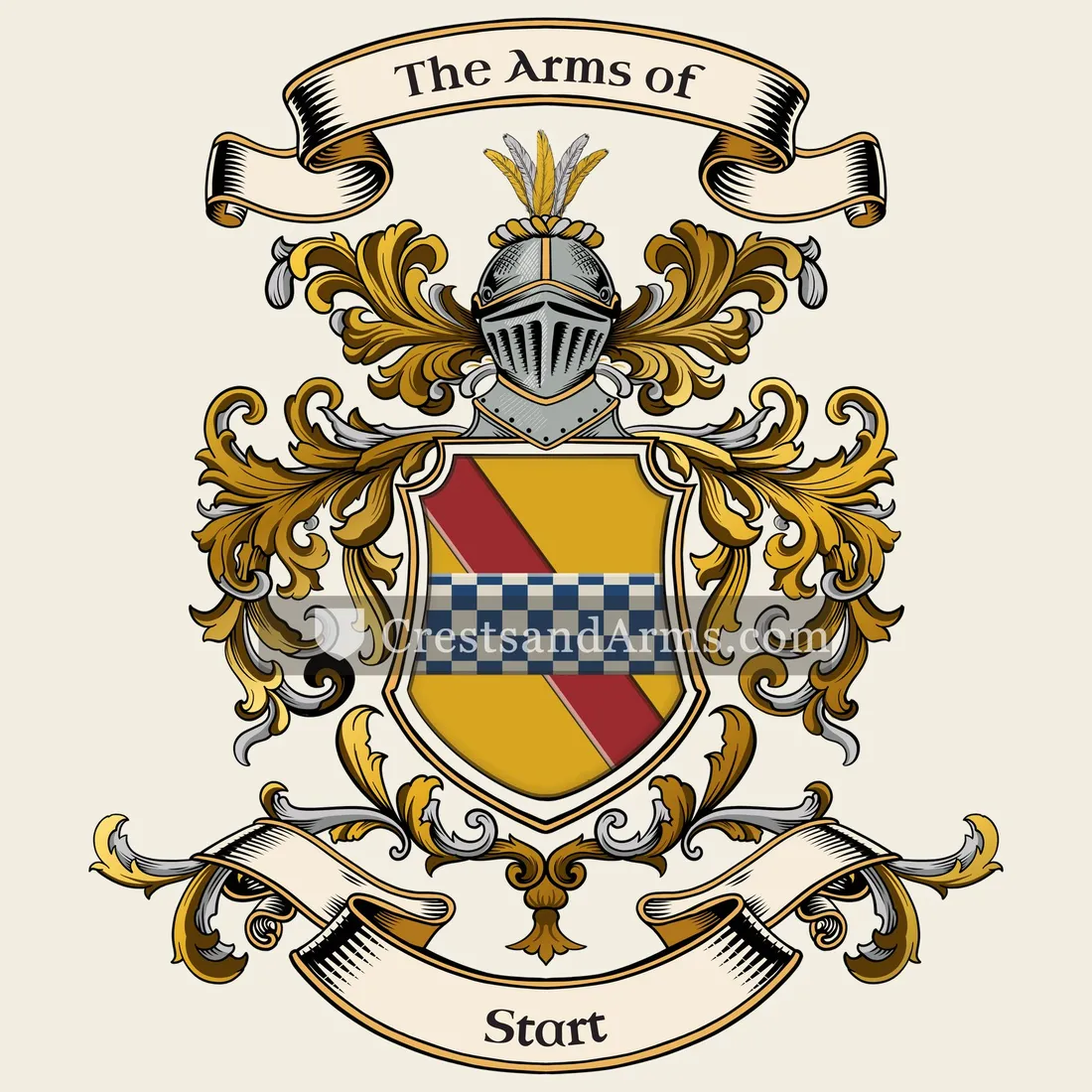
Meaning of the Start family crest colors & symbols
Symbols on this shield
bendDefence, and the scarf of a commander
fessThe military belt, and readiness to serve
chequyConstancy, and the counting-board
Colours
Gold (Or)Means: Generosity
Red (Gules)Means: Military strength
Silver (Argent)Means: Peace and sincerity
Historical info
Source
Sir Bernard Burke, The General Armory of England, Scotland, Ireland and Wales, London: Harrison & Sons, 1884
Blazon (the actual original written record)
“Or, a bend gu. surmounted of a fess chequy az. and ar”
DumfriesCastlemilk · Dumfries, c. 1668
Digital archive packCoat of arms PNG, gold border print PDF, vector SVG and the certificate of authenticity. Sent to your email in minutes.
Map of Scotland showing where the Start arms are recorded
The Start arms were recorded in Dumfries, c. 1668.
Dumfriesshire was Scottish border country facing England across a disputed line. Families held their land in return for defending it, and a defending household carried a shield.
This is where the arms were entered in the register. Families often moved to other parts of the country, so the same name can turn up in more than one region.
The body that granted and recorded arms in Scotland in this period.
Charles II of England
Sovereign of the period
Charles II of England
1660–1685
Reigning in Britain when the Start arms are first recorded.
How Arms Worked in Scotland
Scottish heraldry is unique because it treats a coat of arms as a piece of personal property protected by law. Only one person can own a specific design at any given time. When a family grows, the head keeps the original shield while other relatives must apply for their own distinct version with slight changes to prove their specific identity.
Granting authority
The Court of the Lord Lyon acts as the official body that regulates and controls all heraldic matters throughout Scotland.
How they got arms
Individuals obtain a legal right to their arms through a formal petition process that confirms their identity and family connection.
Where arms were recorded
All valid coats of arms are officially entered into the Public Register of All Arms and Bearings starting from 1672.
The family's standing
Recorded among the armigerous families of Dumfries.
Origin & History of the Start Family in Scotland
The family name Start has deep roots in the rugged landscape of southwestern Scotland, specifically within the region of Dumfries. Historical records confirm that members of the family were established in this area by 1668, a time when the region was defined by shifting political loyalties and the influence of the Covenanters. The name likely originated as a descriptive term or a topographic identifier, perhaps referring to someone who lived near a prominent physical feature or a specific path. In the seventeenth century, families in Dumfries were often tied to the land through agricultural labor or trade, and the presence of the Start name in local parish registers suggests they were part of the settled community during a period of significant social change. As the family grew, they became part of the local fabric of the Scottish Borders, contributing to the daily life and development of the region long before the modern era.
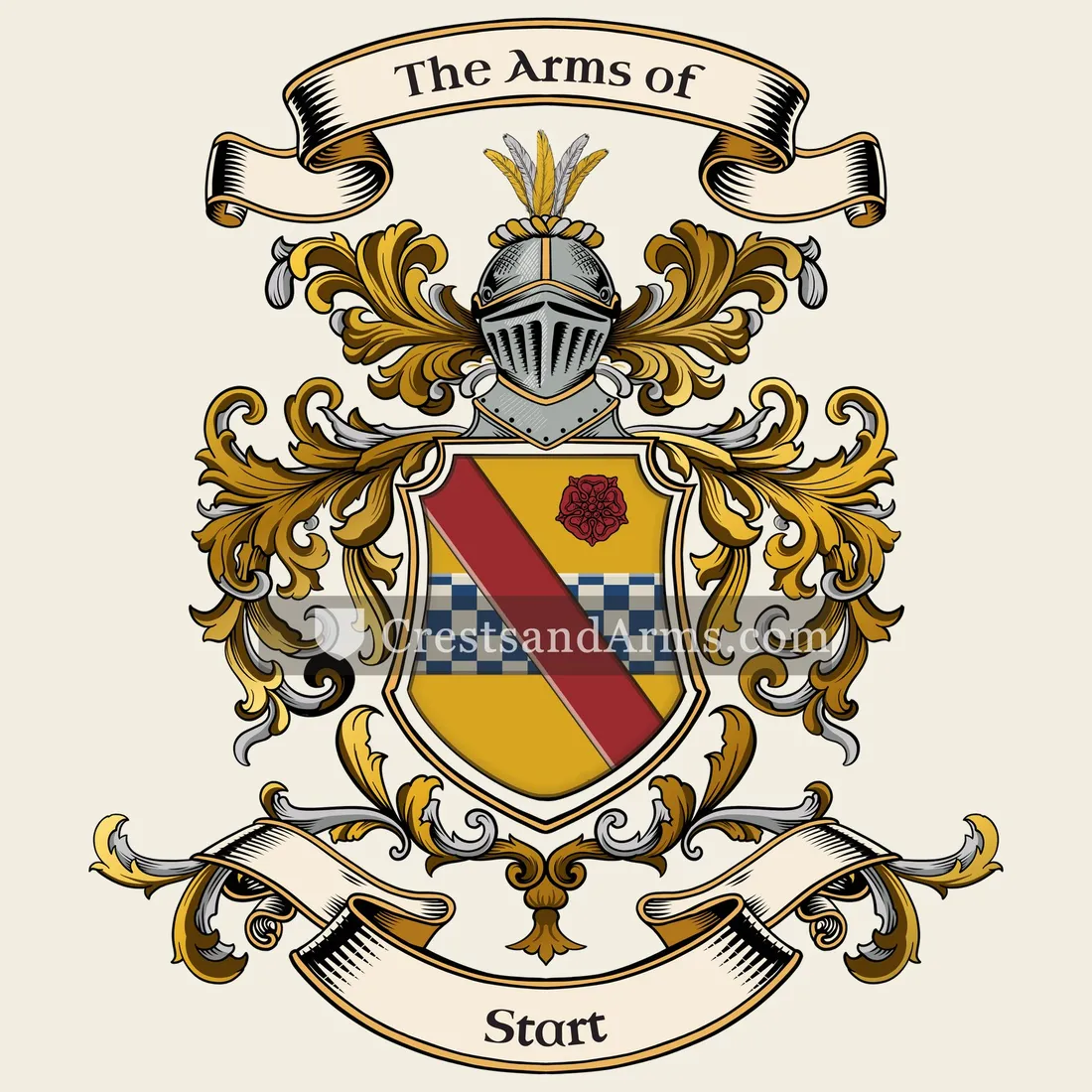
Meaning of the Start family crest colors & symbols
Symbols on this shield
fessThe military belt, and readiness to serve
chequyConstancy, and the counting-board
bendDefence, and the scarf of a commander
roseThe seventh son, and beauty with grace
Colours
Gold (Or)Means: Generosity
Silver (Argent)Means: Peace and sincerity
Red (Gules)Means: Military strength
Historical info
Source
Sir Bernard Burke, The General Armory of England, Scotland, Ireland and Wales, London: Harrison & Sons, 1884
Blazon (the actual original written record)
“Or, a fess chequy az. and ar. surmounted of a bend engr. and in chief a rose gu”
Englandc. 1620
Digital archive packCoat of arms PNG, gold border print PDF, vector SVG and the certificate of authenticity. Sent to your email in minutes.
Map of England showing where the Start arms are recorded
The Start arms were recorded in England, c. 1620.
Arms such as these were typically recorded in York.
Yorkshire is the largest of the English counties, and it held more gentry families than any other. Land there was split among a great many households rather than a few, so a great many of them carried arms.
This is where the arms were entered in the register. Families often moved to other parts of the country, so the same name can turn up in more than one region.
The body that granted and recorded arms in England in this period.
James VI and I
Sovereign of the period
James VI and I
1603–1625
Reigning in Britain when the Start arms are first recorded.
How Arms Worked in England
English heraldry allowed arms to be shared by all legitimate descendants of the original owner. These symbols were treated as personal property that moved through the generations to all children. While the eldest son kept the original design, other family members could use the same shield without needing to change it or register their own unique versions.
Granting authority
The College of Arms in London has regulated the use of coats of arms throughout England and Wales since 1484.
How they got arms
Families typically obtained their coats of arms through a formal grant from the Crown or by proving their ancient right to them.
Where arms were recorded
All official coats of arms are recorded in the registers kept at the College of Arms, which date back to the fifteenth century.
The family's standing
Recorded among the armigerous families of England.
Origin & History of the Start Family in England
The surname Start emerged in England as a descriptive name, likely originating from the Old English word *steort*, which referred to a tail or a projecting piece of land. By the early 17th century, historical records confirm that members of the Start family were well-established in the city of York. During this period, York was a bustling center of trade and religious life, and families like the Starts were often involved in local commerce or skilled crafts. Living in a major northern hub meant that these early ancestors were part of a society transitioning through significant political and social changes. While the name itself points toward a connection to the local landscape, the presence of the family in York by 1620 suggests they were settled members of the community who contributed to the city's growth during the reign of King James I.
Start Meaning & Related Branches
Root word
stert
Old English term referring to a tail, a tongue of land, or a ridge.
This name
StartA topographic name for someone who lived near a tail-shaped piece of land or a ridge.
also spelled
Stuard
Steward
Stewart
Steuart
Documented Sources
J. B. Rietstap, Armorial Général, Gouda: G. B. van Goor Zonen, 1884–87
Bardsley, Charles Wareing, A Dictionary of English and Welsh Surnames, 1901
Reaney, Percy Hide, A Dictionary of British Surnames, 1958
Kent Archives, Canterbury Cathedral Archives: Parish Register Transcripts, 1606
Digital archive packCoat of arms PNG, gold border print PDF, vector SVG and the certificate of authenticity. Sent to your email in minutes.


 fessThe military belt, and readiness to serve
 chequyConstancy, and the counting-board
 bendDefence, and the scarf of a commander
 roseThe seventh son, and beauty with grace
 fessThe military belt, and readiness to serve
 chequyConstancy, and the counting-board
 bendDefence, and the scarf of a commander
 roseThe seventh son, and beauty with grace