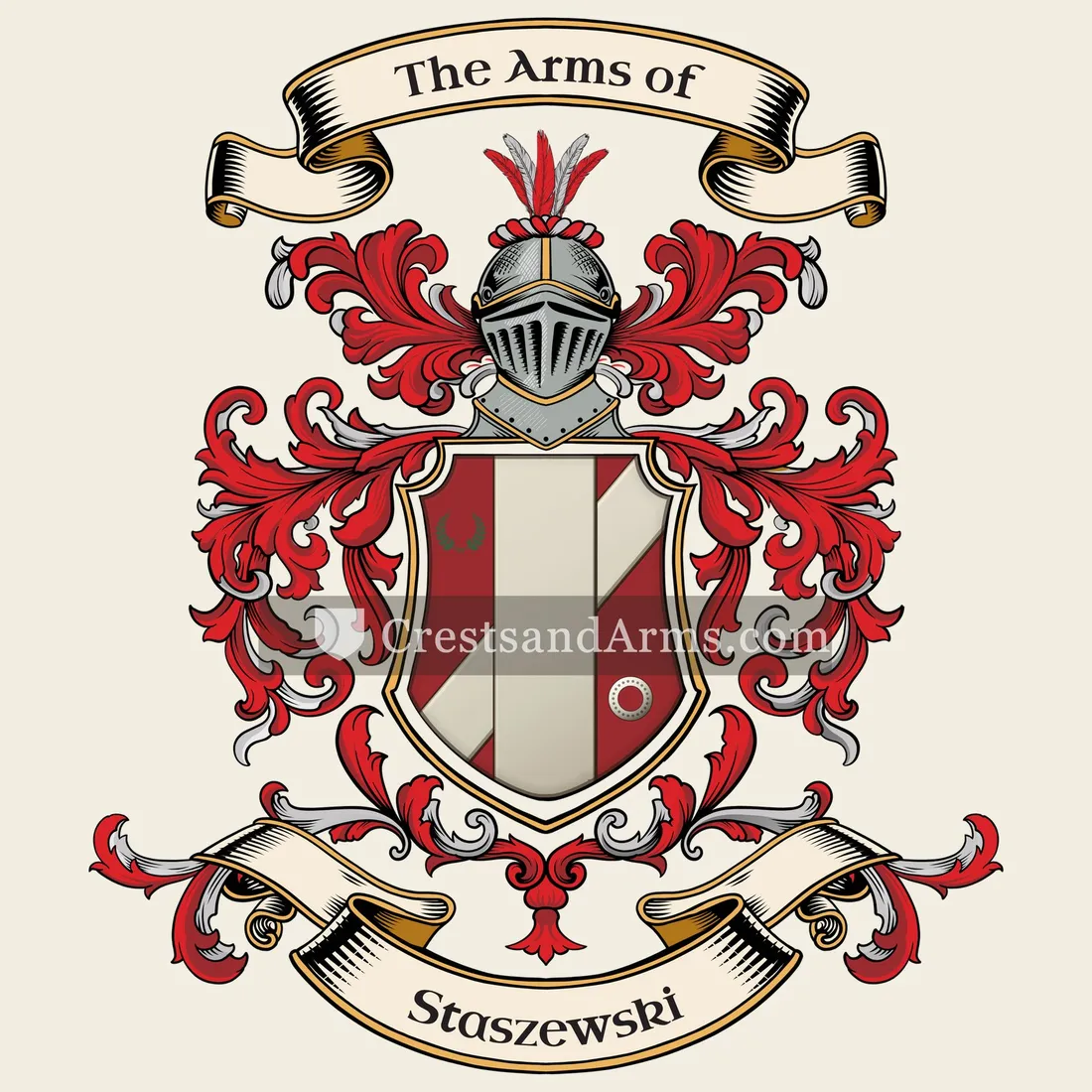
A record of documented arms, meaning and origin, researched for the Staszewski family of Poland.
Reg. 9964 · Polish, T–V
Meaning of the Staszewski family crest colors & symbols
Symbols on this shield
bendDefence, and the scarf of a commander
paleMilitary strength, and a fortified defence
wreathHonour, and a victory crowned
ringFidelity, and a promise kept
Colours
Red (Gules)Means: Military strength
Silver (Argent)Means: Peace and sincerity
Green (Vert)Means: Hope
Historical info
Source
J. B. Rietstap, Armorial Général, Gouda: G. B. van Goor Zonen, 1884–87
Blazon (the actual original written record)
“De gu. à une bande, une barre et un pal retrait en p. d'arg., aboutissant dans un annelet du même en abîme; le tout br. sur une couronne de laurier de sin. Cq. cour. C.: à dextre un bras tenant la couronne de laurier, à sen. un demi-vol de sa.”
Polandc. 1772
Digital archive packCoat of arms PNG, gold border print PDF, vector SVG and the certificate of authenticity. Sent to your email in minutes.
Map of Poland showing where the Staszewski arms are recorded
The Staszewski arms were recorded in Poland, c. 1772.
Arms such as these were typically recorded in Mazovia.
Mazovia held Warsaw, the Polish court and the assemblies where the szlachta met. Poland's nobles were unusually numerous and every one of them bore arms, and Warsaw is where those arms were argued over and recorded.
This is where the arms were entered in the register. Families often moved to other parts of the country, so the same name can turn up in more than one region.
Region
Mazovia
First recorded
1772
Granting Authority for the Staszewski Arms
Ennoblement by the Sejm
Author: Olek Remesz · CC BY-SA 3.0
The body that granted and recorded arms in Poland in this period.
Stanisław August Poniatowski
Sovereign of the period
Stanisław August Poniatowski
1764–1795
Reigning in Poland when the Staszewski arms are first recorded.
How Arms Worked in Poland
Polish noble families shared a single coat of arms across many different surnames, creating large clans rather than individual designs. These symbols were held collectively by all members of the clan regardless of their specific family name. When a new family joined the nobility, they were adopted into an existing clan and began using that group's established shield.
Granting authority
The Sejm, which was the Polish parliament, held the power to grant noble status and the right to bear arms.
How they got arms
Families typically received their coat of arms through a formal act of ennoblement granted by the Sejm for distinguished service.
Where arms were recorded
These grants were officially recorded in the Crown Metrica, which served as the central archive for state documents starting in the sixteenth century.
The family's standing
Recorded among the armigerous families of Poland.
Origin & History of the Staszewski Family in Poland
The surname Staszewski is a classic example of a Polish toponymic name, which means it was originally derived from a specific location. The suffix "-ewski" typically indicates that the family held land or originated from a place called Staszewo. By the year 1772, records confirm that members of the Staszewski family were well-established within the Mazovia region of Poland. During this era, Mazovia was a central hub for the Polish nobility and landowning families who played a significant role in local administration and agriculture. As the family grew, they likely spread from their ancestral village to surrounding towns, maintaining their identity through this distinctive name. This history reflects the broader patterns of Polish settlement, where families often took their names from the small villages they cultivated and called home for generations.
Staszewski Meaning & Related Branches
Root word
Stanisław
Derived from Slavic elements meaning someone who achieves glory or fame.
This name
StaszewskiA habitational surname denoting a person originating from a place named Staszew.
also spelled
Staszewsky
Stashevsky
Stashewski
Stashevski
Documented Sources
J. B. Rietstap, Armorial Général, Gouda: G. B. van Goor Zonen, 1884–87
Krzysztof Górski, Pomorze w dobie wojny trzynastoletniej, 1985
Aleksander Brückner, Słownik etymologiczny języka polskiego, 1927
Archiwum Główne Akt Dawnych w Warszawie, Metryki Koronne
Digital archive packCoat of arms PNG, gold border print PDF, vector SVG and the certificate of authenticity. Sent to your email in minutes.


 bendDefence, and the scarf of a commander
 paleMilitary strength, and a fortified defence
 wreathHonour, and a victory crowned
 ringFidelity, and a promise kept
 bendDefence, and the scarf of a commander
 paleMilitary strength, and a fortified defence
 wreathHonour, and a victory crowned
 ringFidelity, and a promise kept