Map of Netherlands showing where the Steckel arms are recorded
The Steckel arms were recorded in Deventer, c. 1815.
This is where the arms were entered in the register. Families often moved to other parts of the country, so the same name can turn up in more than one region.
Region
Deventer
Town
Deventer
First recorded
1815
Granting Authority for the Steckel Arms
Hoge Raad van Adel
Photograph made by me · CC BY-SA 3.0
The body that granted and recorded arms in Netherlands in this period.
William I of the Netherlands
Sovereign of the period
William I of the Netherlands
1815–1840
Reigning in Netherlands when the Steckel arms are first recorded.
How Arms Worked in Netherlands
In the Netherlands, coats of arms were often used by noble families and those who held specific public offices. These arms were passed down through the generations to legitimate descendants. Younger branches of a family usually kept the original design without needing to add special marks. This system ensured that the family identity remained clear and consistent over many years.
Granting authority
The Hoge Raad van Adel is the official body that regulates and manages noble titles and coats of arms in the Netherlands.
How they got arms
Families typically obtained their coats of arms through official royal grants or by proving their long-standing historical use of the symbols.
Where arms were recorded
Coats of arms are officially recorded in the registers held by the Hoge Raad van Adel, which began its work in 1814.
The family's standing
Recorded among the armigerous families of Netherlands.
Origin & History of the Steckel Family in Netherlands
The surname Steckel has deep roots in the historical landscape of the Netherlands, particularly within the city of Deventer. By the early 19th century, records confirm that members of the family were well-established residents of this Hanseatic city. The name itself likely originated as a descriptive term, potentially referring to a person who lived near a prominent stick or post, or perhaps someone who worked with such materials in a trade. During the Napoleonic era and the subsequent formation of the Kingdom of the Netherlands, families like the Steckels were part of a growing urban middle class that helped shape the local economy. As Deventer served as a vital hub for trade and river transport, the family was positioned in a location that allowed them to participate in the social and professional shifts defining the Dutch nation at the time. Their presence in the 1815 civil registers highlights a period where surnames became increasingly formalized and documented by the government for tax and census purposes.
Meaning of the Steckel family crest colors & symbols
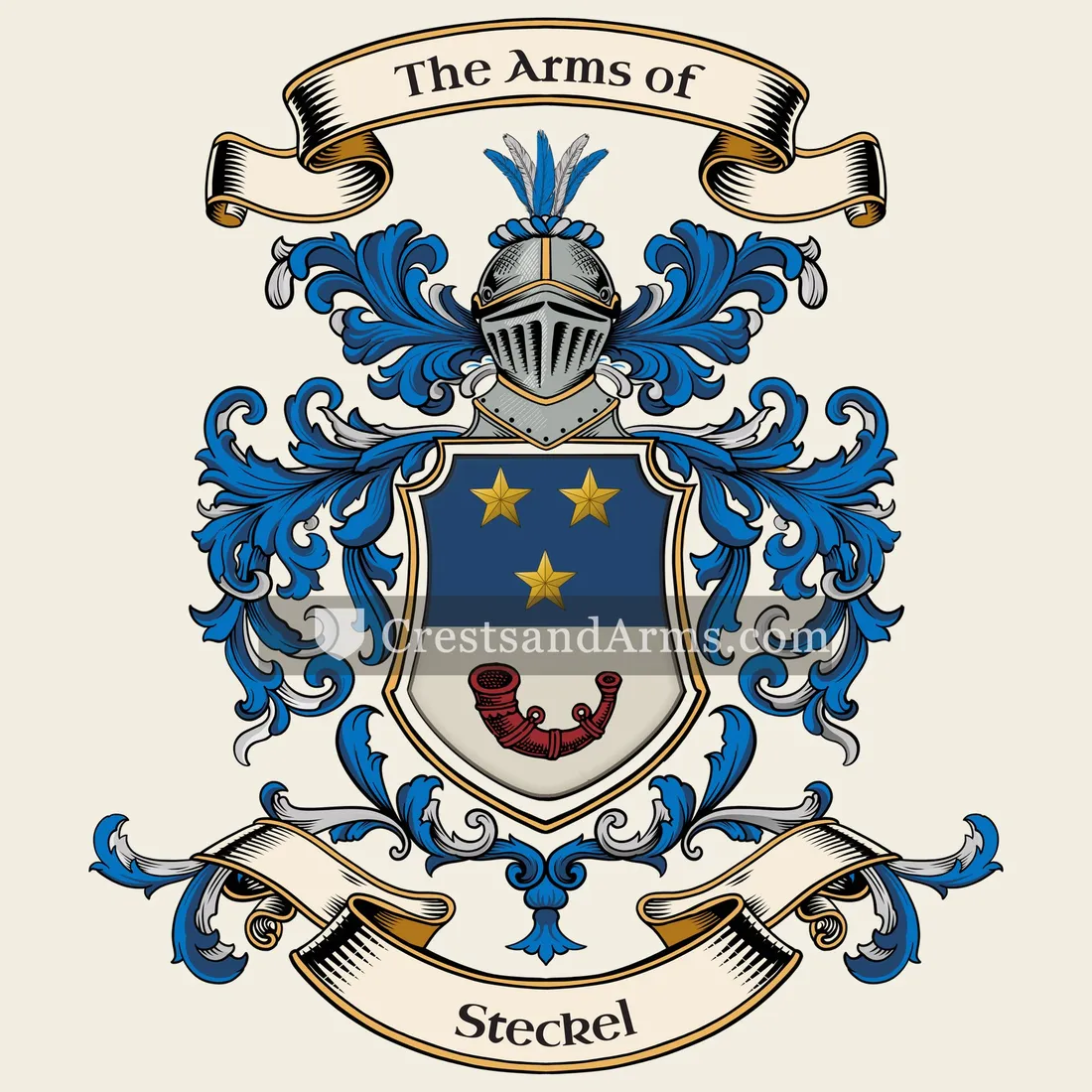
Symbols on this shield
mulletThe third son, and a divine quality from above
hunting horn stringedOne who delights in the chase
Colours
Blue (Azure)Means: Loyalty and truth
Silver (Argent)Means: Peace and sincerity
Gold (Or)Means: Generosity
Red (Gules)Means: Military strength
Historical info
Source
J. B. Rietstap, Armorial Général, Gouda: G. B. van Goor Zonen, 1884–87
Blazon (the actual original written record)
“Coupé: au 1 d'azur à trois étoiles mal-ordonnées d'or; au 2 d'arg. à un cor-de-chasse de gu. C.: un vol d'azur, chaque aile ch. d'une étoile d'arg. L.: d'arg. et d'azur.”
GermanyNuremberg, c. 1765
Digital archive packCoat of arms PNG, gold border print PDF, vector SVG and the certificate of authenticity. Sent to your email in minutes.
Map of Germany showing where the Steckel arms are recorded
The Steckel arms were recorded in Nuremberg, c. 1765.
This is where the arms were entered in the register. Families often moved to other parts of the country, so the same name can turn up in more than one region.
The body that granted and recorded arms in Germany in this period.
Francis I, Holy Roman Emperor
Sovereign of the period
Francis I, Holy Roman Emperor
1745–1765
Reigning in Netherlands when the Steckel arms are first recorded.
How Arms Worked in Germany
In the Holy Roman Empire, coats of arms were often granted to individuals by the Emperor or his representatives. These arms were then passed down through the generations to all legitimate descendants of the original holder. Younger branches of a family usually kept the same shield design without needing to change it, as the arms belonged to the entire lineage.
Granting authority
The Holy Roman Emperor held the sole power to grant new coats of arms throughout his vast imperial territories.
How they got arms
Families typically obtained their coats of arms through a formal imperial grant or by proving their noble status to the authorities.
Where arms were recorded
These grants were officially recorded in the Imperial Chancery registers, which began keeping formal records of such honors during the Middle Ages.
The family's standing
Recorded among the armigerous families of Germany.
Origin & History of the Steckel Family in Germany
The surname Steckel traces its roots back to the German regions, where it likely originated as a descriptive nickname or a reference to a specific occupation. In Middle High German, the term *steckel* often related to a small stick, a staff, or a walking cane, suggesting that the earliest ancestors to carry this name may have been woodworkers, makers of walking sticks, or individuals known for carrying a distinct staff. By the mid-18th century, the family had established a notable presence in the city of Nuremberg. During this period, Nuremberg served as a major hub for trade and craftsmanship, providing a stable environment for families to build their livelihoods through specialized labor. The presence of the Steckel name in city records from 1765 indicates that the family was well-integrated into the urban life of the region, participating in the local economy and social structures that defined this historic center of German industry.
Steckel Meaning & Related Branches
Root word
stec
A stick, branch, or pointed piece of wood.
This name
SteckelAn occupational name for someone who worked with sticks, or a topographic name for someone living near a fence.
also spelled
Stokel
Documented Sources
J. B. Rietstap, Armorial Général, Gouda: G. B. van Goor Zonen, 1884–87
Historisch Centrum Overijssel, Burgerlijke Stand in Overijssel (Deventer)
Beekman, A.A., Geschiedenis van de Nederlanden, 1948
Van Berkel, G. and Samplonius, K., Nederlandse plaatsnamen verklaard, 2018
Digital archive packCoat of arms PNG, gold border print PDF, vector SVG and the certificate of authenticity. Sent to your email in minutes.


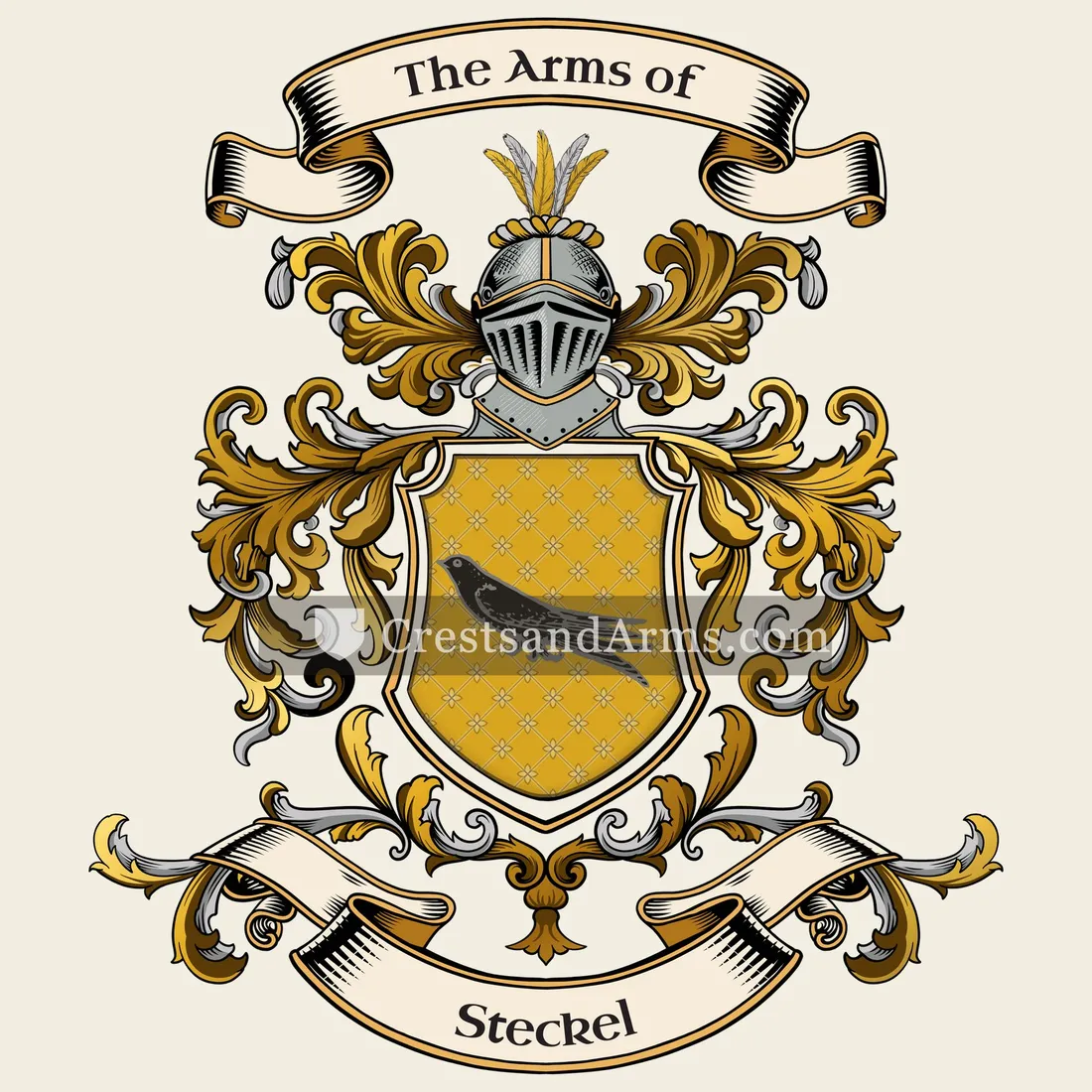
 martletA younger son, who must win his own land
 martletA younger son, who must win his own land


 mulletThe third son, and a divine quality from above
 hunting horn stringedOne who delights in the chase