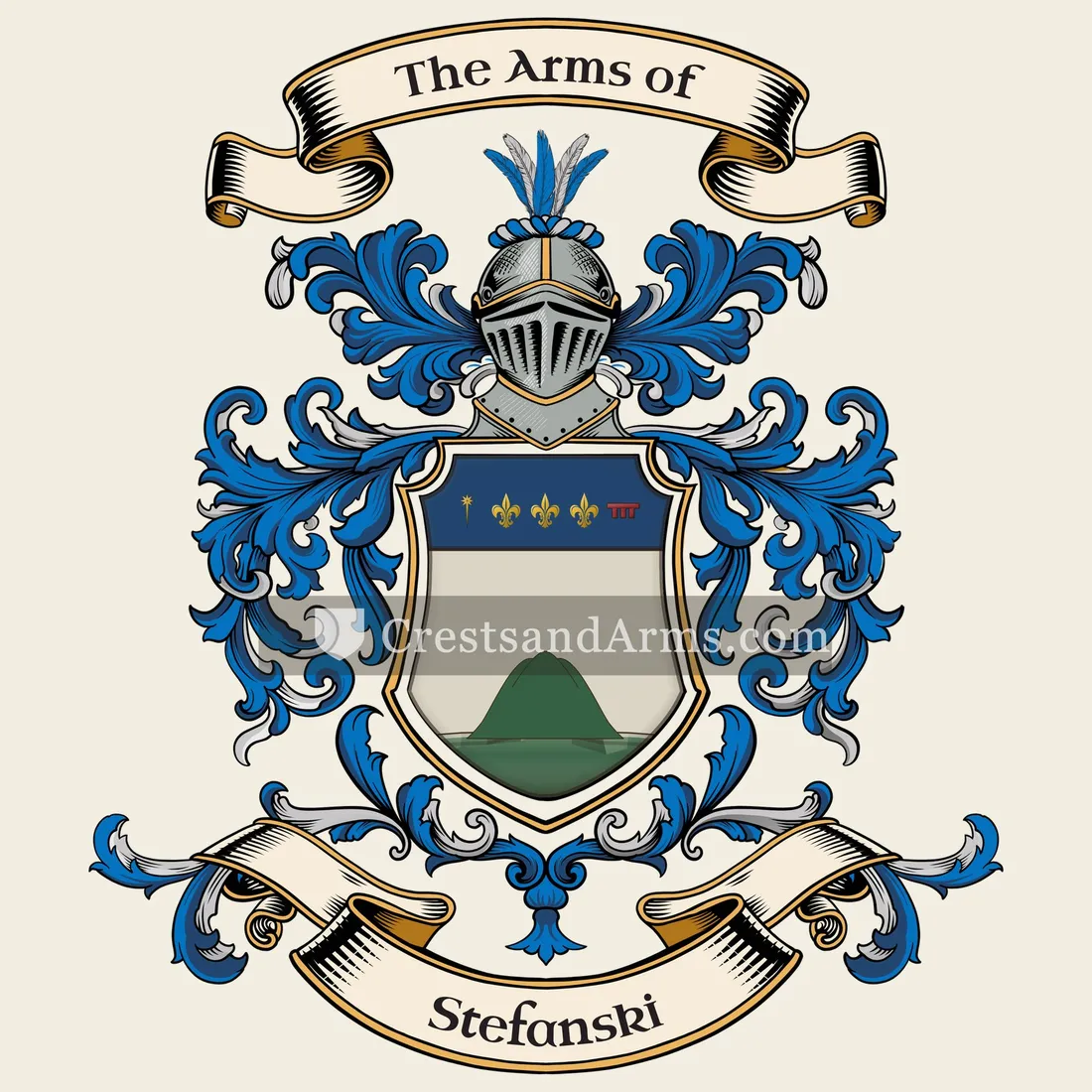
A record of documented arms, meaning and origin, researched for the Stefanski family of Italy.
Reg. 0231 · Italian, T–V
Meaning of the Stefanski family crest colors & symbols
Symbols on this shield
mountThe ground held, and steadfastness upon it
chiefAuthority, wisdom and dominion
labelThe eldest son, during his father's life
cometA great event foretold, and swift renown
fleur de lisPurity, light, and the sixth son
Colours
Silver (Argent)Means: Peace and sincerity
Blue (Azure)Means: Loyalty and truth
Green (Vert)Means: Hope
Gold (Or)Means: Generosity
Red (Gules)Means: Military strength
Historical info
Source
J. B. Rietstap, Armorial Général, Gouda: G. B. van Goor Zonen, 1884–87
Blazon (the actual original written record)
“D'arg. à un mont de trois coupeaux de sin., mouv. de la p., acc. en chef d'une comète d'or; au chef d'azur, ch. de trois fleurs-de-lis d'or, rangées entre les quatre pendants d'un lambel de gu.”
ItalyBologne, c. 1775
Digital archive packCoat of arms PNG, gold border print PDF, vector SVG and the certificate of authenticity. Sent to your email in minutes.
Map of Italy showing where the Stefanski arms are recorded
The Stefanski arms were recorded in Bologne, c. 1775.
This is where the arms were entered in the register. Families often moved to other parts of the country, so the same name can turn up in more than one region.
The body that granted and recorded arms in Italy in this period.
Alvise Giovanni Mocenigo
Sovereign of the period
Alvise Giovanni Mocenigo
1763–1778
Reigning in Italy when the Stefanski arms are first recorded.
How Arms Worked in Italy
In the Italian states, coats of arms were often used by noble families to show their status and history. These symbols were passed down through the generations to all legitimate male descendants. Younger branches of a family usually kept the original design but sometimes added small changes to distinguish their specific line from the main branch.
Granting authority
Various local rulers and city governments controlled the use of coats of arms across the different Italian states.
How they got arms
Families often assumed their own arms or received them as official grants from local lords, popes, or city councils.
Where arms were recorded
Arms were recorded in local city archives or private family books rather than in one single national register.
The family's standing
Recorded among the armigerous families of Italy.
Origin & History of the Stefanski Family in Italy
The surname Stefanski is rooted in the Slavic tradition, derived from the given name Stefan, which originates from the Greek word stephanos meaning crown or garland. While the name is most commonly associated with Polish heritage, historical records confirm that members of the family were established in the city of Bologna by 1775. During this period, Bologna was a prominent center for trade and education within the Papal States, attracting diverse families from across Europe who sought opportunities in its renowned university and merchant guilds. Families like the Stefanskis often moved along established European trade routes, settling in Italian cities to work as skilled craftsmen or administrators. By integrating into the local society of Bologna, these early ancestors helped bridge the cultural gap between their Slavic origins and the vibrant intellectual life of northern Italy.
Stefanski Meaning & Related Branches
Root word
Stephanos
Greek word meaning crown, garland, or wreath.
This name
StefanskiDerived from the Greek name meaning one who is crowned or victorious.
also spelled
Stephani
Stefanny
Documented Sources
J. B. Rietstap, Armorial Général, Gouda: G. B. van Goor Zonen, 1884–87
Archivio di Stato di Bologna, Stato delle anime della parrocchia di San Pietro, 1775
Kutrzeba, Stanisław, Historia ustroju Polski w zarysie, 1905
Rymut, Kazimierz, Nazwiska Polaków: słownik historyczno-etymologiczny, 1999
Digital archive packCoat of arms PNG, gold border print PDF, vector SVG and the certificate of authenticity. Sent to your email in minutes.


 mountThe ground held, and steadfastness upon it
 chiefAuthority, wisdom and dominion
 labelThe eldest son, during his father's life
 cometA great event foretold, and swift renown
 fleur de lisPurity, light, and the sixth son
 mountThe ground held, and steadfastness upon it
 chiefAuthority, wisdom and dominion
 labelThe eldest son, during his father's life
 cometA great event foretold, and swift renown
 fleur de lisPurity, light, and the sixth son