Map of Belgium showing where the Steffens arms are recorded
The Steffens arms were recorded in Brabant, c. 1737.
Brabant lay at the heart of the Low Countries, where the trade routes met. Its towns were wealthy and its landowners many, and both kinds of family kept arms, which is why the region is so heavily represented.
This is where the arms were entered in the register. Families often moved to other parts of the country, so the same name can turn up in more than one region.
The body that granted and recorded arms in Belgium in this period.
Charles VI, Holy Roman Emperor
Sovereign of the period
Charles VI, Holy Roman Emperor
1711–1740
Reigning in Belgium when the Steffens arms are first recorded.
How Arms Worked in Belgium
In Belgium, a coat of arms is considered personal property that is passed down through the male line to legitimate descendants. Families often use the same shield design across generations to show their shared heritage. If a branch of the family wants to change the design, they must apply for an official update to their specific version of the arms.
Granting authority
The Conseil héraldique is the official body that regulates and approves all coats of arms in Belgium.
How they got arms
Families obtain their coats of arms through formal royal grants or by confirming their historical right to use existing designs.
Where arms were recorded
All approved coats of arms are officially recorded in the public registers of the Conseil héraldique since 1844.
The family's standing
Recorded among the armigerous families of Brabant.
Origin & History of the Steffens Family in Belgium
The family name Steffens finds its roots in the Germanic tradition of patronymics, serving as a shortened form of the name Stephen, which translates to "crown" or "wreath." By the early eighteenth century, the family had established a notable presence in the historical region of Brabant, a territory that spanned parts of modern-day Belgium and the Netherlands. During this period, Brabant was a center of agricultural and artisanal activity under the rule of the Austrian Habsburgs. Families like the Steffens were often integrated into the local parish systems, where their names were recorded in baptismal and marriage registers kept by village priests. These documents show that the family lived through a time of significant transition as the region navigated shifting political borders and the slow modernization of rural life. By 1737, the Steffens name was already well-embedded in the social fabric of the Brabant countryside, reflecting a long history of community involvement and regional stability.
Coat of Arms & Family Crest Details
Symbols on this shield
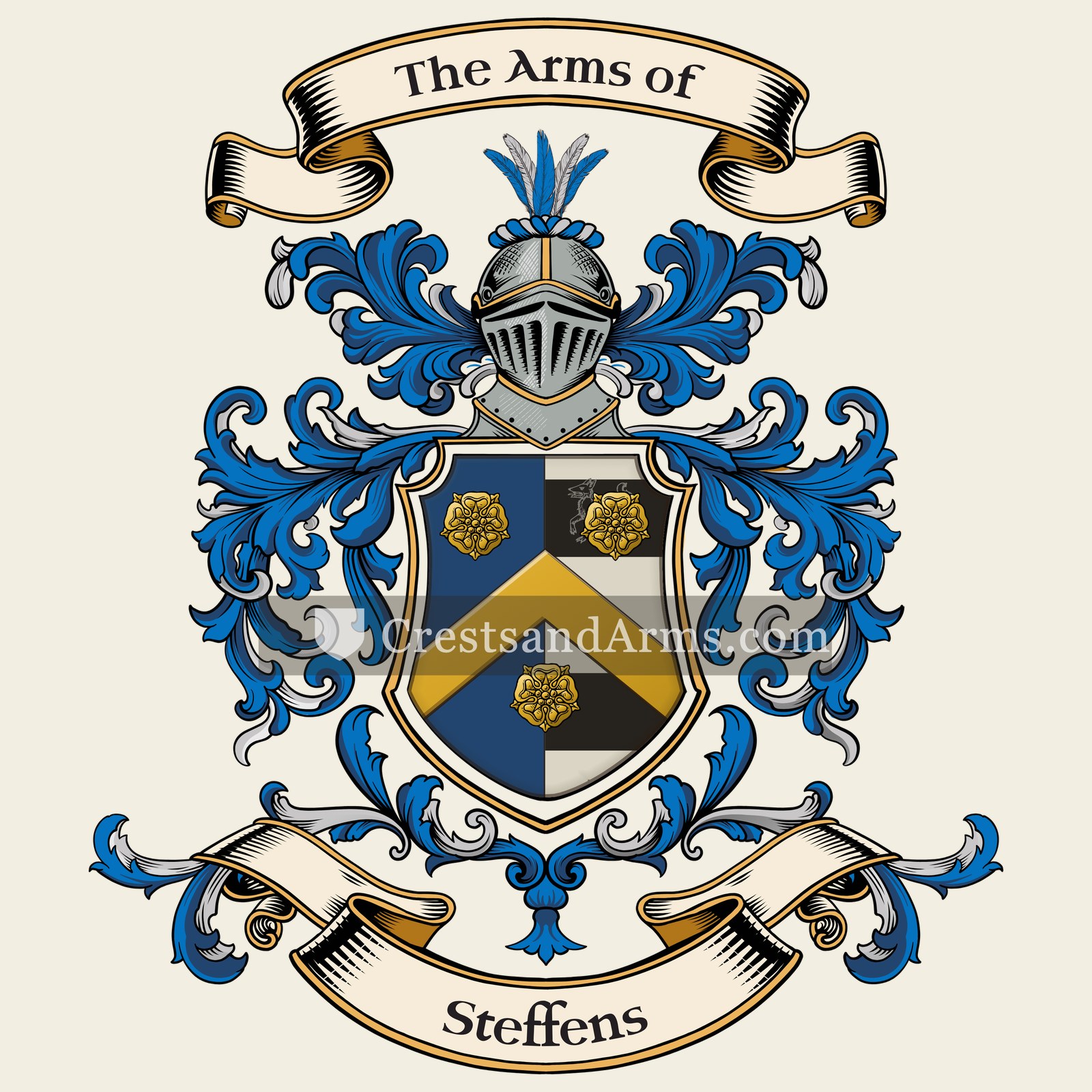
chevronProtection, and faithful service completed
fessThe military belt, and readiness to serve
roseThe seventh son, and beauty with grace
wolfReward from long service and hard work
Colours
Blue (Azure)Means: Loyalty and truth
Silver (Argent)Means: Peace and sincerity
Gold (Or)Means: Generosity
Black (Sable)Means: Constancy
Historical info
Source
J. B. Rietstap, Armorial Général, Gouda: G. B. van Goor Zonen, 1884–87
Blazon (the actual original written record)
“Parti: au 1 d'azur au chev. d'or, acc. de trois roses du même; au 2 d'arg. à deux fasces de sa., acc. en chef d'une tête et col de loup du même. Cq. cour. C.: un loup iss. de sa. L.: à dextre d'or et d'azur, à sen. d'arg. et de sa. D.: VIRTUS, FIDUCIA, PERSEVERANTIA.”
UtrechtUtrecht, c. 1815
Digital archive packCoat of arms PNG, gold border print PDF, vector SVG and the certificate of authenticity. Sent to your email in minutes.
Map of Netherlands showing where the Steffens arms are recorded
The Steffens arms were recorded in Utrecht, c. 1815.
Utrecht was an old church town with rich farming country around it. Both the church and the land produced families of standing, and families of standing kept arms to seal their documents with.
This is where the arms were entered in the register. Families often moved to other parts of the country, so the same name can turn up in more than one region.
Region
Utrecht
First recorded
1815
Granting Authority for the Steffens Arms
Hoge Raad van Adel
Photograph made by me · CC BY-SA 3.0
The body that granted and recorded arms in Netherlands in this period.
William I of the Netherlands
Sovereign of the period
William I of the Netherlands
1815–1840
Reigning in Belgium when the Steffens arms are first recorded.
How Arms Worked in Netherlands
In the Netherlands, coats of arms were often used by noble families and those who held specific public offices. These arms were passed down through the generations to legitimate descendants. Younger branches of a family usually kept the original design without needing to add special marks. This system ensured that the family identity remained clear and consistent over many years.
Granting authority
The Hoge Raad van Adel is the official body that regulates and manages noble titles and coats of arms in the Netherlands.
How they got arms
Families typically obtained their coats of arms through official royal grants or by proving their long-standing historical use of the symbols.
Where arms were recorded
Coats of arms are officially recorded in the registers held by the Hoge Raad van Adel, which began its work in 1814.
The family's standing
Recorded among the armigerous families of Utrecht.
Origin & History of the Steffens Family in Netherlands
The surname Steffens is a patronymic name, which means it was originally derived from the given name of a father or ancestor. In the case of this family, the name originates from the personal name Steven, which is the Dutch version of the Greek name Stephanos. During the early nineteenth century, the Netherlands underwent significant changes in how citizens recorded their identities. In 1811, under French rule, the government required all families to register a permanent surname for official records. By 1815, families bearing the name Steffens were well-established in the city of Utrecht. At this time, Utrecht was a major hub for trade and administration, and families like the Steffens were often part of the growing urban middle class. These early ancestors likely worked as skilled tradespeople or merchants, contributing to the local economy as the nation transitioned into a modern state following the end of the Napoleonic era.
Coat of Arms & Family Crest Details
Symbols on this shield
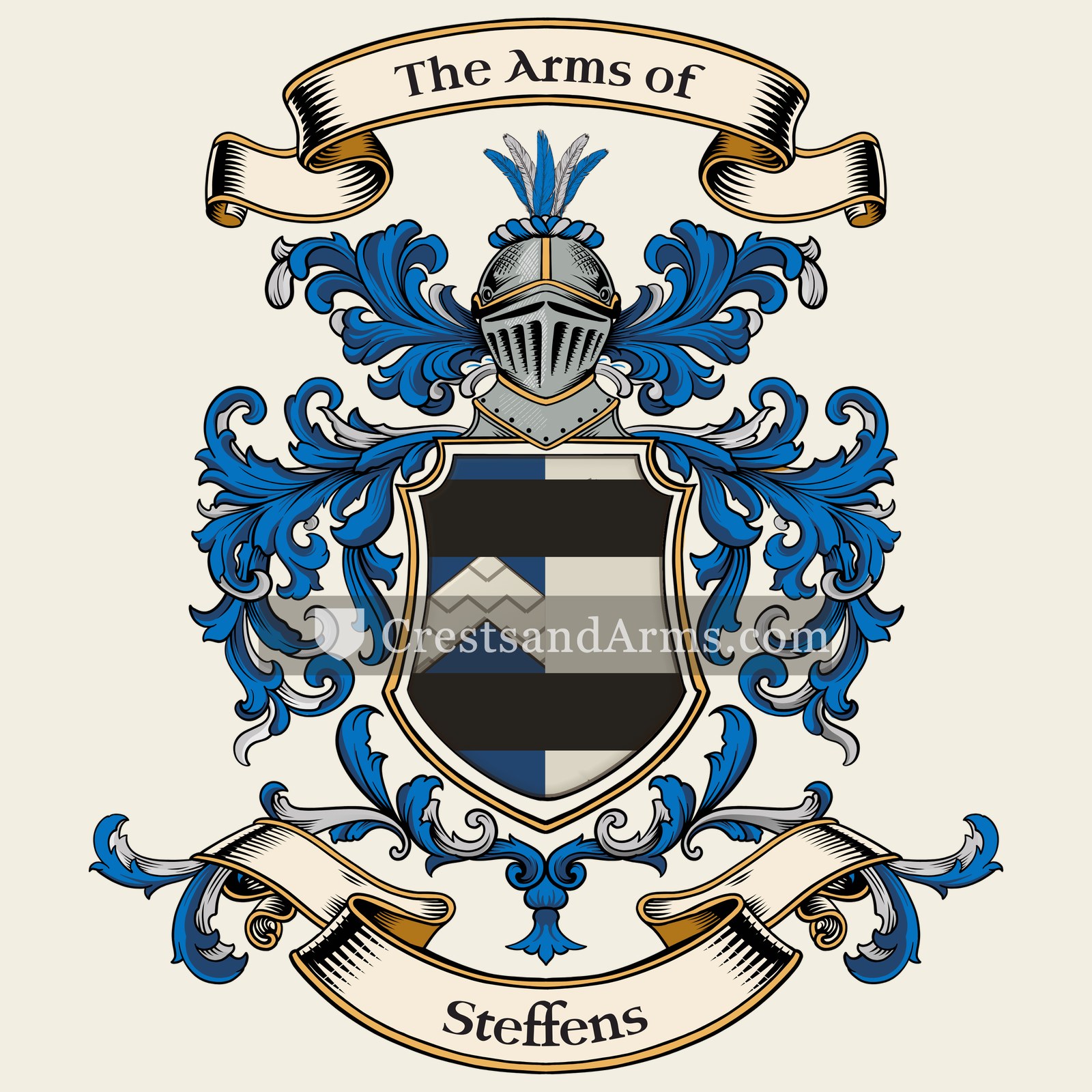
chevronProtection, and faithful service completed
fessThe military belt, and readiness to serve
roseThe seventh son, and beauty with grace
wolfReward from long service and hard work
Colours
Blue (Azure)Means: Loyalty and truth
Silver (Argent)Means: Peace and sincerity
Black (Sable)Means: Constancy
Historical info
Source
J. B. Rietstap, Armorial Général, Gouda: G. B. van Goor Zonen, 1884–87
Blazon (the actual original written record)
“Parti: au 1 d'azur au chev. d'arg., acc. de trois roses du même; au 2 d'arg. à deux fasces de sa., acc. en chef d'une tête et col de loup du même. C.: un loup iss. de sa.”
Francec. 1841
Digital archive packCoat of arms PNG, gold border print PDF, vector SVG and the certificate of authenticity. Sent to your email in minutes.
Map of France showing where the Steffens arms are recorded
The Steffens arms were recorded in France, c. 1841.
Arms such as these were typically recorded in Bretagne.
More families held coats of arms in Bretagne than anywhere else in France. The land was divided into many small estates rather than a few large ones, so far more households counted as gentry, and each needed a shield of its own to be told apart.
This is where the arms were entered in the register. Families often moved to other parts of the country, so the same name can turn up in more than one region.
The body that granted and recorded arms in France in this period.
How Arms Worked in France
In France, a coat of arms was a mark of honor that passed down through the male line to all legitimate descendants. Families often used the same shield without changes to show their shared heritage. If a branch wanted to stand out, they could add a small mark to their shield to show their specific place in the family tree.
Granting authority
The Juge d'armes de France acted as the official authority that regulated and verified coats of arms across the country.
How they got arms
Families typically inherited their arms from ancestors, though they could also receive them through royal grants or by proving their noble status.
Where arms were recorded
Coats of arms were officially recorded in the Armorial Général de France, which began its main collection in the year 1696.
The family's standing
Recorded among the armigerous families of France.
Origin & History of the Steffens Family in France
The family name Steffens carries a rich history that reflects the movement of people across European borders, particularly within the context of the nineteenth century. While the name is often associated with Germanic roots, its presence in the Bretagne region of France by 1841 highlights a period of significant migration and cultural integration. During this era, families often moved to follow new economic opportunities or to escape regional instability, settling into the unique social fabric of northwestern France. By establishing themselves in Bretagne, the early members of the Steffens family became part of a local community that valued maritime trade and agriculture. Their integration into French society during this time suggests a history defined by adaptability and the blending of distinct cultural traditions as they settled into their new home.
Related Branches & Arms
Root word
Stephanus
Derived from the Greek word for crown or garland.
This name
SteffensA patronymic surname meaning son of Stephen, indicating descent from a person bearing that name.
also spelled
Stefens
Stephens
Related arms
Stephensvariant spelling
Documented Sources
J. B. Rietstap, Armorial Général, Gouda: G. B. van Goor Zonen, 1884–87
State Archives in Belgium (Rijksarchief in België), Parochieregisters van Brabant
State Archives in Belgium (Rijksarchief in België), Burgerlijke Stand van de provincie Brabant
Debrabandere, Frans, Woordenboek van de familienamen in België en Noord-Frankrijk, 2003
Leys, O., De familienamen in de provincie Brabant, 1974
Digital archive packCoat of arms PNG, gold border print PDF, vector SVG and the certificate of authenticity. Sent to your email in minutes.


 sickleThe harvest, and the reaping of what was sown
 roseThe seventh son, and beauty with grace
 sickleThe harvest, and the reaping of what was sown
 roseThe seventh son, and beauty with grace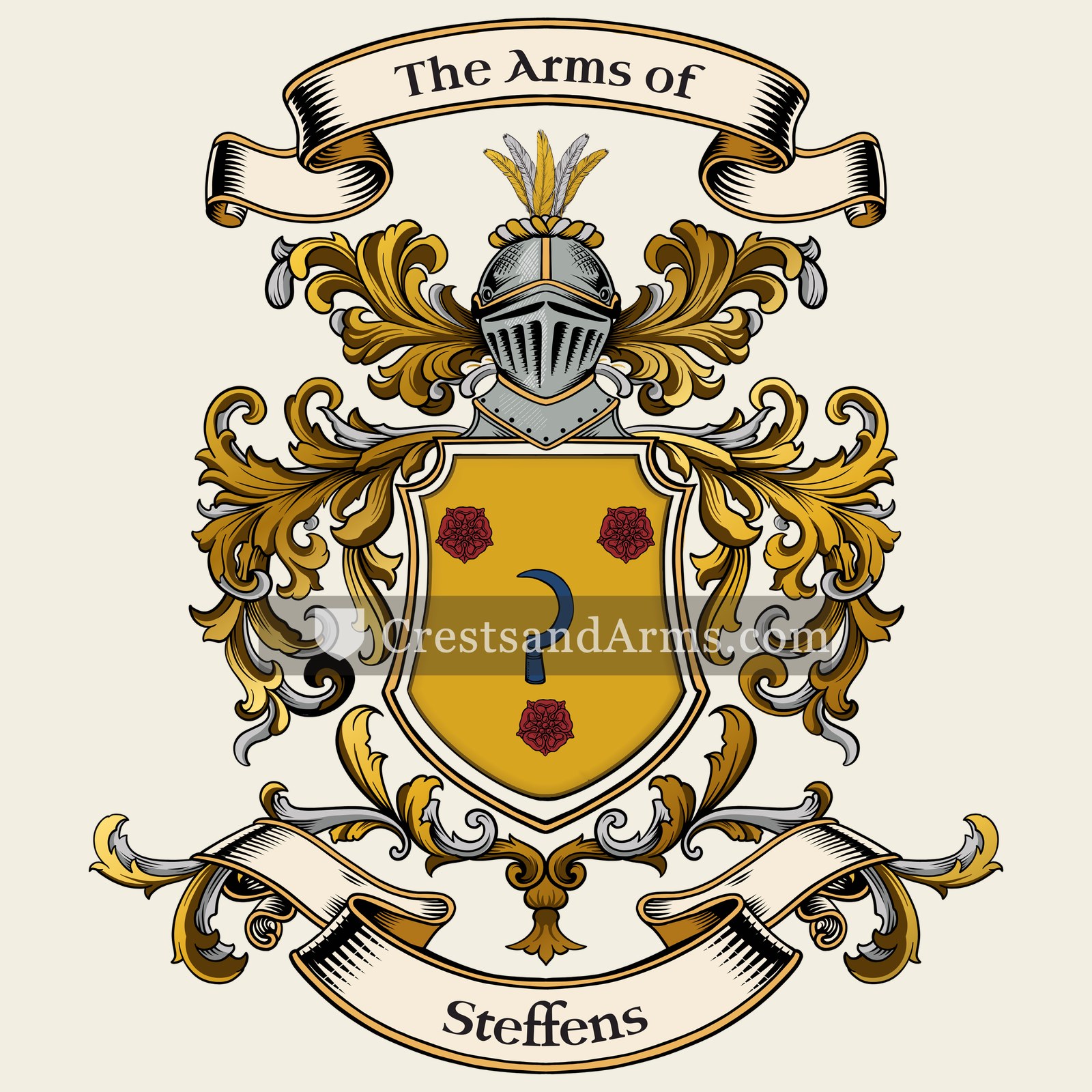


 chevronProtection, and faithful service completed
 fessThe military belt, and readiness to serve
 wolfReward from long service and hard work