Map of Belgium showing where the Steffensen arms are recorded
The Steffensen arms were recorded in Brabant, c. 1737.
Brabant lay at the heart of the Low Countries, where the trade routes met. Its towns were wealthy and its landowners many, and both kinds of family kept arms, which is why the region is so heavily represented.
This is where the arms were entered in the register. Families often moved to other parts of the country, so the same name can turn up in more than one region.
The body that granted and recorded arms in Belgium in this period.
Charles VI, Holy Roman Emperor
Sovereign of the period
Charles VI, Holy Roman Emperor
1711–1740
Reigning in Belgium when the Steffensen arms are first recorded.
How Arms Worked in Belgium
In Belgium, a coat of arms is considered personal property that is passed down through the male line to legitimate descendants. Families often use the same shield design across generations to show their shared heritage. If a branch of the family wants to change the design, they must apply for an official update to their specific version of the arms.
Granting authority
The Conseil héraldique is the official body that regulates and approves all coats of arms in Belgium.
How they got arms
Families obtain their coats of arms through formal royal grants or by confirming their historical right to use existing designs.
Where arms were recorded
All approved coats of arms are officially recorded in the public registers of the Conseil héraldique since 1844.
The family's standing
Recorded among the armigerous families of Brabant.
Origin & History of the Steffensen Family in Belgium
The family name Steffensen carries a distinct history within the region of Brabant, where records confirm the presence of family members as early as 1737. While the name itself is rooted in Germanic and Scandinavian naming traditions, its appearance in the historical landscape of Belgium reflects the movement of families across European borders during the eighteenth century. At that time, Brabant was a bustling center of trade and agriculture, and families like the Steffensens often settled in these areas to participate in the local economy or to serve in administrative roles. The name functions as a patronymic, meaning it was originally formed to identify a person as the son of Steffen. Over generations, this identifier transitioned from a simple description into a permanent surname that anchored the family within the social fabric of the Low Countries. By establishing themselves in Brabant, these early ancestors became part of a long tradition of families who helped shape the local community through their daily labor and civic participation.
Meaning of the Steffensen family crest colors & symbols
Symbols on this shield
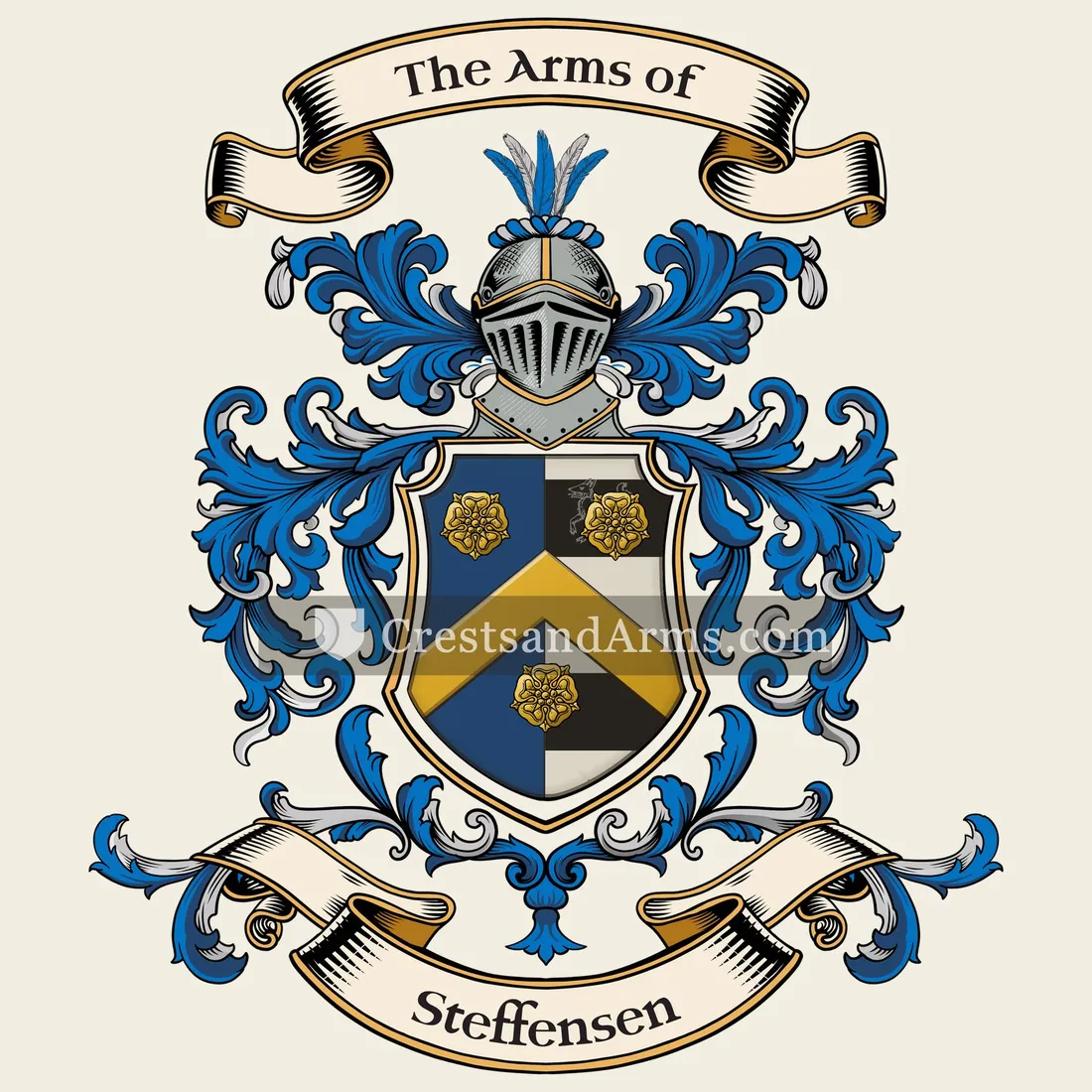
chevronProtection, and faithful service completed
fessThe military belt, and readiness to serve
roseThe seventh son, and beauty with grace
wolfReward from long service and hard work
Colours
Blue (Azure)Means: Loyalty and truth
Silver (Argent)Means: Peace and sincerity
Gold (Or)Means: Generosity
Black (Sable)Means: Constancy
Historical info
Source
J. B. Rietstap, Armorial Général, Gouda: G. B. van Goor Zonen, 1884–87
Blazon (the actual original written record)
“Parti: au 1 d'azur au chev. d'or, acc. de trois roses du même; au 2 d'arg. à deux fasces de sa., acc. en chef d'une tête et col de loup du même. Cq. cour. C.: un loup iss. de sa. L.: à dextre d'or et d'azur, à sen. d'arg. et de sa. D.: VIRTUS, FIDUCIA, PERSEVERANTIA.”
UtrechtUtrecht, c. 1815
Digital archive packCoat of arms PNG, gold border print PDF, vector SVG and the certificate of authenticity. Sent to your email in minutes.
Map of Netherlands showing where the Steffensen arms are recorded
The Steffensen arms were recorded in Utrecht, c. 1815.
Utrecht was an old church town with rich farming country around it. Both the church and the land produced families of standing, and families of standing kept arms to seal their documents with.
This is where the arms were entered in the register. Families often moved to other parts of the country, so the same name can turn up in more than one region.
Region
Utrecht
First recorded
1815
Granting Authority for the Steffensen Arms
Hoge Raad van Adel
Photograph made by me · CC BY-SA 3.0
The body that granted and recorded arms in Netherlands in this period.
William I of the Netherlands
Sovereign of the period
William I of the Netherlands
1815–1840
Reigning in Belgium when the Steffensen arms are first recorded.
How Arms Worked in Netherlands
In the Netherlands, coats of arms were often used by noble families and those who held specific public offices. These arms were passed down through the generations to legitimate descendants. Younger branches of a family usually kept the original design without needing to add special marks. This system ensured that the family identity remained clear and consistent over many years.
Granting authority
The Hoge Raad van Adel is the official body that regulates and manages noble titles and coats of arms in the Netherlands.
How they got arms
Families typically obtained their coats of arms through official royal grants or by proving their long-standing historical use of the symbols.
Where arms were recorded
Coats of arms are officially recorded in the registers held by the Hoge Raad van Adel, which began its work in 1814.
The family's standing
Recorded among the armigerous families of Utrecht.
Origin & History of the Steffensen Family in Netherlands
The surname Steffensen follows a naming tradition known as a patronymic, which means it was originally formed by taking the father’s first name and adding a suffix to indicate descent. In this case, the name translates to "son of Steffen." While this naming style is most commonly associated with Scandinavian regions, the presence of the family in Utrecht by 1815 highlights the movement of people across Northern Europe during the early nineteenth century. At that time, Utrecht was a central hub for trade and administration, making it a likely destination for families migrating for work or stability. As the Netherlands moved toward a more formal system of civil registration during the Napoleonic era, families were required to adopt permanent surnames. This transition helped solidify the patronymic Steffensen into a fixed family name that was passed down through generations in the Dutch heartland.
Meaning of the Steffensen family crest colors & symbols
Symbols on this shield
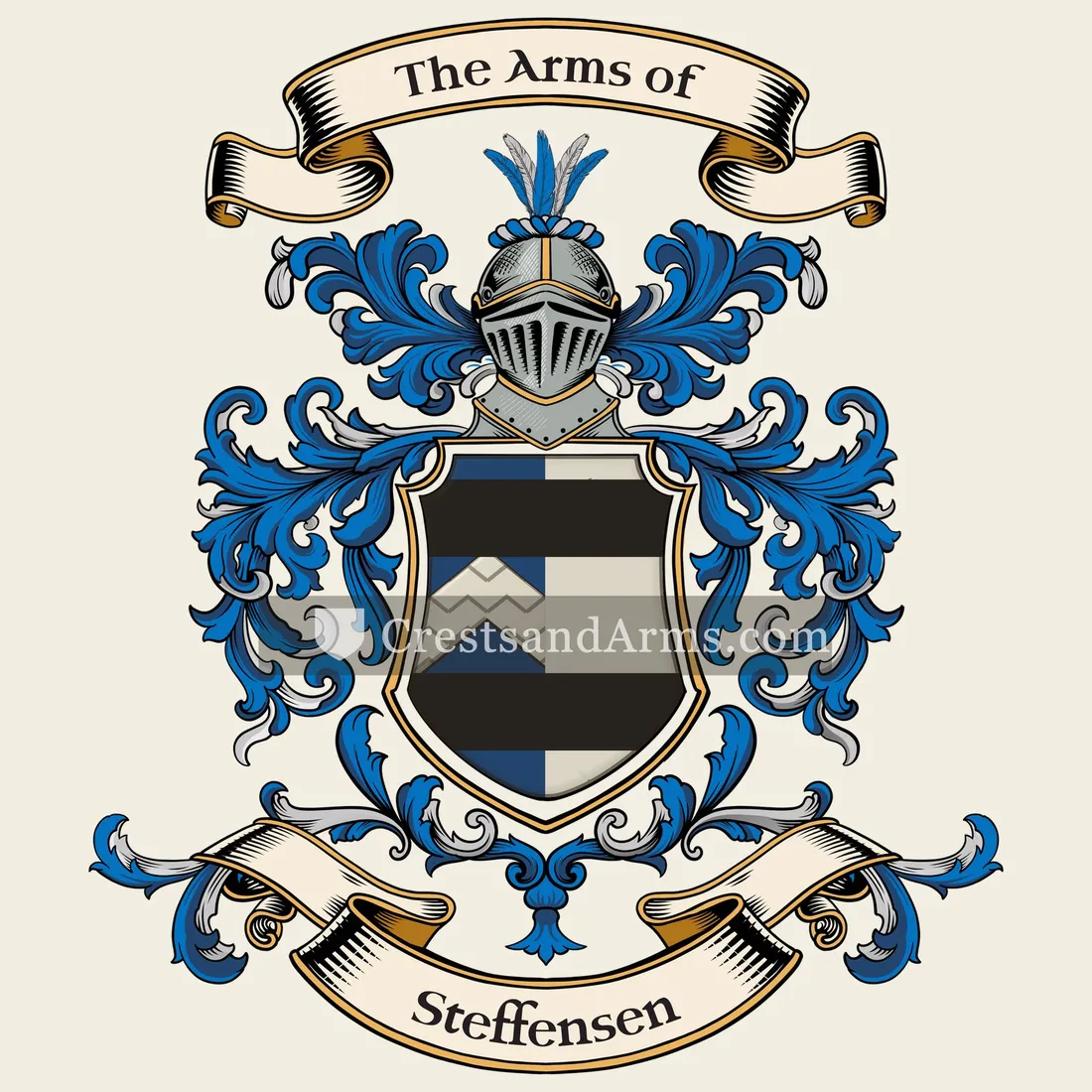
chevronProtection, and faithful service completed
fessThe military belt, and readiness to serve
roseThe seventh son, and beauty with grace
wolfReward from long service and hard work
Colours
Blue (Azure)Means: Loyalty and truth
Silver (Argent)Means: Peace and sincerity
Black (Sable)Means: Constancy
Historical info
Source
J. B. Rietstap, Armorial Général, Gouda: G. B. van Goor Zonen, 1884–87
Blazon (the actual original written record)
“Parti: au 1 d'azur au chev. d'arg., acc. de trois roses du même; au 2 d'arg. à deux fasces de sa., acc. en chef d'une tête et col de loup du même. C.: un loup iss. de sa.”
Francec. 1841
Digital archive packCoat of arms PNG, gold border print PDF, vector SVG and the certificate of authenticity. Sent to your email in minutes.
Map of France showing where the Steffensen arms are recorded
The Steffensen arms were recorded in France, c. 1841.
Arms such as these were typically recorded in Bretagne.
More families held coats of arms in Bretagne than anywhere else in France. The land was divided into many small estates rather than a few large ones, so far more households counted as gentry, and each needed a shield of its own to be told apart.
This is where the arms were entered in the register. Families often moved to other parts of the country, so the same name can turn up in more than one region.
The body that granted and recorded arms in France in this period.
How Arms Worked in France
In France, a coat of arms was a mark of honor that passed down through the male line to all legitimate descendants. Families often used the same shield without changes to show their shared heritage. If a branch wanted to stand out, they could add a small mark to their shield to show their specific place in the family tree.
Granting authority
The Juge d'armes de France acted as the official authority that regulated and verified coats of arms across the country.
How they got arms
Families typically inherited their arms from ancestors, though they could also receive them through royal grants or by proving their noble status.
Where arms were recorded
Coats of arms were officially recorded in the Armorial Général de France, which began its main collection in the year 1696.
The family's standing
Recorded among the armigerous families of France.
Origin & History of the Steffensen Family in France
The surname Steffensen is traditionally rooted in Germanic and Scandinavian naming conventions, meaning "son of Steffen." While the name is not native to France, records confirm that members of the family were established in the region of Bretagne by 1841. During this period, the arrival of families with northern European names in western France was often linked to the expansion of maritime trade, specialized craftsmanship, or shifting borders in northern Europe that prompted migration. Settling in Bretagne, these early family members integrated into a society defined by its strong regional identity and distinct maritime culture. As they put down roots in the French countryside, the family name underwent the natural process of linguistic adaptation, becoming a unique marker of their transition from their ancestral northern origins to their new life in the French provinces.
Steffensen Meaning & Related Branches
Root word
Stephanus
Derived from the Greek word for crown or garland.
This name
SteffensenPatronymic form meaning son of Stephen, indicating descent from a person named Stephen.
also spelled
Stefens
Stephens
Documented Sources
J. B. Rietstap, Armorial Général, Gouda: G. B. van Goor Zonen, 1884–87
State Archives in Belgium (Rijksarchief te België), Parochieregisters van de provincie Brabant
State Archives in Belgium (Rijksarchief te België), Burgerlijke Stand van de provincie Brabant
Debrabandere, Frans, Woordenboek van de familienamen in België en Noord-Frankrijk, 2003
Leys, O., De familienamen in de Zuidelijke Nederlanden, 1972
Digital archive packCoat of arms PNG, gold border print PDF, vector SVG and the certificate of authenticity. Sent to your email in minutes.


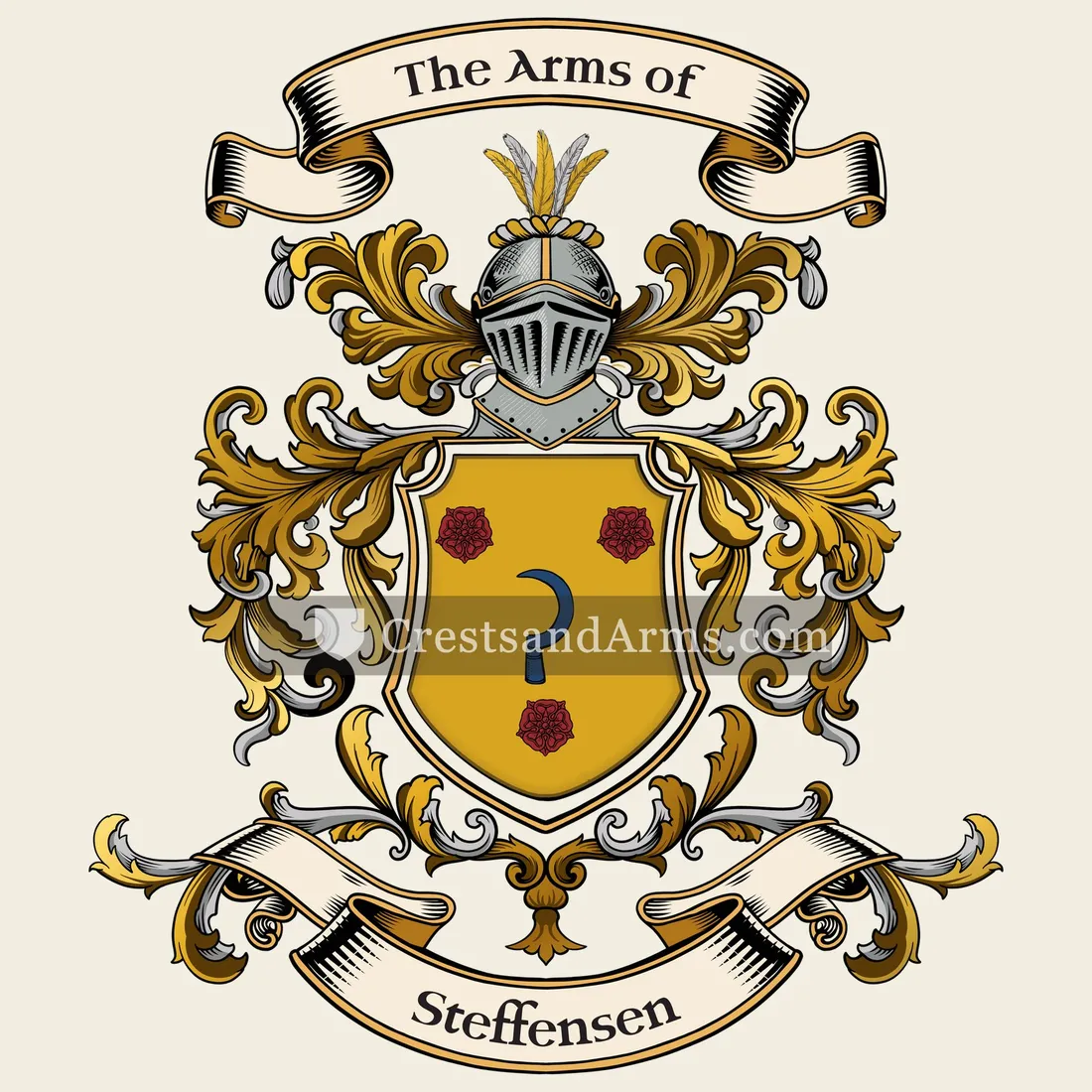
 sickleThe harvest, and the reaping of what was sown
 roseThe seventh son, and beauty with grace
 sickleThe harvest, and the reaping of what was sown
 roseThe seventh son, and beauty with grace


 chevronProtection, and faithful service completed
 fessThe military belt, and readiness to serve
 wolfReward from long service and hard work