Map of Belgium showing where the Steffenson arms are recorded
The Steffenson arms were recorded in Brabant, c. 1737.
Brabant lay at the heart of the Low Countries, where the trade routes met. Its towns were wealthy and its landowners many, and both kinds of family kept arms, which is why the region is so heavily represented.
This is where the arms were entered in the register. Families often moved to other parts of the country, so the same name can turn up in more than one region.
The body that granted and recorded arms in Belgium in this period.
Charles VI, Holy Roman Emperor
Sovereign of the period
Charles VI, Holy Roman Emperor
1711–1740
Reigning in Belgium when the Steffenson arms are first recorded.
How Arms Worked in Belgium
In Belgium, a coat of arms is considered personal property that is passed down through the male line to legitimate descendants. Families often use the same shield design across generations to show their shared heritage. If a branch of the family wants to change the design, they must apply for an official update to their specific version of the arms.
Granting authority
The Conseil héraldique is the official body that regulates and approves all coats of arms in Belgium.
How they got arms
Families obtain their coats of arms through formal royal grants or by confirming their historical right to use existing designs.
Where arms were recorded
All approved coats of arms are officially recorded in the public registers of the Conseil héraldique since 1844.
The family's standing
Recorded among the armigerous families of Brabant.
Origin & History of the Steffenson Family in Belgium
The history of the Steffenson name in Belgium is deeply rooted in the cultural landscape of the Brabant region during the eighteenth century. By 1737, records confirm that members of the family were already established residents within this territory, which was then part of the Austrian Netherlands. The name itself follows a patronymic tradition, meaning it originated as a way to identify a person as the son of Stefan. In the context of Brabant, a region known for its complex network of trade and local administration, the family likely integrated into the local economy as skilled laborers or merchants. Because Brabant served as a central hub for European commerce, families like the Steffensons often moved through these administrative districts to take advantage of new agricultural or urban opportunities. Their presence in the official registers of the time suggests they were recognized members of the community who participated in the legal and social life of their parish.
Meaning of the Steffenson family crest colors & symbols
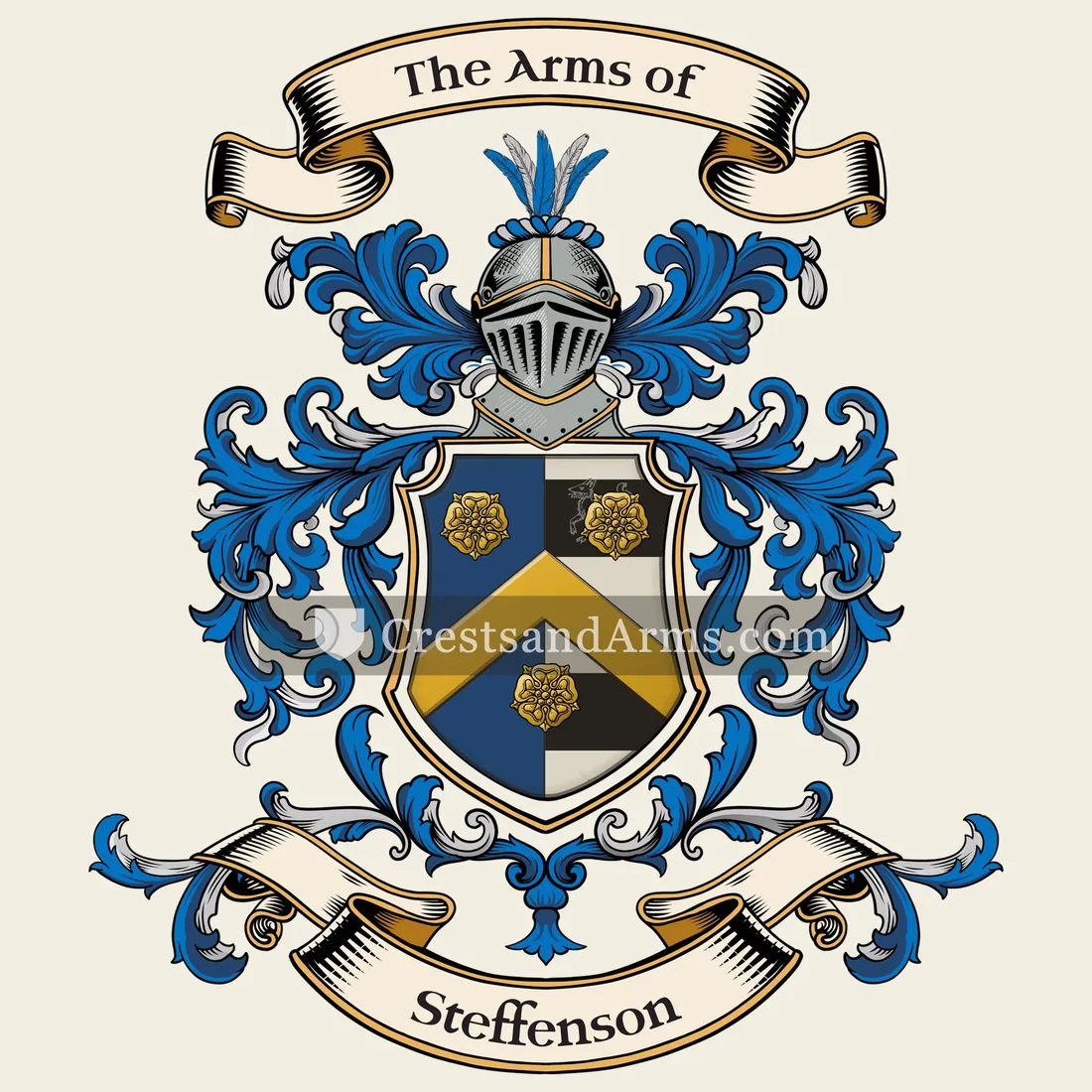
Symbols on this shield
chevronProtection, and faithful service completed
fessThe military belt, and readiness to serve
roseThe seventh son, and beauty with grace
wolfReward from long service and hard work
Colours
Blue (Azure)Means: Loyalty and truth
Silver (Argent)Means: Peace and sincerity
Gold (Or)Means: Generosity
Black (Sable)Means: Constancy
Historical info
Source
J. B. Rietstap, Armorial Général, Gouda: G. B. van Goor Zonen, 1884–87
Blazon (the actual original written record)
“Parti: au 1 d'azur au chev. d'or, acc. de trois roses du même; au 2 d'arg. à deux fasces de sa., acc. en chef d'une tête et col de loup du même. Cq. cour. C.: un loup iss. de sa. L.: à dextre d'or et d'azur, à sen. d'arg. et de sa. D.: VIRTUS, FIDUCIA, PERSEVERANTIA.”
UtrechtUtrecht, c. 1815
Digital archive packCoat of arms PNG, gold border print PDF, vector SVG and the certificate of authenticity. Sent to your email in minutes.
Map of Netherlands showing where the Steffenson arms are recorded
The Steffenson arms were recorded in Utrecht, c. 1815.
Utrecht was an old church town with rich farming country around it. Both the church and the land produced families of standing, and families of standing kept arms to seal their documents with.
This is where the arms were entered in the register. Families often moved to other parts of the country, so the same name can turn up in more than one region.
Region
Utrecht
First recorded
1815
Granting Authority for the Steffenson Arms
Hoge Raad van Adel
Photograph made by me · CC BY-SA 3.0
The body that granted and recorded arms in Netherlands in this period.
William I of the Netherlands
Sovereign of the period
William I of the Netherlands
1815–1840
Reigning in Belgium when the Steffenson arms are first recorded.
How Arms Worked in Netherlands
In the Netherlands, coats of arms were often used by noble families and those who held specific public offices. These arms were passed down through the generations to legitimate descendants. Younger branches of a family usually kept the original design without needing to add special marks. This system ensured that the family identity remained clear and consistent over many years.
Granting authority
The Hoge Raad van Adel is the official body that regulates and manages noble titles and coats of arms in the Netherlands.
How they got arms
Families typically obtained their coats of arms through official royal grants or by proving their long-standing historical use of the symbols.
Where arms were recorded
Coats of arms are officially recorded in the registers held by the Hoge Raad van Adel, which began its work in 1814.
The family's standing
Recorded among the armigerous families of Utrecht.
Origin & History of the Steffenson Family in Netherlands
The surname Steffenson reflects a patronymic naming tradition, meaning it originated as a way to identify a person as the son of Steffen. While the name carries strong roots in Northern Europe, its presence in the Netherlands became documented during the early nineteenth century. By 1815, records confirm that members of the family were established in the city of Utrecht. During this period, the Netherlands was undergoing significant social changes following the end of the Napoleonic era and the formation of the United Kingdom of the Netherlands. Families like the Steffensons living in Utrecht at this time were part of a society transitioning into a modern administrative state, where the government began to standardize civil registration and family records more strictly than ever before. This shift helped solidify the spelling and official recognition of the name within the Dutch population as the family integrated into the urban life of one of the country's oldest cities.
Meaning of the Steffenson family crest colors & symbols
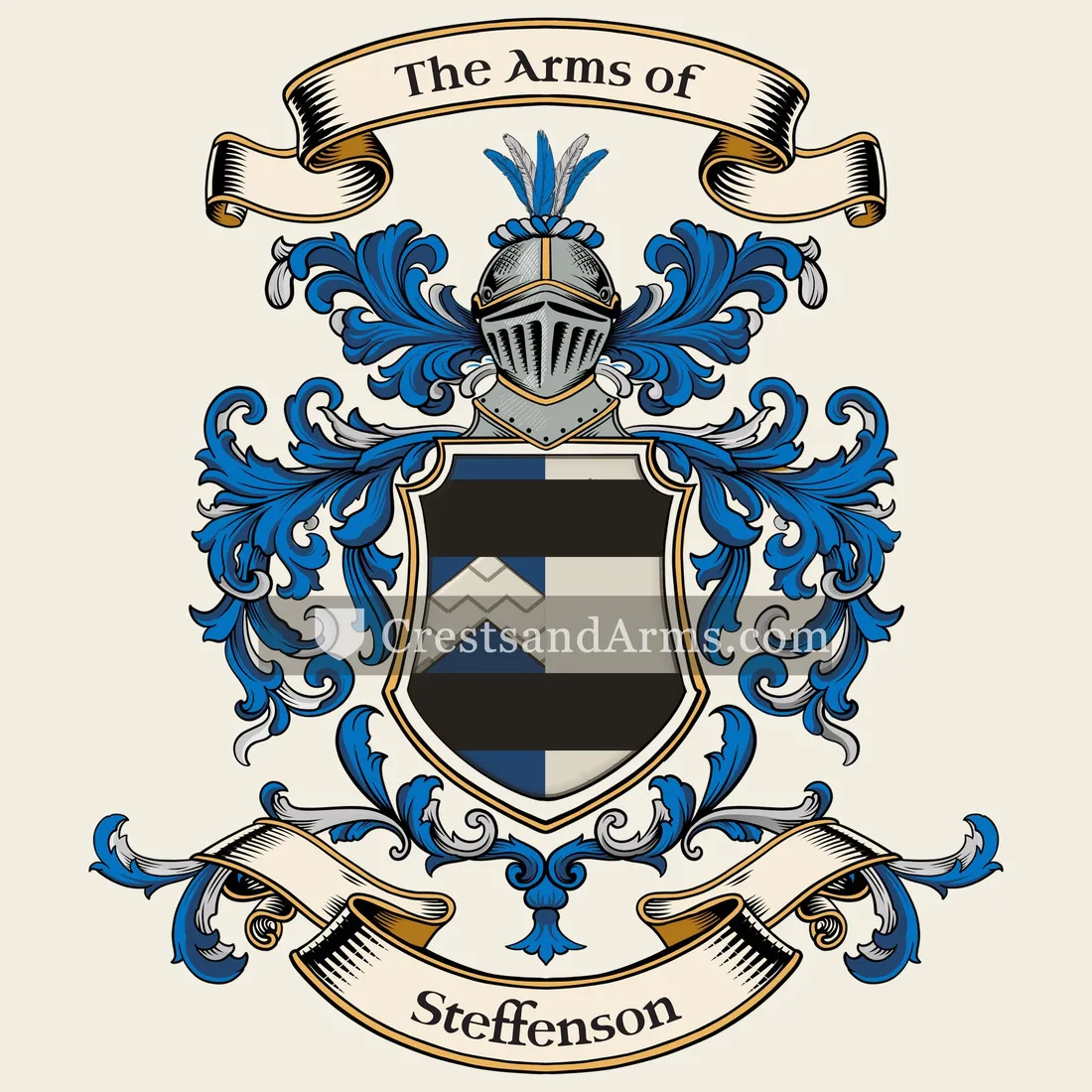
Symbols on this shield
chevronProtection, and faithful service completed
fessThe military belt, and readiness to serve
roseThe seventh son, and beauty with grace
wolfReward from long service and hard work
Colours
Blue (Azure)Means: Loyalty and truth
Silver (Argent)Means: Peace and sincerity
Black (Sable)Means: Constancy
Historical info
Source
J. B. Rietstap, Armorial Général, Gouda: G. B. van Goor Zonen, 1884–87
Blazon (the actual original written record)
“Parti: au 1 d'azur au chev. d'arg., acc. de trois roses du même; au 2 d'arg. à deux fasces de sa., acc. en chef d'une tête et col de loup du même. C.: un loup iss. de sa.”
Francec. 1841
Digital archive packCoat of arms PNG, gold border print PDF, vector SVG and the certificate of authenticity. Sent to your email in minutes.
Map of France showing where the Steffenson arms are recorded
The Steffenson arms were recorded in France, c. 1841.
Arms such as these were typically recorded in Bretagne.
More families held coats of arms in Bretagne than anywhere else in France. The land was divided into many small estates rather than a few large ones, so far more households counted as gentry, and each needed a shield of its own to be told apart.
This is where the arms were entered in the register. Families often moved to other parts of the country, so the same name can turn up in more than one region.
The body that granted and recorded arms in France in this period.
How Arms Worked in France
In France, a coat of arms was a mark of honor that passed down through the male line to all legitimate descendants. Families often used the same shield without changes to show their shared heritage. If a branch wanted to stand out, they could add a small mark to their shield to show their specific place in the family tree.
Granting authority
The Juge d'armes de France acted as the official authority that regulated and verified coats of arms across the country.
How they got arms
Families typically inherited their arms from ancestors, though they could also receive them through royal grants or by proving their noble status.
Where arms were recorded
Coats of arms were officially recorded in the Armorial Général de France, which began its main collection in the year 1696.
The family's standing
Recorded among the armigerous families of France.
Origin & History of the Steffenson Family in France
The family name Steffenson is rooted in a Germanic naming tradition that signifies "son of Stephen," yet its presence in the French region of Bretagne by 1841 highlights a fascinating movement of people across European borders. During the early 19th century, Bretagne was a hub for maritime trade and industrial growth, which often drew skilled workers and families from northern regions to settle in its coastal towns. While the name itself carries a Scandinavian or North German linguistic heritage, the family’s integration into the Breton landscape suggests they were part of a broader migration pattern that saw families seeking new opportunities in the vibrant ports of western France. By the time official records placed the family in this region in 1841, they had already begun to weave their own history into the local community, adapting to the unique cultural and social fabric of the Breton peninsula while maintaining the distinct identity of their ancestral name.
Steffenson Meaning & Related Branches
Root word
Stephanus
Derived from the Greek word stephanos meaning crown or garland.
This name
SteffensonPatronymic surname indicating descent from a person named Stephen.
also spelled
Stefens
Stephens
Documented Sources
J. B. Rietstap, Armorial Général, Gouda: G. B. van Goor Zonen, 1884–87
State Archives in Belgium (Rijksarchief in België), Parochieregisters van Brabant
State Archives in Belgium (Rijksarchief in België), Registers van de Burgerlijke Stand
De Flou, Karel, Woordenboek der Toponymie van westelijk Vlaanderen, Vlaamsch-Artois, het Land van den Hoek, de graafschappen Guines en Boulogne, en een gedeelte van Fransch-Vlaanderen, 1914
Leys, O., De familienamen in de Zuidelijke Nederlanden, 1970
Digital archive packCoat of arms PNG, gold border print PDF, vector SVG and the certificate of authenticity. Sent to your email in minutes.


 sickleThe harvest, and the reaping of what was sown
 roseThe seventh son, and beauty with grace
 sickleThe harvest, and the reaping of what was sown
 roseThe seventh son, and beauty with grace
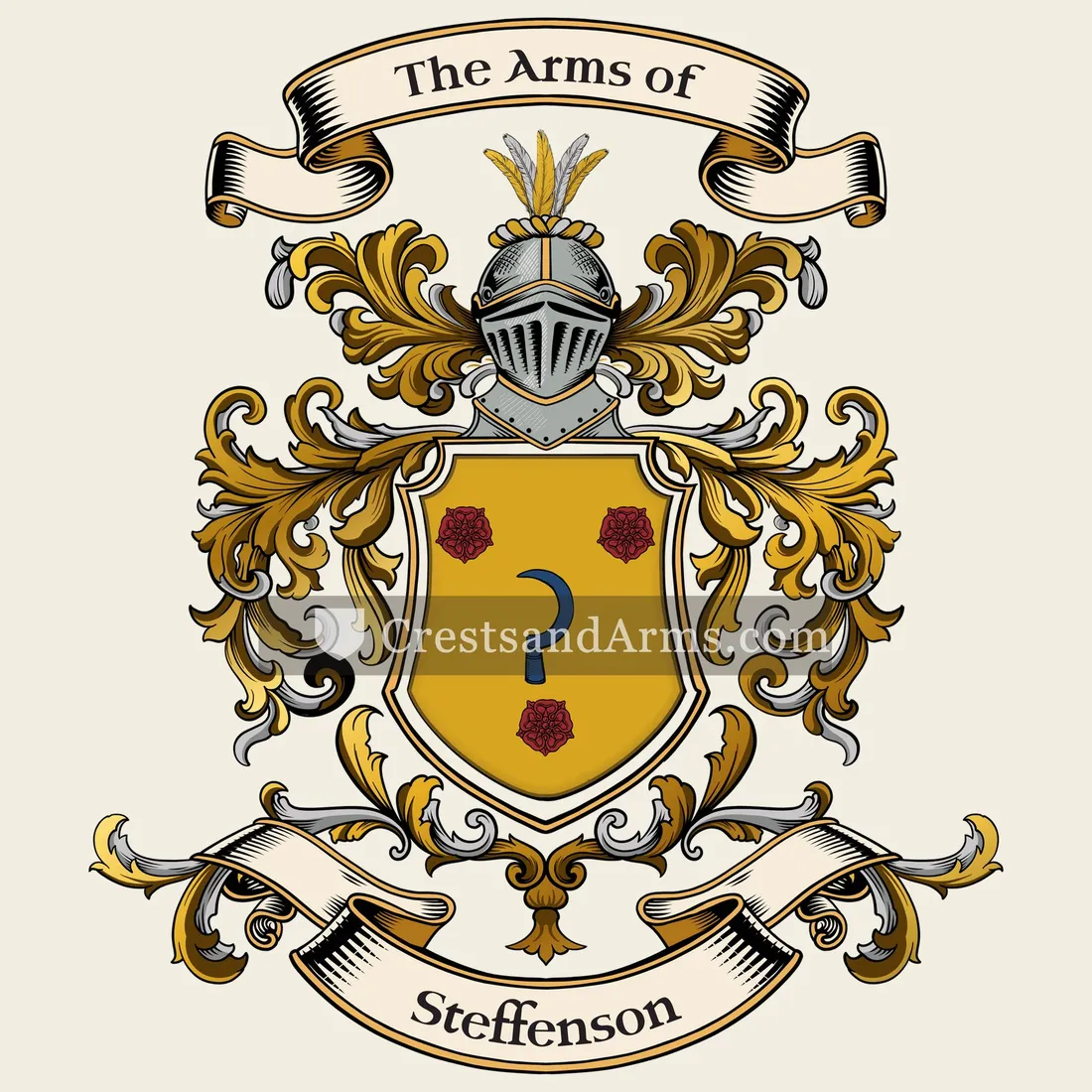


 chevronProtection, and faithful service completed
 fessThe military belt, and readiness to serve
 wolfReward from long service and hard work