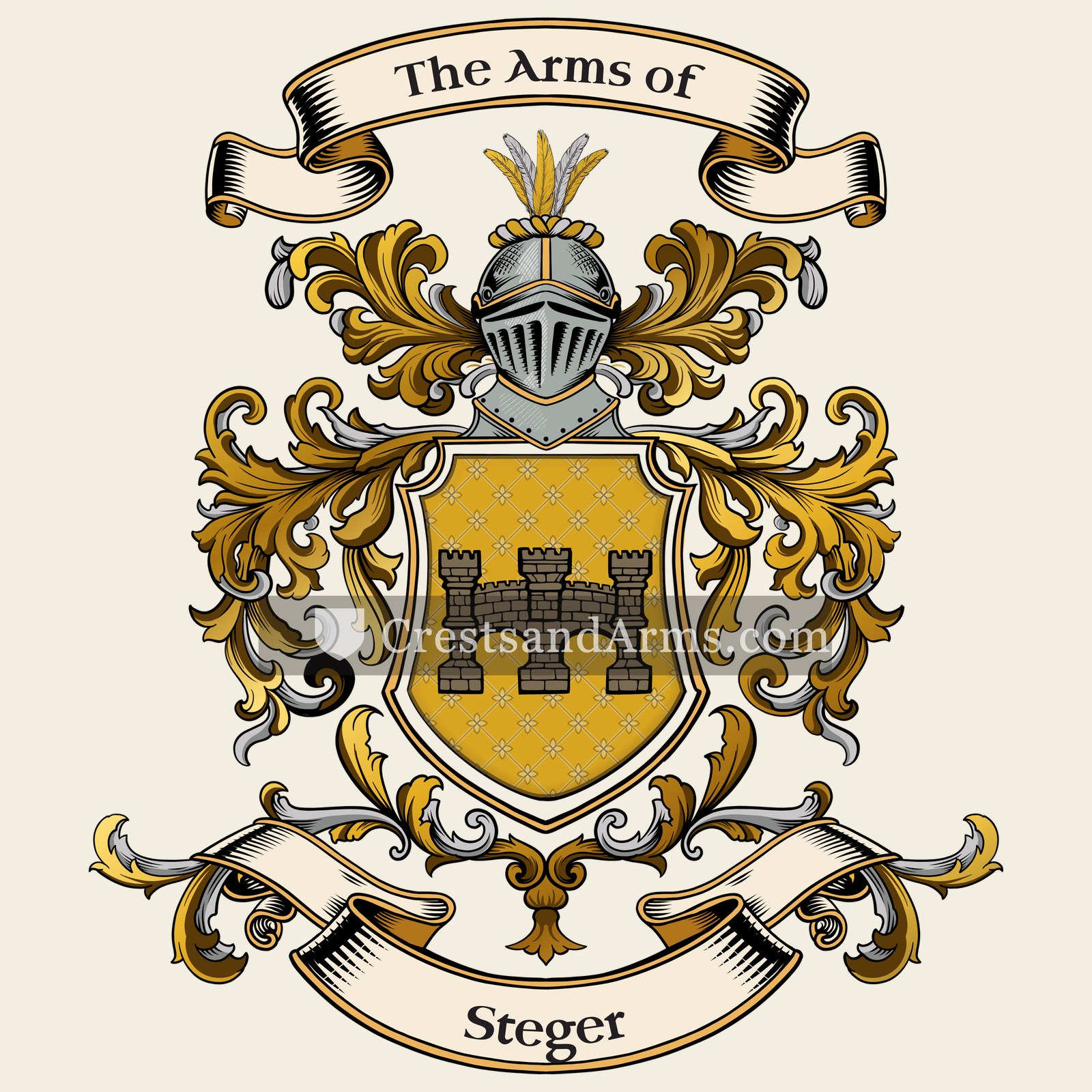
A record of documented arms, meaning and origin, researched for the Steger family lines. Documented in 2 countries.
Reg. 7511 · Dutch, T–V
Coat of Arms & Family Crest Details
Symbols on this shield
bendDefence, and the scarf of a commander
lionCourage, strength and royalty
riverThe bounds of a land, and life carried through it
bridgeOne who joins what was divided
Colours
Blue (Azure)Means: Loyalty and truth
Gold (Or)Means: Generosity
Historical info
Source
J. B. Rietstap, Armorial Général, Gouda: G. B. van Goor Zonen, 1884–87
Blazon (the actual original written record)
“Ec.: aux 1 et 4 d'azur au lion d'or, arm. et lamp. de gu.; aux 2 et 3 d'azur à une rivière au nat. en barre et un pont d'or jeté sur cette rivière. Cq. cour. C.: un vol, d'azur et d'or, l'aile dextre ch. d'une barre et l'aile sen. d'une bande, surch. chacune de trois étoiles, le tout de l'un à l'autre.”
Netherlandsc. 1815
Digital archive packCoat of arms PNG, gold border print PDF, vector SVG and the certificate of authenticity. Sent to your email in minutes.
Map of Netherlands showing where the Steger arms are recorded
The Steger arms were recorded in Netherlands, c. 1815.
Arms such as these were typically recorded in Friesland.
Friesland was low, wet country on the northern coast of the Netherlands, farmed by families who had held the same land for centuries. Free landholders were unusually common there, and a free landholder could carry arms.
This is where the arms were entered in the register. Families often moved to other parts of the country, so the same name can turn up in more than one region.
Region
Friesland
First recorded
1815
Granting Authority for the Steger Arms
Hoge Raad van Adel
Photograph made by me · CC BY-SA 3.0
The body that granted and recorded arms in Netherlands in this period.
William I of the Netherlands
Sovereign of the period
William I of the Netherlands
1815–1840
Reigning in Netherlands when the Steger arms are first recorded.
How Arms Worked in Netherlands
In the Netherlands, coats of arms were often used by noble families and those who held specific public offices. These arms were passed down through the generations to legitimate descendants. Younger branches of a family usually kept the original design without needing to add special marks. This system ensured that the family identity remained clear and consistent over many years.
Granting authority
The Hoge Raad van Adel is the official body that regulates and manages noble titles and coats of arms in the Netherlands.
How they got arms
Families typically obtained their coats of arms through official royal grants or by proving their long-standing historical use of the symbols.
Where arms were recorded
Coats of arms are officially recorded in the registers held by the Hoge Raad van Adel, which began its work in 1814.
The family's standing
Recorded among the armigerous families of Netherlands.
Origin & History of the Steger Family in Netherlands
The surname Steger has deep roots in the northern regions of the Netherlands, particularly within the province of Friesland. By the early 19th century, the family was well-established in this area, as evidenced by official records from 1815. The name itself likely originated as a topographical descriptor, referring to someone who lived near a steep path, a bridge, or a specific type of structure known as a steg. In the Frisian context, families often adopted surnames to comply with changing administrative requirements during the Napoleonic era, which forced many citizens to formalize their family names in civil registries. As the Steger family integrated into the local community, they became part of the distinct cultural and linguistic landscape of Friesland. Their presence in the region during this time reflects the broader movement of families settling into fixed identities as the Dutch government modernized its record-keeping systems.
Coat of Arms & Family Crest Details
Symbols on this shield
saltireResolution, and St Andrew's cross
bridgeOne who joins what was divided
Colours
Gold (Or)Means: Generosity
Historical info
Source
J. B. Rietstap, Armorial Général, Gouda: G. B. van Goor Zonen, 1884–87
Blazon (the actual original written record)
“D'or à un pont de bois sans balustrades, soutenu de deux paires d'étançons croisés en saut.; le dit pont sommé de deux coqs hardis de sa., crêtés, barbés, bq. et m. de gu., affr. Cq. cour. C.: un vol à l'antique d'or; ou, le pont de l'écu (sans coqs), entre un vol à l'antique, d'or et de sa. L.: d'or et de sa.”
Austriac. 1631
Digital archive packCoat of arms PNG, gold border print PDF, vector SVG and the certificate of authenticity. Sent to your email in minutes.
Map of Austria showing where the Steger arms are recorded
The Steger arms were recorded in Austria, c. 1631.
Arms such as these were typically recorded in Tyrol.
Tyrol was mountain country in western Austria, where the valleys were held by families who had been there a very long time. Old tenure counted for more than money, and old families carried arms.
This is where the arms were entered in the register. Families often moved to other parts of the country, so the same name can turn up in more than one region.
Region
Tyrol
First recorded
1631
Granting Authority for the Steger Arms
Imperial and Royal chancery
Sodacan · CC BY-SA 3.0
The body that granted and recorded arms in Austria in this period.
Ferdinand II, Holy Roman Emperor
Sovereign of the period
Ferdinand II, Holy Roman Emperor
1619–1637
Reigning in Netherlands when the Steger arms are first recorded.
How Arms Worked in Austria
Austrian coats of arms were often linked directly to noble titles granted by the Emperor. These symbols belonged to the entire family line rather than just one individual. When a family grew, new branches kept the original design without needing to change it. This system allowed all members of a noble house to share the same identity across many generations.
Granting authority
The Imperial and Royal chancery managed all heraldic matters and controlled the official granting of arms throughout the Austrian lands.
How they got arms
Families typically received their arms through a formal imperial decree that often accompanied the elevation of a person to noble status.
Where arms were recorded
Official records of these grants were kept in the Imperial Register of Nobility which began its formal documentation process in 1453.
The family's standing
Recorded among the armigerous families of Austria.
Origin & History of the Steger Family in Austria
The surname Steger finds its roots in the rugged landscape of the Austrian Tyrol, where the name first appeared in official records during the early seventeenth century. Derived from the Middle High German word *steger*, the name historically identified someone who lived near a steep path, a mountain trail, or a wooden staircase used to navigate the challenging alpine terrain. By 1631, families bearing this name were well-established in the region, likely working as farmers, foresters, or laborers who relied on the local geography for their livelihood. Because the Tyrol was a vital crossroads for trade between northern and southern Europe, the Steger family name became deeply woven into the social fabric of these mountain communities. Over time, the name evolved from a simple description of a person’s home or workplace into a permanent family identifier that persisted through generations of life in the Alps.
Related Branches & Arms
Root word
steg
A path, narrow way, or bridge.
This name
StegerAn occupational surname for someone who lived near or maintained a bridge or path.
also spelled
Stegger
Stegher
Stegeren
Related arms
Auxionsimilar arms
Duclaussimilar arms
Mandagoutsimilar arms
Staegervariant spelling
Documented Sources
J. B. Rietstap, Armorial Général, Gouda: G. B. van Goor Zonen, 1884–87
Tresoar (Fries Historisch en Letterkundig Centrum), Burgerlijke Stand van Friesland
Van der Schaar, J., Woordenboek van voornamen, 1964
Nederlandse Familienamenbank, Meertens Instituut, 2010
Digital archive packCoat of arms PNG, gold border print PDF, vector SVG and the certificate of authenticity. Sent to your email in minutes.


 bendDefence, and the scarf of a commander
 lionCourage, strength and royalty
 riverThe bounds of a land, and life carried through it
 bridgeOne who joins what was divided
 bendDefence, and the scarf of a commander
 lionCourage, strength and royalty
 riverThe bounds of a land, and life carried through it
 bridgeOne who joins what was divided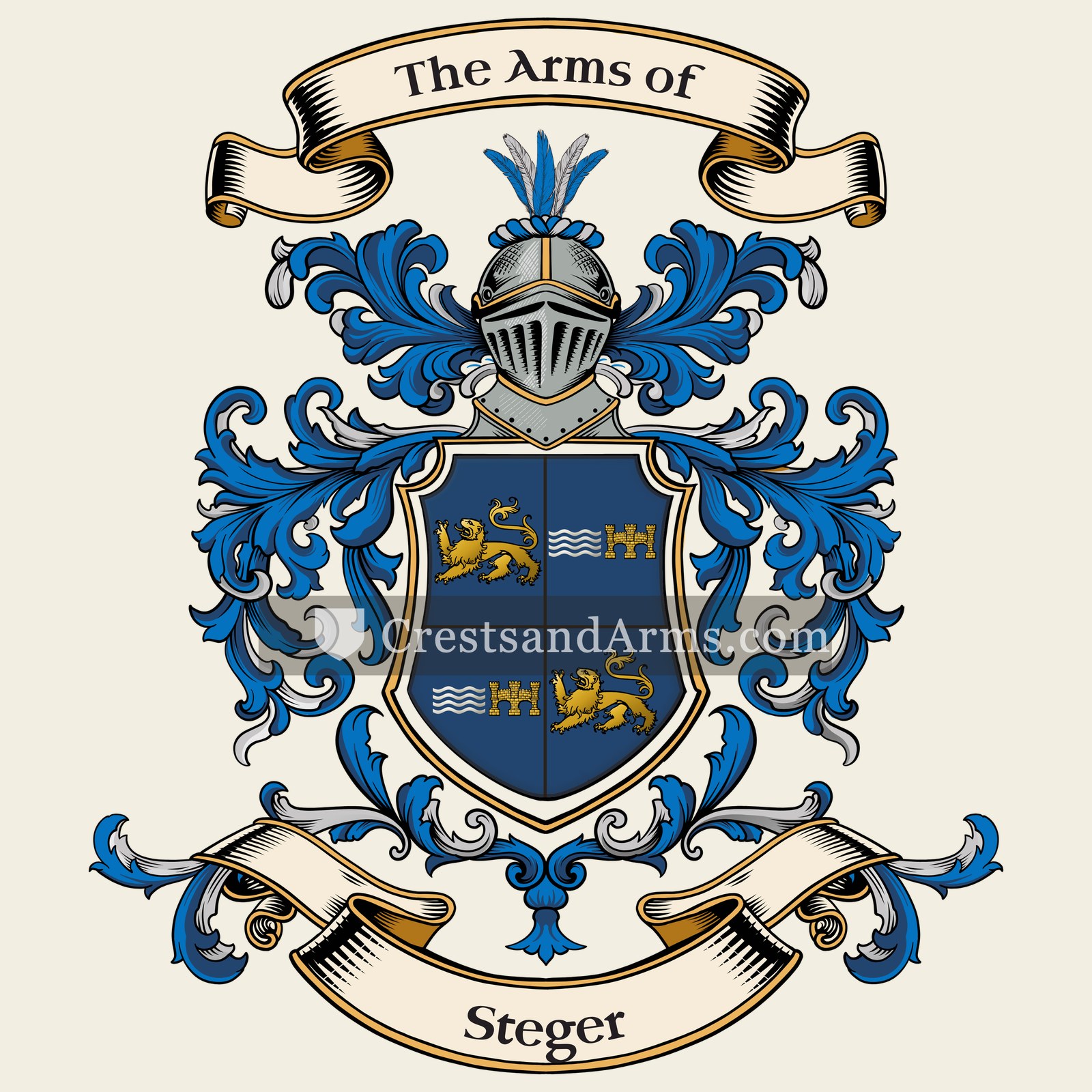


 saltireResolution, and St Andrew's cross