A record of documented arms, meaning and origin, researched for the Steiger family lines. Documented in 2 countries.
Reg. 5461 · German, T–V
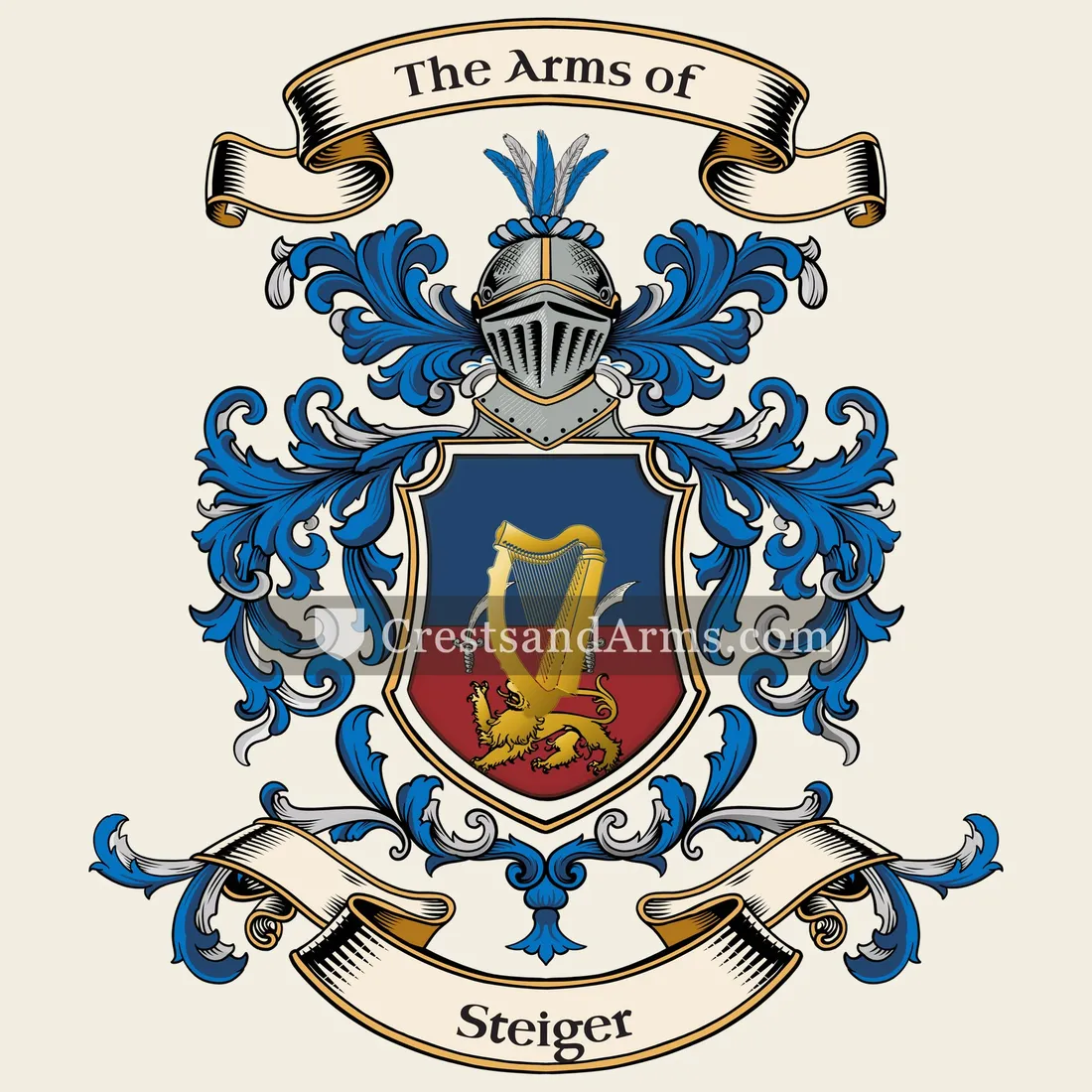
Meaning of the Steiger family crest colors & symbols
Symbols on this shield
swordJustice, and military honour
harpWell-tuned governance and love of music
lionCourage, strength and royalty
Colours
Blue (Azure)Means: Loyalty and truth
Red (Gules)Means: Military strength
Silver (Argent)Means: Peace and sincerity
Gold (Or)Means: Generosity
Historical info
Source
J. B. Rietstap, Armorial Général, Gouda: G. B. van Goor Zonen, 1884–87
Blazon (the actual original written record)
“Coupé: au 1 parti: a. d'azur plein; b. de sa. au lion de St.-Marc d'or; au 2 de gu. à deux épées d'arg., garnies d'or, passées en saut., perçant une lyre d'or. Cq. cour. C.: trois pl. d'aut., une d'arg. entre deux d'azur. L. d'arg. et d'azur.”
WurttembergWurttemberg, c. 1874
Digital archive packCoat of arms PNG, gold border print PDF, vector SVG and the certificate of authenticity. Sent to your email in minutes.
Map of Germany showing where the Steiger arms are recorded
The Steiger arms were recorded in Wurttemberg, c. 1874.
Wurttemberg was southern German country of small estates and well-off market towns. Both landowners and leading townsmen kept arms there, so the region carries far more names than its size suggests.
This is where the arms were entered in the register. Families often moved to other parts of the country, so the same name can turn up in more than one region.
The body that granted and recorded arms in Germany in this period.
Wilhelm I
Sovereign of the period
Wilhelm I
1861–1888
Reigning in Germany when the Steiger arms are first recorded.
How Arms Worked in Germany
Prussian heraldry was strictly tied to social rank and noble status rather than being a free choice for every citizen. These symbols were treated as permanent family property that moved through the generations to all legitimate heirs. If a family branch wanted to change their design to stand out, they had to apply for official permission to alter their specific version of the shield.
Granting authority
The Prussian Heroldsamt acted as the central state office that managed and strictly controlled all noble titles and coats of arms.
How they got arms
Families usually obtained their arms through formal royal grants or by proving their long-standing noble status to the state authorities.
Where arms were recorded
All official coats of arms were kept in the rolls of the Prussian Heroldsamt, which functioned from 1706 until 1918.
The family's standing
Recorded among the armigerous families of Wurttemberg.
Origin & History of the Steiger Family in Germany
The surname Steiger is a classic occupational name that originated in the German-speaking regions of Europe during the Middle Ages. The word itself comes from the Middle High German term *stīger*, which referred to a person who climbed or ascended, often describing someone who worked in the mining industry as a foreman or a mine supervisor. Because mining was a vital part of the economy in southern German regions like Württemberg, many families adopted this name to reflect their professional status and technical expertise. By the time records show the family living in Württemberg in 1874, the name had been established for centuries as a marker of skilled labor and community standing. Over time, the name spread from these early mining centers to become a common identifier for families throughout the region, reflecting a long history of craftsmanship and local industry.
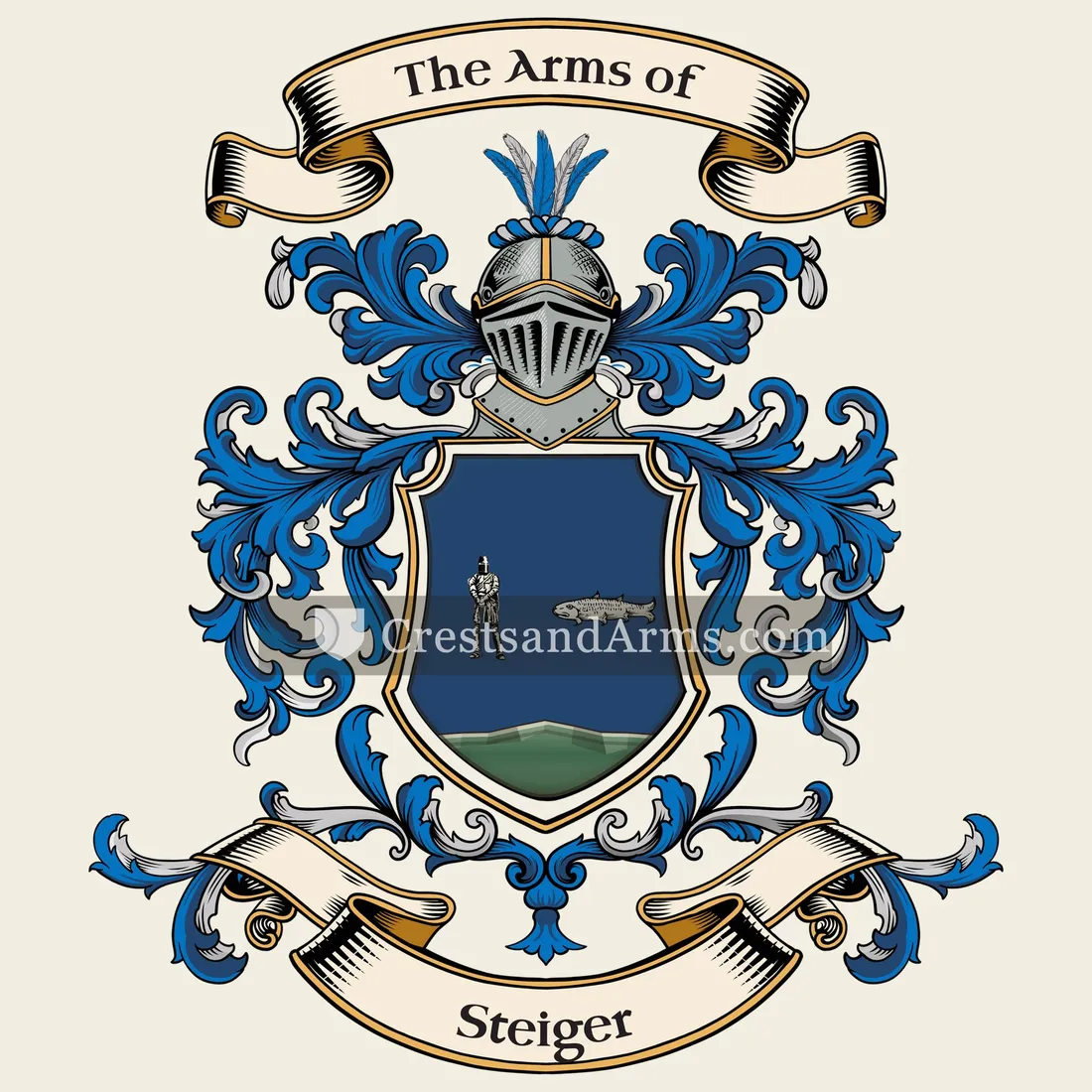
Meaning of the Steiger family crest colors & symbols
Symbols on this shield
mountThe ground held, and steadfastness upon it
knightChivalry and service in arms
fishA true and generous mind, and Christian faith
Colours
Blue (Azure)Means: Loyalty and truth
Green (Vert)Means: Hope
Silver (Argent)Means: Peace and sincerity
Historical info
Source
J. B. Rietstap, Armorial Général, Gouda: G. B. van Goor Zonen, 1884–87
Blazon (the actual original written record)
“D'azur à un homme d'armes, arm. d'arg., coiffé d'un morion du même, posé sur un tertre de sin., tenant de sa main dextre un trèfle du même et de sa sen. une pique au nat. C.: l'homme d'armes, iss. L. d'arg. et d'azur.”
SwitzerlandBâle, c. 1745
Digital archive packCoat of arms PNG, gold border print PDF, vector SVG and the certificate of authenticity. Sent to your email in minutes.
Map of Switzerland showing where the Steiger arms are recorded
The Steiger arms were recorded in Bâle, c. 1745.
This is where the arms were entered in the register. Families often moved to other parts of the country, so the same name can turn up in more than one region.
The body that granted and recorded arms in Switzerland in this period.
How Arms Worked in Switzerland
In Switzerland, coats of arms were not restricted to the nobility and were often adopted by common citizens and families. These symbols were passed down through generations to show family identity. When branches of a family grew, they often changed small details of the design to distinguish their own line from the original group.
Granting authority
Cantonal and civic authorities managed the use of coats of arms within their specific regions and local jurisdictions.
How they got arms
Families typically assumed their own coats of arms based on local custom rather than receiving them from a central monarch.
Where arms were recorded
Arms were recorded in various cantonal and civic registers starting from the fourteenth century throughout the Swiss region.
The family's standing
Recorded among the armigerous families of Switzerland.
Origin & History of the Steiger Family in Switzerland
The surname Steiger is deeply rooted in the German-speaking regions of Switzerland, where it functioned as an occupational name for someone who worked in mining or climbed steep terrain. By the mid-18th century, the family had established a notable presence in the city of Basel, with records confirming members of the Steiger family were living there by 1745. During this era, families with this name were often involved in the skilled trades or the merchant class that helped drive the economy of Swiss city-states. Because the name describes a specific type of labor or movement, it likely emerged independently in several different mountain communities before members eventually migrated to urban centers like Basel. This transition from rural life to city living allowed the family to integrate into the professional guilds that governed Swiss society at the time.
Steiger Meaning & Related Branches
Root word
steigen
To climb, ascend, or mount.
This name
SteigerAn occupational name for a mine foreman or a mountain climber.
also spelled
Steigger
Steigher
Steigeren
Styger
Related arms
Staigervariant spelling
Documented Sources
J. B. Rietstap, Armorial Général, Gouda: G. B. van Goor Zonen, 1884–87
Bahlow, Hans. Deutsches Namenlexikon: Familien- und Vornamen nach Ursprung und Sinn erklärt. 1967
Heintze, Albert. Die deutschen Familiennamen: geschichtlich, geographisch, sprachlich. 1903
Landesarchiv Baden-Württemberg, Bestand E 157: Württembergische Zivilstandsregister
Digital archive packCoat of arms PNG, gold border print PDF, vector SVG and the certificate of authenticity. Sent to your email in minutes.


 swordJustice, and military honour
 harpWell-tuned governance and love of music
 lionCourage, strength and royalty
 swordJustice, and military honour
 harpWell-tuned governance and love of music
 lionCourage, strength and royalty


 mountThe ground held, and steadfastness upon it
 knightChivalry and service in arms
 fishA true and generous mind, and Christian faith