A record of documented arms, meaning and origin, researched for the Steigerwald family lines. Documented in 2 countries.
Reg. 9622 · German, T–V
Meaning of the Steigerwald family crest colors & symbols
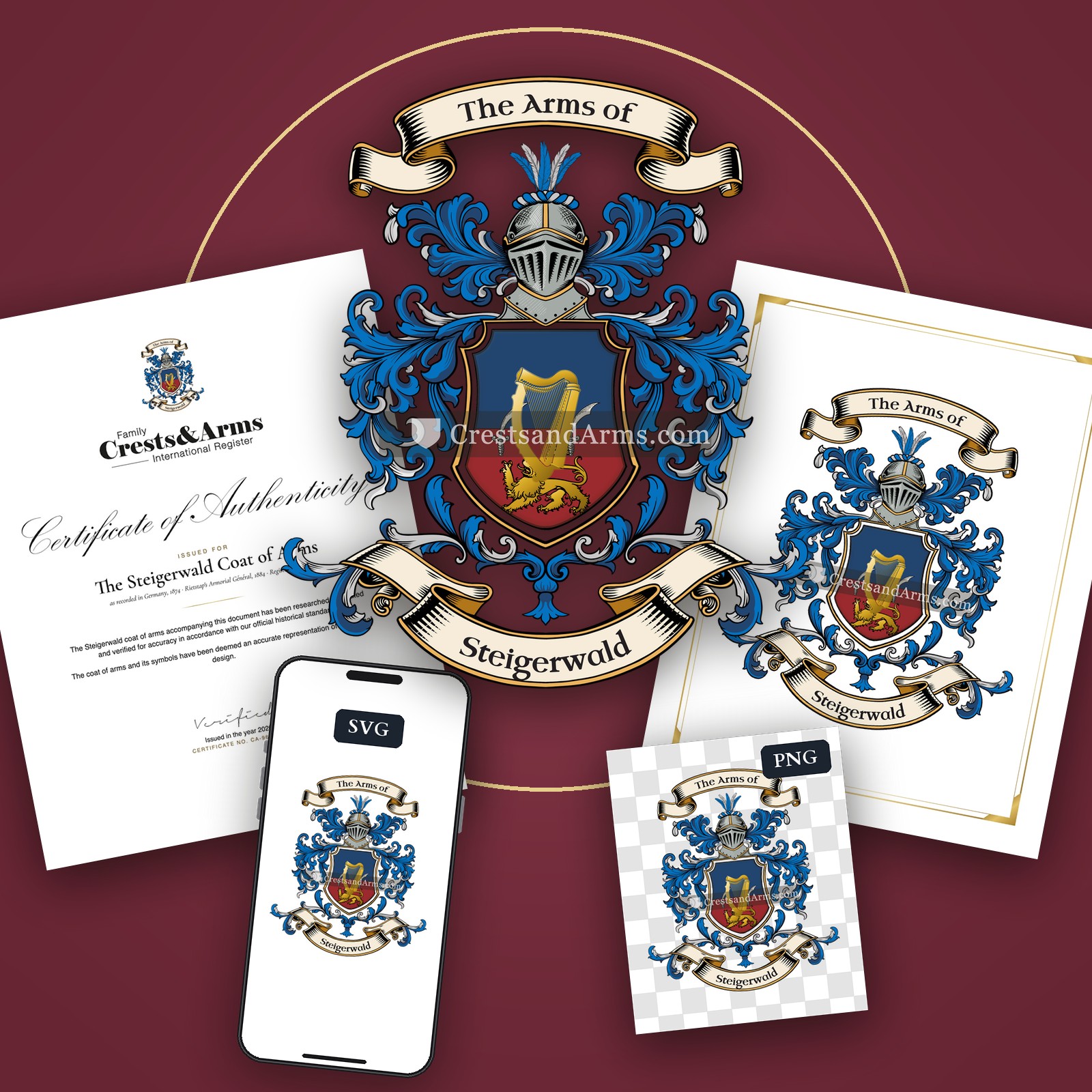
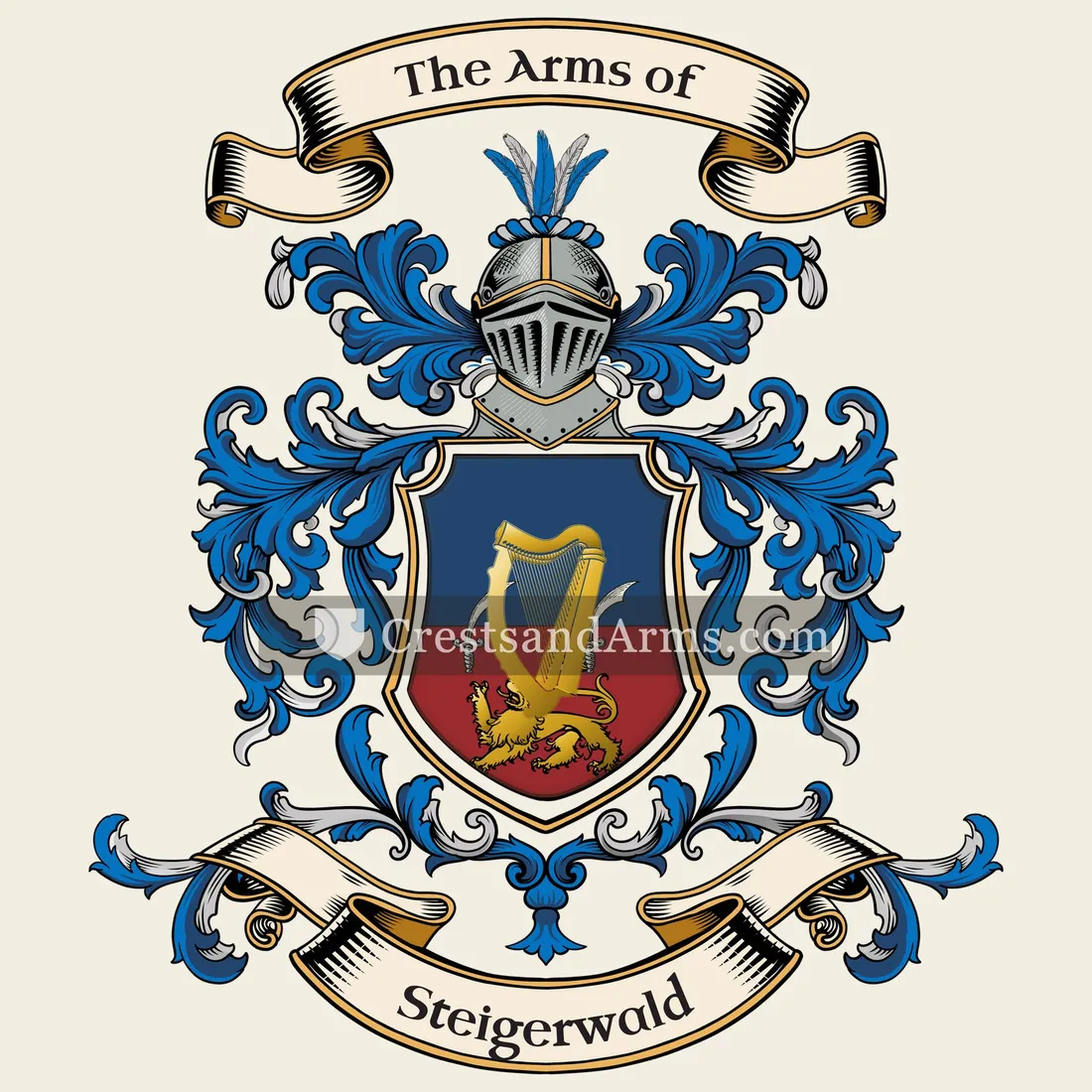
Symbols on this shield
swordJustice, and military honour
harpWell-tuned governance and love of music
lionCourage, strength and royalty
Colours
Blue (Azure)Means: Loyalty and truth
Red (Gules)Means: Military strength
Silver (Argent)Means: Peace and sincerity
Gold (Or)Means: Generosity
Historical info
Source
J. B. Rietstap, Armorial Général, Gouda: G. B. van Goor Zonen, 1884–87
Blazon (the actual original written record)
“Coupé: au 1 parti: a. d'azur plein; b. de sa. au lion de St.-Marc d'or; au 2 de gu. à deux épées d'arg., garnies d'or, passées en saut., perçant une lyre d'or. Cq. cour. C.: trois pl. d'aut., une d'arg. entre deux d'azur. L. d'arg. et d'azur.”
WurttembergWurttemberg, c. 1874
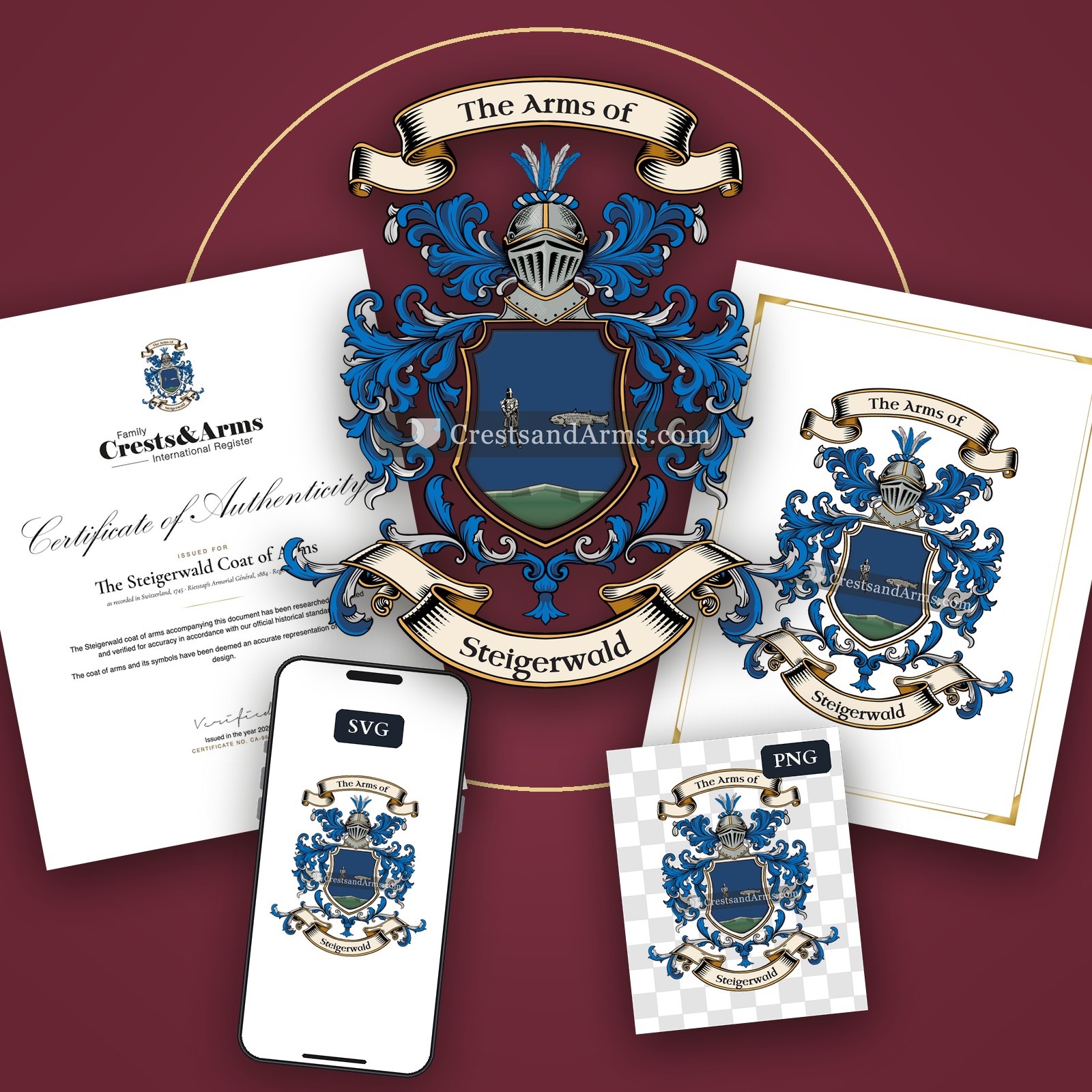
Digital archive packCoat of arms PNG, gold border print PDF, vector SVG and the certificate of authenticity. Sent to your email in minutes.
Map of Germany showing where the Steigerwald arms are recorded
The Steigerwald arms were recorded in Wurttemberg, c. 1874.
Wurttemberg was southern German country of small estates and well-off market towns. Both landowners and leading townsmen kept arms there, so the region carries far more names than its size suggests.
This is where the arms were entered in the register. Families often moved to other parts of the country, so the same name can turn up in more than one region.
The body that granted and recorded arms in Germany in this period.
Wilhelm I
Sovereign of the period
Wilhelm I
1861–1888
Reigning in Germany when the Steigerwald arms are first recorded.
How Arms Worked in Germany
Prussian heraldry was strictly tied to social rank and noble status rather than being a free choice for every citizen. These symbols were treated as permanent family property that moved through the generations to all legitimate heirs. If a family branch wanted to change their design to stand out, they had to apply for official permission to alter their specific version of the shield.
Granting authority
The Prussian Heroldsamt acted as the central state office that managed and strictly controlled all noble titles and coats of arms.
How they got arms
Families usually obtained their arms through formal royal grants or by proving their long-standing noble status to the state authorities.
Where arms were recorded
All official coats of arms were kept in the rolls of the Prussian Heroldsamt, which functioned from 1706 until 1918.
The family's standing
Recorded among the armigerous families of Wurttemberg.
Origin & History of the Steigerwald Family in Germany
The name Steigerwald originates from the German language and describes a specific type of landscape. The word combines "Steiger," which refers to a steep path or a person who works in a mine, and "Wald," which means forest. Historically, this name was often given to families living near the Steigerwald, a forested mountain range in the Franconia region of Bavaria. Over time, families moved from these rural areas into different parts of the German states, including Württemberg. By the late 19th century, records confirm that members of the Steigerwald family were well-established in Württemberg, participating in the local economy and community life. These families were typically part of the working or middle class, contributing to the agricultural and industrial growth that defined the region during that era.
Meaning of the Steigerwald family crest colors & symbols
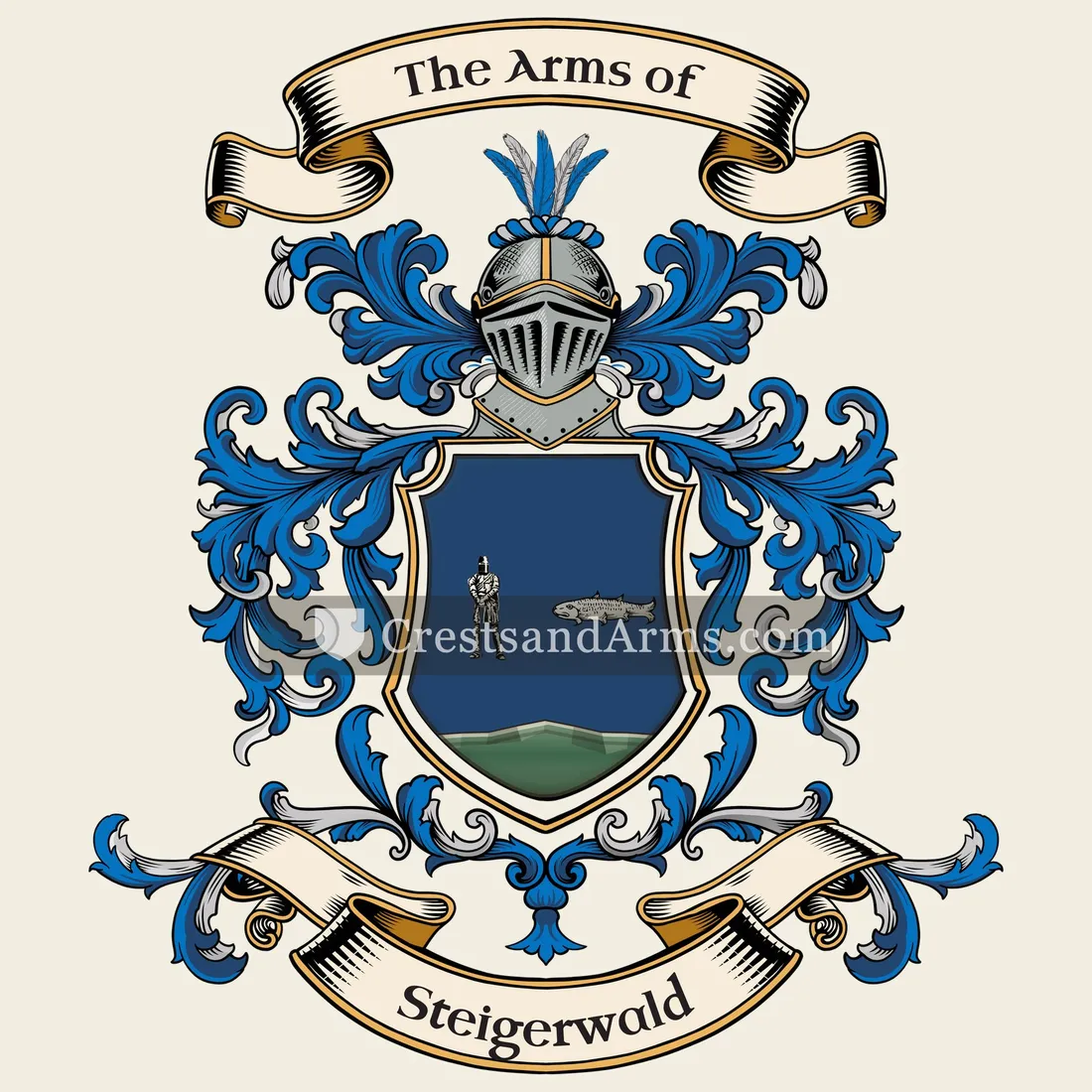
Symbols on this shield
mountThe ground held, and steadfastness upon it
knightChivalry and service in arms
fishA true and generous mind, and Christian faith
Colours
Blue (Azure)Means: Loyalty and truth
Green (Vert)Means: Hope
Silver (Argent)Means: Peace and sincerity
Historical info
Source
J. B. Rietstap, Armorial Général, Gouda: G. B. van Goor Zonen, 1884–87
Blazon (the actual original written record)
“D'azur à un homme d'armes, arm. d'arg., coiffé d'un morion du même, posé sur un tertre de sin., tenant de sa main dextre un trèfle du même et de sa sen. une pique au nat. C.: l'homme d'armes, iss. L. d'arg. et d'azur.”
SwitzerlandBâle, c. 1745
Digital archive packCoat of arms PNG, gold border print PDF, vector SVG and the certificate of authenticity. Sent to your email in minutes.
Map of Switzerland showing where the Steigerwald arms are recorded
The Steigerwald arms were recorded in Bâle, c. 1745.
This is where the arms were entered in the register. Families often moved to other parts of the country, so the same name can turn up in more than one region.
The body that granted and recorded arms in Switzerland in this period.
How Arms Worked in Switzerland
In Switzerland, coats of arms were not restricted to the nobility and were often adopted by common citizens and families. These symbols were passed down through generations to show family identity. When branches of a family grew, they often changed small details of the design to distinguish their own line from the original group.
Granting authority
Cantonal and civic authorities managed the use of coats of arms within their specific regions and local jurisdictions.
How they got arms
Families typically assumed their own coats of arms based on local custom rather than receiving them from a central monarch.
Where arms were recorded
Arms were recorded in various cantonal and civic registers starting from the fourteenth century throughout the Swiss region.
The family's standing
Recorded among the armigerous families of Switzerland.
Origin & History of the Steigerwald Family in Switzerland
The family name Steigerwald originates from the German language and translates literally to "steep forest," likely describing the rugged, wooded terrain where early ancestors lived. By the mid-eighteenth century, the family had established a notable presence in the city of Bâle, Switzerland, as evidenced by records dating back to 1745. During this period, Bâle served as a vital center for trade and intellectual exchange, and families like the Steigerwalds were often integrated into the city’s growing merchant and artisan classes. While the name carries roots in the mountainous landscapes of Central Europe, its migration into the Swiss cantons reflects the broader movement of families seeking stability and economic opportunity in the urban hubs of the Enlightenment era. This transition from rural origins to the structured environment of Bâle suggests that the family was part of the steady demographic shifts that shaped Swiss society during the eighteenth century.
Steigerwald Meaning & Related Branches
Root word
Steig and Wald
Steig means a steep path or ascent; Wald means a forest.
This name
SteigerwaldRefers to a person who lived near a forest path or a steep wooded trail.
also spelled
Steigger
Steigher
Steigeren
Styger
Documented Sources
J. B. Rietstap, Armorial Général, Gouda: G. B. van Goor Zonen, 1884–87
Bahlow, Hans, Deutsches Namenlexikon: Familien- und Vornamen nach Ursprung und Sinn erklärt, 1967
Heintze, Albert, Die deutschen Familiennamen: geschichtlich, geographisch, sprachlich, 1903
Landesarchiv Baden-Württemberg, Bestand J 191: Württembergische Zivilstandsregister, 1874
Digital archive packCoat of arms PNG, gold border print PDF, vector SVG and the certificate of authenticity. Sent to your email in minutes.


 swordJustice, and military honour
 harpWell-tuned governance and love of music
 lionCourage, strength and royalty
 swordJustice, and military honour
 harpWell-tuned governance and love of music
 lionCourage, strength and royalty


 mountThe ground held, and steadfastness upon it
 knightChivalry and service in arms
 fishA true and generous mind, and Christian faith