A record of documented arms, meaning and origin, researched for the Stein family lines. Documented in 3 countries.
Reg. 7536 · German, T–V
Coat of Arms & Family Crest Details
Symbols on this shield
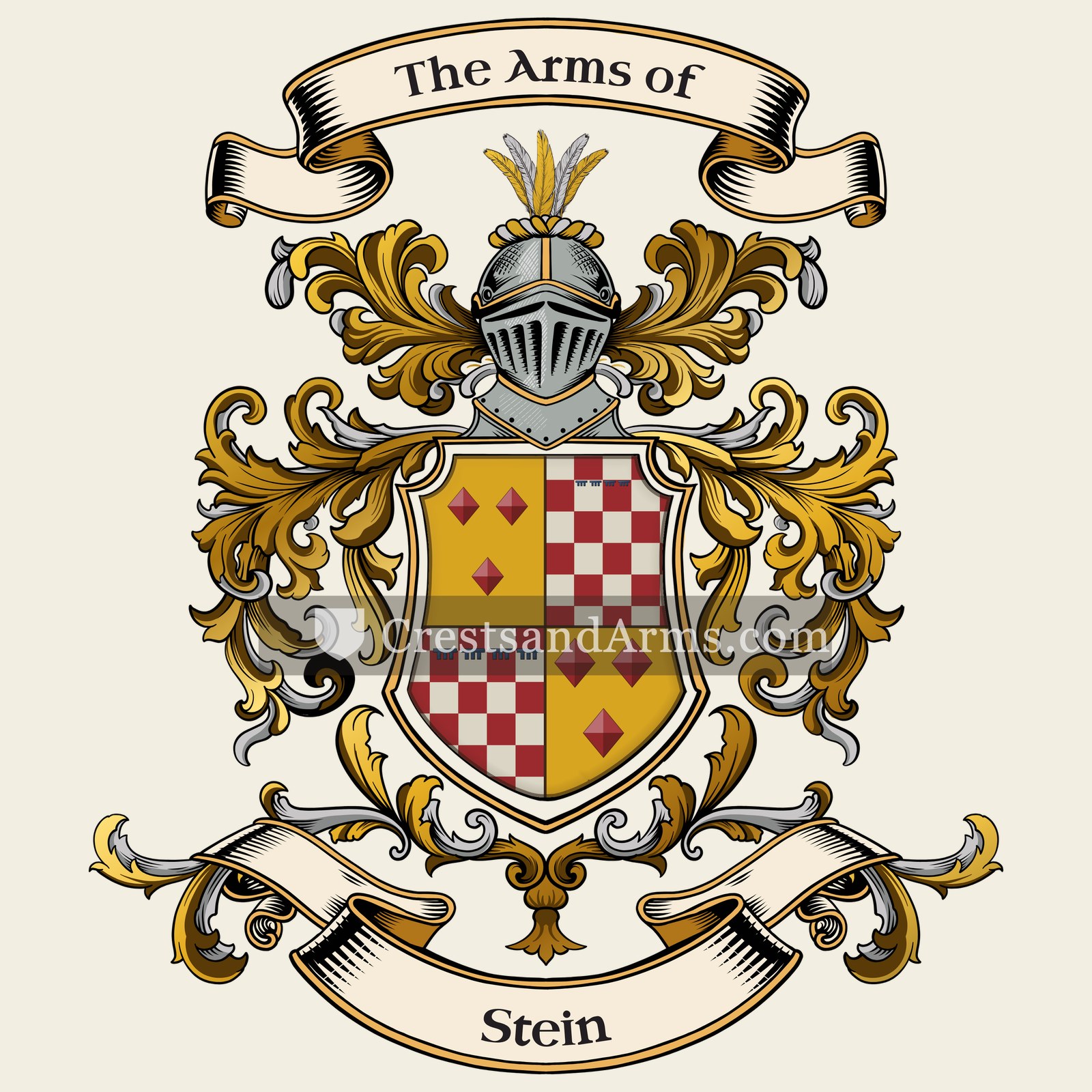
chequyConstancy, and the counting-board
labelThe eldest son, during his father's life
lozengeHonour and nobility, and the arms of a woman
Colours
Gold (Or)Means: Generosity
Silver (Argent)Means: Peace and sincerity
Red (Gules)Means: Military strength
Blue (Azure)Means: Loyalty and truth
Historical info
Source
J. B. Rietstap, Armorial Général, Gouda: G. B. van Goor Zonen, 1884–87
Blazon (the actual original written record)
“Ec.: aux 1 et 4 d'or à trois los. de gu., aboutées en bande; aux 2 et 3 échiq. d'arg. et de gu., à un lambel de quatre pendants d'azur en chef. C.: un coussin d'arg., sommé d'un demi-vol de sa.”
WestphaliaWestphalia, c. 1765
Digital archive packCoat of arms PNG, gold border print PDF, vector SVG and the certificate of authenticity. Sent to your email in minutes.
Map of Germany showing where the Stein arms are recorded
The Stein arms were recorded in Westphalia, c. 1765.
Westphalia was a land of small estates and fortified farmhouses in western Germany. Its families were numerous and not especially rich, but each held its own ground, and holding ground was what brought arms.
This is where the arms were entered in the register. Families often moved to other parts of the country, so the same name can turn up in more than one region.
The body that granted and recorded arms in Germany in this period.
Francis I, Holy Roman Emperor
Sovereign of the period
Francis I, Holy Roman Emperor
1745–1765
Reigning in Germany when the Stein arms are first recorded.
How Arms Worked in Germany
In the Holy Roman Empire, coats of arms were often granted to individuals by the Emperor or his representatives. These arms were then passed down through the generations to all legitimate descendants of the original holder. Younger branches of a family usually kept the same shield design without needing to change it, as the arms belonged to the entire lineage.
Granting authority
The Holy Roman Emperor held the sole power to grant new coats of arms throughout his vast imperial territories.
How they got arms
Families typically obtained their coats of arms through a formal imperial grant or by proving their noble status to the authorities.
Where arms were recorded
These grants were officially recorded in the Imperial Chancery registers, which began keeping formal records of such honors during the Middle Ages.
The family's standing
Recorded among the armigerous families of Westphalia.
Origin & History of the Stein Family in Germany
The surname Stein is a classic example of a topographic name, which means it was originally given to people based on the landscape where they lived. In the German language, the word *Stein* translates to stone or rock. During the Middle Ages, families often adopted this name because they resided near a prominent rocky outcrop, a stone building, or a fortified castle. By the time records confirm the family presence in the Westphalia region in 1765, the name had already been established for centuries as a way to identify individuals by their local geography. Because Westphalia was a region defined by its diverse terrain and historical trade routes, families with this name were likely settled farmers or craftsmen who maintained a deep connection to their specific plot of land. This naming tradition reflects a time when a person’s identity was closely tied to the physical environment of their home village.
Coat of Arms & Family Crest Details
Symbols on this shield
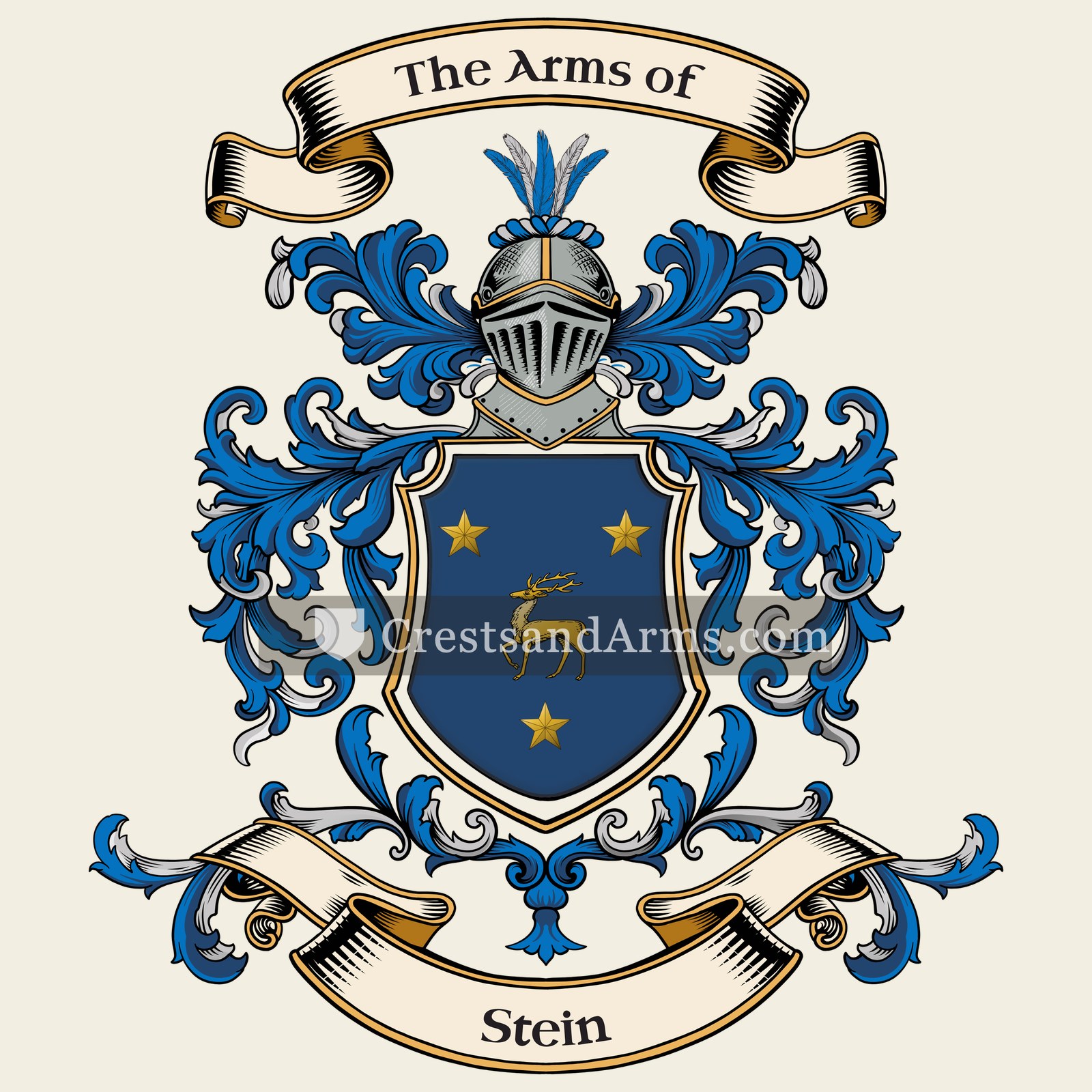
stagPeace and harmony, and one who will not fight unprovoked
mulletThe third son, and a divine quality from above
Colours
Blue (Azure)Means: Loyalty and truth
Gold (Or)Means: Generosity
Historical info
Source
J. B. Rietstap, Armorial Général, Gouda: G. B. van Goor Zonen, 1884–87
Blazon (the actual original written record)
“D'azur à un rencontre de cerf d'or, cour. du même, acc. de trois étoiles mal-ordonnées aussi d'or. C.: une épée d'arg., garnie d'or, en pal, la pointe de la lame accostée de deux étoiles (5) d'or; entre un vol, coupé alt. d'or et d'azur.”
Polandc. 1653
Digital archive packCoat of arms PNG, gold border print PDF, vector SVG and the certificate of authenticity. Sent to your email in minutes.
Map of Poland showing where the Stein arms are recorded
The Stein arms were recorded in Poland, c. 1653.
Arms such as these were typically recorded in Mazovia.
Mazovia held Warsaw, the Polish court and the assemblies where the szlachta met. Poland's nobles were unusually numerous and every one of them bore arms, and Warsaw is where those arms were argued over and recorded.
This is where the arms were entered in the register. Families often moved to other parts of the country, so the same name can turn up in more than one region.
Region
Mazovia
First recorded
1653
Granting Authority for the Stein Arms
Ennoblement by the Sejm
Author: Olek Remesz · CC BY-SA 3.0
The body that granted and recorded arms in Poland in this period.
John II Casimir Vasa
Sovereign of the period
John II Casimir Vasa
1648–1668
Reigning in Germany when the Stein arms are first recorded.
How Arms Worked in Poland
Polish noble families shared a single coat of arms across many different surnames, creating large clans rather than individual designs. These symbols were held collectively by all members of the clan regardless of their specific family name. When a new family joined the nobility, they were adopted into an existing clan and began using that group's established shield.
Granting authority
The Sejm, which was the Polish parliament, held the power to grant noble status and the right to bear arms.
How they got arms
Families typically received their coat of arms through a formal act of ennoblement granted by the Sejm for distinguished service.
Where arms were recorded
These grants were officially recorded in the Crown Metrica, which served as the central archive for state documents starting in the sixteenth century.
The family's standing
Recorded among the armigerous families of Poland.
Origin & History of the Stein Family in Poland
The history of the Stein family in Poland is deeply rooted in the Mazovia region, where ancestors were documented as early as 1653. During the seventeenth century, Mazovia was a center for families who often worked as skilled tradespeople or managed land within the local agricultural economy. The name itself is of Germanic origin and translates to stone, which often signaled that a family lived near a prominent rocky landmark or worked as stonemasons. As these families settled in the Polish heartland, they integrated into the local social fabric while maintaining their distinct identity. Over time, the Stein name became a fixture in regional records, reflecting the movement of families across the Vistula river basin as they sought new opportunities in growing trade towns. This early presence in 1653 highlights a period of stability and growth for the family as they established their roots within the complex landscape of the Polish-Lithuanian Commonwealth.
Coat of Arms & Family Crest Details
Symbols on this shield
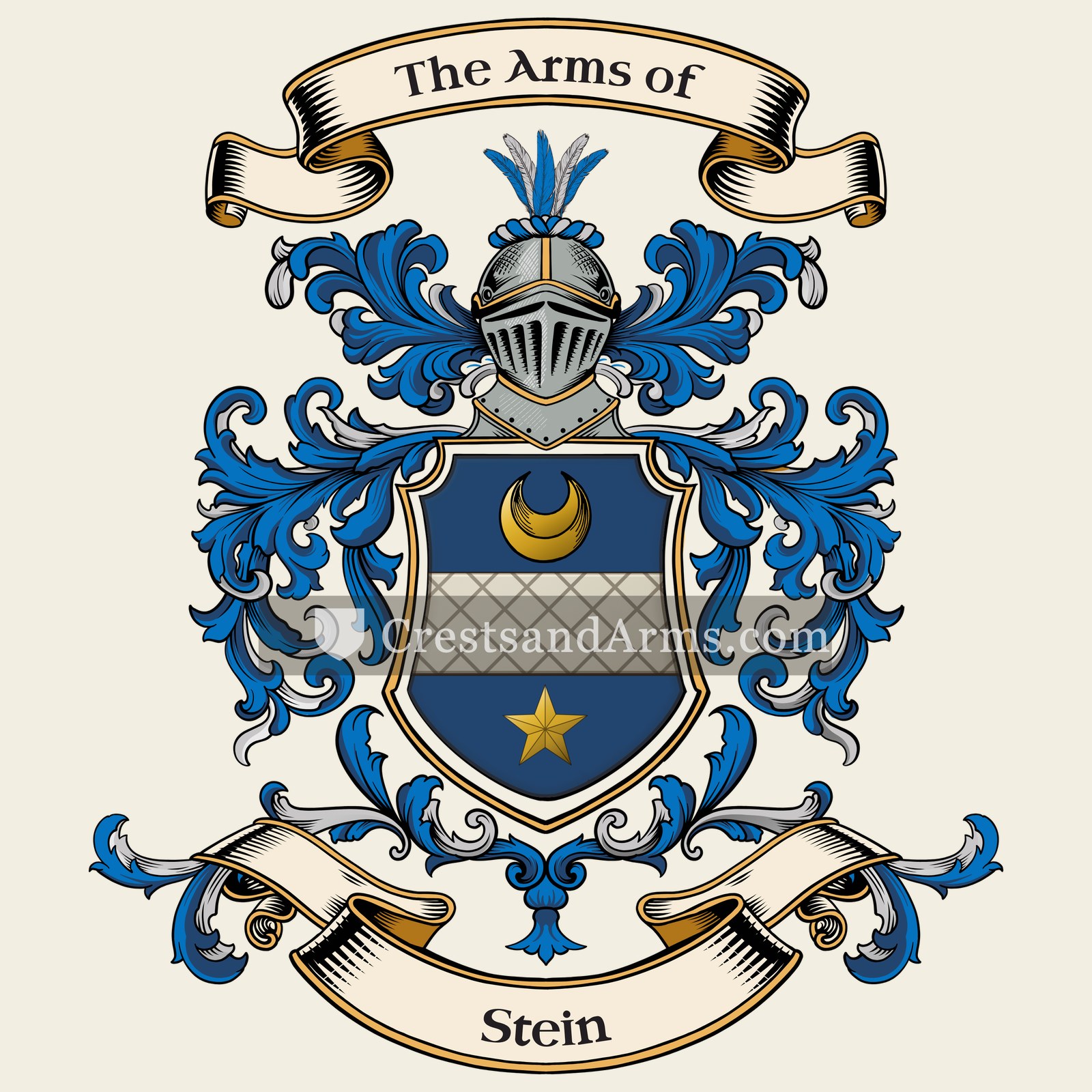
fessThe military belt, and readiness to serve
crescentHonour by the sovereign, and the second son
mulletThe third son, and a divine quality from above
Colours
Blue (Azure)Means: Loyalty and truth
Silver (Argent)Means: Peace and sincerity
Gold (Or)Means: Generosity
Historical info
Source
J. B. Rietstap, Armorial Général, Gouda: G. B. van Goor Zonen, 1884–87
Blazon (the actual original written record)
“D'azur à la fasce d'arg., acc. en chef à dextre d'une lune figurée d'or et à sen. d'une étoile (8) du même. C.: un écran carré aux armes de l'écu, le bord supérieur orné de plumes d'arg.”
Switzerlandc. 1745
Digital archive packCoat of arms PNG, gold border print PDF, vector SVG and the certificate of authenticity. Sent to your email in minutes.
Map of Switzerland showing where the Stein arms are recorded
The Stein arms were recorded in Switzerland, c. 1745.
Arms such as these were typically recorded in Bern.
Bern was the largest of the Swiss cantons and ran itself, with its own council and its own courts. Its governing families held office for generations, and office of that kind carried a shield with it.
This is where the arms were entered in the register. Families often moved to other parts of the country, so the same name can turn up in more than one region.
The body that granted and recorded arms in Switzerland in this period.
How Arms Worked in Switzerland
In Switzerland, coats of arms were not restricted to the nobility and were often adopted by common citizens and families. These symbols were passed down through generations to show family identity. When branches of a family grew, they often changed small details of the design to distinguish their own line from the original group.
Granting authority
Cantonal and civic authorities managed the use of coats of arms within their specific regions and local jurisdictions.
How they got arms
Families typically assumed their own coats of arms based on local custom rather than receiving them from a central monarch.
Where arms were recorded
Arms were recorded in various cantonal and civic registers starting from the fourteenth century throughout the Swiss region.
The family's standing
Recorded among the armigerous families of Switzerland.
Origin & History of the Stein Family in Switzerland
The family name Stein is rooted in the German word for stone, which often served as a descriptive term for people living near prominent rocky landmarks or stone structures. By the mid-18th century, the name was well-established within the social and political fabric of Bern, Switzerland. Records confirm that members of the family were active residents of the city by 1745, a time when Bern was a powerful city-state governed by a strict patrician class. During this era, families with names like Stein often integrated into the local guilds or administrative offices that kept the city running. Because the name is tied to the physical landscape, it suggests that the earliest ancestors likely settled in areas where stone quarries or rocky terrain defined the local geography. Over time, these individuals transitioned from being identified by their surroundings to carrying the name as a formal hereditary surname, eventually becoming a recognized part of the Swiss population in the canton of Bern.
Stein Meaning & Related Branches
Root word
stainaz
Proto-Germanic term referring to a hard, solid object or rock.
This name
SteinOccupational or topographic name for someone who lived near a stone or worked as a stonemason.
also spelled
Steyn
Stine
Related arms
Stainvariant spelling
Steynvariant spelling
Documented Sources
J. B. Rietstap, Armorial Général, Gouda: G. B. van Goor Zonen, 1884–87
Bahlow, Hans, Deutsches Namenlexikon: Familien- und Vornamen nach Ursprung und Sinn erklärt, 1967
Gottschald, Max, Deutsche Namenkunde: Unsere Familiennamen nach ihrer Entstehung und Bedeutung, 1971
Landesarchiv Nordrhein-Westfalen, Kirchenbücher der evangelischen und katholischen Kirchengemeinden in Westfalen, 1765
Digital archive packCoat of arms PNG, gold border print PDF, vector SVG and the certificate of authenticity. Sent to your email in minutes.


 chequyConstancy, and the counting-board
 labelThe eldest son, during his father's life
 lozengeHonour and nobility, and the arms of a woman
 chequyConstancy, and the counting-board
 labelThe eldest son, during his father's life
 lozengeHonour and nobility, and the arms of a woman


 stagPeace and harmony, and one who will not fight unprovoked
 mulletThe third son, and a divine quality from above


 fessThe military belt, and readiness to serve
 crescentHonour by the sovereign, and the second son