Map of Denmark showing where the Steinbauer arms are recorded
The Steinbauer arms were recorded in Denmark, c. 1482.
Arms such as these were typically recorded in Sjaælland.
Zealand held the Danish court, the crown's offices and Copenhagen itself. Families who served the king kept estates within reach of it, and royal service was the ordinary route to a coat of arms.
This is where the arms were entered in the register. Families often moved to other parts of the country, so the same name can turn up in more than one region.
The body that granted and recorded arms in Denmark in this period.
John, King of Denmark
Sovereign of the period
John, King of Denmark
1481–1513
Reigning in Denmark when the Steinbauer arms are first recorded.
How Arms Worked in Denmark
Danish heraldry during this period was closely tied to noble status and royal favor rather than being open to all citizens. Arms were typically granted by the monarch to individuals, and these symbols were then shared by all members of the noble house. If a family line died out, the right to use those specific arms ended with them.
Granting authority
The Danish royal chancery held the power to issue and regulate official coats of arms for the kingdom.
How they got arms
Families usually received their arms through a formal royal grant that confirmed their noble status and rights.
Where arms were recorded
These grants were officially recorded in the Danish Royal Chancery records starting in the sixteenth century.
The family's standing
Recorded among the armigerous families of Denmark.
Origin & History of the Steinbauer Family in Denmark
The history of the Steinbauer name in Denmark traces back to the late fifteenth century, marking the family as part of the social landscape in Sjælland by 1482. The name itself reflects a German influence, as "Steinbauer" translates to a stone builder or a farmer who worked on stony ground. During this period, families with such occupational surnames often settled in growing trade centers or near rural estates where their specific skills in construction or land management were highly valued. As the family established their roots in the Danish region, they integrated into the local community by participating in the agricultural and craft-based economy that defined the era. Their presence in the historical records from 1482 suggests that they were settled members of the population during a time when surnames were becoming more permanent identifiers for families across Northern Europe.
Meaning of the Steinbauer family crest colors & symbols
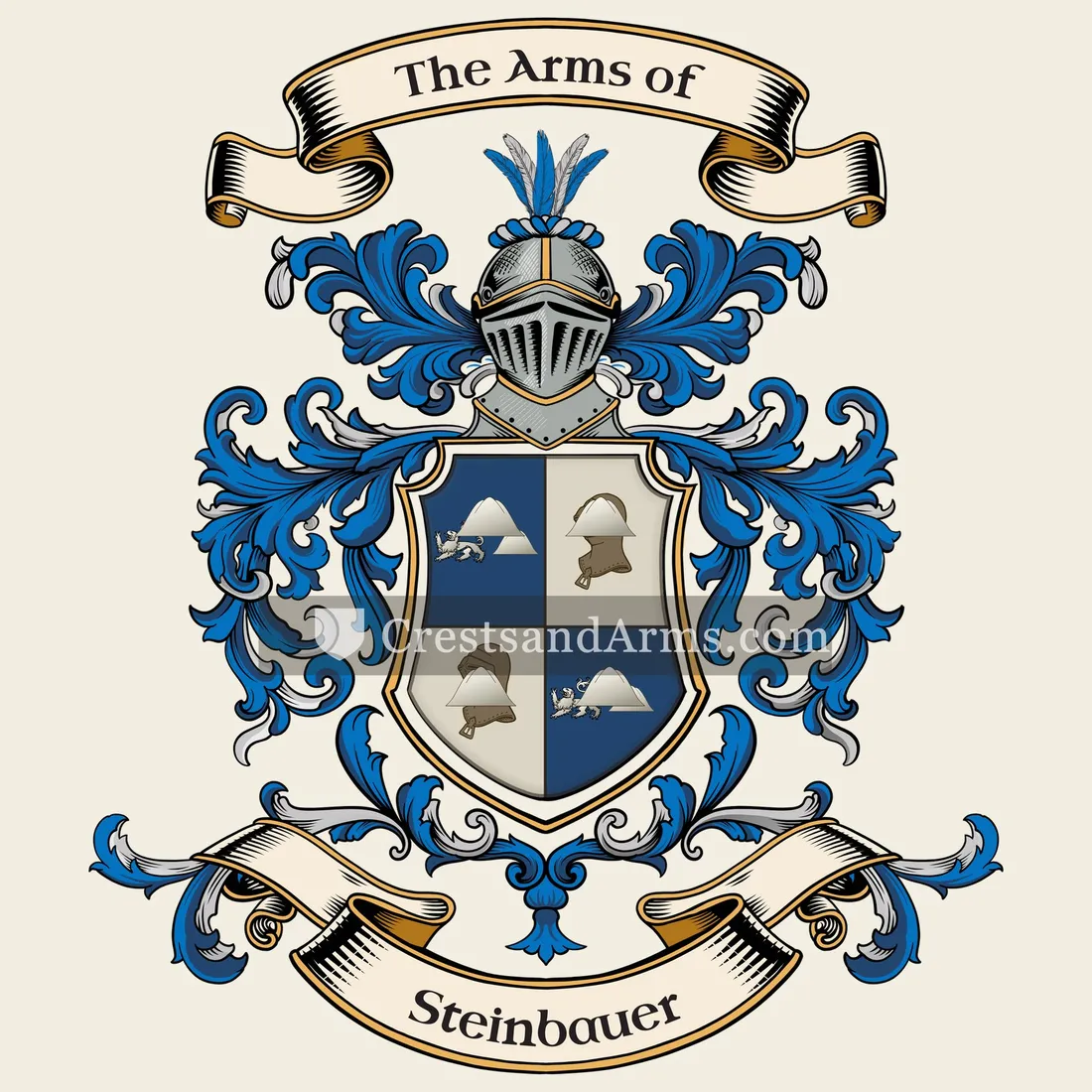
Symbols on this shield
mountThe ground held, and steadfastness upon it
lionCourage, strength and royalty
helmetWisdom and security in defence
Colours
Blue (Azure)Means: Loyalty and truth
Silver (Argent)Means: Peace and sincerity
Historical info
Source
J. B. Rietstap, Armorial Général, Gouda: G. B. van Goor Zonen, 1884–87
Blazon (the actual original written record)
“Ec.: aux 1 et 4 d'azur au lion naiss. d'arg., cour. d'or. ramp. contre un rocher d'arg., mouv. du flanc dextre: le tout mouv. d'une eau d'arg. en p.; aux 2 et 3 d'arg. à un casque au nat., taré de trois quarts, grillé de trois pièces d'or, le crâne du casque environné d'une couronne de laurier de sin. Sur le tout d'or à un rang de quatre ou cinq rochers d'arg., mouv. de la p. Trois cq. cour. C.: 1° un lion cont. d'or, tenant une épée au nat.; 2° un bouquetin iss. d'or, accorné d'arg.; entre un vol, coupé alt. d'or, et de sa.; 3° un bras, arm. d'arg., en pal, la main de carn. tenant une couronne de laurier de sin., ornée en flancs de deux roses de gu. et en”
Swedenc. 1654
Digital archive packCoat of arms PNG, gold border print PDF, vector SVG and the certificate of authenticity. Sent to your email in minutes.
Map of Sweden showing where the Steinbauer arms are recorded
The Steinbauer arms were recorded in Sweden, c. 1654.
Arms such as these were typically recorded in Stockholm.
Stockholm held the Swedish court and the House of Nobility, where every noble family's arms were entered and kept. Families ennobled for service registered there, which is why so many are recorded around the city.
This is where the arms were entered in the register. Families often moved to other parts of the country, so the same name can turn up in more than one region.
The body that granted and recorded arms in Sweden in this period.
Christina of Sweden
Sovereign of the period
Christina of Sweden
1632–1654
Reigning in Denmark when the Steinbauer arms are first recorded.
How Arms Worked in Sweden
In Sweden, a coat of arms belonged to a noble family as a whole rather than just one individual. These arms were passed down through the generations to all legitimate descendants. Younger branches of the family used the same shield without needing to change it. This system ensured that the entire lineage shared the same identity and status under the law.
Granting authority
The Riddarhuset, or House of Nobility, regulated all noble coats of arms in Sweden under royal authority.
How they got arms
Families received their coats of arms through royal grants of nobility which were then officially registered with the House.
Where arms were recorded
Coats of arms were officially recorded in the Swedish House of Nobility register starting in the year 1626.
The family's standing
Recorded among the armigerous families of Sweden.
Origin & History of the Steinbauer Family in Sweden
The Steinbauer family name first appeared in the historical records of Stockholm in 1654, marking a significant presence during a time when Sweden was a rising power in Europe. The name itself reflects a Germanic origin, likely brought to the Swedish capital by skilled craftsmen or merchants who migrated north to support the growing urban economy. During the mid-seventeenth century, Stockholm was rapidly expanding as a center for trade and administration, attracting professionals from across the Baltic region. Early members of the family were integrated into the city’s social fabric, likely working in specialized trades that were essential for the construction and maintenance of the capital. By establishing themselves in Stockholm during this period, the Steinbauer family became part of the diverse population that helped shape the city into a major northern European hub. Their early history illustrates the movement of families across borders in search of new opportunities during an era of significant growth and change.
Steinbauer Meaning & Related Branches
Root word
Stein and Bauer
Stone and builder or farmer
This name
SteinbauerA person who builds with stone or a farmer living on stony land.
also spelled
Stenberg
Documented Sources
J. B. Rietstap, Armorial Général, Gouda: G. B. van Goor Zonen, 1884–87
Krarup, Alfred. Danmarks gamle Personnavne. 1936
Rigsarkivet (The Danish National Archives). Diplomatarium Danicum, Series 2, Volume 1. 1482
Digital archive packCoat of arms PNG, gold border print PDF, vector SVG and the certificate of authenticity. Sent to your email in minutes.


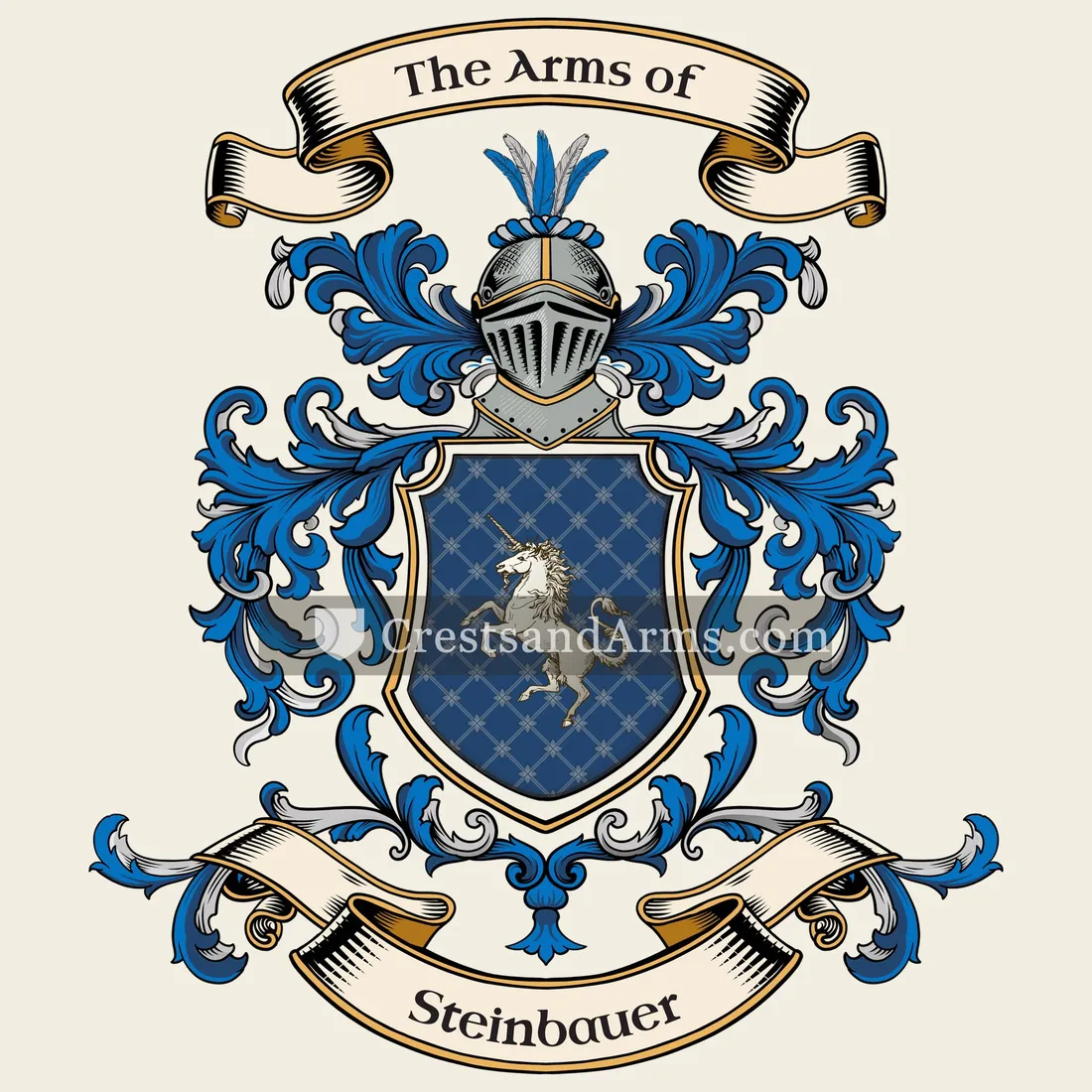
 unicornPurity, and extreme courage in defence of honour
 unicornPurity, and extreme courage in defence of honour


 mountThe ground held, and steadfastness upon it
 lionCourage, strength and royalty
 helmetWisdom and security in defence