Map of Denmark showing where the Steinberg arms are recorded
The Steinberg arms were recorded in Denmark, c. 1482.
Arms such as these were typically recorded in Sjaælland.
Zealand held the Danish court, the crown's offices and Copenhagen itself. Families who served the king kept estates within reach of it, and royal service was the ordinary route to a coat of arms.
This is where the arms were entered in the register. Families often moved to other parts of the country, so the same name can turn up in more than one region.
The body that granted and recorded arms in Denmark in this period.
John, King of Denmark
Sovereign of the period
John, King of Denmark
1481–1513
Reigning in Denmark when the Steinberg arms are first recorded.
How Arms Worked in Denmark
Danish heraldry during this period was closely tied to noble status and royal favor rather than being open to all citizens. Arms were typically granted by the monarch to individuals, and these symbols were then shared by all members of the noble house. If a family line died out, the right to use those specific arms ended with them.
Granting authority
The Danish royal chancery held the power to issue and regulate official coats of arms for the kingdom.
How they got arms
Families usually received their arms through a formal royal grant that confirmed their noble status and rights.
Where arms were recorded
These grants were officially recorded in the Danish Royal Chancery records starting in the sixteenth century.
The family's standing
Recorded among the armigerous families of Denmark.
Origin & History of the Steinberg Family in Denmark
The history of the Steinberg name in Denmark begins with deep roots on the island of Sjælland, where family members were documented as early as 1482. During this period, the name likely emerged as a topographic descriptor, reflecting the family’s connection to the rocky or stony landscapes common in parts of the Danish countryside. As the name took hold in the region, the family became part of the local social fabric, navigating the shifts in Danish society during the late Middle Ages. Because the name is Germanic in origin, its presence in Sjælland suggests that the family may have been part of the broader migration patterns and trade networks that linked Denmark to Northern Germany. By establishing themselves in the heart of the Danish kingdom, these early ancestors helped set the stage for the family to grow and evolve alongside the nation for centuries to come.
Coat of Arms & Family Crest Details
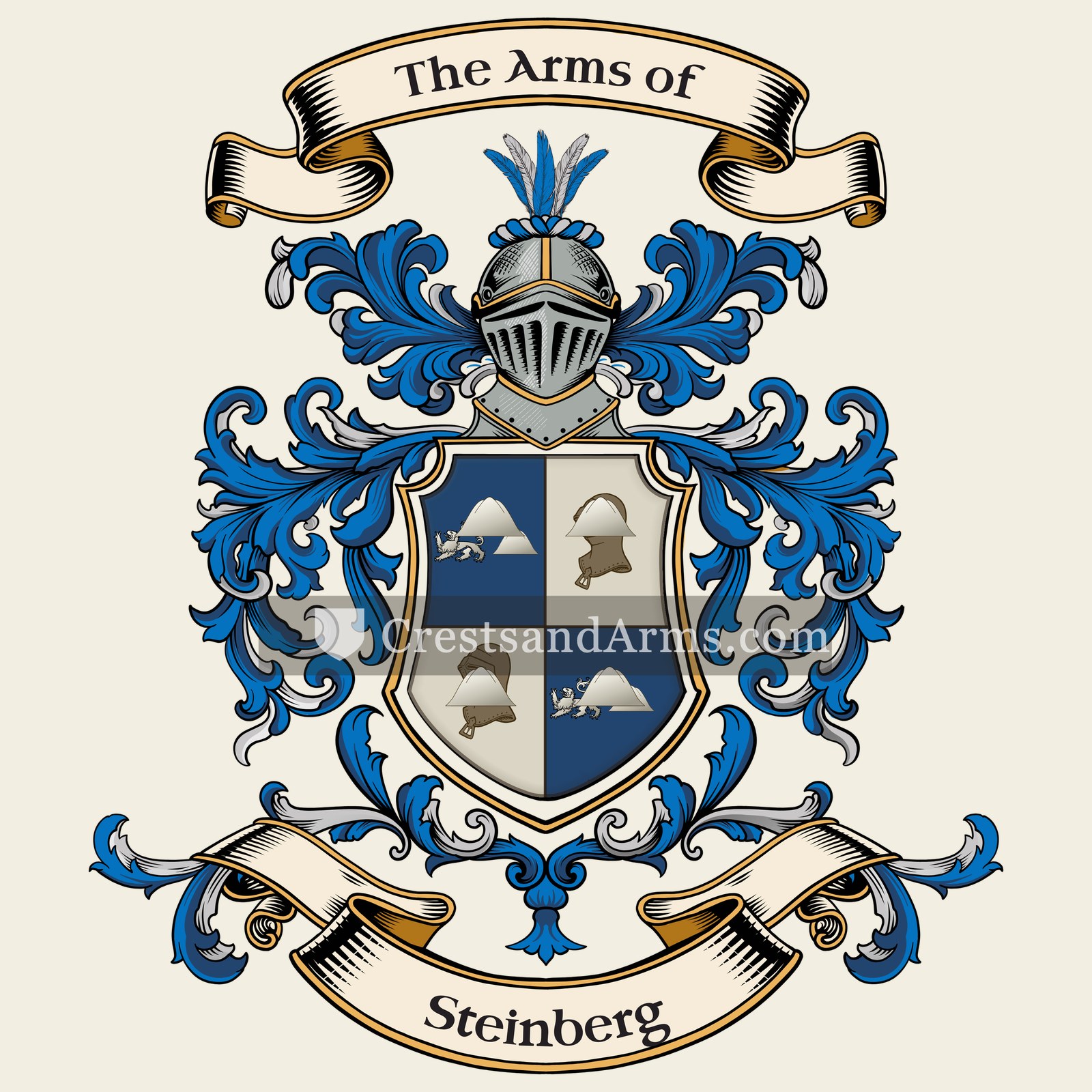
Symbols on this shield
mountThe ground held, and steadfastness upon it
lionCourage, strength and royalty
helmetWisdom and security in defence
Colours
Blue (Azure)Means: Loyalty and truth
Silver (Argent)Means: Peace and sincerity
Historical info
Source
J. B. Rietstap, Armorial Général, Gouda: G. B. van Goor Zonen, 1884–87
Blazon (the actual original written record)
“Ec.: aux 1 et 4 d'azur au lion naiss. d'arg., cour. d'or. ramp. contre un rocher d'arg., mouv. du flanc dextre: le tout mouv. d'une eau d'arg. en p.; aux 2 et 3 d'arg. à un casque au nat., taré de trois quarts, grillé de trois pièces d'or, le crâne du casque environné d'une couronne de laurier de sin. Sur le tout d'or à un rang de quatre ou cinq rochers d'arg., mouv. de la p. Trois cq. cour. C.: 1° un lion cont. d'or, tenant une épée au nat.; 2° un bouquetin iss. d'or, accorné d'arg.; entre un vol, coupé alt. d'or, et de sa.; 3° un bras, arm. d'arg., en pal, la main de carn. tenant une couronne de laurier de sin., ornée en flancs de deux roses de gu. et en”
Swedenc. 1654
Digital archive packCoat of arms PNG, gold border print PDF, vector SVG and the certificate of authenticity. Sent to your email in minutes.
Map of Sweden showing where the Steinberg arms are recorded
The Steinberg arms were recorded in Sweden, c. 1654.
Arms such as these were typically recorded in Stockholm.
Stockholm held the Swedish court and the House of Nobility, where every noble family's arms were entered and kept. Families ennobled for service registered there, which is why so many are recorded around the city.
This is where the arms were entered in the register. Families often moved to other parts of the country, so the same name can turn up in more than one region.
The body that granted and recorded arms in Sweden in this period.
Christina of Sweden
Sovereign of the period
Christina of Sweden
1632–1654
Reigning in Denmark when the Steinberg arms are first recorded.
How Arms Worked in Sweden
In Sweden, a coat of arms belonged to a noble family as a whole rather than just one individual. These arms were passed down through the generations to all legitimate descendants. Younger branches of the family used the same shield without needing to change it. This system ensured that the entire lineage shared the same identity and status under the law.
Granting authority
The Riddarhuset, or House of Nobility, regulated all noble coats of arms in Sweden under royal authority.
How they got arms
Families received their coats of arms through royal grants of nobility which were then officially registered with the House.
Where arms were recorded
Coats of arms were officially recorded in the Swedish House of Nobility register starting in the year 1626.
The family's standing
Recorded among the armigerous families of Sweden.
Origin & History of the Steinberg Family in Sweden
The name Steinberg first appeared in the official records of Stockholm in 1654, marking the family as part of the vibrant urban landscape during Sweden’s period as a major European power. At this time, Stockholm was rapidly expanding as a center for trade and administration, and many families with German-sounding names moved to the city to work as merchants, craftsmen, or government officials. The name itself is descriptive, likely originating from the German words for stone and mountain or hill, which suggests that the family’s ancestors may have lived near a rocky landscape before settling in the Swedish capital. By establishing themselves in Stockholm during the mid-17th century, the early members of the Steinberg family became part of the city’s growing middle class. They lived through a time of significant social change as Sweden transitioned into a centralized state, and their presence in the city archives provides a clear link to the professional and social networks that defined life in old Stockholm.
Related Branches & Arms
Root word
Stein and Berg
Stone and mountain or hill
This name
SteinbergA topographic name for someone living near a stony mountain or hill.
also spelled
Stenberg
Related arms
Stainbergvariant spelling
Steinbregvariant spelling
Documented Sources
J. B. Rietstap, Armorial Général, Gouda: G. B. van Goor Zonen, 1884–87
Krarup, Alfred. Danmarks gamle Personnavne. 1941
Nielsen, O. Olddanske Personnavne. 1883
Rigsarkivet, Diplomatarium Danicum
Digital archive packCoat of arms PNG, gold border print PDF, vector SVG and the certificate of authenticity. Sent to your email in minutes.


 unicornPurity, and extreme courage in defence of honour
 unicornPurity, and extreme courage in defence of honour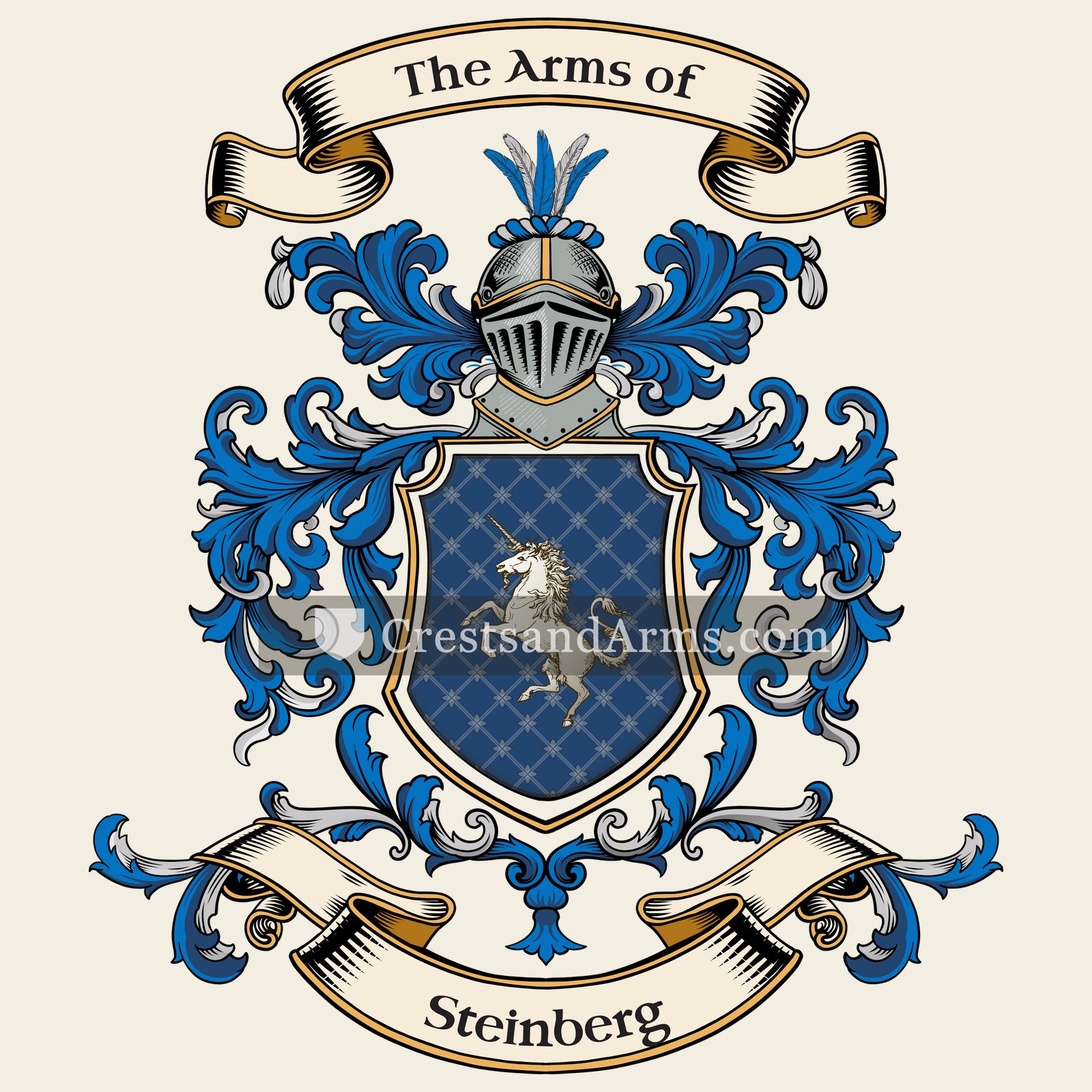


 mountThe ground held, and steadfastness upon it
 lionCourage, strength and royalty
 helmetWisdom and security in defence