Map of Belgium showing where the Stepanyan arms are recorded
The Stepanyan arms were recorded in Liege, c. 1737.
Liege was a prosperous town and its surrounding country, living on metalworking and trade. Merchant families grew rich, bought land outside the walls, and took arms as landowners rather than tradesmen.
This is where the arms were entered in the register. Families often moved to other parts of the country, so the same name can turn up in more than one region.
The body that granted and recorded arms in Belgium in this period.
Charles VI, Holy Roman Emperor
Sovereign of the period
Charles VI, Holy Roman Emperor
1711–1740
Reigning in Belgium when the Stepanyan arms are first recorded.
How Arms Worked in Belgium
In Belgium, a coat of arms is considered personal property that is passed down through the male line to legitimate descendants. Families often use the same shield design across generations to show their shared heritage. If a branch of the family wants to change the design, they must apply for an official update to their specific version of the arms.
Granting authority
The Conseil héraldique is the official body that regulates and approves all coats of arms in Belgium.
How they got arms
Families obtain their coats of arms through formal royal grants or by confirming their historical right to use existing designs.
Where arms were recorded
All approved coats of arms are officially recorded in the public registers of the Conseil héraldique since 1844.
The family's standing
Recorded among the armigerous families of Liege.
Origin & History of the Stepanyan Family in Belgium
The Stepanyan family name traces its roots to the Armenian highlands, but its presence in Western Europe reveals a fascinating history of movement and adaptation. By 1737, members of the family were documented as residents in the city of Liège, which was then part of the Prince-Bishopric of Liège. During this era, Liège served as a vital crossroads for trade and intellectual exchange, attracting merchants and travelers from across the Ottoman Empire. The Stepanyans likely arrived in the region as part of a small but influential network of Armenian traders who facilitated the movement of luxury goods like silk and spices between the East and the Low Countries. Settling in a city known for its industrial spirit and independent governance, these early family members integrated into the local economy while maintaining their cultural identity. Their presence in the city records from the eighteenth century highlights how the family name became established in the Belgian landscape long before the modern era of mass migration.
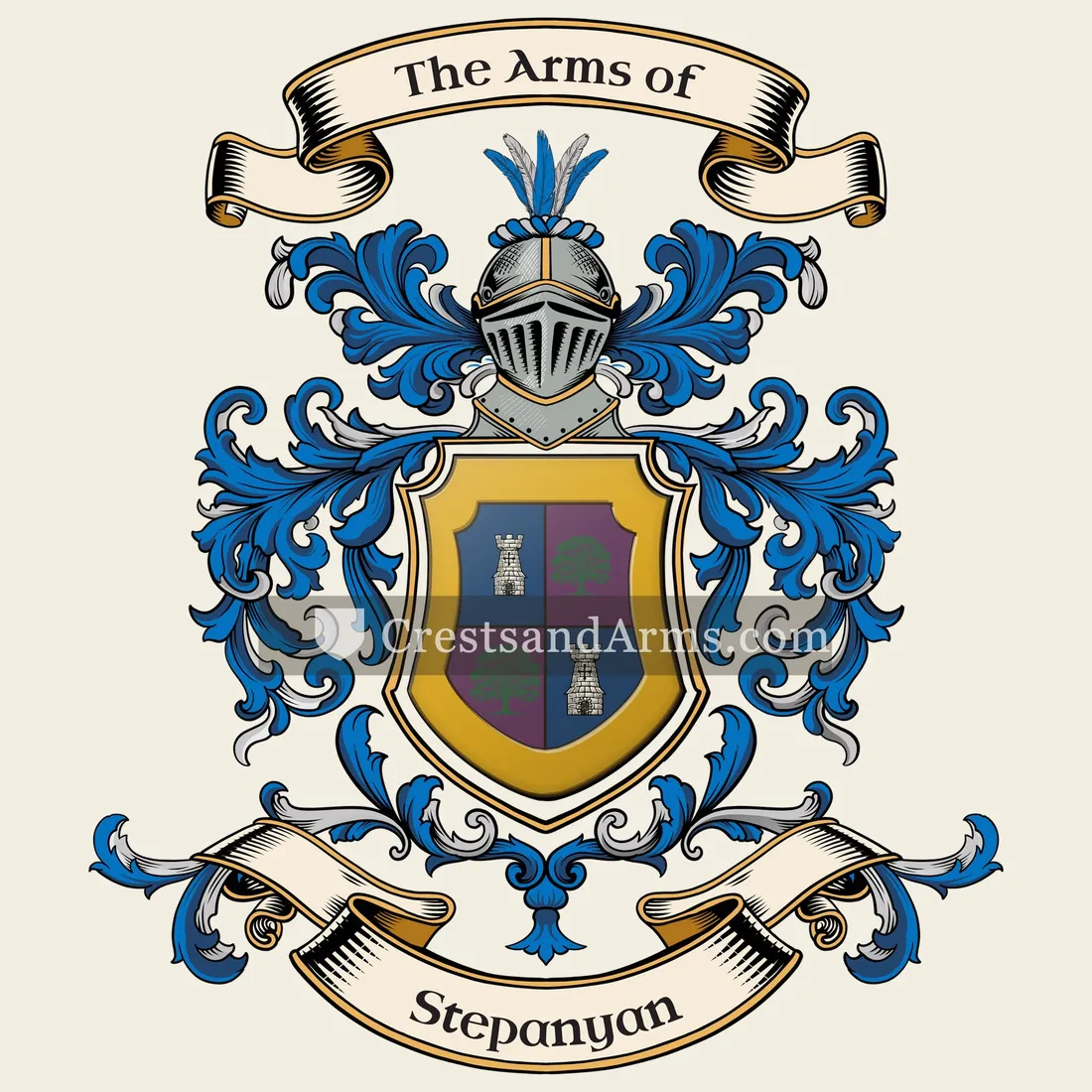
Meaning of the Stepanyan family crest colors & symbols
Symbols on this shield
towerGrandeur and solidity, and a stronghold defended
treeLife, endurance and deep roots
Colours
Blue (Azure)Means: Loyalty and truth
Purple (Purpure)Means: Royal majesty
Gold (Or)Means: Generosity
Silver (Argent)Means: Peace and sincerity
Green (Vert)Means: Hope
Historical info
Source
J. B. Rietstap, Armorial Général, Gouda: G. B. van Goor Zonen, 1884–87
Blazon (the actual original written record)
“Ec.: aux 1 et 4 d'azur à une tour d'arg., maçonnée de sa., ouv. du champ; aux 2 et 3 de pourpre à un arbre arr. de sin. L'écu bordé d'or. C.: un lion iss. d'arg., supp. de ses pattes la tour de l'écu; entre un vol de sa. L.: à dextre d'or et de pourpre, à sen. d'arg. et d'azur.”
Germanyc. 1765
Digital archive packCoat of arms PNG, gold border print PDF, vector SVG and the certificate of authenticity. Sent to your email in minutes.
Map of Germany showing where the Stepanyan arms are recorded
The Stepanyan arms were recorded in Germany, c. 1765.
Arms such as these were typically recorded in Bavaria.
Bavaria was a country of old landed families and walled market towns. Estates passed down the same line for centuries, and both the landowners and the leading townsmen kept arms, which is why so many Bavarian names sit in the registers.
This is where the arms were entered in the register. Families often moved to other parts of the country, so the same name can turn up in more than one region.
The body that granted and recorded arms in Germany in this period.
Francis I, Holy Roman Emperor
Sovereign of the period
Francis I, Holy Roman Emperor
1745–1765
Reigning in Belgium when the Stepanyan arms are first recorded.
How Arms Worked in Germany
In the Holy Roman Empire, coats of arms were often granted to individuals by the Emperor or his representatives. These arms were then passed down through the generations to all legitimate descendants of the original holder. Younger branches of a family usually kept the same shield design without needing to change it, as the arms belonged to the entire lineage.
Granting authority
The Holy Roman Emperor held the sole power to grant new coats of arms throughout his vast imperial territories.
How they got arms
Families typically obtained their coats of arms through a formal imperial grant or by proving their noble status to the authorities.
Where arms were recorded
These grants were officially recorded in the Imperial Chancery registers, which began keeping formal records of such honors during the Middle Ages.
The family's standing
Recorded among the armigerous families of Germany.
Origin & History of the Stepanyan Family in Germany
The Stepanyan family name traces its roots to the Armenian tradition of patronymics, where the suffix "-yan" denotes descent from a specific ancestor. While the name is deeply connected to the Caucasus region, historical records confirm that members of the family were established in Bavaria by 1765. During the eighteenth century, Bavaria served as a crossroads for trade and diplomacy, often attracting merchants and scholars from the East who sought new opportunities within the Holy Roman Empire. The presence of the Stepanyan family in this region suggests they were likely part of an early network of travelers or professionals who integrated into the local German society while maintaining their distinct cultural heritage. By settling in Bavaria, these early family members navigated a landscape defined by strict guild regulations and local administrative oversight, leaving behind a legacy of adaptation and resilience that helped them establish a foothold in Central Europe.
Stepanyan Meaning & Related Branches
Root word
Stephanos
Greek word meaning crown, garland, or wreath.
This name
StepanyanAn Armenian patronymic surname meaning son of Stephen, derived from the Greek name for a crown.
also spelled
Stephani
Stephannie
Stephaney
Stefani
Stephanie
Documented Sources
J. B. Rietstap, Armorial Général, Gouda: G. B. van Goor Zonen, 1884–87
Archives de l'État à Liège, Registres paroissiaux de la ville de Liège (1737)
Baum, Wilhelm, Die Armenier in Europa: Eine Geschichte der armenischen Diaspora (2000)
Kévonian, Keram, Marchands arméniens en Europe: Réseaux et échanges au XVIIIe siècle (1995)
Digital archive packCoat of arms PNG, gold border print PDF, vector SVG and the certificate of authenticity. Sent to your email in minutes.


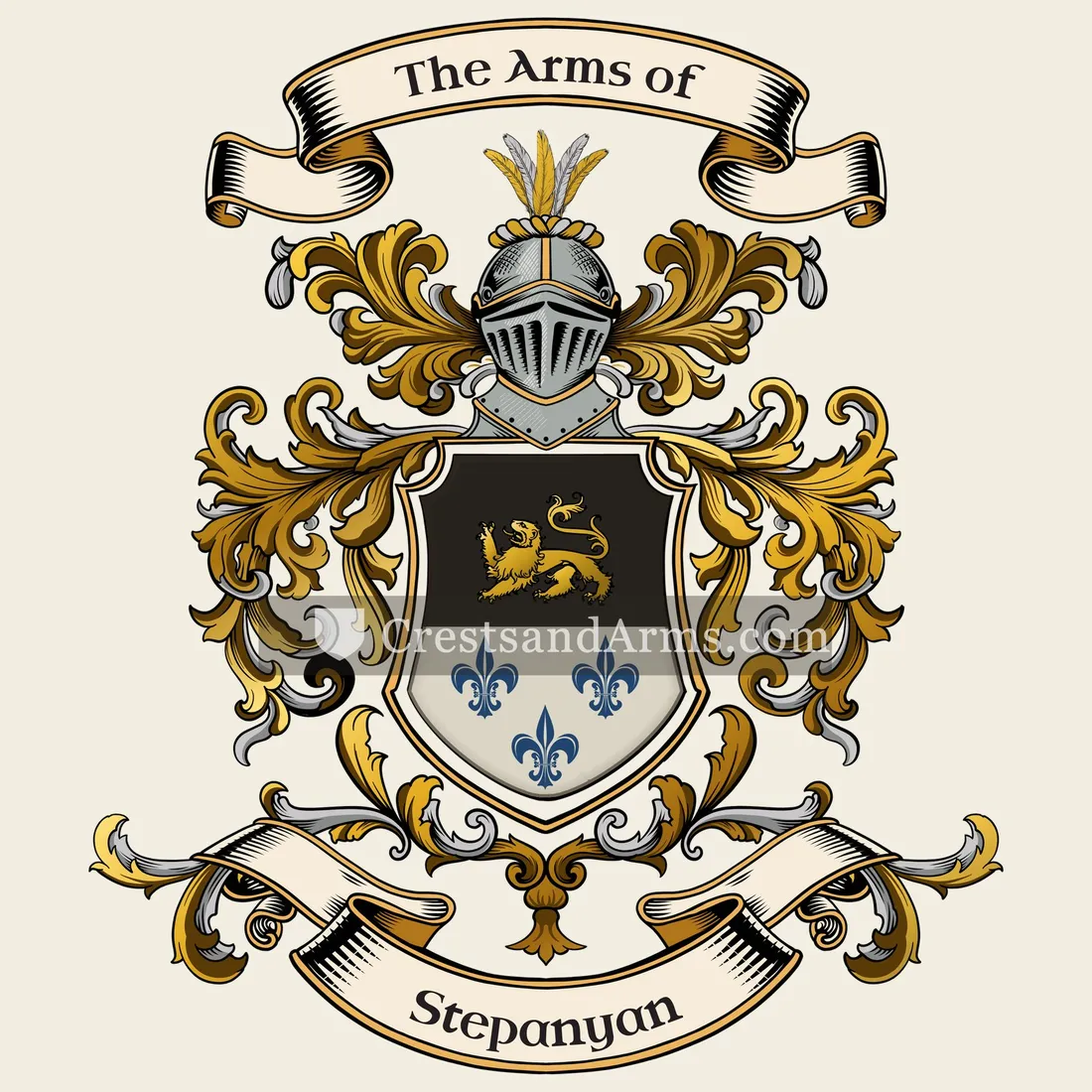
 lionCourage, strength and royalty
 fleur de lisPurity, light, and the sixth son
 lionCourage, strength and royalty
 fleur de lisPurity, light, and the sixth son


 towerGrandeur and solidity, and a stronghold defended
 treeLife, endurance and deep roots