Map of Belgium showing where the Stephanie arms are recorded
The Stephanie arms were recorded in Liege, c. 1737.
Liege was a prosperous town and its surrounding country, living on metalworking and trade. Merchant families grew rich, bought land outside the walls, and took arms as landowners rather than tradesmen.
This is where the arms were entered in the register. Families often moved to other parts of the country, so the same name can turn up in more than one region.
The body that granted and recorded arms in Belgium in this period.
Charles VI, Holy Roman Emperor
Sovereign of the period
Charles VI, Holy Roman Emperor
1711–1740
Reigning in Belgium when the Stephanie arms are first recorded.
How Arms Worked in Belgium
In Belgium, a coat of arms is considered personal property that is passed down through the male line to legitimate descendants. Families often use the same shield design across generations to show their shared heritage. If a branch of the family wants to change the design, they must apply for an official update to their specific version of the arms.
Granting authority
The Conseil héraldique is the official body that regulates and approves all coats of arms in Belgium.
How they got arms
Families obtain their coats of arms through formal royal grants or by confirming their historical right to use existing designs.
Where arms were recorded
All approved coats of arms are officially recorded in the public registers of the Conseil héraldique since 1844.
The family's standing
Recorded among the armigerous families of Liege.
Origin & History of the Stephanie Family in Belgium
The family name Stephanie has deep roots in the historical landscape of the Prince-Bishopric of Liège, where records confirm the presence of family members as early as 1737. During this period, Liège was a major industrial and cultural hub known for its coal mining and metalworking industries. Families living in this region often identified themselves through their connection to local parishes and trade guilds. The name itself is derived from the Greek name Stephanos, which means crown or garland. In the eighteenth century, names like Stephanie were often passed down through generations as a way to honor religious saints or respected ancestors within the community. Living in Liège meant that these early family members were part of a complex society that balanced French cultural influences with local Walloon traditions. By settling in this region, the family became part of the long history of the Meuse River valley, which served as a vital center for commerce and social life in what is now modern Belgium.
Meaning of the Stephanie family crest colors & symbols
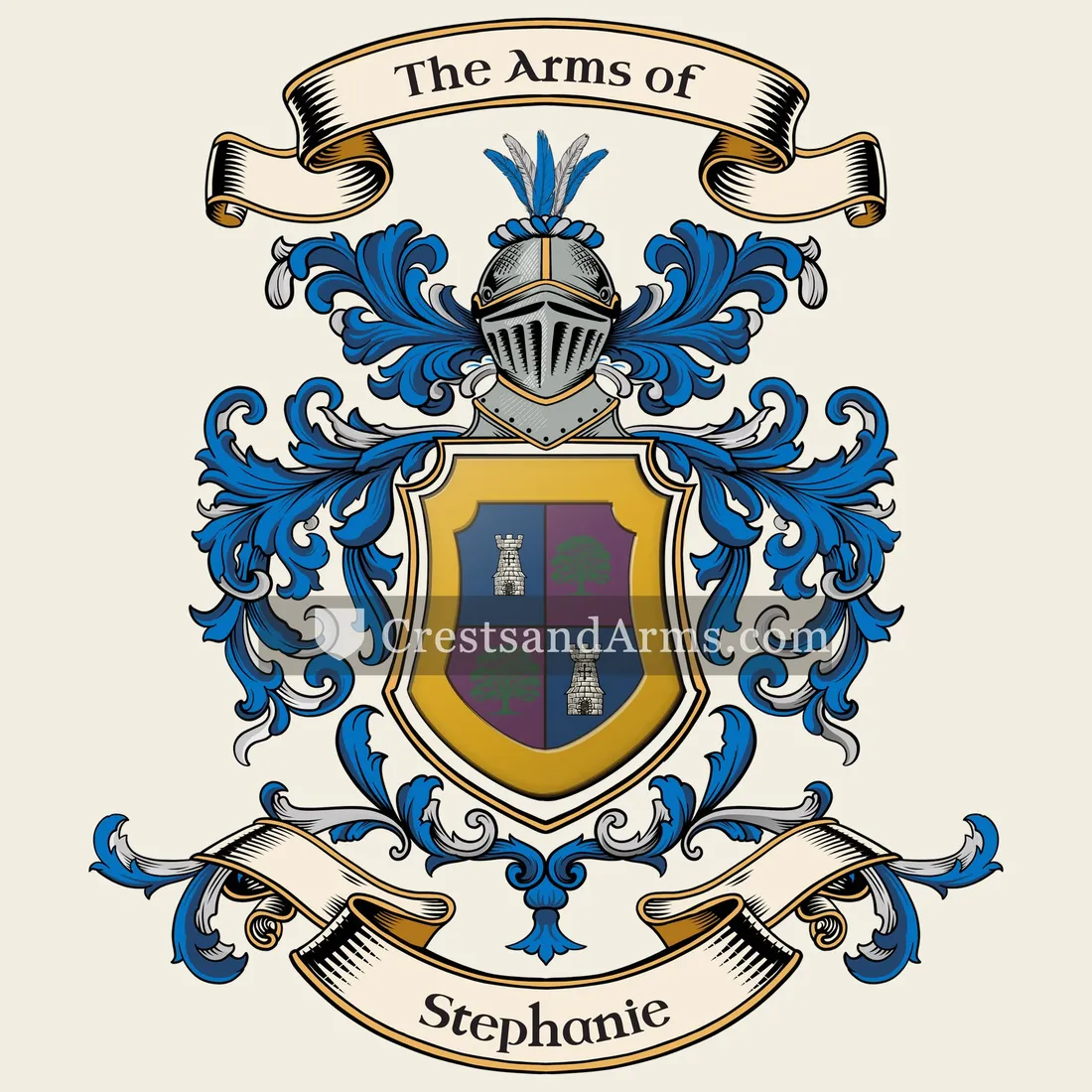
Symbols on this shield
towerGrandeur and solidity, and a stronghold defended
treeLife, endurance and deep roots
Colours
Blue (Azure)Means: Loyalty and truth
Purple (Purpure)Means: Royal majesty
Gold (Or)Means: Generosity
Silver (Argent)Means: Peace and sincerity
Green (Vert)Means: Hope
Historical info
Source
J. B. Rietstap, Armorial Général, Gouda: G. B. van Goor Zonen, 1884–87
Blazon (the actual original written record)
“Ec.: aux 1 et 4 d'azur à une tour d'arg., maçonnée de sa., ouv. du champ; aux 2 et 3 de pourpre à un arbre arr. de sin. L'écu bordé d'or. C.: un lion iss. d'arg., supp. de ses pattes la tour de l'écu; entre un vol de sa. L.: à dextre d'or et de pourpre, à sen. d'arg. et d'azur.”
Germanyc. 1765
Digital archive packCoat of arms PNG, gold border print PDF, vector SVG and the certificate of authenticity. Sent to your email in minutes.
Map of Germany showing where the Stephanie arms are recorded
The Stephanie arms were recorded in Germany, c. 1765.
Arms such as these were typically recorded in Bavaria.
Bavaria was a country of old landed families and walled market towns. Estates passed down the same line for centuries, and both the landowners and the leading townsmen kept arms, which is why so many Bavarian names sit in the registers.
This is where the arms were entered in the register. Families often moved to other parts of the country, so the same name can turn up in more than one region.
The body that granted and recorded arms in Germany in this period.
Francis I, Holy Roman Emperor
Sovereign of the period
Francis I, Holy Roman Emperor
1745–1765
Reigning in Belgium when the Stephanie arms are first recorded.
How Arms Worked in Germany
In the Holy Roman Empire, coats of arms were often granted to individuals by the Emperor or his representatives. These arms were then passed down through the generations to all legitimate descendants of the original holder. Younger branches of a family usually kept the same shield design without needing to change it, as the arms belonged to the entire lineage.
Granting authority
The Holy Roman Emperor held the sole power to grant new coats of arms throughout his vast imperial territories.
How they got arms
Families typically obtained their coats of arms through a formal imperial grant or by proving their noble status to the authorities.
Where arms were recorded
These grants were officially recorded in the Imperial Chancery registers, which began keeping formal records of such honors during the Middle Ages.
The family's standing
Recorded among the armigerous families of Germany.
Origin & History of the Stephanie Family in Germany
The name Stephanie originates from the Greek name Stephanos, which translates to crown or garland. In Germany, the name gained popularity through its association with Saint Stephen, the first Christian martyr. By the mid-18th century, the family was well-established in the region of Bavaria. During this era, Bavarian society was deeply influenced by the traditions of the Holy Roman Empire and the local Catholic Church. Families living in this area often kept detailed parish records to track baptisms, marriages, and deaths. These documents show that the family was part of a stable agricultural or trade-based community during the 1765 period. As the family grew, they contributed to the local economy and social fabric of their Bavarian towns. Their presence in these historical records reflects the broader movement of families settling into permanent homes across Southern Germany during the Enlightenment.
Stephanie Meaning & Related Branches
Root word
Stephanos
Greek word meaning crown, garland, or wreath.
This name
StephanieDerived from the Greek term for a crown, symbolizing victory or honor.
also spelled
Stephani
Stephannie
Stephaney
Stefani
Stephanie
Documented Sources
J. B. Rietstap, Armorial Général, Gouda: G. B. van Goor Zonen, 1884–87
Archives de l'État à Liège, Registres paroissiaux de la ville de Liège (1737)
Kurgan-van Hentenryk, Ginette, Dictionnaire des patrons en Belgique: les hommes, les entreprises, les réseaux, 1996
Kupper, Jean-Louis, Liège et l'église impériale, XIe-XIIe siècles, 1981
Digital archive packCoat of arms PNG, gold border print PDF, vector SVG and the certificate of authenticity. Sent to your email in minutes.


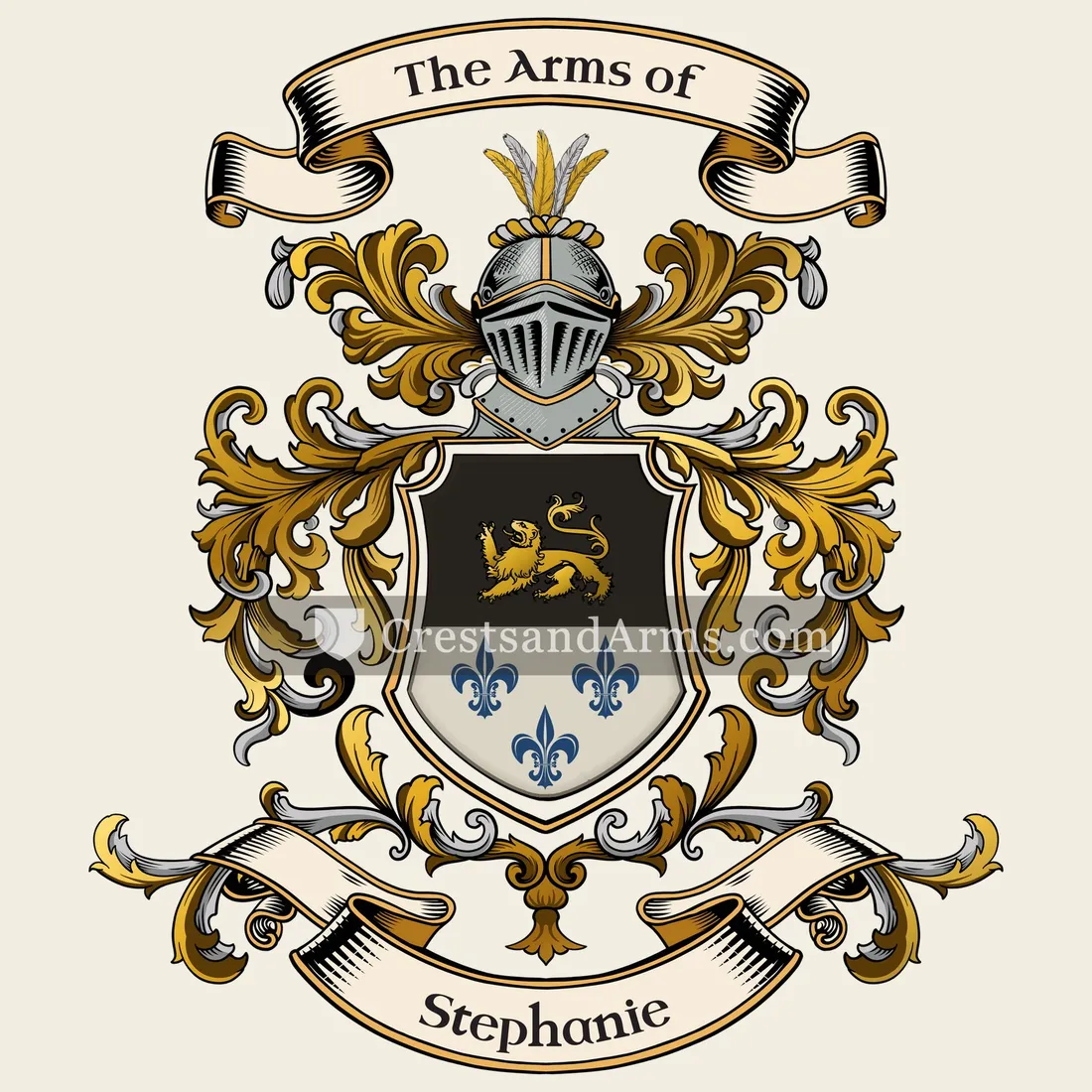
 lionCourage, strength and royalty
 fleur de lisPurity, light, and the sixth son
 lionCourage, strength and royalty
 fleur de lisPurity, light, and the sixth son


 towerGrandeur and solidity, and a stronghold defended
 treeLife, endurance and deep roots