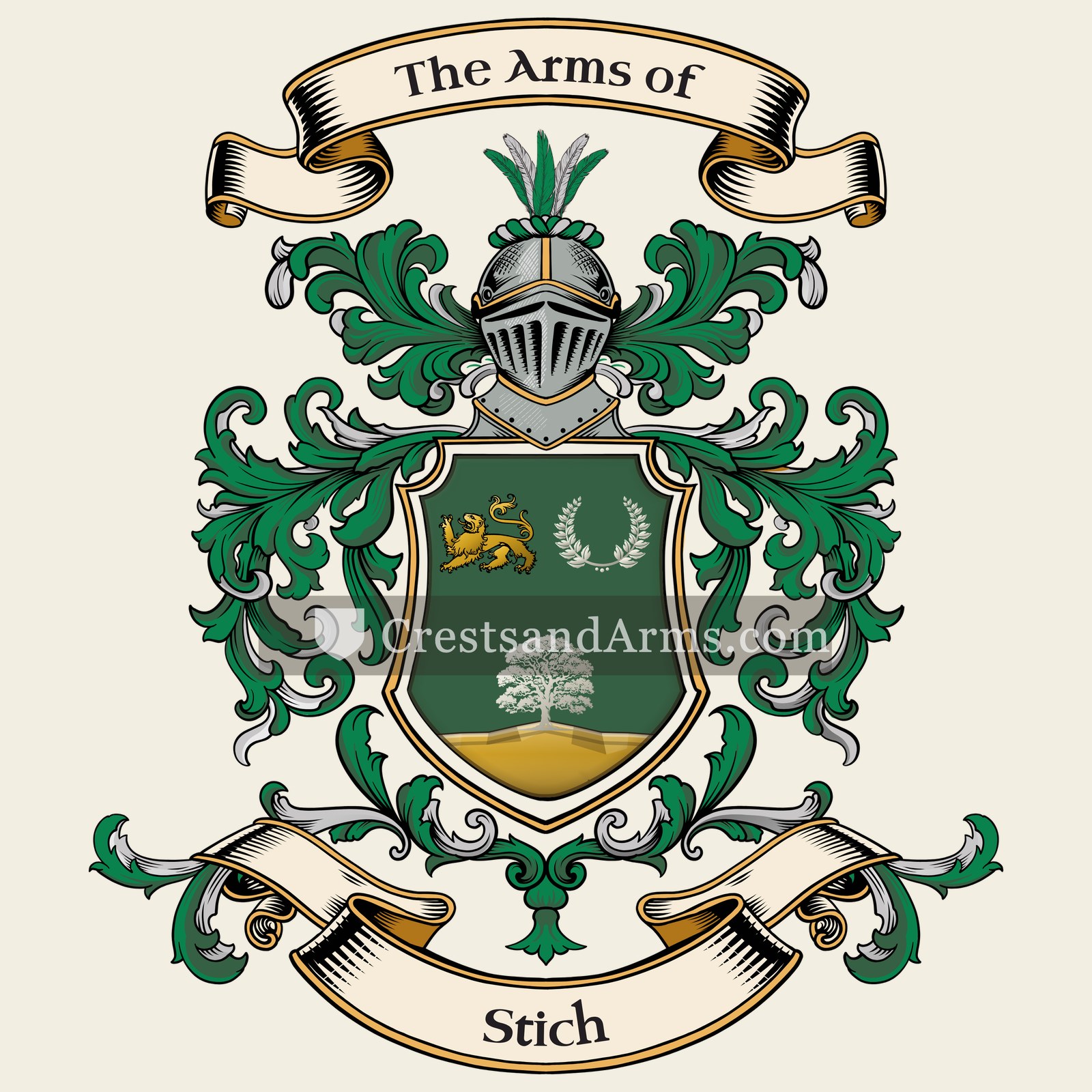
A record of documented arms, meaning and origin, researched for the Stich family of Finland.
Reg. 5874 · Finnish, T–V
Coat of Arms & Family Crest Details
Symbols on this shield
saltireResolution, and St Andrew's cross
mountThe ground held, and steadfastness upon it
lionCourage, strength and royalty
wreathHonour, and a victory crowned
treeLife, endurance and deep roots
Colours
Green (Vert)Means: Hope
Gold (Or)Means: Generosity
Historical info
Source
J. B. Rietstap, Armorial Général, Gouda: G. B. van Goor Zonen, 1884–87
Blazon (the actual original written record)
“Tiercé en pairle renversé: à dextre de sin. au lion d'or; à sen. de gu. à deux sabres d'arg., garnis d'or, passés en saut., entourés d'une couronne de laurier de sin.; en p. d'arg. à un arbre de sin., sur un tertre du même. C.: un lion iss. d'or, tenant de sa patte dextre un sabre d'arg., garni d'or, et de sa sen. un drapeau d'arg., flottant à dextre, ch. du chiffre G A (Gustave Adolphe) d'or, surm. d'une couronne royale du même.”
Finlandc. 1719
Digital archive packCoat of arms PNG, gold border print PDF, vector SVG and the certificate of authenticity. Sent to your email in minutes.
Map of Finland showing where the Stich arms are recorded
The Stich arms were recorded in Finland, c. 1719.
Arms such as these were typically recorded in Uusimaa.
Uusimaa was the Finnish coast facing Sweden, and the part of the country most closely tied to Stockholm. Its landowners and officers served the Swedish crown, and that service is what put their arms on record.
This is where the arms were entered in the register. Families often moved to other parts of the country, so the same name can turn up in more than one region.
The body that granted and recorded arms in Finland in this period.
How Arms Worked in Finland
Nobility in Finland held the exclusive right to register their coats of arms with the House of Nobility. These symbols were tied to the family name and were inherited by all members of the noble house. If a family branch moved or changed status, they kept their original design to maintain their identity within the official records.
Granting authority
The Finnish House of Nobility served as the official body that managed and protected all noble coats of arms.
How they got arms
Families received their arms through formal letters of nobility or by having their existing ancestral symbols confirmed by the House.
Where arms were recorded
All approved coats of arms were officially recorded in the Finnish House of Nobility Armorial starting in 1818.
The family's standing
Recorded among the armigerous families of Finland.
Origin & History of the Stich Family in Finland
The family name Stich has deep roots in the historical region of Uusimaa, where members of the family were documented as early as 1719. During this period, Uusimaa was part of the Swedish Realm, and the name likely emerged from the linguistic traditions of the era. In German and related Germanic languages, the word "stich" often refers to a prick, a stitch, or a specific point, which suggests that the name may have originally been a descriptive occupational surname for someone skilled in needlework or tailoring. As families moved across the Baltic Sea region for trade and military service, the name became established within the local parish records of southern Finland. These early ancestors were part of a society that relied heavily on church registers to track births, marriages, and deaths, which allowed the Stich family to maintain a consistent identity through generations of social and political change in the region.
Related Branches & Arms
Root word
Stichus
Latin term for a line of verse or a row.
This name
StichAn occupational name for a tailor or someone who works with stitches.
also spelled
Sticht
von Shtikht
Stich
Documented Sources
J. B. Rietstap, Armorial Général, Gouda: G. B. van Goor Zonen, 1884–87
National Archives of Finland (Kansallisarkisto), Church Records of the Evangelical Lutheran Church of Finland (Suomen evankelis-luterilaisen kirkon arkistot)
Pirinen, Kauko, Suomen kirkon historia 1, 1991
Vilkuna, Kustaa, Etunimet, 2007
Digital archive packCoat of arms PNG, gold border print PDF, vector SVG and the certificate of authenticity. Sent to your email in minutes.


 saltireResolution, and St Andrew's cross
 mountThe ground held, and steadfastness upon it
 lionCourage, strength and royalty
 wreathHonour, and a victory crowned
 treeLife, endurance and deep roots
 saltireResolution, and St Andrew's cross
 mountThe ground held, and steadfastness upon it
 lionCourage, strength and royalty
 wreathHonour, and a victory crowned
 treeLife, endurance and deep roots