A record of documented arms, meaning and origin, researched for the Stiggers family lines. Documented in 2 countries.
Reg. 4751 · German, T–V
Coat of Arms & Family Crest Details
Symbols on this shield
swordJustice, and military honour
harpWell-tuned governance and love of music
lionCourage, strength and royalty
Colours
Blue (Azure)Means: Loyalty and truth
Red (Gules)Means: Military strength
Silver (Argent)Means: Peace and sincerity
Gold (Or)Means: Generosity
Historical info
Source
J. B. Rietstap, Armorial Général, Gouda: G. B. van Goor Zonen, 1884–87
Blazon (the actual original written record)
“Coupé: au 1 parti: a. d'azur plein; b. de sa. au lion de St.-Marc d'or; au 2 de gu. à deux épées d'arg., garnies d'or, passées en saut., perçant une lyre d'or. Cq. cour. C.: trois pl. d'aut., une d'arg. entre deux d'azur. L. d'arg. et d'azur.”
WurttembergWurttemberg, c. 1874
Digital archive packCoat of arms PNG, gold border print PDF, vector SVG and the certificate of authenticity. Sent to your email in minutes.
Map of Germany showing where the Stiggers arms are recorded
The Stiggers arms were recorded in Wurttemberg, c. 1874.
Wurttemberg was southern German country of small estates and well-off market towns. Both landowners and leading townsmen kept arms there, so the region carries far more names than its size suggests.
This is where the arms were entered in the register. Families often moved to other parts of the country, so the same name can turn up in more than one region.
The body that granted and recorded arms in Germany in this period.
Wilhelm I
Sovereign of the period
Wilhelm I
1861–1888
Reigning in Germany when the Stiggers arms are first recorded.
How Arms Worked in Germany
Prussian heraldry was strictly tied to social rank and noble status rather than being a free choice for every citizen. These symbols were treated as permanent family property that moved through the generations to all legitimate heirs. If a family branch wanted to change their design to stand out, they had to apply for official permission to alter their specific version of the shield.
Granting authority
The Prussian Heroldsamt acted as the central state office that managed and strictly controlled all noble titles and coats of arms.
How they got arms
Families usually obtained their arms through formal royal grants or by proving their long-standing noble status to the state authorities.
Where arms were recorded
All official coats of arms were kept in the rolls of the Prussian Heroldsamt, which functioned from 1706 until 1918.
The family's standing
Recorded among the armigerous families of Wurttemberg.
Origin & History of the Stiggers Family in Germany
The family name Stiggers originates from the southwestern region of Germany known as Württemberg. Historical records confirm that members of the family were established in this area by 1874. The name itself is likely rooted in the German language, potentially deriving from occupational or descriptive terms common to the Swabian dialect spoken in that region. During the nineteenth century, Württemberg was a kingdom undergoing significant social and economic shifts, including the rise of industrialization and increased migration. Families like the Stiggers were part of this evolving landscape, living in a region defined by its dense forests, rolling hills, and strong traditions of craftsmanship. By the late 1800s, the family was well-integrated into the local community, participating in the daily life and agricultural or trade-based economy that characterized the villages of the German southwest.
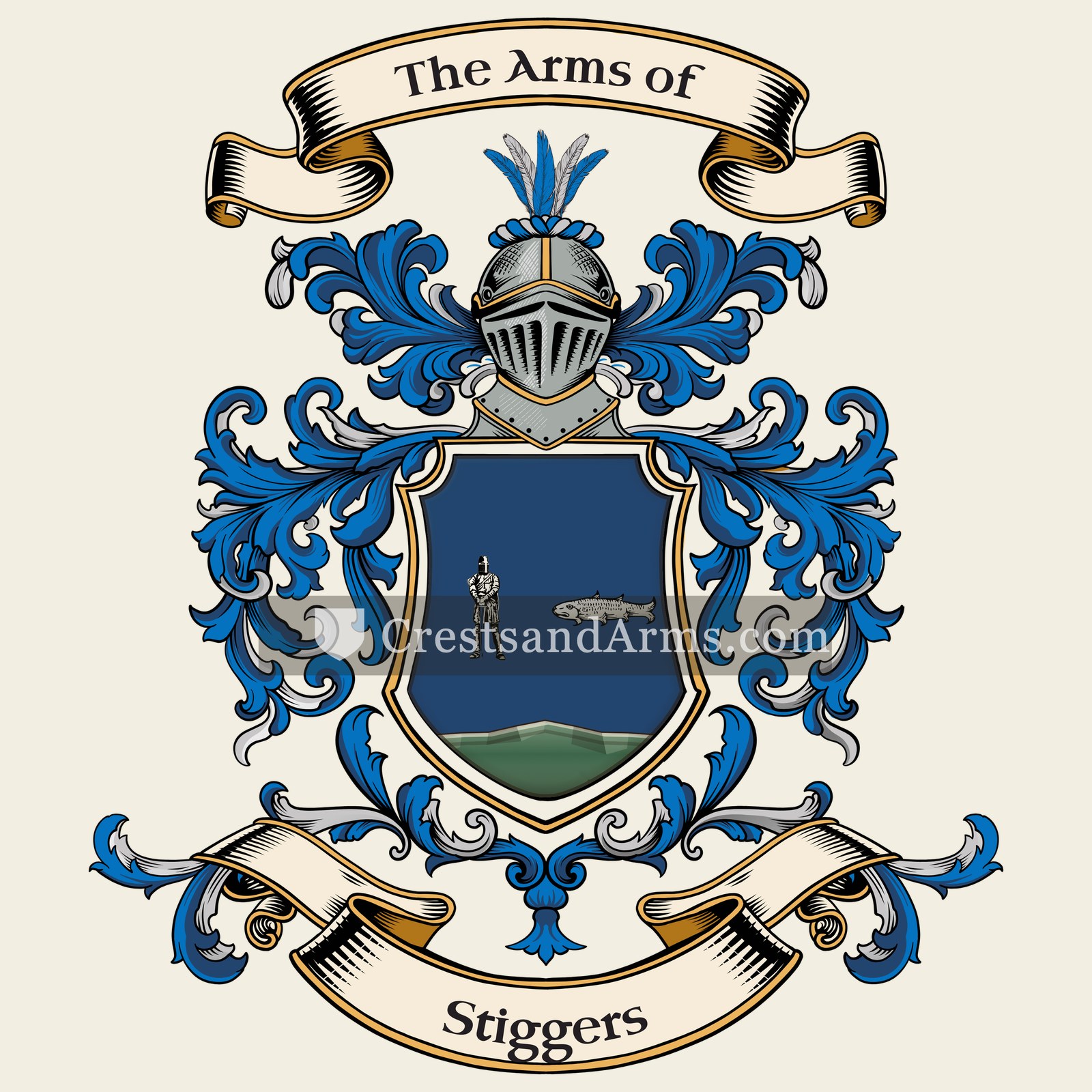
Coat of Arms & Family Crest Details
Symbols on this shield
mountThe ground held, and steadfastness upon it
knightChivalry and service in arms
fishA true and generous mind, and Christian faith
Colours
Blue (Azure)Means: Loyalty and truth
Green (Vert)Means: Hope
Silver (Argent)Means: Peace and sincerity
Historical info
Source
J. B. Rietstap, Armorial Général, Gouda: G. B. van Goor Zonen, 1884–87
Blazon (the actual original written record)
“D'azur à un homme d'armes, arm. d'arg., coiffé d'un morion du même, posé sur un tertre de sin., tenant de sa main dextre un trèfle du même et de sa sen. une pique au nat. C.: l'homme d'armes, iss. L. d'arg. et d'azur.”
SwitzerlandBâle, c. 1745
Digital archive packCoat of arms PNG, gold border print PDF, vector SVG and the certificate of authenticity. Sent to your email in minutes.
Map of Switzerland showing where the Stiggers arms are recorded
The Stiggers arms were recorded in Bâle, c. 1745.
This is where the arms were entered in the register. Families often moved to other parts of the country, so the same name can turn up in more than one region.
The body that granted and recorded arms in Switzerland in this period.
How Arms Worked in Switzerland
In Switzerland, coats of arms were not restricted to the nobility and were often adopted by common citizens and families. These symbols were passed down through generations to show family identity. When branches of a family grew, they often changed small details of the design to distinguish their own line from the original group.
Granting authority
Cantonal and civic authorities managed the use of coats of arms within their specific regions and local jurisdictions.
How they got arms
Families typically assumed their own coats of arms based on local custom rather than receiving them from a central monarch.
Where arms were recorded
Arms were recorded in various cantonal and civic registers starting from the fourteenth century throughout the Swiss region.
The family's standing
Recorded among the armigerous families of Switzerland.
Origin & History of the Stiggers Family in Switzerland
The family name Stiggers has deep roots in the Swiss city of Bâle, where records confirm their presence as early as 1745. During this period, Bâle was a thriving center of trade and craftsmanship, and the Stiggers family likely integrated into the urban fabric as skilled workers or merchants. The name itself is thought to be linked to the German word "Steiger," which historically referred to a person who worked in mining or acted as a foreman. In the context of 18th-century Switzerland, this suggests that the family may have originally descended from individuals involved in the extraction of minerals or the management of labor in the mountainous regions surrounding the city. As they settled in Bâle, the family became part of a society defined by strict guild regulations and a strong emphasis on civic duty. Their presence in official municipal documents from the mid-1700s indicates that they were recognized citizens who participated in the social and economic life of the region during a time of significant transition in European history.
Related Branches & Arms
Root word
Stieg
A narrow path, mountain trail, or steep ascent.
This name
StiggersAn occupational or locational surname for someone who lived near or maintained a steep path.
also spelled
Steigger
Steigher
Steigeren
Styger
Documented Sources
J. B. Rietstap, Armorial Général, Gouda: G. B. van Goor Zonen, 1884–87
Statistisches Landesamt Baden-Württemberg, Württembergisches Jahrbuch für Statistik und Landeskunde, 1874
Königlich Statistisch-Topographisches Bureau, Beschreibung des Oberamts, 1870–1890
Landesarchiv Baden-Württemberg, Bestand E 151: Zivilstandsregister, 1874
Digital archive packCoat of arms PNG, gold border print PDF, vector SVG and the certificate of authenticity. Sent to your email in minutes.


 swordJustice, and military honour
 harpWell-tuned governance and love of music
 lionCourage, strength and royalty
 swordJustice, and military honour
 harpWell-tuned governance and love of music
 lionCourage, strength and royalty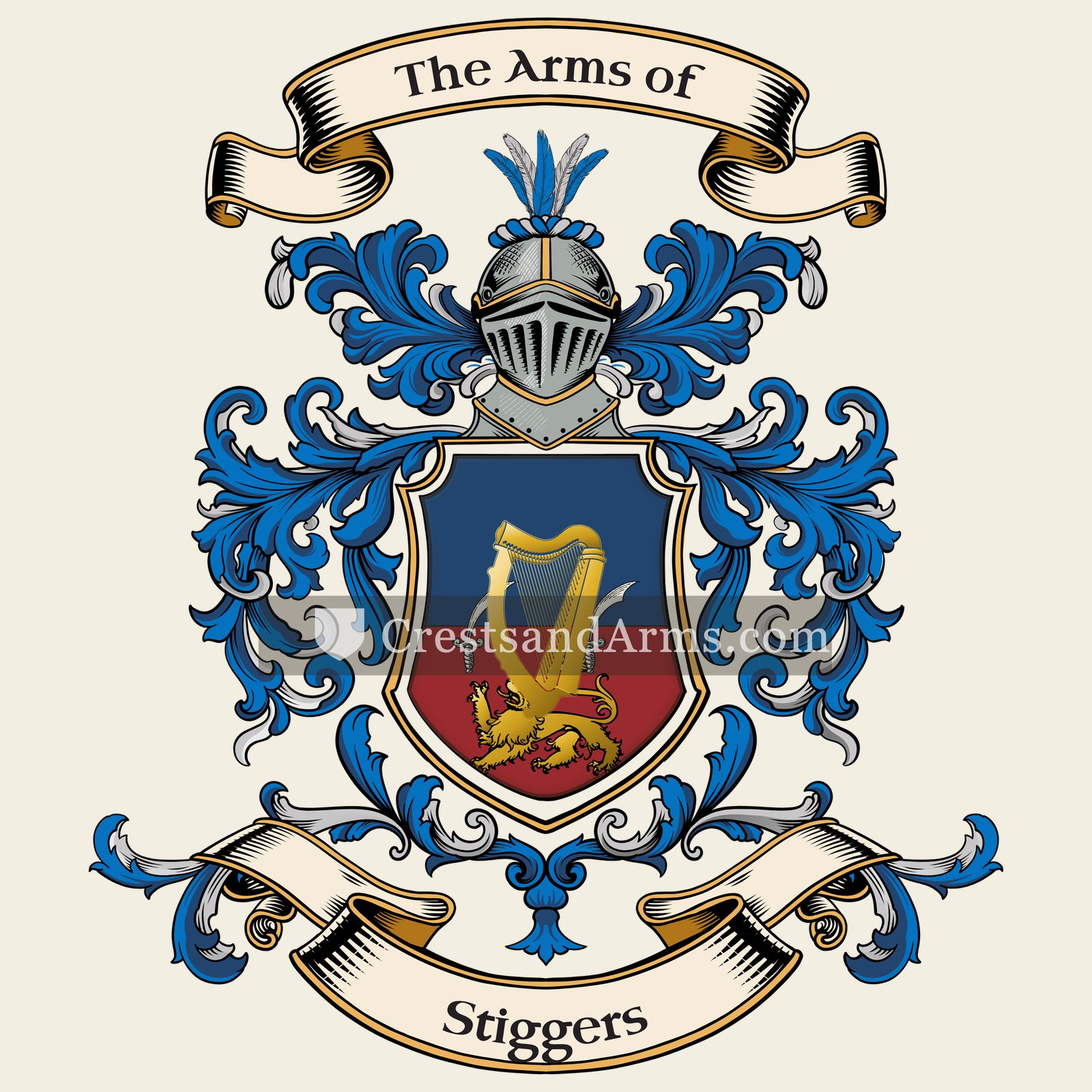


 mountThe ground held, and steadfastness upon it
 knightChivalry and service in arms
 fishA true and generous mind, and Christian faith