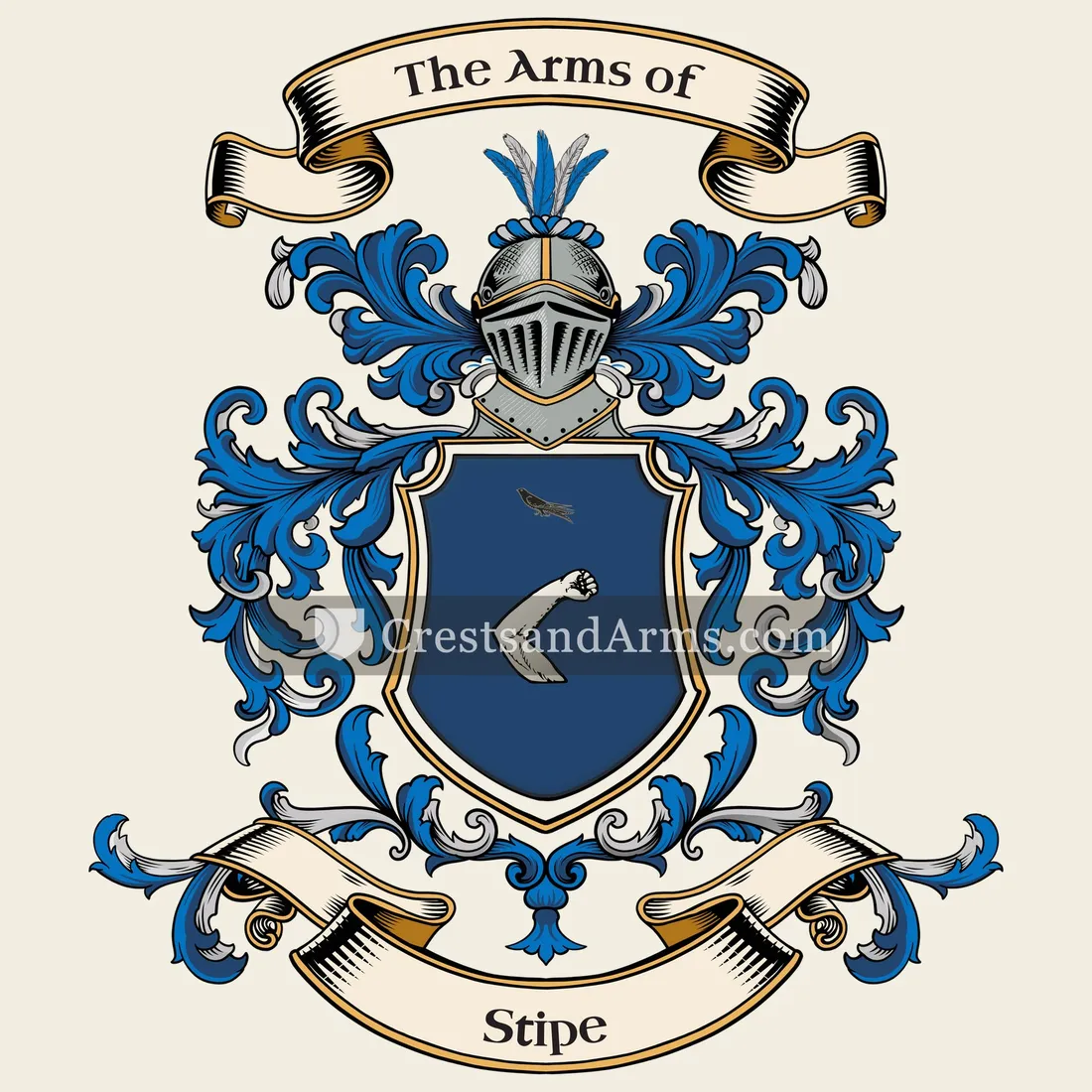
A record of documented arms, meaning and origin, researched for the Stipe family of France.
Reg. 8953 · French, T–V
Meaning of the Stipe family crest colors & symbols
Symbols on this shield
armA person of action, industrious and laborious
martletA younger son, who must win his own land
Colours
Blue (Azure)Means: Loyalty and truth
Black (Sable)Means: Constancy
Historical info
Source
J. B. Rietstap, Armorial Général, Gouda: G. B. van Goor Zonen, 1884–87
Blazon (the actual original written record)
“D'azur à un senestrochère de carn., paré d'arg., mouv. du flanc, tenant deux clés d'arg., passées en saut.; et une merlette de sa., soutenue du panneton dextre.”
DauphineDauphine, c. 1663
Digital archive packCoat of arms PNG, gold border print PDF, vector SVG and the certificate of authenticity. Sent to your email in minutes.
Map of France showing where the Stipe arms are recorded
The Stipe arms were recorded in Dauphine, c. 1663.
Dauphine lay in the mountains of south-eastern France, a country of small estates and scattered valleys. Its gentry were many and mostly modest, and even a small landholding was enough to justify arms.
This is where the arms were entered in the register. Families often moved to other parts of the country, so the same name can turn up in more than one region.
The body that granted and recorded arms in France in this period.
Louis XIV of France
Sovereign of the period
Louis XIV of France
1643–1715
Reigning in France when the Stipe arms are first recorded.
How Arms Worked in France
In France, a coat of arms was a mark of honor that passed down through the male line to all legitimate descendants. Families often used the same shield without changes to show their shared heritage. If a branch wanted to stand out, they could add a small mark to their shield to show their specific place in the family tree.
Granting authority
The Juge d'armes de France acted as the official authority that regulated and verified coats of arms across the country.
How they got arms
Families typically inherited their arms from ancestors, though they could also receive them through royal grants or by proving their noble status.
Where arms were recorded
Coats of arms were officially recorded in the Armorial Général de France, which began its main collection in the year 1696.
The family's standing
Recorded among the armigerous families of Dauphine.
Origin & History of the Stipe Family in France
The family name Stipe has deep roots in the historical region of Dauphiné, France, where records confirm the presence of family members as early as 1663. During the seventeenth century, this mountainous area was a crossroads for trade and migration between the Alps and the Rhône Valley. Families living in Dauphiné at this time often held roles in local agriculture or regional administration, as the rugged landscape required strong community ties to manage the land. The name likely evolved from regional dialects common to the southeastern part of France, reflecting the linguistic shifts that occurred as local populations moved through the alpine passes. By establishing themselves in this specific province, the early Stipe family became part of a long tradition of mountain dwellers who helped shape the social and economic character of the region before later generations began to spread further across Europe and beyond.
Stipe Meaning & Related Branches
Root word
Stephanus
Derived from the Greek word for a crown or garland.
This name
StipeA French variant of Stephen, signifying one who is crowned or victorious.
also spelled
Saint-Pee
St.-Pee
San-Peo
Saint Pe
Saint-Pe
Documented Sources
J. B. Rietstap, Armorial Général, Gouda: G. B. van Goor Zonen, 1884–87
Archives départementales de l'Isère, Registres paroissiaux et d'état civil de la commune de Dauphiné, 1663
Bouchard, Gérard, Quelques arpents d'Amérique: Population et économie du peuplement français, 1996
Chorier, Nicolas, Histoire générale de Dauphiné, 1661
Digital archive packCoat of arms PNG, gold border print PDF, vector SVG and the certificate of authenticity. Sent to your email in minutes.


 armA person of action, industrious and laborious
 martletA younger son, who must win his own land
 armA person of action, industrious and laborious
 martletA younger son, who must win his own land