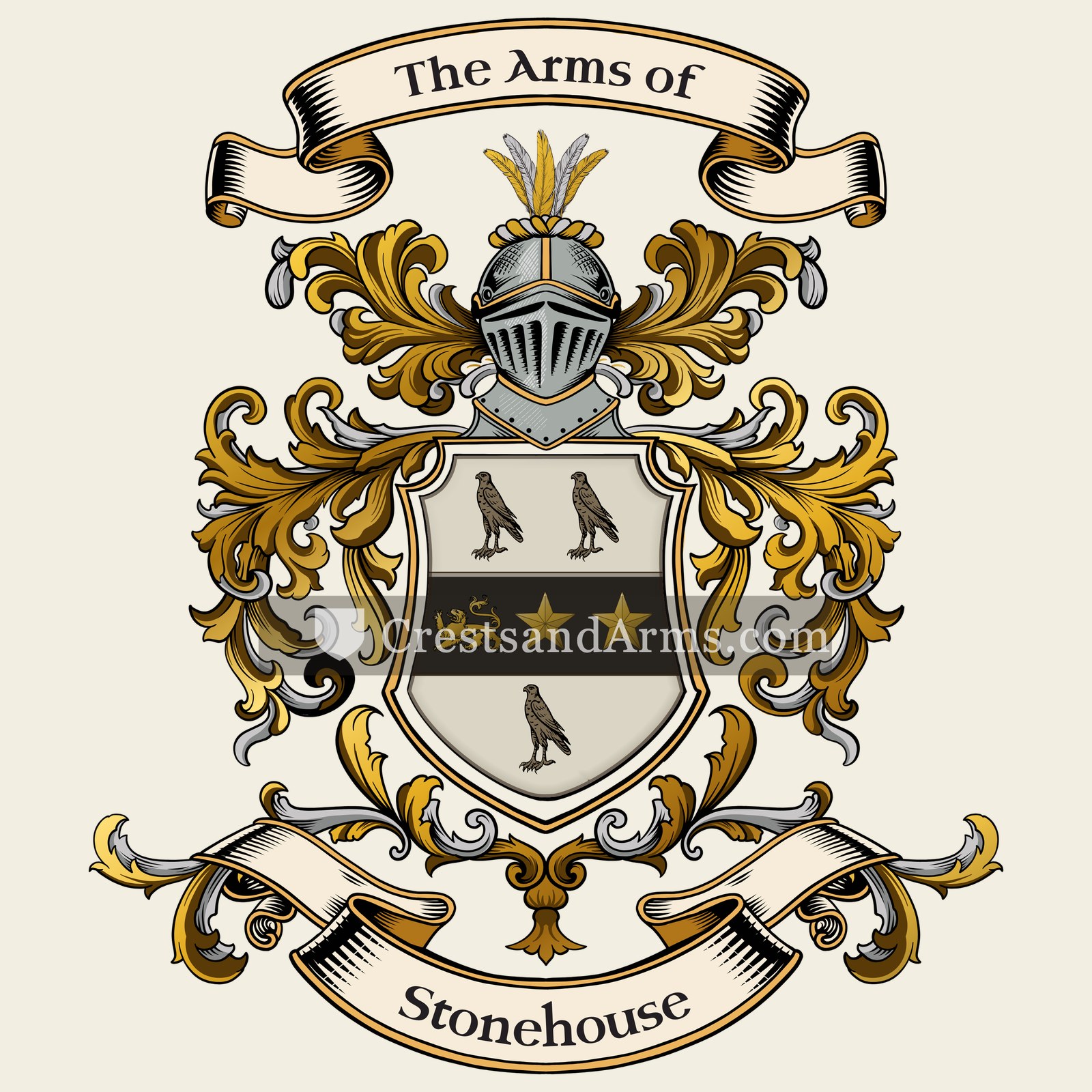
A record of documented arms, meaning and origin, researched for the Stonehouse family of Britain.
Reg. 1773 · Britain, T–V
Coat of Arms & Family Crest Details
Symbols on this shield
fessThe military belt, and readiness to serve
lionCourage, strength and royalty
mulletThe third son, and a divine quality from above
falconOne eager and quick in pursuit
Colours
Silver (Argent)Means: Peace and sincerity
Black (Sable)Means: Constancy
Gold (Or)Means: Generosity
Historical info
Source
J. B. Rietstap, Armorial Général, Gouda: G. B. van Goor Zonen, 1884–87
Blazon (the actual original written record)
“D'arg. à la fasce de sa., ch. d'une tête de léopard d'or, entre deux étoiles (5) du même; ladite fasce acc. de trois autours ess. au nat. C.: une tête de dogue d'arg., coll. de sa., enchaînée d'arg., tenant entre ses dents une colombe volante du même. D.: SUBLIMIORA PETAMUS.”
EssexEssex, c. 1641
Digital archive packCoat of arms PNG, gold border print PDF, vector SVG and the certificate of authenticity. Sent to your email in minutes.
Map of Britain showing where the Stonehouse arms are recorded
The Stonehouse arms were recorded in Essex, c. 1641.
Essex lay close enough to London for City money to buy land there. Merchants who prospered moved out to estates within a day's ride, and a new landowner almost always wanted arms to go with the ground.
This is where the arms were entered in the register. Families often moved to other parts of the country, so the same name can turn up in more than one region.
The body that granted and recorded arms in Britain in this period.
Charles I of England
Sovereign of the period
Charles I of England
1625–1649
Reigning in Britain when the Stonehouse arms are first recorded.
How Arms Worked in Britain
English heraldry allowed arms to be shared by all legitimate descendants of the original owner. These symbols were treated as personal property that moved through the generations to all children. While the eldest son kept the original design, other family members could use the same shield without needing to change it or register their own unique versions.
Granting authority
The College of Arms in London has regulated the use of coats of arms throughout England and Wales since 1484.
How they got arms
Families typically obtained their coats of arms through a formal grant from the Crown or by proving their ancient right to them.
Where arms were recorded
All official coats of arms are recorded in the registers kept at the College of Arms, which date back to the fifteenth century.
The family's standing
Recorded among the armigerous families of Essex.
Origin & History of the Stonehouse Family in Britain
The surname Stonehouse is a locative name, meaning it was originally adopted by families who lived near or within a prominent stone dwelling. During the medieval period, when most commoners lived in timber or mud structures, a house built of stone was a rare and notable landmark that served as a clear identifier for those residing nearby. By 1641, records confirm that members of the Stonehouse family were well-established in the county of Essex. At this time, England was on the brink of significant political upheaval, and families in Essex were often involved in the local agricultural and trade networks that defined the region. These early ancestors likely lived as farmers or skilled tradespeople, contributing to the local economy while maintaining the identity associated with their ancestral home. Over generations, the name transitioned from a simple description of a place into a permanent family legacy that tracked the movement and growth of the family across the English countryside.
Related Branches & Arms
Root word
Stan and Hus
Old English for stone and house or dwelling.
This name
StonehouseA locational surname referring to someone who lived in a house built of stone.
also spelled
Stonehouse
Documented Sources
J. B. Rietstap, Armorial Général, Gouda: G. B. van Goor Zonen, 1884–87
Reaney, P.H., A Dictionary of British Surnames, 1958
Essex Record Office, Quarter Sessions Rolls, 1641
Lower, Mark Antony, Patronymica Britannica: A Dictionary of the Family Names of the United Kingdom, 1860
Digital archive packCoat of arms PNG, gold border print PDF, vector SVG and the certificate of authenticity. Sent to your email in minutes.


 fessThe military belt, and readiness to serve
 lionCourage, strength and royalty
 mulletThe third son, and a divine quality from above
 falconOne eager and quick in pursuit
 fessThe military belt, and readiness to serve
 lionCourage, strength and royalty
 mulletThe third son, and a divine quality from above
 falconOne eager and quick in pursuit