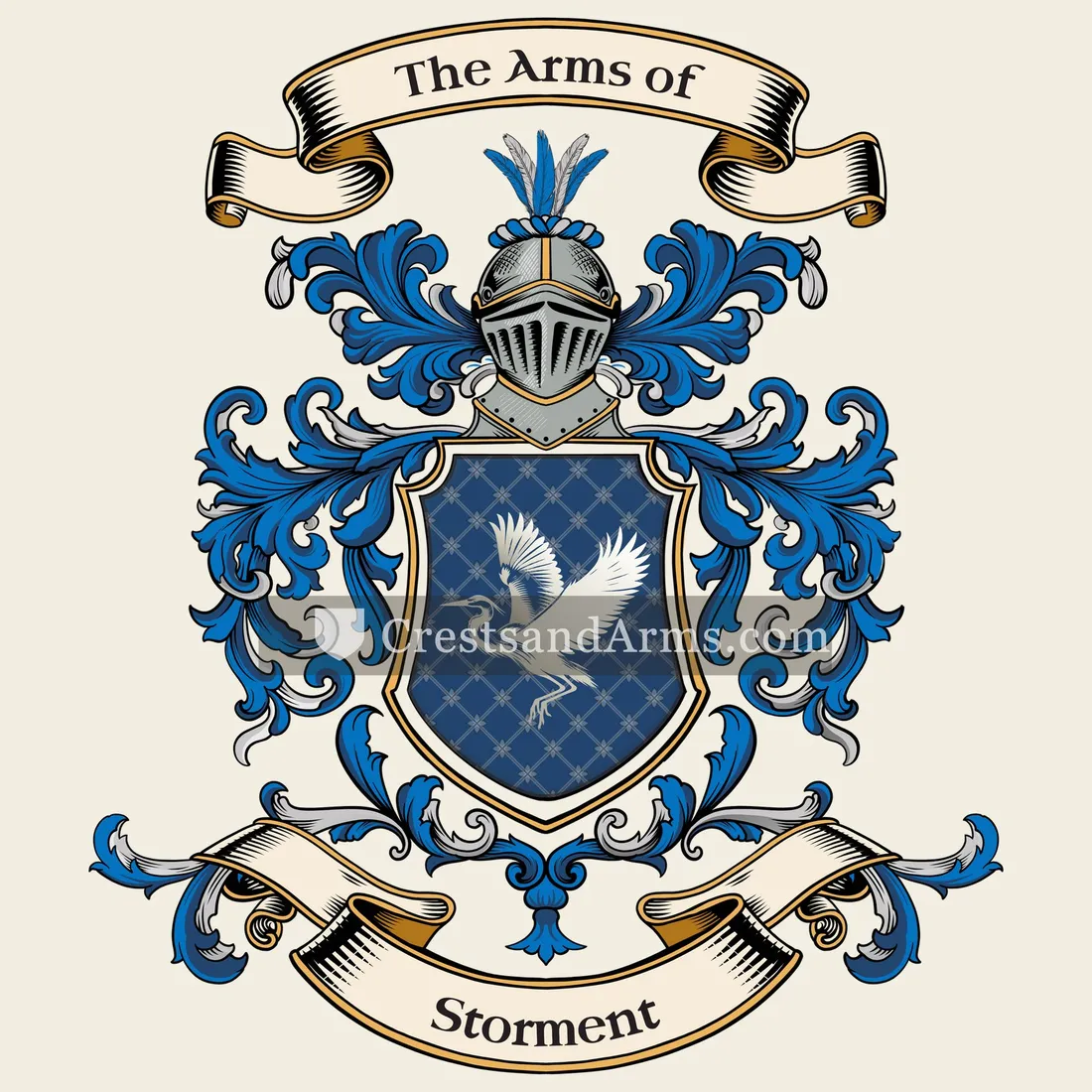
A record of documented arms, meaning and origin, researched for the Storment family of Germany.
Reg. 1956 · German, T–V
Meaning of the Storment family crest colors & symbols
Symbols on this shield
heronPatience and quiet watchfulness
Colours
Blue (Azure)Means: Loyalty and truth
Silver (Argent)Means: Peace and sincerity
Historical info
Source
J. B. Rietstap, Armorial Général, Gouda: G. B. van Goor Zonen, 1884–87
Blazon (the actual original written record)
“D'azur à une cigogne d'arg., bq. et m. de gu., tenant en son bec une anguille de sa. Cq. cour. C.: un vol, coupé alt. d'azur et d'arg. L. d'arg. et d'azur.”
GermanyHan, c. 1745
Digital archive packCoat of arms PNG, gold border print PDF, vector SVG and the certificate of authenticity. Sent to your email in minutes.
Map of Germany showing where the Storment arms are recorded
The Storment arms were recorded in Han, c. 1745.
This is where the arms were entered in the register. Families often moved to other parts of the country, so the same name can turn up in more than one region.
The body that granted and recorded arms in Germany in this period.
Charles VII, Holy Roman Emperor
Sovereign of the period
Charles VII, Holy Roman Emperor
1742–1745
Reigning in Germany when the Storment arms are first recorded.
How Arms Worked in Germany
In the Holy Roman Empire, coats of arms were often granted to individuals by the Emperor or his representatives. These arms were then passed down through the generations to all legitimate descendants of the original holder. Younger branches of a family usually kept the same shield design without needing to change it, as the arms belonged to the entire lineage.
Granting authority
The Holy Roman Emperor held the sole power to grant new coats of arms throughout his vast imperial territories.
How they got arms
Families typically obtained their coats of arms through a formal imperial grant or by proving their noble status to the authorities.
Where arms were recorded
These grants were officially recorded in the Imperial Chancery registers, which began keeping formal records of such honors during the Middle Ages.
The family's standing
Recorded among the armigerous families of Germany.
Origin & History of the Storment Family in Germany
The family name Storment is rooted in the history of the German-speaking regions of Europe, specifically within the area of Han. Historical records confirm that members of the family were established in this region by 1745. During this period, families in the German states often lived in tight-knit agricultural communities where names were tied to specific geographic locations or local occupations. As the family moved and expanded, the spelling of the name likely shifted to reflect the phonetic habits of new regions and the transition from German to English records. By the mid-18th century, the Storment family was part of the broader migration patterns that saw many people move from the Rhineland toward the American colonies in search of land and religious freedom. This journey required significant resilience, as these early ancestors had to navigate complex travel routes and adapt to entirely new social structures upon their arrival.
Storment Meaning & Related Branches
Root word
Sturm
A German noun referring to a storm or violent disturbance.
This name
StormentAn occupational or descriptive name for a person with a tempestuous or forceful personality.
also spelled
Storen
Documented Sources
J. B. Rietstap, Armorial Général, Gouda: G. B. van Goor Zonen, 1884–87
Faust, Albert Bernhardt. The German Element in the United States. 1909
Strassburger, Ralph Beaver. Pennsylvania German Pioneers: A Publication of the Original Lists of Arrivals in the Port of Philadelphia from 1727 to 1808. 1934
Pennsylvania State Archives. Records of the Provincial Council, 1682–1776
Digital archive packCoat of arms PNG, gold border print PDF, vector SVG and the certificate of authenticity. Sent to your email in minutes.


 heronPatience and quiet watchfulness
 heronPatience and quiet watchfulness