Map of Italy showing where the Strada arms are recorded
The Strada arms were recorded in Milan, c. 1775.
This is where the arms were entered in the register. Families often moved to other parts of the country, so the same name can turn up in more than one region.
The body that granted and recorded arms in Italy in this period.
Alvise Giovanni Mocenigo
Sovereign of the period
Alvise Giovanni Mocenigo
1763–1778
Reigning in Italy when the Strada arms are first recorded.
How Arms Worked in Italy
In the Italian states, coats of arms were often used by noble families to show their status and history. These symbols were passed down through the generations to all legitimate male descendants. Younger branches of a family usually kept the original design but sometimes added small changes to distinguish their specific line from the main branch.
Granting authority
Various local rulers and city governments controlled the use of coats of arms across the different Italian states.
How they got arms
Families often assumed their own arms or received them as official grants from local lords, popes, or city councils.
Where arms were recorded
Arms were recorded in local city archives or private family books rather than in one single national register.
The family's standing
Recorded among the armigerous families of Italy.
Origin & History of the Strada Family in Italy
The family name Strada is deeply rooted in the Italian language, as the word itself translates to road or street. Historically, this surname was often given to families who lived near a major thoroughfare or those who worked in the construction and maintenance of the vital trade routes that connected Italian city-states. By the time the family was firmly established in Milan in 1775, they were part of a society that placed great importance on urban development and commerce. During this period, Milan served as a bustling center of trade and culture under the influence of the Habsburg monarchy. Families with this name were likely integrated into the professional or merchant classes that kept the city moving. Because the name is tied to the physical landscape of Italy, it reflects a long history of people who were essential to the movement of goods and travelers across the region.
Coat of Arms & Family Crest Details
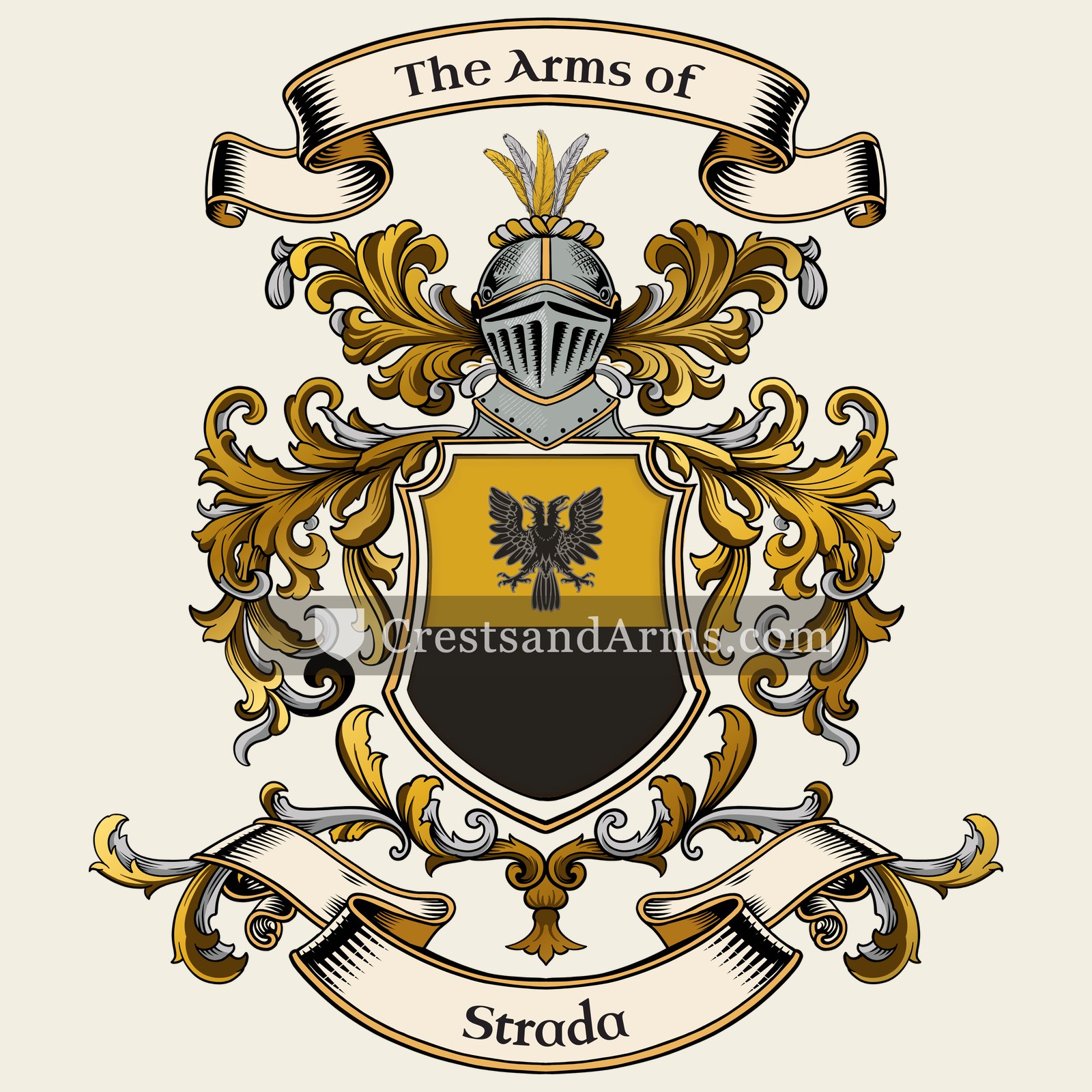
Symbols on this shield
bendDefence, and the scarf of a commander
fessThe military belt, and readiness to serve
eagleNobility, strength and a keen mind
Colours
Gold (Or)Means: Generosity
Black (Sable)Means: Constancy
Historical info
Source
J. B. Rietstap, Armorial Général, Gouda: G. B. van Goor Zonen, 1884–87
Blazon (the actual original written record)
“Coupé: au 1 d'or à l'aigle ép. de sa., cour. d'or; au 2 parti: a. tiercé en fasce de sa., d'arg. et de gu.; b. bandé de gu. et de sa. Deux cq. cour. C.: 1° une aigle cont. de sa., cour. d'or; 2° un vol à l'antique de sa., ch. d'une fasce d'arg. L. d'or, de gu. et de sa.”
AuvergneAuvergne, c. 1772
Digital archive packCoat of arms PNG, gold border print PDF, vector SVG and the certificate of authenticity. Sent to your email in minutes.
Map of Austria showing where the Strada arms are recorded
The Strada arms were recorded in Auvergne, c. 1772.
Auvergne was mountain country in the middle of France, poor in money but thick with old families. Estates were small and held for a very long time, and long tenure counted for more than wealth when it came to arms.
This is where the arms were entered in the register. Families often moved to other parts of the country, so the same name can turn up in more than one region.
Region
Auvergne
First recorded
1772
Granting Authority for the Strada Arms
Imperial and Royal chancery
Sodacan · CC BY-SA 3.0
The body that granted and recorded arms in Austria in this period.
Joseph II, Holy Roman Emperor
Sovereign of the period
Joseph II, Holy Roman Emperor
1765–1790
Reigning in Italy when the Strada arms are first recorded.
How Arms Worked in Austria
Austrian coats of arms were often linked directly to noble titles granted by the Emperor. These symbols belonged to the entire family line rather than just one individual. When a family grew, new branches kept the original design without needing to change it. This system allowed all members of a noble house to share the same identity across many generations.
Granting authority
The Imperial and Royal chancery managed all heraldic matters and controlled the official granting of arms throughout the Austrian lands.
How they got arms
Families typically received their arms through a formal imperial decree that often accompanied the elevation of a person to noble status.
Where arms were recorded
Official records of these grants were kept in the Imperial Register of Nobility which began its formal documentation process in 1453.
The family's standing
Recorded among the armigerous families of Auvergne.
Origin & History of the Strada Family in Austria
The history of the Strada family name in Austria is deeply connected to the movement of people across the European continent during the eighteenth century. While the family established a documented presence in the Auvergne region of France by 1772, the name itself carries roots that trace back to the Latin word for road or path. In the context of the Austrian Empire, families with this name were often associated with the vital trade routes and mountain passes that linked the diverse territories of Central Europe. As the family moved eastward, they likely integrated into the local administrative and merchant classes who managed the flow of goods and information between the Italian states and the Austrian heartland. This migration pattern reflects a broader trend of families seeking new opportunities in the bustling urban centers of the Habsburg lands, where their surname served as a testament to their history as travelers and connectors of distant regions.
Related Branches & Arms
Root word
strata
Latin term referring to paved roads or layers of stone.
This name
StradaOccupational name for someone who lived near or worked on a paved road.
also spelled
Stradda
Stradah
Stradas
Documented Sources
J. B. Rietstap, Armorial Général, Gouda: G. B. van Goor Zonen, 1884–87
De Felice, Emidio. Dizionario dei cognomi italiani. 1978
State Archives of Milan (Archivio di Stato di Milano), Anagrafe Civica
Digital archive packCoat of arms PNG, gold border print PDF, vector SVG and the certificate of authenticity. Sent to your email in minutes.


 fessThe military belt, and readiness to serve
 paleMilitary strength, and a fortified defence
 chiefAuthority, wisdom and dominion
 eagleNobility, strength and a keen mind
 fessThe military belt, and readiness to serve
 paleMilitary strength, and a fortified defence
 chiefAuthority, wisdom and dominion
 eagleNobility, strength and a keen mind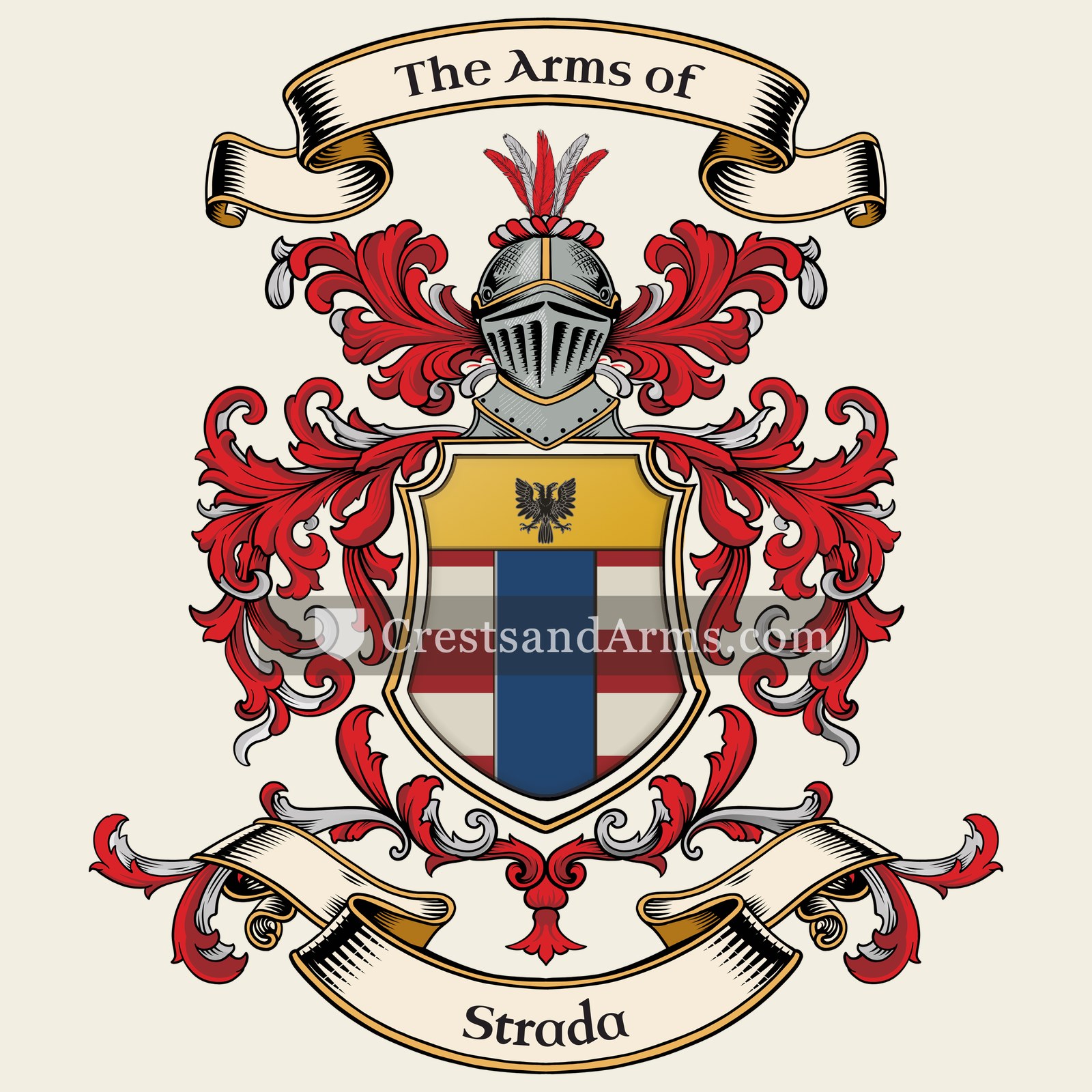


 bendDefence, and the scarf of a commander