Map of Scotland showing where the Strang arms are recorded
The Strang arms were recorded in Fife, c. 1748.
Fife was farming country between two firths, with royal palaces and old burghs along its coast. Its landed families were numerous and close to the court, and closeness to the court brought arms.
This is where the arms were entered in the register. Families often moved to other parts of the country, so the same name can turn up in more than one region.
The body that granted and recorded arms in Scotland in this period.
George II of Great Britain
Sovereign of the period
George II of Great Britain
1727–1760
Reigning in Scotland when the Strang arms are first recorded.
How Arms Worked in Scotland
Scottish heraldry is unique because it treats a coat of arms as a piece of personal property protected by law. Only one person can own a specific design at any given time. When a family grows, the head keeps the original shield while other relatives must apply for their own distinct version with slight changes to prove their specific identity.
Granting authority
The Court of the Lord Lyon acts as the official body that regulates and controls all heraldic matters throughout Scotland.
How they got arms
Individuals obtain a legal right to their arms through a formal petition process that confirms their identity and family connection.
Where arms were recorded
All valid coats of arms are officially entered into the Public Register of All Arms and Bearings starting from 1672.
The family's standing
Recorded among the armigerous families of Fife.
Origin & History of the Strang Family in Scotland
The family name Strang has deep roots in the Scottish Lowlands, particularly within the coastal region of Fife. Historical records confirm that members of the Strang family were well-established in this area by the middle of the eighteenth century. The name itself is thought to be a descriptive surname, likely derived from the Middle English word "strang," which meant strong or physically powerful. In the social structure of early modern Scotland, such names often originated as nicknames for individuals known for their vigor or resilience. By 1748, the family was integrated into the local community, participating in the agricultural and civic life that defined the Fife landscape during that era. These early ancestors lived through a time of significant transition in Scotland, as the nation moved toward the industrial age while maintaining its traditional rural customs.
Coat of Arms & Family Crest Details
Symbols on this shield
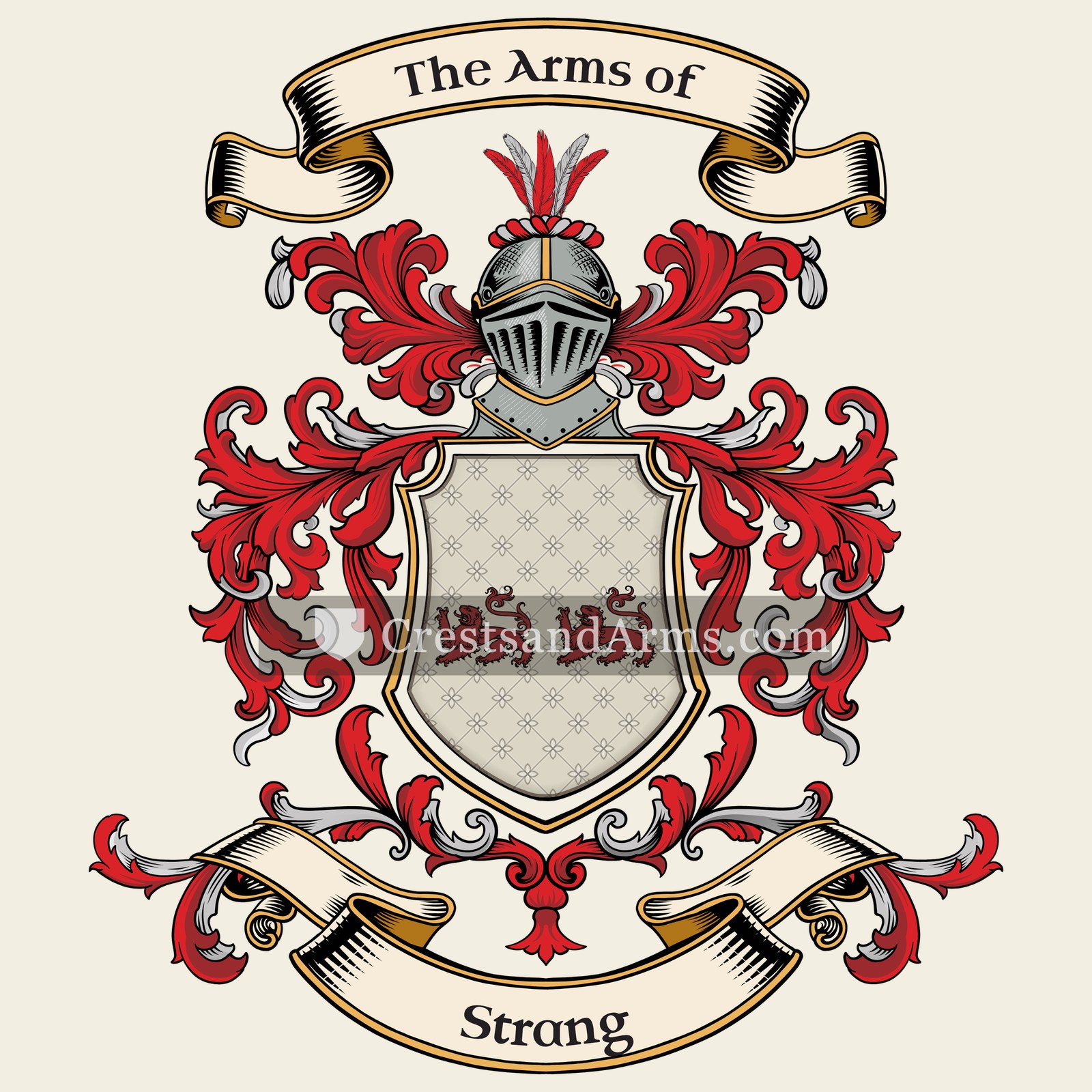
lionCourage, strength and royalty
Colours
Silver (Argent)Means: Peace and sincerity
Red (Gules)Means: Military strength
Historical info
Source
Sir Bernard Burke, The General Armory of England, Scotland, Ireland and Wales, London: Harrison & Sons, 1884
Blazon (the actual original written record)
“Ar. two lions pass. gu”
Englandc. 1620
Digital archive packCoat of arms PNG, gold border print PDF, vector SVG and the certificate of authenticity. Sent to your email in minutes.
Map of England showing where the Strang arms are recorded
The Strang arms were recorded in England, c. 1620.
Arms such as these were typically recorded in York.
Yorkshire is the largest of the English counties, and it held more gentry families than any other. Land there was split among a great many households rather than a few, so a great many of them carried arms.
This is where the arms were entered in the register. Families often moved to other parts of the country, so the same name can turn up in more than one region.
The body that granted and recorded arms in England in this period.
James VI and I
Sovereign of the period
James VI and I
1603–1625
Reigning in Scotland when the Strang arms are first recorded.
How Arms Worked in England
English heraldry allowed arms to be shared by all legitimate descendants of the original owner. These symbols were treated as personal property that moved through the generations to all children. While the eldest son kept the original design, other family members could use the same shield without needing to change it or register their own unique versions.
Granting authority
The College of Arms in London has regulated the use of coats of arms throughout England and Wales since 1484.
How they got arms
Families typically obtained their coats of arms through a formal grant from the Crown or by proving their ancient right to them.
Where arms were recorded
All official coats of arms are recorded in the registers kept at the College of Arms, which date back to the fifteenth century.
The family's standing
Recorded among the armigerous families of England.
Origin & History of the Strang Family in England
The surname Strang has deep roots in Northern England, particularly within the historic city of York. By the early 17th century, members of the family were well-established residents of this region. The name itself is thought to be a descriptive nickname derived from the Old English word "strang," which meant strong or severe. In the social structure of medieval and early modern England, such names were often given to individuals who displayed physical power or a firm personality. Because York was a major center for trade and administration during this period, families like the Strangs were often involved in the local merchant guilds or civic life. Their presence in the city by 1620 suggests they were part of the stable middle class that helped sustain the local economy and community during a time of significant transition in English history.
Related Branches & Arms
Root word
strang
Old Norse word meaning strong or physically powerful.
This name
StrangA descriptive nickname for a person who was physically robust or powerful.
also spelled
Strong
Stronge
Related arms
Strongvariant spelling
Strongevariant spelling
Brucerecorded with Strang, same area
Documented Sources
Sir Bernard Burke, The General Armory of England, Scotland, Ireland and Wales, London: Harrison & Sons, 1884
Black, George Fraser. The Surnames of Scotland: Their Origin, Meaning, and History. 1946
National Records of Scotland. Kirk Session Records of Fife. CH2 series. 1748
Digital archive packCoat of arms PNG, gold border print PDF, vector SVG and the certificate of authenticity. Sent to your email in minutes.


 chevronProtection, and faithful service completed
 cross symbolChristian faith and service
 lozengeHonour and nobility, and the arms of a woman
 chevronProtection, and faithful service completed
 cross symbolChristian faith and service
 lozengeHonour and nobility, and the arms of a woman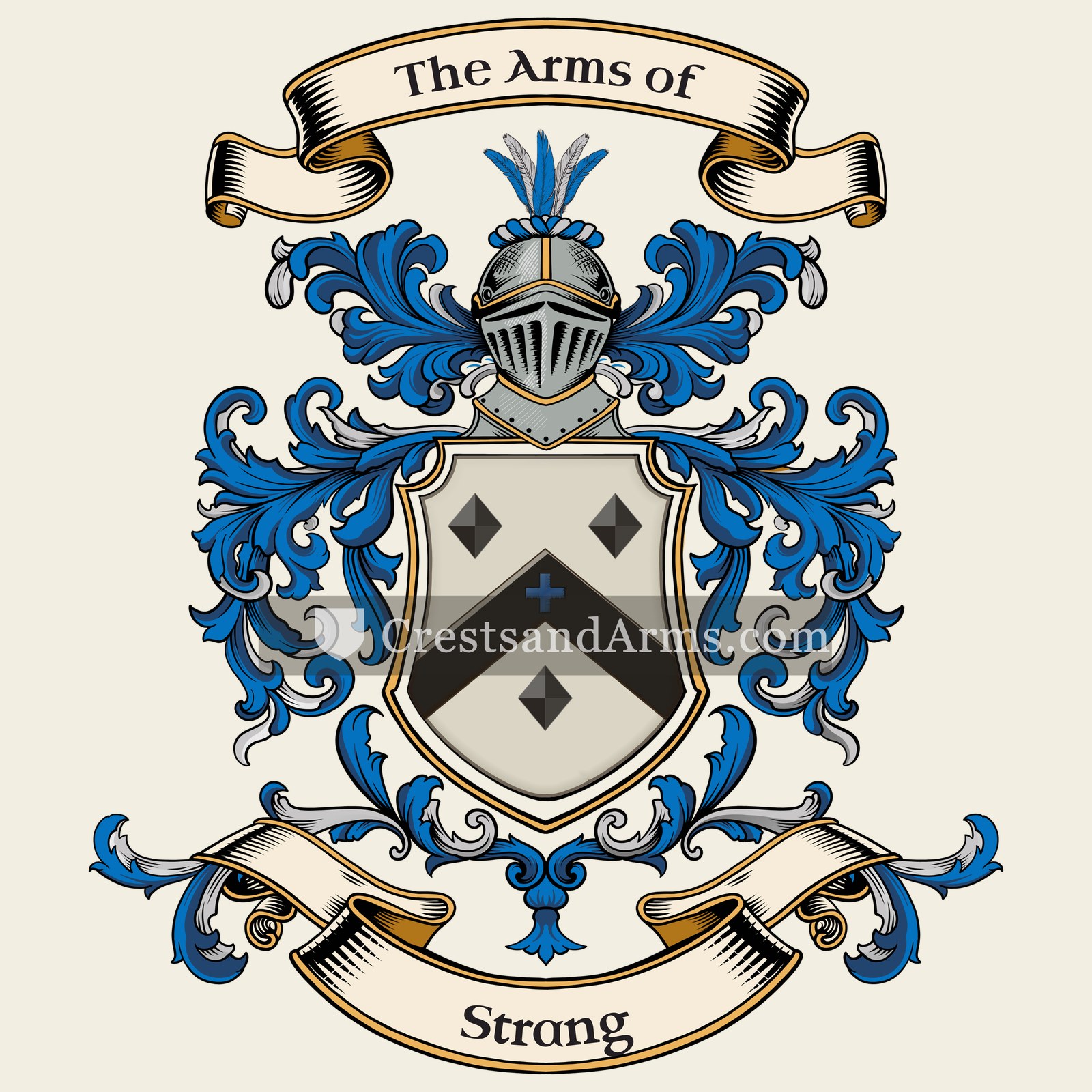


 lionCourage, strength and royalty